Cheese in French Life
Cool, humid air slips through the natural fissures called fleurines and into the maturing caves of Roquefort-sur-Soulzon.
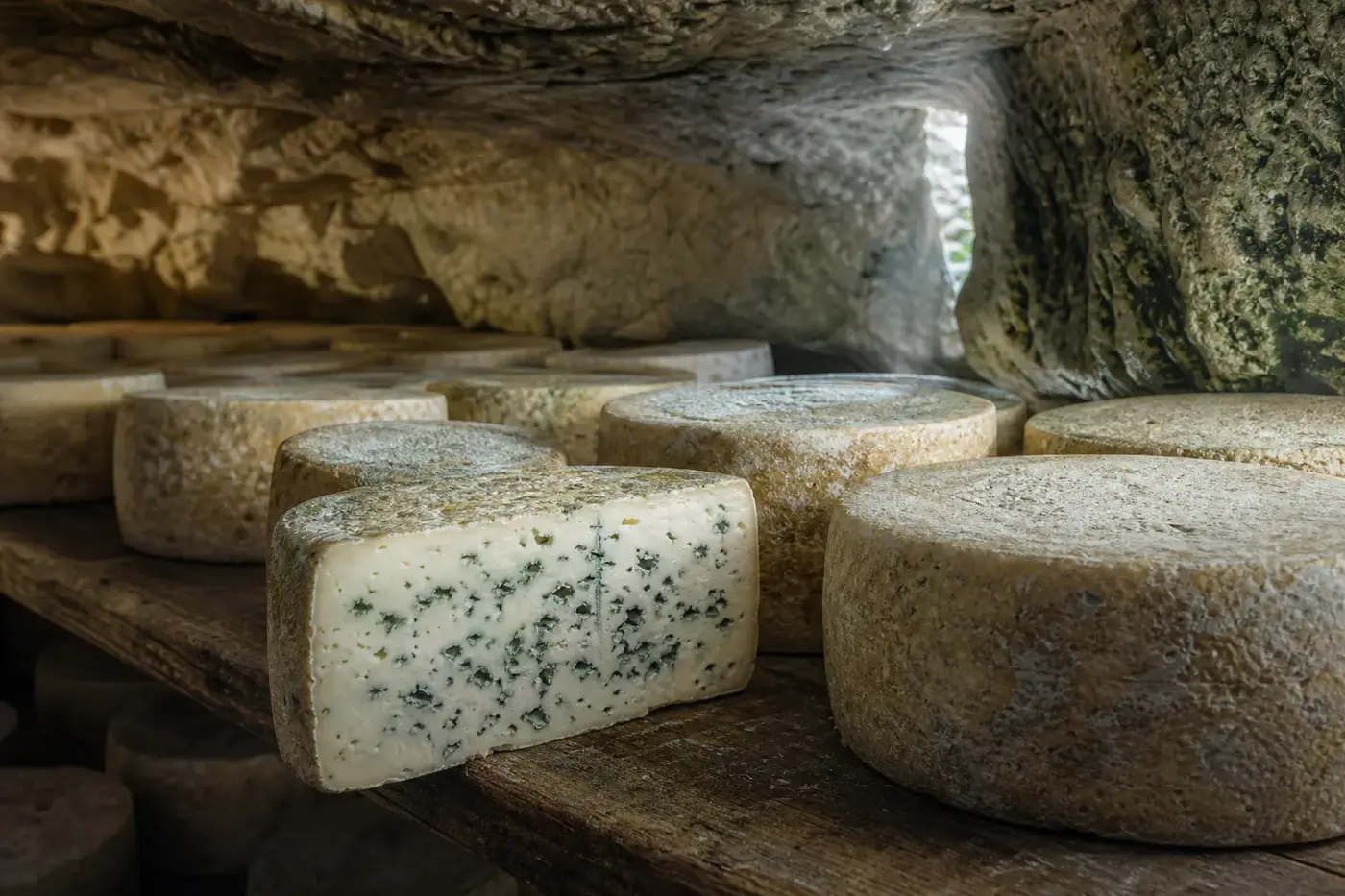
Cool, humid air slips through the natural fissures called fleurines and into the maturing caves of Roquefort-sur-Soulzon. Inside, raw sheep's milk cheese develops Roquefort's blue-green veins. Before you taste a mouthful, the landscape is already making its presence felt.[2][5]
Follow that thread across France, from the Jura's large wheels to a market purchase, a cheese-counter conversation or a shared plate. Cheese brings farming and skilled work to the table. What happens around that table is another story, and every household tells it differently.[3][4][5]
From hurried bread to a celebration
You needn't save French cheese for a ceremonial cheeseboard. A piece of bread is quite sufficient company. Something grabbed in a hurry and something chosen for a celebration tell different stories about the same food. Everyday convenience and regional pride both belong here.
UNESCO's account of the gastronomic meal of the French puts people gathering for significant occasions at its heart. Choosing products, tasting them and passing knowledge between generations are central to that practice. Those rituals help explain why cheese matters, without making every household's dinner sound identical.[3]
Taste the landscape, one cheese at a time
In the Jura, limestone plateaux, substantial rainfall and sharply contrasting seasons shape the setting described in the Comté specification. It connects that landscape with grassland farming and cheese made from raw cow's milk. INAO identifies hazelnut, honey and vegetal aromas in Comté. Season, place and age give you plenty to discover from one cheese to another.[1][4]
Cow, goat and sheep milk offer three starting points, not three promises about flavour. Ask what the animals eat, where their milk comes from and how the cheese matures. Climate shapes farming and storage conditions; the cheesemaker works within them, making decisions of their own. Follow those choices and your cheese map becomes much more revealing.[1][2][4][5]
Start with the Jura, then head for Roquefort
Begin in the Jura with Comté, a large, cooked-curd cow's milk cheese whose production area includes parts of Doubs, Jura and Ain. “Cooked-curd” means that the curds, the solids separated from milk, are heated during manufacture. The milk used for Comté itself is raw.[1][4]
Then turn to Roquefort, made from raw sheep's milk. Its blue-green veins develop through the action of Penicillium roqueforti, the mould introduced during manufacture. Its defining geography includes the maturing caves at Roquefort-sur-Soulzon, where natural fissures known as fleurines supply cool, humid air.[2][5]
Each cheese gives you a different question to follow. How does a dairy organise milk collection, or a cave influence maturation? At the counter, bring a locally made goat's milk cheese into the conversation. Ask where it was actually made: a picturesque name is lovely, but it isn't an address.
For goat's milk, request two cheeses at different stages of maturation. You'll have more to explore than the assumption that both will taste sharp. Ask where the milk comes from, what the animals eat, and how the cheeses were made and matured. That comparison opens a conversation about farming, season and local decisions, rather than making one animal species answer for an entire flavour.
Meet the people behind the wheel
Comté is a collective undertaking, as INAO describes it. The farmer supplies the milk, the cheesemaker transforms it, and the affineur manages maturation. Affinage is the French term for that maturing work. It isn't a separate kind of cheese.[1]
Those jobs may belong to different businesses. In the Jura, village dairies called fruitières bring milk together for cheesemaking. Ask your shop who made the cheese and who matured it: the name above the door may belong to its selector or seller. Knowing who did what gives a recommendation more substance.[1]
Let AOP start the conversation
AOP stands for appellation d'origine protégée, the French wording for the European Union's protected designation of origin, or PDO. Under Regulation (EU) 2024/1143, a product's quality or characteristics must be essentially or exclusively due to its geographical environment, including inherent natural and human factors. All production steps must take place within the defined area, subject to the regulation's specified exceptions.[6]
EU rules protect registered names against misuse and evocation. The product specification sets out the relevant production requirements. If you'd like to untangle the different schemes, turn to protected names explained.[6]
At the counter, use AOP as information about origin and method. A new recipe, or a cheese made outside a designated area, can be full of interest under its own name. Ask about provenance, assess its condition and listen to the seller. An appellation helps you choose; an interesting cheese doesn't have to carry one.
Ask a little more at the cheese counter
Choose where you buy according to the conversation you want. At a market, ask whether the stallholder makes the cheese or selects it from other dairies. A specialist cheesemonger can compare two maturities or find something ready for a particular meal. In a supermarket, start with the pack or counter label.
Specific questions bring useful answers: which milk, which dairy, which treatment, and when should you eat it? Say whether you want a mild flavour, firmer texture or a more pronounced rind. Mention dietary requirements before accepting a recommendation. For the next layer of detail, try reading a cheese label.
Tell the seller when and where you'll eat your purchase. A picnic needs different practical planning from a cheese heading straight into a refrigerator. If your portion is being cut and wrapped, ask for its name and dairy to be written down. Otherwise, your most useful souvenir may be a very vague memory of the counter.
Give cheese its own moment
In the meal described by UNESCO, cheese follows the main course and comes before dessert. It gets a moment of its own between savoury dishes and something sweet. The inscription concerns a celebratory social practice, with attention to food, company and passing on knowledge.[3]
At someone else's table, follow your host's invitation rather than a memorised script. There might be one cheese or several, another helping or a move straight to dessert. Take a modest first portion and ask about anything unfamiliar. Curiosity and consideration for the next person will take you further than elaborate etiquette.
Put together a board worth sharing
For a small gathering, begin with a few contrasting cheeses. Try a firm cheese, a softer one and a goat's milk cheese, putting your guests' needs first. That suggested mix gives you variety. A seller can help you find examples in good condition.
- Choose for the occasion. Explain how many people will share the board and whether it follows dinner or forms the meal.
- Share the whole cheese fairly. Cut a small round into wedges, a log into discs and a large wedge into portions sharing its centre and outer edge.
- Give flavours some space. Give blue cheese its own knife. Leave room to cut without pushing neighbouring pieces.
- Serve a little, then replenish. French ANSES domestic hygiene guidance, as at November 2026, advises against leaving food at room temperature for more than two hours before refrigeration. Serve smaller portions rather than displaying your whole purchase.[7]
Leave room for bread, wine and pleasure
Start with plain bread and water if you want to compare your cheeses easily. Add accompaniments for pleasure, not ceremony. Fresh fruit, a little fruit preserve or a different loaf can change the experience. Your board needn't become an interior design project.
To explore a region, consider Comté with a Jura wine. Ask a local seller how it works with that cheese's age and flavour. Matching origins gives you something to compare, not a rule to obey. Wine pairing features in UNESCO's account of the gastronomic meal, but still or sparkling water deserves equal consideration at your table.[3]
If adults of legal drinking age choose alcohol, offer small servings alongside drinks without alcohol. People who are pregnant, driving, taking medicines that interact with alcohol or recovering from alcohol dependence should not drink. Consult NHS advice in the UK or equivalent national advice where you live. Unsweetened tea or an apple drink without alcohol are other options to try; explore flavour and intensity in cheese and wine pairing.
Choose raw milk cheese with the right guidance
ANSES advises vulnerable groups in France to avoid raw milk and raw milk cheeses, with an exception for cooked pressed cheeses such as Comté. Its published guidance addresses children, pregnant people, older people and people with weakened immunity. Have the relevant group-specific advice to hand when choosing. A cheese's name alone isn't enough.[7][8]
For pregnancy, ANSES also lists soft cheeses with bloomy or washed rinds and cheeses sold grated among foods to avoid. The distinction therefore goes beyond raw versus pasteurised milk. Its children's guidance covers ages zero to five and six to ten. Consult the advice for your child's age before choosing.[8]
For these French sources, November 2026 is the reference point. Follow their linked guidance and ask your doctor, midwife or dietitian about your circumstances. For help with the terms, see raw milk, thermised and pasteurised cheese.
Follow a tradition that's still moving
A quick sandwich, a carefully planned tasting and curiosity about unfamiliar styles all belong in contemporary cheese culture. Your preferences as a visitor needn't become a test of someone else's Frenchness. Ask what the seller enjoys now, what suits tonight's meal and whether another age would change the choice.
Tradition moves through formal decisions, too. A French order dated 18 December 2025 approved a modified Comté specification, published in January 2026. Its detailed provisions cover matters including herd management and grassland. Here, tradition takes shape through present-day farming decisions, rather than simply surviving as an attractive story.[4][9]
A dairy or cellar visit can bring those connections into focus. Before planning one, consult the official visitor information for booking conditions, accessibility and what you can actually see. Production work comes first, ahead of any expectation of an unrestricted tour.
Ask about the work as well as the history. What changes with the season, and which tasks happen daily? How are cheeses selected for further maturation? Those questions leave room for modern equipment, revised farming requirements and individual judgement alongside the older techniques that first caught your attention.
Bring your cheese home, details and all
Three phrases can open your counter conversation: Quel lait ? asks which milk; Est-il au lait cru ? asks whether it uses raw milk; Pour manger ce soir explains that you want to eat it tonight. Before choosing, mention your travel plans and any limits on refrigeration. Give the seller the practical picture.
Ask for storage instructions and keep the label or identifying information. ANSES recommends keeping the coldest part of a domestic refrigerator between 0 and 4 °C. Arrange refrigeration at your accommodation before buying. Keep chilled purchases cold on the journey there, too.[7]
Before taking cheese across a border, consult the destination's official customs and animal-health rules, plus any transit country's requirements. Explain that it comes from France and is food for personal use. Neither packaging nor an appellation mark gives you permission to import it.
For a direct personal journey from France to Great Britain, GOV.UK guidance as at 7 November 2026 prohibits bringing in cheese. Great Britain means England, Scotland and Wales; Northern Ireland has separate rules to consult. When that restriction applies, enjoy your purchases in France. Consult the official guidance again before departure.[10]
If a purchase is recalled, turn to France's RappelConso notices. Match the product and batch details, not just the cheese name, and follow the notice's instructions. Keep enough information for the seller to identify what you bought.[11]
General information only, not medical advice: follow the official guidance where you live.
Questions people ask
What is the difference between Comté and Roquefort?
Comté is a large, cooked curd cheese made from raw cow’s milk in an area that includes parts of Doubs, Jura and Ain. Roquefort is made from raw sheep’s milk and develops blue and green veins through the action of Penicillium roqueforti.
What does AOP mean on French cheese?
AOP stands for appellation d’origine protégée, the French wording for the EU’s protected designation of origin. A product’s quality or characteristics must be essentially or exclusively due to its geographical environment, and all production steps must take place in the defined area, subject to specified exceptions.
When is cheese served in a French meal?
In the celebratory meal described by UNESCO, cheese follows the main course and comes before dessert. At someone else’s table, the host’s invitation is a better guide than a memorised script.
Can pregnant people eat raw milk cheese?
ANSES advises vulnerable groups, including pregnant people, to avoid raw milk and raw milk cheeses, with an exception for cooked pressed cheeses such as Comté. For pregnancy, ANSES also lists soft cheeses with bloomy or washed rinds and cheeses sold grated among foods to avoid. Check the ANSES guidance and ask your doctor, midwife or dietitian about your circumstances.
Can I bring cheese from France into Great Britain?
GOV.UK guidance checked on 7 November 2026 prohibits bringing cheese into Great Britain on a direct personal journey from France. Great Britain means England, Scotland and Wales, while Northern Ireland has separate rules. Recheck the official guidance before departure.
Sources
- Institut national de l'origine et de la qualité: Comté, official product account, undated, accessed November 2026. Used for attributed aromas, regional setting and the roles of producers, cheesemakers and affineurs.
- Institut national de l'origine et de la qualité: Roquefort, official product account, undated, accessed November 2026. Used for the milk, blue veining and cave environment.
- UNESCO: Gastronomic meal of the French, nomination file 00437, inscribed 2010; read alongside the 2010 evaluation document, ITH/10/5.COM/CONF.202/6. Used for the celebratory context, transmission, course sequence and wine pairing.
- French Ministry of Agriculture, published through INAO: Cahier des charges de l'appellation d'origine protégée Comté, specification linked by INAO to Bulletin officiel no. 02, 8 January 2026. Used for production, geographical conditions and farming provisions.
- French Ministry of Agriculture, published through INAO: Cahier des charges de l'appellation d'origine protégée Roquefort, February 2026 version, Bulletin officiel no. 07, 12 February 2026. Used for the milk, manufacture and geographically defined cave maturation.
- European Parliament and Council: Regulation (EU) 2024/1143, consolidated text dated 18 March 2026, particularly Articles 26, 46 and 49. Used for EU name protection, the designation-of-origin definition and specifications.
- ANSES: Hygiène domestique : dix recommandations à retenir, undated leaflet, accessed November 2026. Used for vulnerable-group precautions, refrigerator temperature and the two-hour room-temperature limit.
- ANSES: Repères alimentaires pour les populations spécifiques : Enfants, femmes enceintes & allaitantes, personnes âgées, press dossier, 25 June 2019, particularly the microbiological-risk table on page 15. Used for group-specific French advice.
- French Ministry of Agriculture, Légifrance: Arrêté du 18 décembre 2025 relatif à la modification du cahier des charges de l'appellation d'origine protégée « Comté », published 7 January 2026. Used for the dated approval of the revised specification.
- UK Government: Bringing food into Great Britain: Meat, dairy, fish and animal products, live traveller guidance, checked 7 November 2026. Used for the personal-import restriction affecting cheese brought from France to Great Britain.
- French Government, RappelConso: Lait et produits laitiers, live dairy-product recall notices, checked 7 November 2026. Used for the official purchase-specific recall-checking route.
Researched from official French product records and specifications, EU legislation, UNESCO documentation, ANSES guidance and government travel and recall information; practical suggestions are editorial desk research.
Last checked: November 2026
Last checked November 2026.
The editors suggest you read next
Cheese Around the World: How Different Countries Eat It
Curds dry in the Mongolian sun, on their way to becoming aaruul, a portable food suited to nomadic life.