Cheese Packaging and Waste
You unwrap a wedge of cheese, and there it is: a thin film ready for the bin.
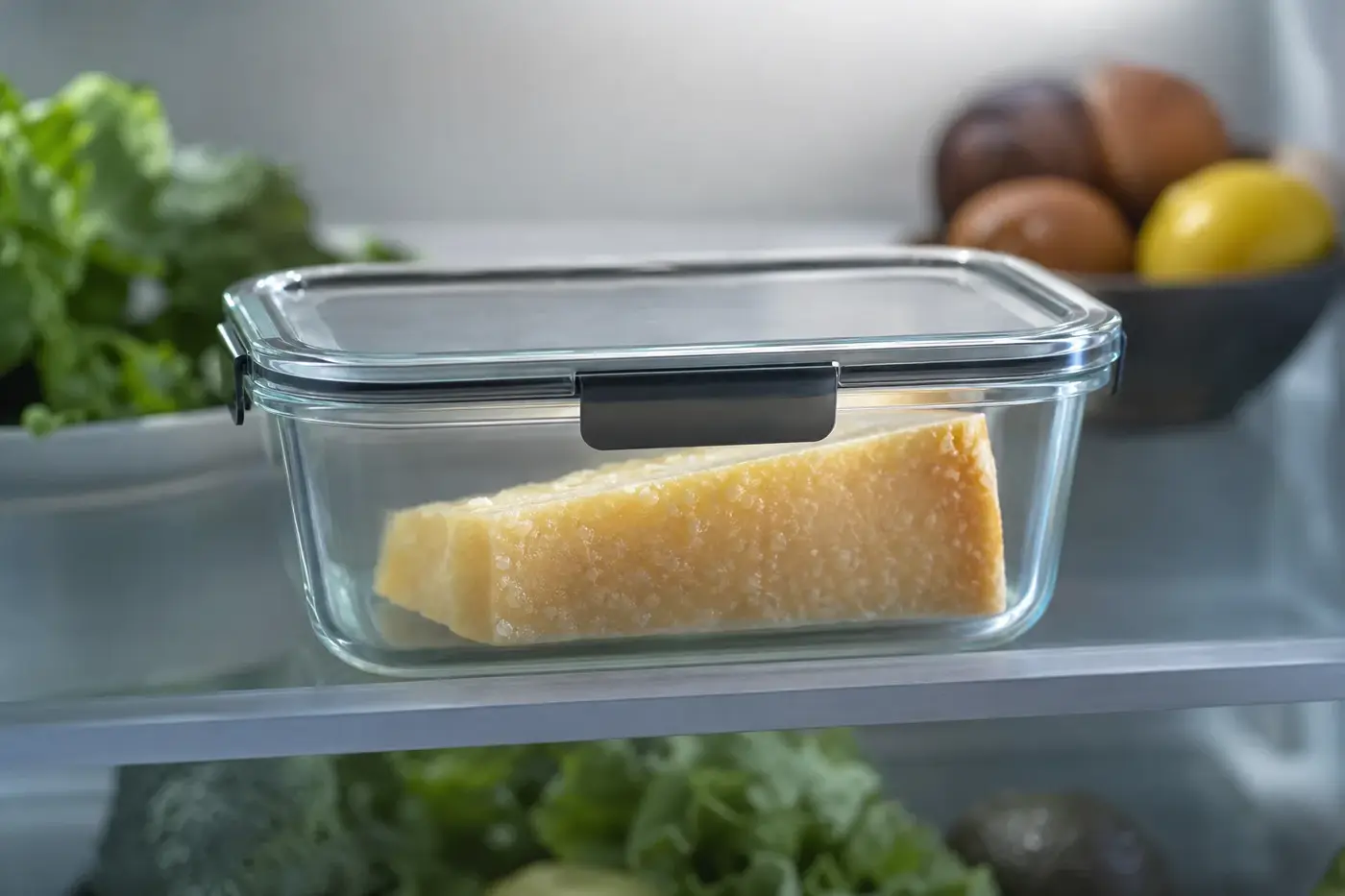
You unwrap a wedge of cheese, and there it is: a thin film ready for the bin. Less visible is everything you lose if the cheese goes uneaten: the milk, processing and refrigeration. Good packaging protects that investment, keeping your cheese fit to eat while offering a disposal route you can actually use.[1,2]
Your wrapper has a busy little life
Keeping hands off cheese is only the beginning. A wrapper separates it from handling and other potential contamination. It also manages escaping water, incoming oxygen and gases moving through a ripening cheese. A container or supporting pack protects cheese that spreads, crumbles or crushes easily.[1,3]
Those jobs do not always pull in the same direction. A strong moisture barrier helps prevent drying; a changed atmosphere can slow particular spoilage organisms. Start with your cheese: what protection does it need through transport, sale and storage?[1,3]
The wrapper carries useful information, too. If you move cheese into another container, keep its storage instructions, date and product identification. The guide to reading cheese labels explains what is worth retaining.
Find the right wrapping for your cheese
Choose protection for the cheese’s condition and how you plan to use it. A material’s appearance cannot tell you whether it is right for the job.
- Fresh cheese: think about containment, protection against contamination and refrigeration together. Research on fresh acid-coagulated cheese shows that the packaging atmosphere can influence microbial growth and sensory quality during chilled storage.[4]
- Soft cheese: give physical support as much attention as the wrapper. For a ripened cheese, find out whether the pack allows continuing maturation or protects the finished retail product.
- Hard cheese: protect the exposed cut face from drying. A larger piece only helps if your household will finish it.
- Blue cheese: follow the instructions for the finished cheese and its particular wrapping. What cheesemaking and ripening require is different from what a cut retail wedge needs.
Take those differences shopping, then follow your cheese’s storage instructions. At the counter, ask which wrapping to keep and how to cover the cheese after cutting. The differences between cheese styles explain why one wrapping method cannot suit everything.
Inside the sealed pack
Vacuum packaging removes much of the air before sealing. Modified atmosphere packaging, often shortened to MAP, replaces air with a controlled gas mixture, commonly selected from carbon dioxide, nitrogen and oxygen. Both methods can slow spoilage and extend chilled shelf life.[3]
A 2020 fresh-cheese experiment compared air, vacuum and two nitrogen/carbon dioxide atmospheres over 18 days of refrigerated storage. Vacuum and modified atmospheres inhibited the monitored microbial growth compared with air packaging. That finding applies to the cheese, films and conditions studied, not to a household storage deadline.[4]
Less oxygen also brings specific safety requirements. The Food Standards Agency explains that these packs need controls against hazards including non-proteolytic Clostridium botulinum. Follow the label on commercially packed cheese: opening or repacking changes the conditions on which its unopened shelf life depends.[3]
A handsome wrapper is not the whole story
Judge the whole pack, including its lid, liner and coating. This checklist pairs packaging functions with British disposal guidance. Looking virtuous is not a disposal route.[1,5,6,7,8]
| Material | What your cheese needs | What to check before disposal |
|---|---|---|
| Plastic film | Film construction and an intact seal determine suitability for vacuum or gas packing.[3] | Check whether your exact film is accepted locally or at a supermarket collection point.[5] |
| Plastic tub | Keeps spreadable cheese contained; retain storage instructions when reusing it. | Empty and rinse it, then check the lid and film separately.[8] |
| Coated cheese paper | Ask about the coating and whether the wrapper should stay around your cheese. | A paper-like appearance does not establish recyclability. Ordinary paper recycling guidance excludes food-soiled paper.[6] |
| Aluminium foil | Find out whether you have foil or a bonded combination of materials. | Remove food residue and follow local foil collection instructions.[7] |
| Wax | Find out whether it is a cheese coating or separate wrapping, and ask how to remove it. | Get disposal instructions for that particular material. |
| Reusable container | Choose a food-contact container whose size and shape suit your cheese.[12] | Consider repeated use, washing and eventual disposal together.[1] |
You cannot see a wrapper’s whole construction at a glance. A paper-looking exterior can conceal other materials. A reusable box, meanwhile, needs enough repeated use to justify its production and washing in an environmental comparison.[1,9]
When helpful layers complicate recycling
The layers protecting your cheese can make recycling harder. The Competition and Markets Authority gives examples of mixed-material packaging presented as environmentally favourable even though its construction makes recycling difficult. Separate components where the pack and collection instructions tell you to.[9]
Food residue matters just as much. Recycle Now advises rinsing plastic pots and tubs because leftover food can contaminate other recyclables. Its paper guidance excludes paper stained with food or grease, including greaseproof paper. Your cheese-stained wrapper therefore needs a different decision from a clean cardboard sleeve.[6,8]
For aluminium foil, Recycle Now recommends wiping it or dipping it in washing-up water to remove residue. Then scrunch suitable foil together into a larger ball. Check local acceptance first.[7]
Give every part the right destination
Look up the component, not just “cheese packaging”. Your council’s current guidance or Recycle Now’s postcode checker can tell you about flexible film, tubs, foil and coated paper. Different parts of the same pack may need different collection routes.[5,6,7,8]
Recycle Now lists cheese wrapping and plastic film lids among materials accepted at selected major-supermarket collection points. Check your individual store’s accepted materials, as its guidance explicitly advises. Items should be clean and free of food; remove sticky labels where possible.[5]
Keep compostable and biodegradable plastics out of conventional flexible-plastic recycling. For composting, check both the certification and the receiving service’s instructions. A collection point that accepts ordinary carrier bags does not necessarily accept every cheese pouch.[5,9]
Count the cheese you actually eat
The wrapper is only part of the environmental story. An assessment needs to follow cheese and packaging together: production, transport, refrigeration, packaging manufacture, disposal and the quantity of food actually eaten. Compare wrappers alone and you can miss the consequences of a pack that leaves more cheese uneaten.[1,2]
The Austrian StopWaste project combined consumer assessments with life-cycle modelling for cream cheese and a soft ripened cheese. In its specified consumption and waste scenarios, smaller portions could offset additional packaging by reducing food waste. How often people ate the cheese was among the assumptions shaping that finding.[2]
For a convincing comparison, ask for the same quantity of cheese consumed and equivalent protection. You also need measured or justified waste assumptions and disposal routes relevant to the market concerned. Comparisons involving reusable containers need realistic washing and reuse assumptions, too. These tests tell you more than packaging weight alone.[1,2]
Read the small print on green promises
Four familiar claims answer four different questions. Before you let one guide your choice, look at what it actually promises.
- Recyclable concerns the packaging’s potential recovery route. Check which component it covers and what collection or preparation is required.[9]
- Recycled content describes material already incorporated into the pack. It does not establish a collection route for the finished packaging.[9,17]
- Compostable needs stated conditions. Industrial compostability and suitability for your home compost heap are different propositions.[9]
- Biodegradable needs information about the conditions of breakdown. The word alone cannot tell you how to dispose of the pack.[9]
The CMA’s Green Claims Code says environmental claims should be clear, substantiated and properly qualified. Its compostable-cup example shows how omitting a requirement for specialist treatment can make a claim misleading. UK consumer law also addresses misleading actions and omissions.[9,20]
Bring home an amount you will finish
Buy the amount you expect to use. At a cheese counter, ask whether the seller accepts suitable reusable containers, and make sure storage and date information comes home with your purchase. Counter buying helps when it matches quantity to consumption. Your enthusiasm, admirable though it is, is not a portion guide.
For repacking, choose clean, undamaged containers suitable for food contact. Keep identification and instructions with the cheese, and make opened portions easy to find. A box already in regular use is a practical place to start with reuse.[1,12]
For UK household refrigeration, the FSA recommends a fridge temperature between 0 and 5 °C and following the food’s storage instructions. Use a fridge thermometer rather than relying solely on the control dial.[10] You can find fuller guidance in how to store cheese at home.
Fresh wrapping does not reset the date
Use by concerns safety; best before concerns quality. UK official guidance makes that distinction, but storage instructions still matter: incorrect storage can make food unsafe before its use-by date. Follow instructions for after opening rather than relying only on the unopened date.[11]
New wrapping neither resets a date nor reverses unsafe storage. UK guidance says not to eat, cook or freeze food after its use by date, even if it looks and smells fine. Check current Food Standards Agency guidance for food cooked or frozen by that date.[11]
Unwanted mould needs its own decision, not simply another wrapper. Follow the cheese-specific advice in when to cut and when to bin.[10,11]
The UK rules behind your wrapper
Food-contact controls, extended producer responsibility and Plastic Packaging Tax do different jobs. This November 2026 summary draws on official sources.
| Framework | Where it applies | What it does |
|---|---|---|
| Food-contact requirements | Great Britain uses assimilated legislation; Northern Ireland follows applicable EU requirements. Each nation has domestic enforcement provisions.[12,13,14] | Article 3 of Regulation (EC) No 1935/2004 addresses migration that could endanger health, unacceptably change food composition or impair sensory characteristics.[12] |
| Extended producer responsibility, or EPR | UK packaging producers meeting the relevant activity, turnover and packaging thresholds.[15,16] | Obligated producers must report packaging data and, where applicable, contribute towards managing household packaging waste. Duties depend on role and size.[15,16] |
| Plastic Packaging Tax | UK manufacture and import of relevant finished plastic packaging components.[17,18,19] | Components containing less than 30% recycled plastic can be chargeable. Those meeting that percentage still count towards registration thresholds.[17] |
Cheese packaging has no blanket EPR exemption. Responsibility can sit with a brand owner rather than the business physically packing the cheese. Official guidance exempts charities, but not their profit-making trading subsidiaries.[15,16]
Plastic Packaging Tax registration tests include manufacturing or importing at least 10 tonnes in the previous 12 months, or expecting that quantity in the next 30 days. Imports of filled packaging can count. Specific exemptions include certain transport packaging used to import multiple goods; biodegradable and compostable plastics remain within the tax’s definition of plastic.[17,18,19]
General information only, not medical advice: follow the official guidance where you live.
Questions people ask
Can cheese wrappers be recycled?
Recycle Now lists cheese wrapping and plastic film lids among materials accepted at selected major supermarket collection points. Check what the individual store accepts, make sure items are clean and free of food, and remove sticky labels where possible.
How should cheese be stored in the fridge?
The Food Standards Agency recommends a fridge temperature between 0 and 5 °C and following the food’s storage instructions. It advises using a fridge thermometer rather than relying solely on the control dial; check its current guidance.
Does new wrapping reset a cheese’s use by date?
No. UK guidance says new wrapping does not reset the date or reverse unsafe storage. The Food Standards Agency advises against eating, cooking or freezing food after its use by date, even if it looks and smells fine; check its current guidance.
What is the difference between vacuum packaging and modified atmosphere packaging?
Vacuum packaging removes much of the air before sealing. Modified atmosphere packaging replaces air with a controlled mixture of gases, commonly selected from carbon dioxide, nitrogen and oxygen.
Is buying cheese in smaller portions better for the environment?
It can be, depending on how much cheese is eaten and wasted. In the Austrian StopWaste project’s specified scenarios, smaller portions could offset extra packaging by reducing food waste.
Sources
- United Nations Environment Programme, Single-use supermarket food packaging and its alternatives: Recommendations from life cycle assessments, 2022. Report.
- University of Natural Resources and Life Sciences, Vienna, and StopWaste project partners, Food Packaging Sustainability: A guide for packaging manufacturers, food processors, retailers, political institutions & NGOs, 2020. Project guide.
- Food Standards Agency, The safety and shelf-life of vacuum and modified atmosphere packed chilled foods with respect to non-proteolytic Clostridium botulinum, December 2020. Guidance.
- Journal of Food Science and Technology, Evaluation of quality parameters and shelf life of fresh cheese packed under modified atmosphere, volume 57, pages 2722 to 2731, 2020. Original research.
- WRAP, Recycle Now, Plastic bags and wrapping, live guidance, checked November 2026. Collection guidance.
- WRAP, Recycle Now, Paper, live guidance, checked November 2026. Collection guidance.
- WRAP, Recycle Now, Foil, live guidance, checked November 2026. Collection guidance.
- WRAP, Recycle Now, Plastic pots, tubs and trays, live guidance, checked November 2026. Collection guidance.
- Competition and Markets Authority, Making environmental claims on goods and services, September 2021, live version checked November 2026. Green Claims Code guidance.
- Food Standards Agency, How to chill, freeze and defrost food safely, live version checked November 2026. Household guidance.
- UK Government, Understanding food labelling: Best before and use-by dates, live version checked November 2026. Date guidance. Retrieved through the FSA’s former date-guidance address.
- Regulation (EC) No 1935/2004, Article 3, General requirements, assimilated text retrieved November 2026. Binding provision.
- Northern Ireland business information service, Food contact materials and packaging, undated live guidance, retrieved November 2026. Jurisdiction guidance.
- Food Standards Agency, Food contact materials regulations, April 2018; UK Government, Food labelling and packaging: Overview, live version checked November 2026. FSA guidance; four-nation legislative links.
- UK Government, The Producer Responsibility Obligations (Packaging and Packaging Waste) Regulations 2024, SI 2024/1332, original instrument. Regulations.
- Department for Environment, Food & Rural Affairs and Environment Agency, Check if you must comply with EPR for packaging, updated 19 August 2026. Current operational guidance.
- HM Revenue & Customs, Check which packaging is subject to Plastic Packaging Tax, updated 28 August 2026. Scope and recycled-content guidance.
- HM Revenue & Customs, Check when you must register for Plastic Packaging Tax, updated 31 March 2023. Registration guidance.
- HM Revenue & Customs, Check which packaging is not subject to Plastic Packaging Tax, updated 12 October 2022; Finance Act 2021, Part 2, live text retrieved November 2026. Exemptions; binding framework.
- Digital Markets, Competition and Consumers Act 2024, sections 226 and 227, live text retrieved November 2026. Misleading actions; misleading omissions.
This desk-researched article brings together official British packaging, collection and food-handling guidance with published packaging research and life-cycle assessments.
Last checked: November 2026
Last checked November 2026.
The editors suggest you read next

Sustainability in Cheese: The Complete Guide
At the cheese vat, curd parts company with liquid whey.