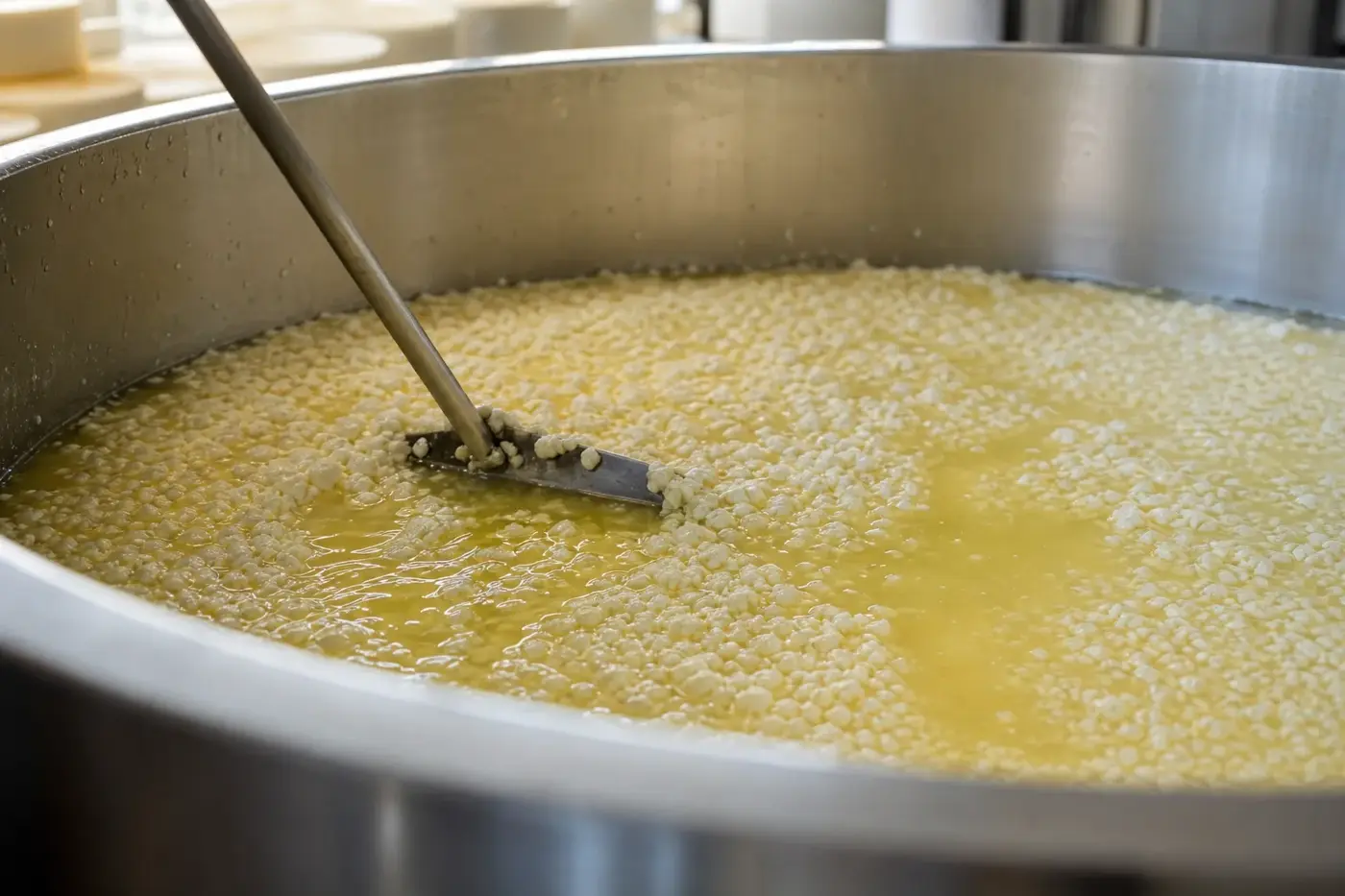
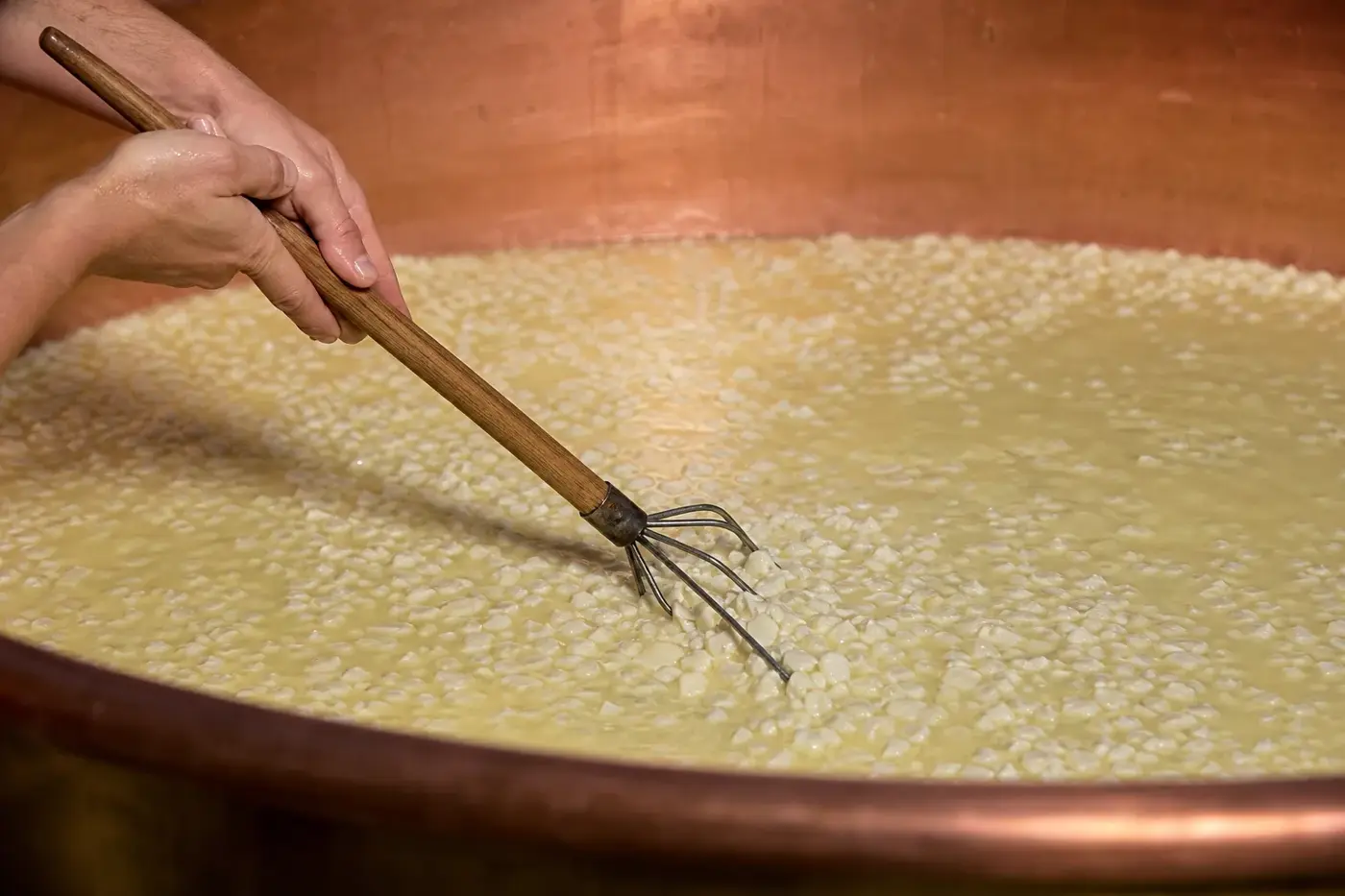
Peer into the vat. Fragile pieces of freshly cut milk gel sit in the whey they are beginning to release. With warmth and movement, they shrink and firm, squeezing out more liquid. The cheesemaker's handling of these tender particles helps decide how much moisture reaches the mould, and how the cheese develops from there. [1,7]
First, give the curd a moment
Cutting opens escape routes for whey, but leaves the curd particles vulnerable. Some methods allow a short rest before any movement begins. Known as healing, this pause lets the freshly cut surfaces become more resistant to damage while they remain surrounded by whey. [1,5]
Cooking and stirring usually come next, before the main separation of curd from whey. But the cheese sets the itinerary: some soft curds go into draining moulds with little agitation, while other methods remove part of the whey during work in the vat. You can follow the wider sequence in how cheese is made. [3,9]
Cooking, but not as your kitchen knows it
Here, cooking means raising the temperature of the curds and whey according to the cheese's production method. Heat may enter through the vat jacket, while stirring distributes it evenly. The aim is to guide the curd's development, particularly whey release and culture activity, rather than get dinner on the table. [5,9]
This is separate from pasteurising milk. Among its milk pasteurisation combinations, the US FDA's published chart specifies 72 °C (161 °F) for 15 seconds, applied to every particle in properly operated equipment. Cooking curd does not automatically fulfil a pasteurisation treatment. [2] You can explore those separate milk treatments in raw milk, thermised and pasteurised cheese.
Follow the whey on its way out
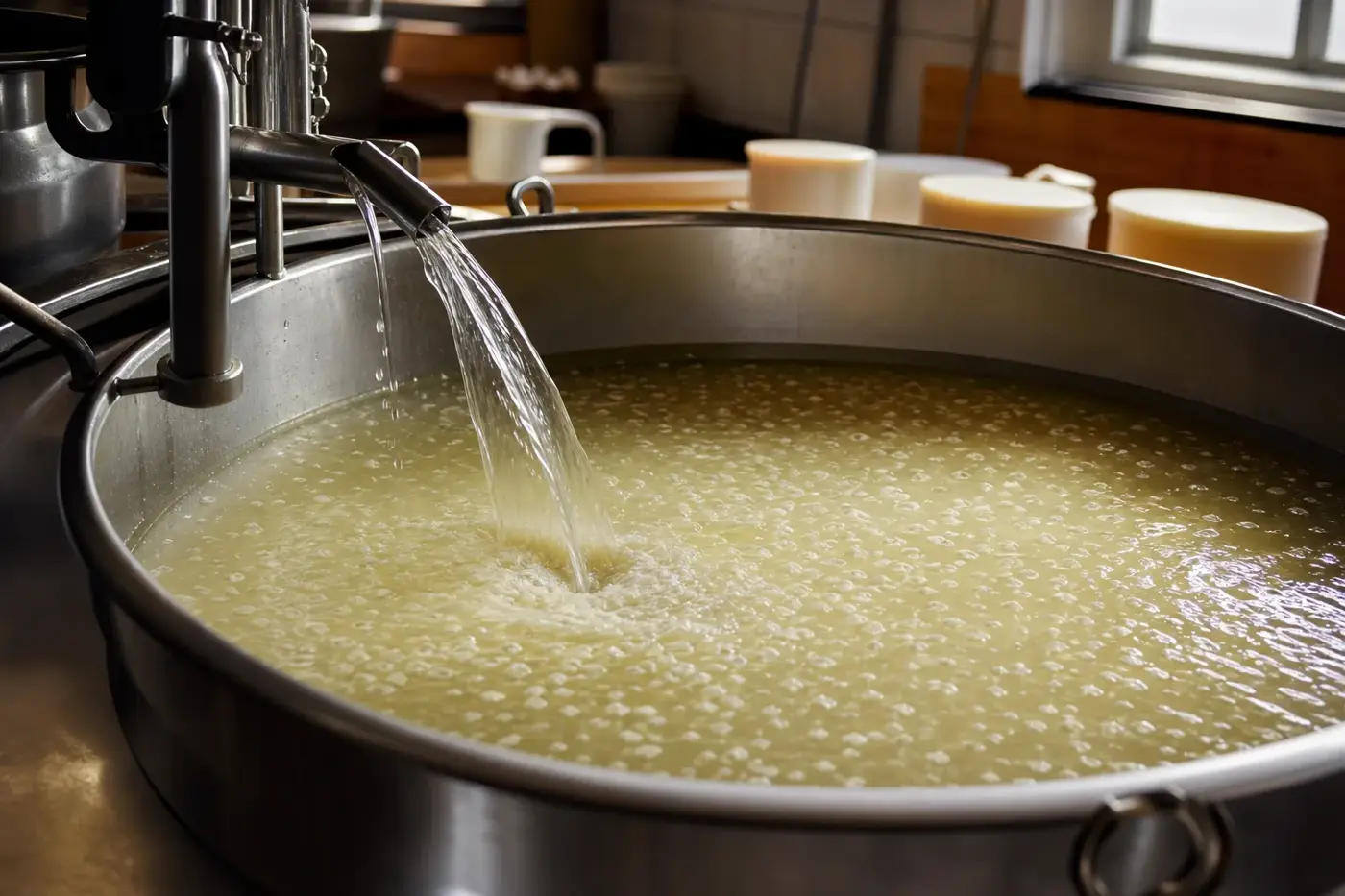
Inside fresh curd, a network of caseins, the principal milk proteins, holds everything together. As that network contracts, liquid escapes through its pores. This is syneresis, and cutting helps by exposing more surface and shortening the liquid's journey out of each particle. [3,4]
Heat and developing acidity encourage the contraction. Cheesemakers commonly track acidity through pH: as pH falls, acidity rises. The departing whey carries dissolved lactose, the milk sugar, along with minerals and other soluble components, changing the curd's composition as well as its water content. [3,9]
Particle size, though, cannot tell you the whole drainage story. A controlled study of milk protein concentration, cut size and setting temperature found that these factors interacted during stirring. Microscopy also revealed different cooked curd structures after different setting temperatures. By cooking time, the milk and the gel's earlier history have already left particles draining differently. [8]
Keep those grains moving, gently
Leave curds to settle and they can gather at the bottom of the vat and stick together. Those lumps retain whey differently from separate grains, creating uneven conditions across the batch. Early stirring therefore calls for a light touch: enough movement to keep particles suspended, without damaging them. [9]
Movement also spreads heat and brings particles into contact. Brief collisions and compressions help them release whey. As the curds firm, they can withstand more movement, so the stirring that suits a freshly cut curd may not suit the end of cooking. [1,3]
More stirring is not always more progress
Stir too forcefully and valuable milk solids can leave the vat. Broken fragments, known as fines, escape with the whey, and fat can go with them. Smaller pieces alone are not proof that moisture removal is under control. [4]
An experiment with recombined milk in an 11 litre vat tested three cutting intensities and three stirring speeds, with three replicates. Higher stirring speeds increased losses of fines and fat, particularly after less intensive initial cutting; the researchers attributed this to larger particles shattering during stirring. Yet curd moisture did not change significantly across the treatments. Faster stirring meant greater losses, not significantly drier curd. [4]
Four controls to keep in balance
Cooking needs a heating programme, not simply a temperature to aim for. The American Cheese Society's production guidance stresses gradual heating and records of the temperature rise. It also highlights the heat held in a warm vat jacket, which can keep warming the contents after the heat supply stops. [5]
| Control | What the cheesemaker adjusts | Why it matters |
|---|---|---|
| Heating rate | How quickly the temperature rises | Heating too quickly can harden particle surfaces and hinder moisture release. [5] |
| Final temperature | How warm the curds become | Shapes contraction and the activity of the chosen cultures. [7] |
| Stirring intensity | How strongly the curds move | Keeps particles suspended and helps whey escape, while limiting damage. [1,4] |
| Holding time | How long the chosen conditions last | Allows more time for whey release and acid development before draining. [9] |
None of these controls works alone. A longer hold, for example, gives both drainage and fermentation more time. The endpoint is the curd's condition, judged against the method being followed, rather than any single setting. The thermometer gets a say, not the casting vote. [7,9]
From tender soft curds to supple Alpine grains
Some soft cheeses reach their draining hoops without any stirring at all. Published production guidance describes curds ladled straight into them, preserving the delicate material needed for a softly handled cheese with high moisture. Much of the moisture management then takes place through drainage in the mould, rather than prolonged movement in the vat. [3]
For an Alpine cooked curd, you follow a different route. The Swiss Gruyère specification's published 2016 English version describes vat work producing a supple, waxy curd with sufficient dry matter. It gives a cooking range of 54 to 59 °C, before moulding and pressing. Those words, “supple” and “waxy”, matter: the goal is character as well as dryness. [6]
You can explore the cheese itself in Le Gruyère. Set these approaches beside each other and the contrast becomes clear. Each cheese's method determines its handling and moisture management, whether a delicate curd is left to drain or a cooked grain is prepared for pressing. [3,6]
The cultures are still at work
While the cheesemaker cooks and stirs, starter cultures keep fermenting lactose. These bacteria are added to guide acid production, and temperature shapes their response. Mesophilic cultures favour moderate temperatures; thermophilic cultures tolerate higher ones and are used in hotter cooked cheeses. Raising the heat can encourage activity within a culture's working range and suppress it beyond that range. [7,9]
Much of this acid production happens inside the particles, where bacteria became trapped as the milk set. Cooking must therefore bring physical contraction and active fermentation along together. Two batches can reach the same final temperature with different acidity if they warm at different speeds or spend different lengths of time there. [7]
Let the curd tell you when it is ready
Readiness is a condition of the particles, not simply a time or temperature. The FAO's production manual describes curds becoming progressively firmer, linking readiness for further processing to the required firmness and dryness. The cheesemaker assesses the curd alongside the clock and thermometer. [1]
If you look at size and texture, there are more clues. Are the grains reasonably consistent, or have large pieces remained and then broken apart? Are surfaces becoming resistant while the interiors still hold moisture? These observations sit alongside measurements using pH or titratable acidity, the latter measuring the acid neutralised in a standard test. [4,5,8]
The intended cheese sets the target. A soft curd ready for ladling and a firmer cooked grain ready for pressing have different endpoints. You cannot borrow the appearance or acidity target of one to judge the other. [3,6]
Today's moisture, tomorrow's cheese
The water travelling out of the vat with the curd helps shape the cheese's eventual body and ripening environment. Moisture works alongside acidity and salt to influence microbial growth and enzyme activity. During maturation, those enzymes break down cheese components, contributing to changes in texture and flavour. [3,7]
More retained moisture generally supports a softer body, but it does not work alone. The protein network, mineral balance, fat, salt and ripening conditions all help determine the result, and further whey can leave during subsequent drainage and pressing. Cooking sets part of the starting condition for ripening; later handling and maturation continue reshaping the cheese. [3,6,7]
Washing, cheddaring, stretching, pressing: where next?
As you follow the curd beyond this stage, you may encounter these operations after vat work, or overlapping with it. Each has its own job:
- Washing replaces some whey with water, removing lactose and changing the potential for later acid production. Warm wash water can heat the curds too, allowing washing and cooking to happen together. See Gouda. [3,5]
- Cheddaring lets drained curds mat, then involves cutting, turning and stacking slabs as acidity develops. Here the cheesemaker handles a mass of curd, rather than separate grains suspended in whey. See Cheddar. [5]
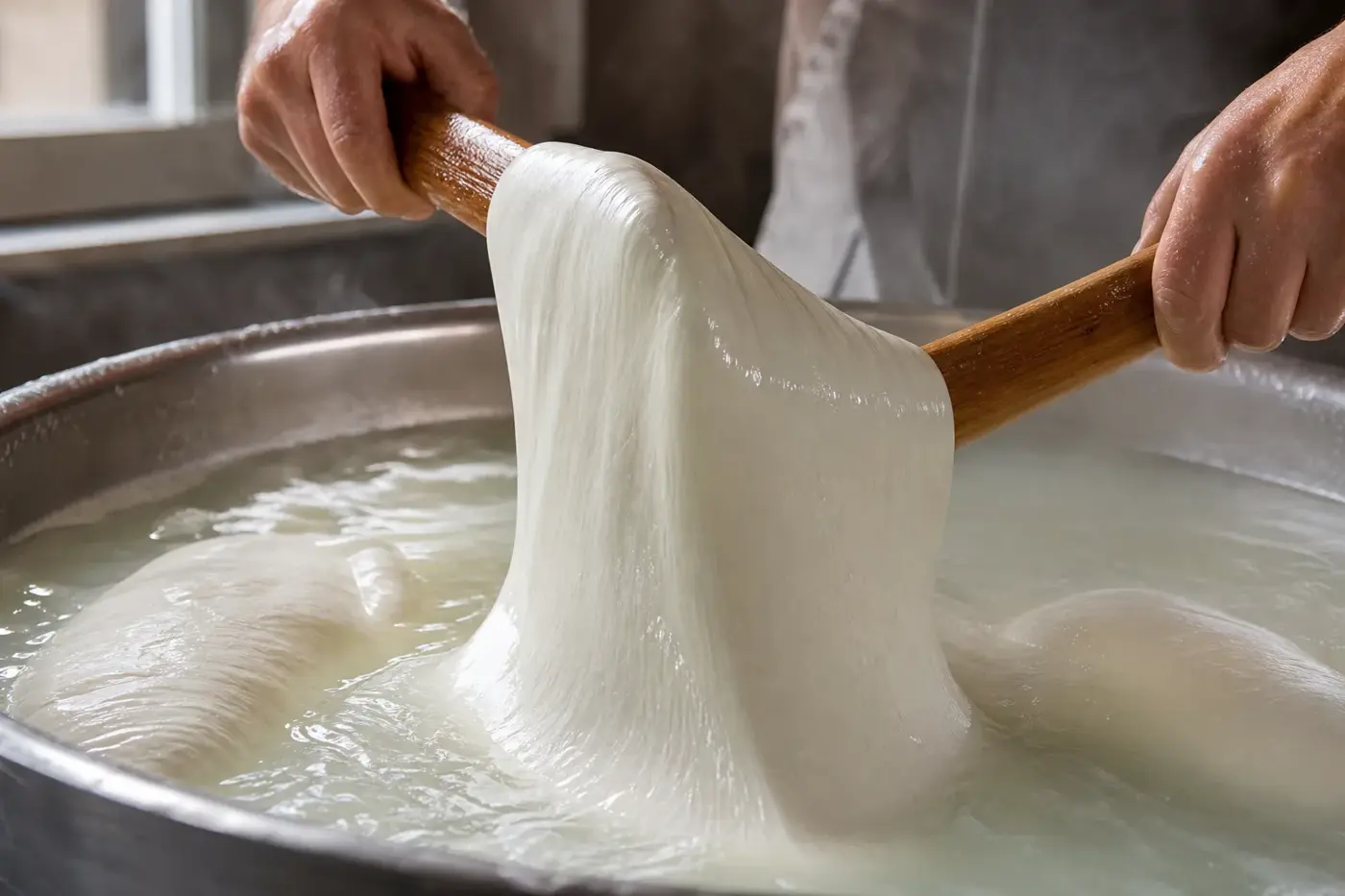
- Stretching heats and kneads suitably acidified curd into a cohesive, stretched mass. This develops the aligned structure of pasta filata cheeses. See Mozzarella. [3]
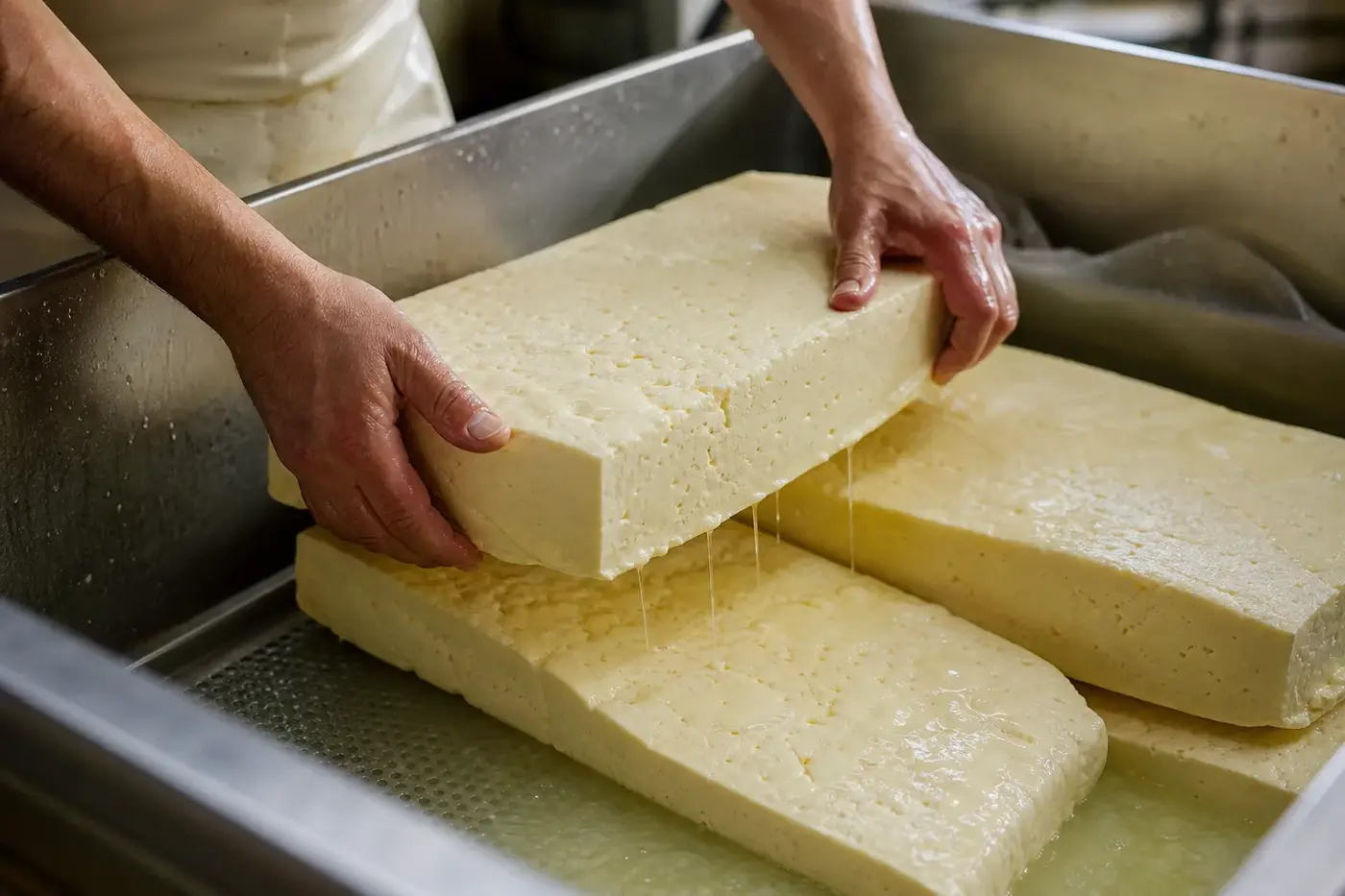
- Pressing applies pressure to shaped curd, helping particles fuse and more whey drain. It happens after the loose curds leave their whey bath, as you can see in the cheesemaking sequence. [3,6]
General information only, not medical advice: follow the official guidance where you live.
Questions people ask
Why are curds cooked and stirred?
Warmth and movement make curds shrink and firm, helping them release whey. Stirring also spreads heat and keeps the particles suspended and apart.
Does cooking curd pasteurise the milk?
Cooking curd is a different operation from pasteurising milk and does not automatically fulfil a pasteurisation treatment. The US FDA's published chart includes a milk pasteurisation combination of 72 °C for 15 seconds.
What is syneresis in cheesemaking?
Syneresis is the expulsion of whey as the curd's protein network contracts. Cutting, heat and developing acidity help the whey leave the curd.
Are all cheese curds stirred and cooked?
No. Some soft cheese curds are ladled straight into draining hoops without stirring, while an Alpine cooked curd is heated before moulding and pressing.
What is washed curd?
Washing replaces some whey with water, removing lactose and changing the potential for later acid production. Warm wash water can also heat the curds, so washing and cooking can happen together.
Sources
- Food and Agriculture Organization of the United Nations. Small-scale dairy farming manual, Volume 1, online PDF, publication year not established from the retrieved extract. Cheesemaking discussion, printed pages 228 to 230. Source document.
- US Food and Drug Administration. Dairy Product Manufacturers-Attachment 1-4, online inspection guidance, undated retrieved edition. Attachment 4, pasteurisation chart. Official guidance.
- Consortium for Educational Communication. Cheese, educational module, undated retrieved edition. Sections 6.3 to 6.5, curd treatment, shaping and ripening. Teaching document.
- American Dairy Science Association, Journal of Dairy Science. Effects of Cutting Intensity and Stirring Speed on Syneresis and Curd Losses During Cheese Manufacture, volume 91, pages 2575 to 2582, 2008. DOI: 10.3168/jds.2007-0628. Research paper.
- American Cheese Society. Best Practices Guide for Cheesemakers, second edition, February 2017. Chapter 6, pages 62 to 65, and associated process controls. Guide.
- Swiss Federal Office of Agriculture. Specifications of Gruyère AOP, English version identified as 2016, particularly sections 24 and 25. The document states that the French text is authoritative. Published specification.
- American Society for Microbiology, Microbiology Spectrum. The Basics of Cheesemaking, volume 1, number 1, 2013. DOI: 10.1128/microbiolspec.cm-0002-2012. Scientific article.
- American Dairy Science Association, Journal of Dairy Science. Response surface methodology modeling of protein concentration, coagulum cut size, and set temperature on curd moisture loss kinetics during curd stirring, 2019. Publisher-indexed abstract. Research record.
- Tetra Pak. Dairy Processing Handbook: Cheese, online edition retrieved November 2026, revision date not stated in the retrieved text. Sections on pre-stirring, heating and final stirring. Equipment manufacturer's technical reference. Technical chapter.
This article was researched through published production guidance, dairy science research and a dated cheese specification, synthesising the relationship between vat controls and curd development.
Last checked: November 2026
Last checked November 2026.
The editors suggest you read next
Cutting the Curd: Why the Size of the Pieces Matters
At dairy Boselli, a spino breaks the set milk for Parmigiano Reggiano into minute granules.