Stretching the Curd: How Mozzarella Is Made
Watch the maker lift the warmed curd.
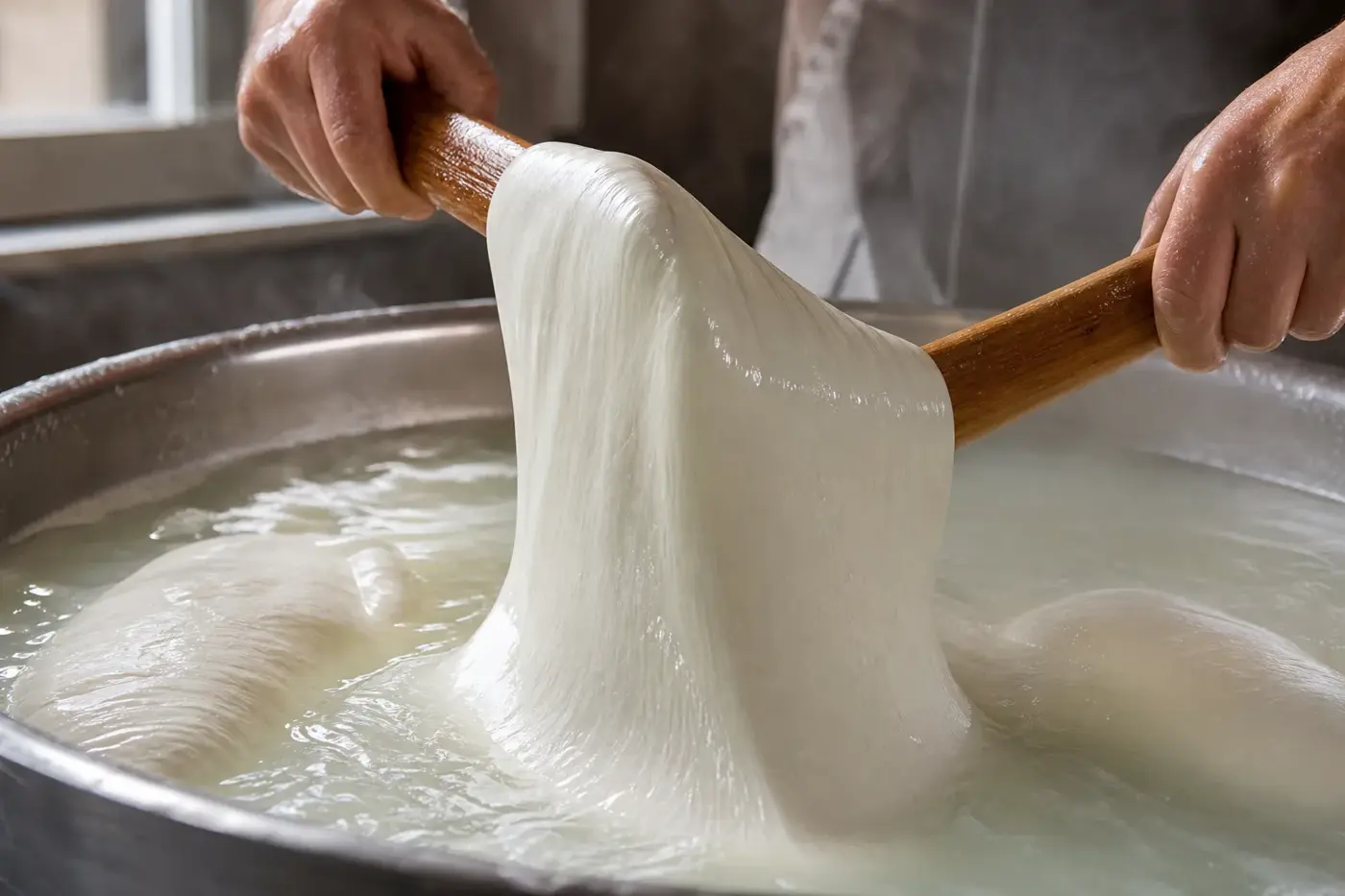
Watch the maker lift the warmed curd. Separate pieces gather into one yielding ribbon, stretching into something you might recognise long before it becomes a ball of mozzarella. Heat and mechanical working reorganise the milk-protein network of suitably acidified curd, giving the cheese its wonderful elasticity.[1][2][3]
Pasta filata: follow that ribbon
That ribbon places mozzarella in the pasta filata family. These cheeses are heated and stretched once acidification has made their curd workable. By now, the milk has already set and much of its liquid has gone: you are watching an existing curd being reshaped, not milk simply thickening in hot water.[1][2][3]
Pulling harder will not persuade an unready curd to stretch. Even mozzarella has its limits. Its protein network must reach a state where heat lets it deform while enough connections remain to hold it together; research on rennet curds shows how acidity and temperature shift that balance between rigidity and flow.[1]
For the earlier stages mozzarella shares with other cheeses, start with how cheese is made. Here, the fascination lies in what happens next. How does the maker prepare a set mass for its second transformation, into something supple enough to draw out?
Buffalo or cow’s milk? Meet the starting ingredient
Your mozzarella can begin with buffalo milk or cow’s milk. Cow’s milk mozzarella is often called fior di latte. Campania’s agriculture department describes fresh buffalo milk, relatively rich in fat and protein, as the starting ingredient for Mozzarella di Bufala Campana, with stretching then giving the cheese its structure.[2]
Both milks pass through acidification, coagulation and stretching. But the maker has to work with the material in front of them. Research identifies calcium concentration as an important influence on how mozzarella curd responds to heat and acidity, so the right working condition depends on both milk and process.[3]
You can explore the cheese itself in the mozzarella reference article. To follow its manufacture, keep two questions separate: which milk supplies the protein and fat, and how does the maker prepare that protein network to stretch? The starting ingredient matters, but it cannot do the whole job.
Starter cultures: quiet work before the big stretch
Before the dramatic pulling comes some much quieter activity. In cultured mozzarella manufacture, bacteria that produce lactic acid begin acidification. The US mozzarella standard describes warming the dairy ingredients and introducing a bacterial culture before adding a clotting enzyme; for buffalo mozzarella, the protection consortium describes a natural whey starter kept from previous cheesemaking.[4][5]
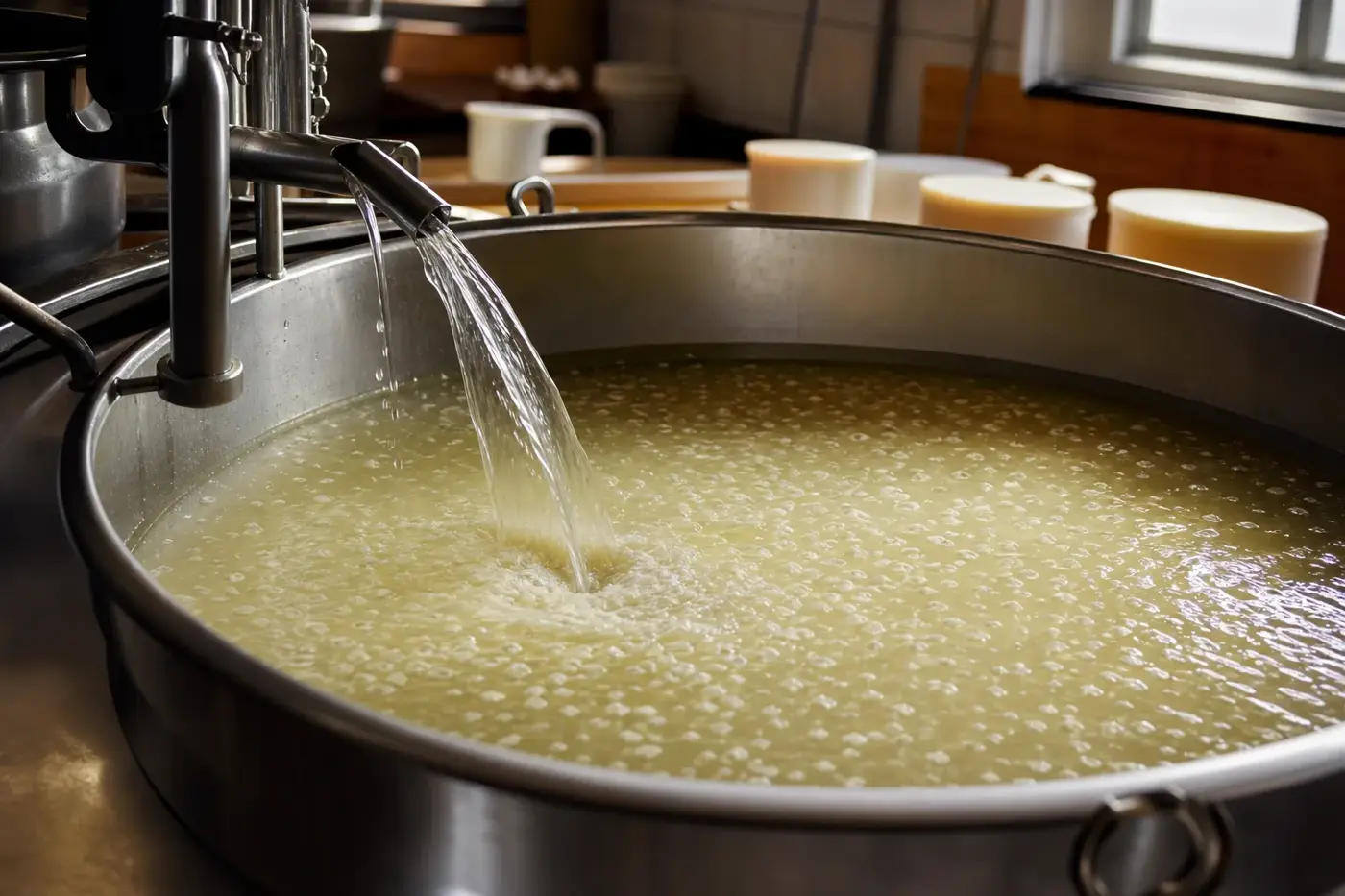
That starter brings biological activity into the vat. The maker manages the conditions in which it proceeds, and the activity continues after the milk has set. In the consortium’s account, the curd rests in whey, acidifying until it reaches the condition needed for stretching.[5]
“Resting” makes this sound rather more leisurely than it is. Inside the curd, changes in the relationship between acidity, calcium and milk proteins are preparing it for the later stretch.[3] You cannot see a hot ribbon yet, but its groundwork is already taking shape.
Rennet: watch the milk find its structure
Rennet gives the curd its first connected structure. Its enzymes act on the surface of casein micelles, the small assemblies containing milk’s principal cheese-forming proteins. Once their stability changes, those assemblies can join into a network, turning liquid milk into a gel with liquid held inside it.[1]
Rennet and acidification have different jobs, so a good set does not mean the curd is ready to stretch. Rennet establishes the network that makes the curd. Acidification changes conditions within that network and helps determine its later behaviour: milk can set successfully and still be unready for pulling.[1][3]
Cheesemakers use different clotting enzymes, whose origins and functions you can explore in rennet explained. For mozzarella, keep this sequence in mind: coagulation builds the starting structure. Heat and movement reshape it later.
Cut, drain, rest: preparing for the pull
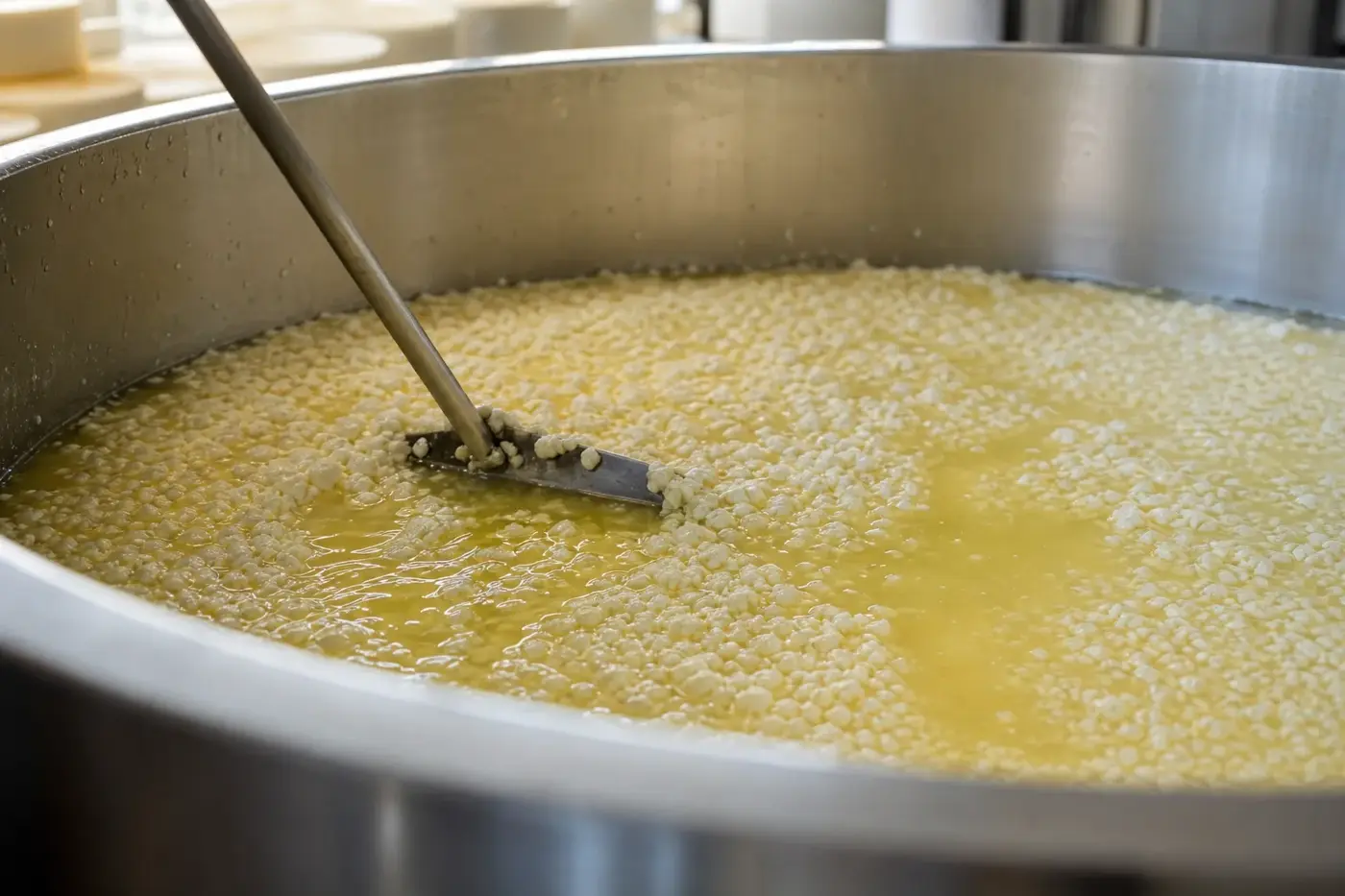
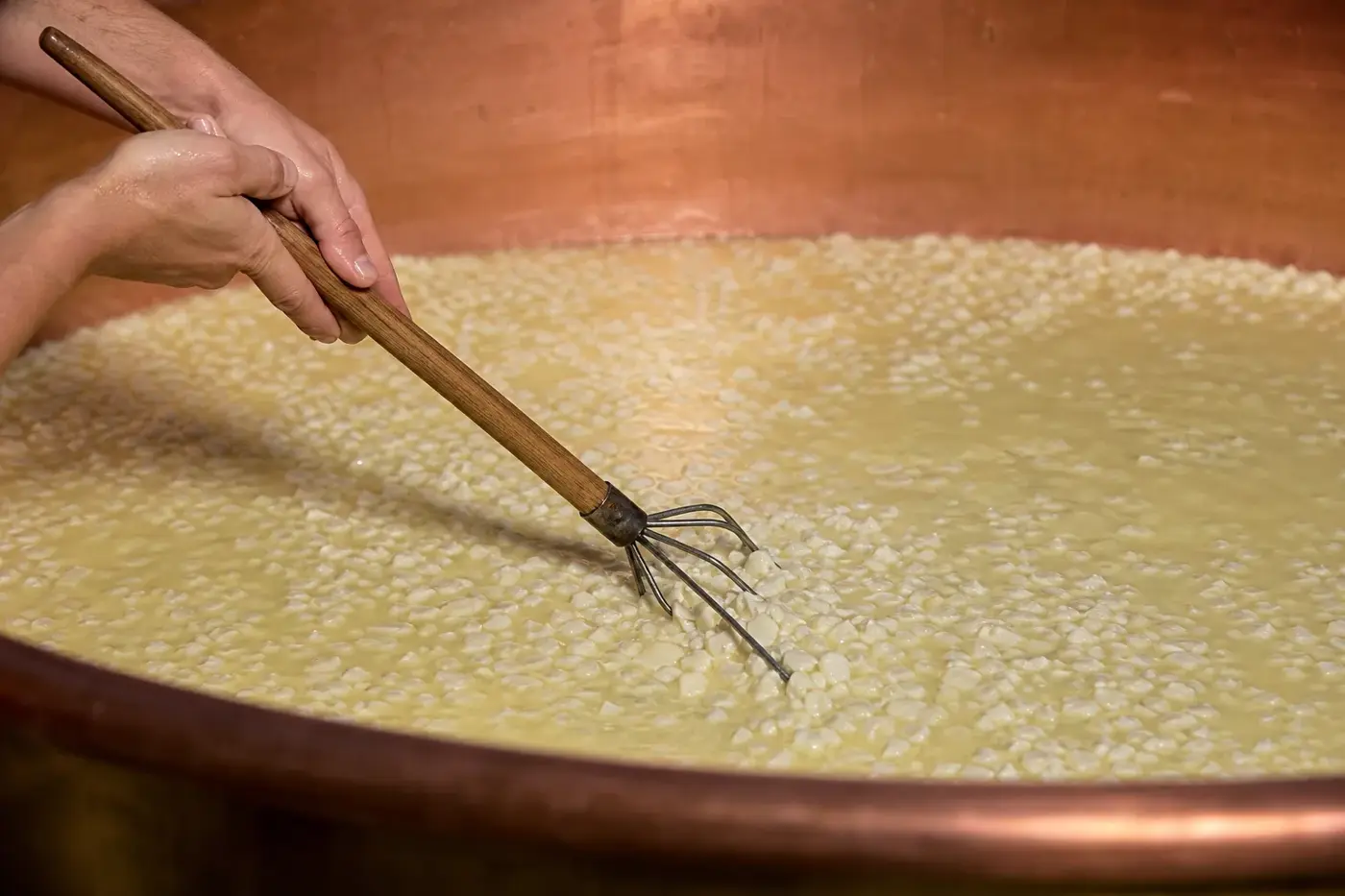
Cutting the gel lets whey, its liquid portion, separate from the curd. Stirring and subsequent drainage help manage that separation. Depending on the product and process, the US standards also describe further cutting, standing, reheating or piling as possible stages of mozzarella manufacture.[4]
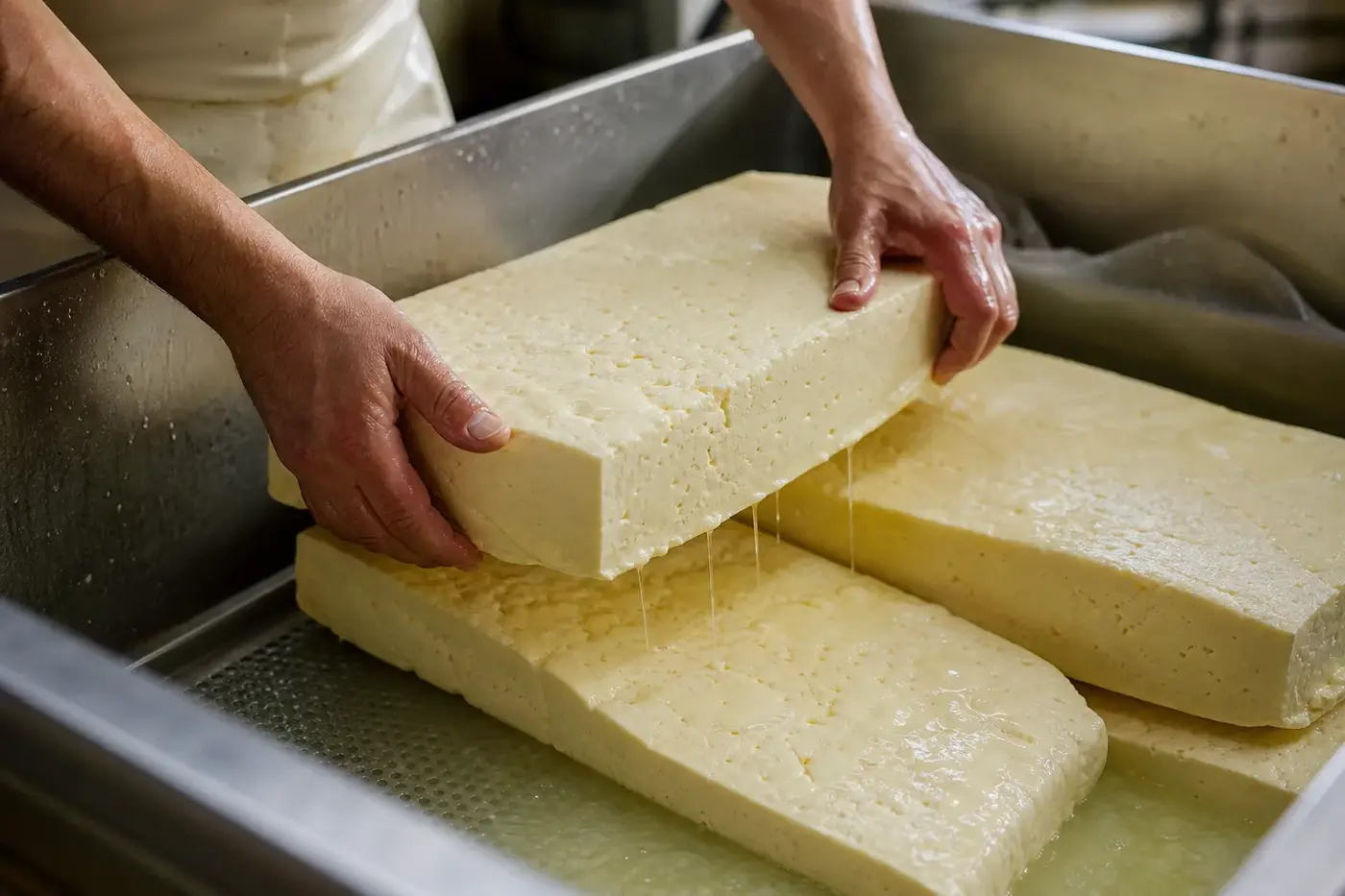
For buffalo mozzarella, the consortium describes breaking the coagulated milk and separating whey. The curd then acidifies before its final drainage and preparation for stretching. Physical handling and acid development happen together, so the pieces you see becoming smaller and drier are changing in less visible ways too.[5]
The aim is a network with the mineral balance and working properties needed for stretching. Drainage removes liquid, while acidification influences where calcium is distributed. Together, these changes help determine whether the next application of heat will give the maker a mass they can work.[3]
Acidity: finding the moment to stretch
Calcium helps connect the casein structure. As acidity rises, some of the calcium associated with that structure becomes soluble. Research on mozzarella describes this redistribution, alongside changes in protein hydration, as part of what lets curd flow during plasticisation: the stage when heat makes it deformable.[3]
The maker needs the curd to hold together and move at the same time. Enough connections must remain to keep the mass intact, yet the heated curd must be free enough to extend. One acidity reading cannot give you the whole picture: calcium content and distribution influence how curd behaves at a particular pH, the measure of acidity.[3]
Readiness therefore depends on the method. The research describes directly acidified mozzarella curd being plasticised at a higher pH, around 5.6, when its total calcium concentration is lower than that of traditionally prepared curd. Borrow a pH value from another method and you may get the wrong idea.[3]
Timing means following a changing material, not simply watching the clock. In the consortium’s production account, acidification is followed by a physical test. The maker wants a practical answer: will the warmed sample extend uniformly without breaking?[5]
The hot water test: a small sample tells the story
Before committing the batch, the maker tests a portion of curd. The consortium describes finely breaking up the sample, adding hot water and bringing it together. It is then drawn out with a wooden stick and by hand; in that production method, uniform extension without breaking is the signal to proceed.[5]
You can see the value of asking the curd itself. The test reveals whether this particular sample, with its present acidity and composition, will form a continuous stretched mass when heated. Firmness, good drainage or a certain number of hours at rest cannot answer that question quite so directly.[3][5]
It is also a preview of the main event. Separate pieces must unite before they can extend together. A successful test shows that the required physical response is possible, but the full batch still needs controlled heating and working to make it happen.[4][5]
Lift, fold, stretch: now comes the transformation
The prepared curd is divided before stretching begins. Campania’s agriculture department describes working the heated mass with a ladle and stick, repeatedly lifting and drawing it until it becomes homogeneous. Separate pieces merge into one continuous mass, ready for portioning and shaping.[2]
Industrial equipment can bring about the same transformation. In one experimental mozzarella study, researchers used a twin-screw stretcher and deliberately varied screw speed, processing temperature and working time. Each offers a different form of control: both the movement applied to the curd and the heat it receives can influence the cheese you end up with.[6]
Heat alone does not tell the story. A separate experimental study investigated free-oil formation by examining mozzarella curd under different combinations of compression, stretching and cooking temperature. Its design makes the practical point clear: thermal treatment and mechanical working act together, rather than stretching being merely a final pull after heating.[7]
The goal is a cohesive mass the maker can work and shape. The US standards describe kneading and stretching until the curd is smooth and free of lumps, then cutting and moulding it. Controlled heat and movement turn prepared curd into cheese that can hold its intended form.[4]
Inside the ribbon: the making of that familiar chew
Think of the stringiness and chewiness you recognise in heated mozzarella. They come from its protein structure, with dairy research describing fibres within that structure as contributors to its stretching behaviour. Acidification prepares the network to flow; stretching gives that deformable material direction.[3]
The transformation happens at two scales. You see separate pieces merge into a continuous mass, while inside, heat and stretching rearrange and align the protein network in the direction of pulling, helping create mozzarella’s layered texture.[3] Research on rennet curds shows how markedly rigidity and fluidity can change with temperature and acidity.[1]
That structure helps explain the appealing contradiction: mozzarella can resist and still extend. It remains a connected protein material, but its manufacturing history allows it to deform. Those production conditions matter when you reheat it too: the experimental stretcher study found differences associated with changes in processing variables.[6]
Fingers, cold water and salt: giving mozzarella its shape
Once the curd is workable, the maker portions and shapes it. Campania’s agriculture department describes the traditional hand operation: thumb and forefinger separate the pieces, which are then cooled in cold water and salted. Rounded pieces, knots and plaits are among the shapes the department records.[2]
The order is not identical in every production system. The US standards allow salt to be added during manufacture and describe firming the moulded cheese in cold water. Cooling and salting are part of the overall process, with their timing determined by the cheese being made.[4]
Fresh or lower moisture: find the right mozzarella for your kitchen
Fresh mozzarella is often packed in liquid and eaten fresh; lower moisture mozzarella is commonly used in cooking, including on pizza. Both rely on stretching, but their moisture and intended performance differ. USDA specifications assess body, texture, meltability, stretchability and free fat, making cooking behaviour part of the requirements for particular products.[8]
For you as a cook, that distinction is useful, but the legal categories have a specific scope. In November 2026, the US standards draw the following precise distinction by moisture content. These figures define US legal categories, not every fresh mozzarella made worldwide.[4]
| US cheese category | How much moisture the whole cheese contains | Legal source |
|---|---|---|
| Mozzarella cheese | More than 52%, up to and including 60% | 21 CFR 133.155 |
| Low-moisture mozzarella cheese | More than 45%, up to and including 52% | 21 CFR 133.156 |
Moisture is not the whole recipe for cooking performance. USDA specifications also examine whether heated cheese melts and stretches appropriately, and how much free fat it releases. To understand how mozzarella will work as your ingredient, you need to consider those properties together.[8]
Keep it fresh: make room in the fridge
If you follow Food Standards Agency guidance in England, Northern Ireland and Wales, keep your home fridge between 0 and 5 °C. The agency advises refrigerating dairy products and following the storage instructions on their packaging. Use a fridge thermometer to check the actual temperature.[9]
Once you open the pack, follow its directions, including any limit on keeping the cheese and any instructions about its liquid. The FSA distinguishes use by dates, which concern safety, from best before dates, which concern quality. Do not eat food after its use by date, even if it looks and smells fine; incorrect storage can make food unsafe before that date.[10]
When you are preparing food, keep chilled mozzarella out of the fridge for the shortest time possible, as the FSA advises. For practical help with wrapping and fridge organisation, see how to store cheese at home.[9]
Curd will not stretch? Look back before you pull again
If your heated sample breaks instead of extending evenly, it may not have reached the condition required by the maker’s test.[5] Acidity and calcium balance interact during plasticisation. That is why curd prepared by a different acidification method can behave differently even at a familiar pH.[3]
Heating and working introduce more variables. The experimental mozzarella studies changed processing temperature, working time, screw speed, compression or stretching to investigate the resulting behaviour. Repeatedly heating and pulling an unsuccessful curd changes several conditions at once, making it harder for you to identify the cause.[6][7]
Keep a troubleshooting record that separates your milk choice and acidification method from the later heating and working conditions. Those distinctions follow directly from the variables examined in the research. Before answering a poor stretch with more pulling, establish how the curd was prepared and what has already happened to it.[3][6][7]
General information only, not medical advice: follow the official guidance where you live.
Questions people ask
How is mozzarella made?
The milk is acidified and set into a gel, which is cut so that whey can separate. The curd continues to acidify before it is heated, kneaded and stretched into a smooth mass, then shaped.
Is mozzarella made from buffalo milk or cow’s milk?
Mozzarella can be made from either. Cow’s milk mozzarella is often called fior di latte, while Mozzarella di Bufala Campana starts with fresh buffalo milk.
Why does my mozzarella curd break instead of stretching?
A sample that breaks rather than extending evenly may not have reached the condition required for stretching. Acidity and calcium balance interact, while heating and working also affect the curd’s behaviour.
What is the difference between fresh mozzarella and mozzarella used for cooking?
Fresh mozzarella is often packed in liquid and eaten fresh, while mozzarella with less moisture is commonly used in cooking, including on pizza. Both are stretched, but differ in moisture and intended performance.
How should I store mozzarella after opening it?
The Food Standards Agency advises refrigerating dairy products and following the pack’s storage instructions, including any directions about the liquid and how long to keep the cheese after opening. It advises keeping the fridge between 0 and 5 °C in England, Northern Ireland and Wales, and checking the temperature with a fridge thermometer. See the Food Standards Agency’s food storage guidance.
Sources
- University of Yamanashi researchers. Quantifying thermally induced flowability of rennet cheese curds. Research manuscript, arXiv version 1, 15 October 2014. Retrieved manuscript.
- Regione Campania, agriculture department. Mozzarella di bufala campana D.O.P. Updated 29 August 2019. Official production account.
- Journal of Dairy Science. Effect of pH and Calcium Concentration on Some Textural and Functional Properties of Mozzarella Cheese. Volume 85, 2002, pages 1655 to 1669. Retrieved publisher extract; full-text access was unsuccessful. Publisher record.
- US Food and Drug Administration. 21 CFR Part 133: Cheeses and Related Cheese Products, sections 133.155 and 133.156. eCFR text displayed as current to 30 October 2026, checked November 2026. Retrieved regulatory text.
- Consorzio di Tutela Mozzarella di Bufala Campana DOP. Manufacture. Undated industry-body production account, retrieved November 2026. Production account.
- Journal of Dairy Science. The stretchability of Mozzarella cheese evaluated by a temperature-controlled 3-prong hook test. 2012. Retrieved publisher extract; full-text access was unsuccessful. Publisher record.
- Journal of Dairy Science. The Effect of Compression, Stretching, and Cooking Temperature on Free Oil Formation in Mozzarella Curd. 2003. Retrieved publisher extract; full-text access was unsuccessful. Publisher record.
- US Department of Agriculture, Agricultural Marketing Service. USDA Specifications for Mozzarella Cheeses. Effective 24 September 2012, reprinted December 2018. Official specifications.
- Food Standards Agency. How to chill, freeze and defrost food safely. Published 18 December 2017, current retrieved guidance, November 2026. Applies to England, Northern Ireland and Wales. Official chilling guidance.
- Food Standards Agency. Understanding food labelling: Best before and use-by dates. Current retrieved guidance, November 2026. Official date-label guidance.
Researched through official production accounts, US food standards, published experimental research and Food Standards Agency consumer guidance.
Last checked: November 2026
Last checked November 2026.
The editors suggest you read next
Cutting the Curd: Why the Size of the Pieces Matters
At dairy Boselli, a spino breaks the set milk for Parmigiano Reggiano into minute granules.