Washing the Curd
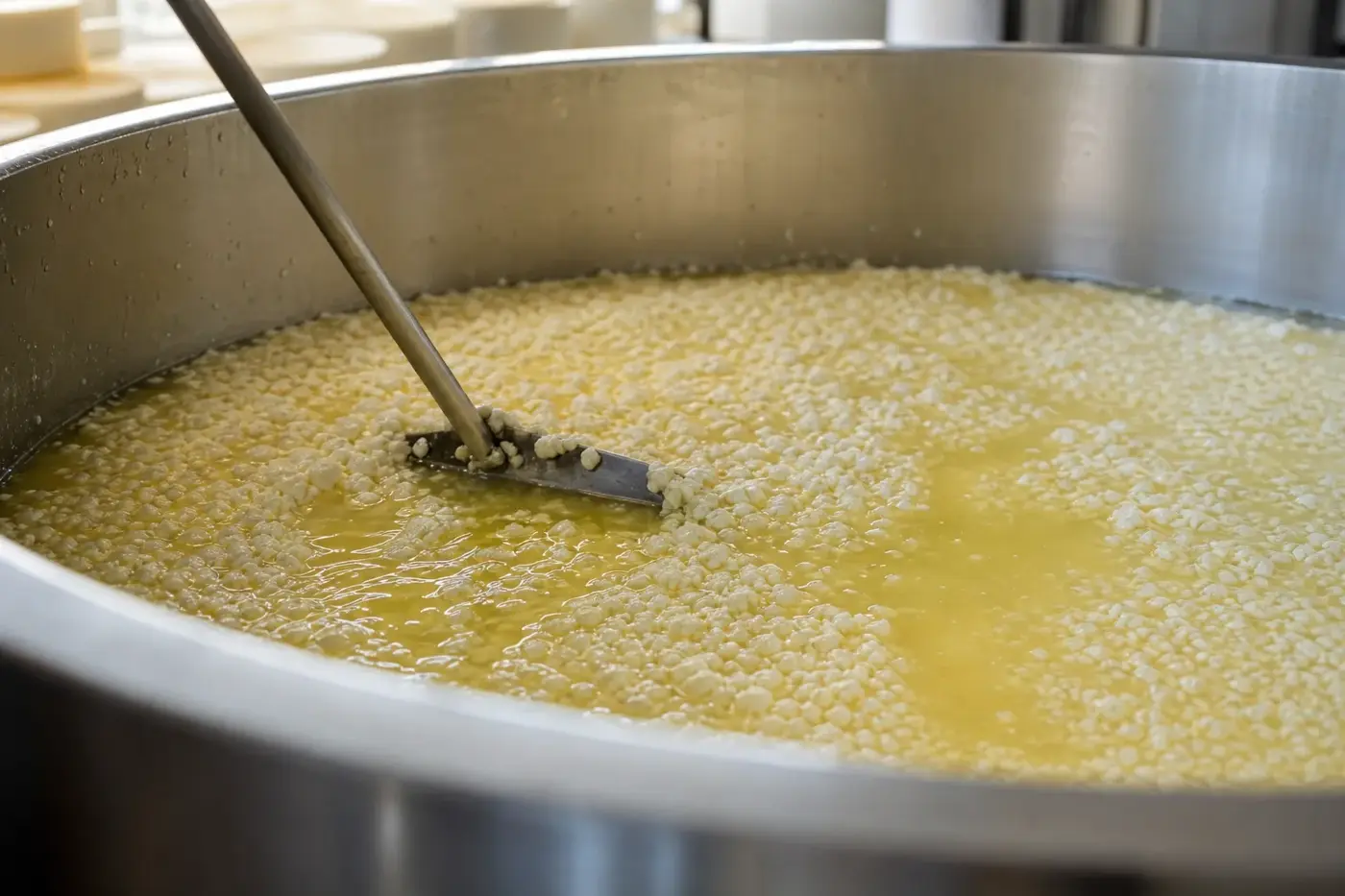
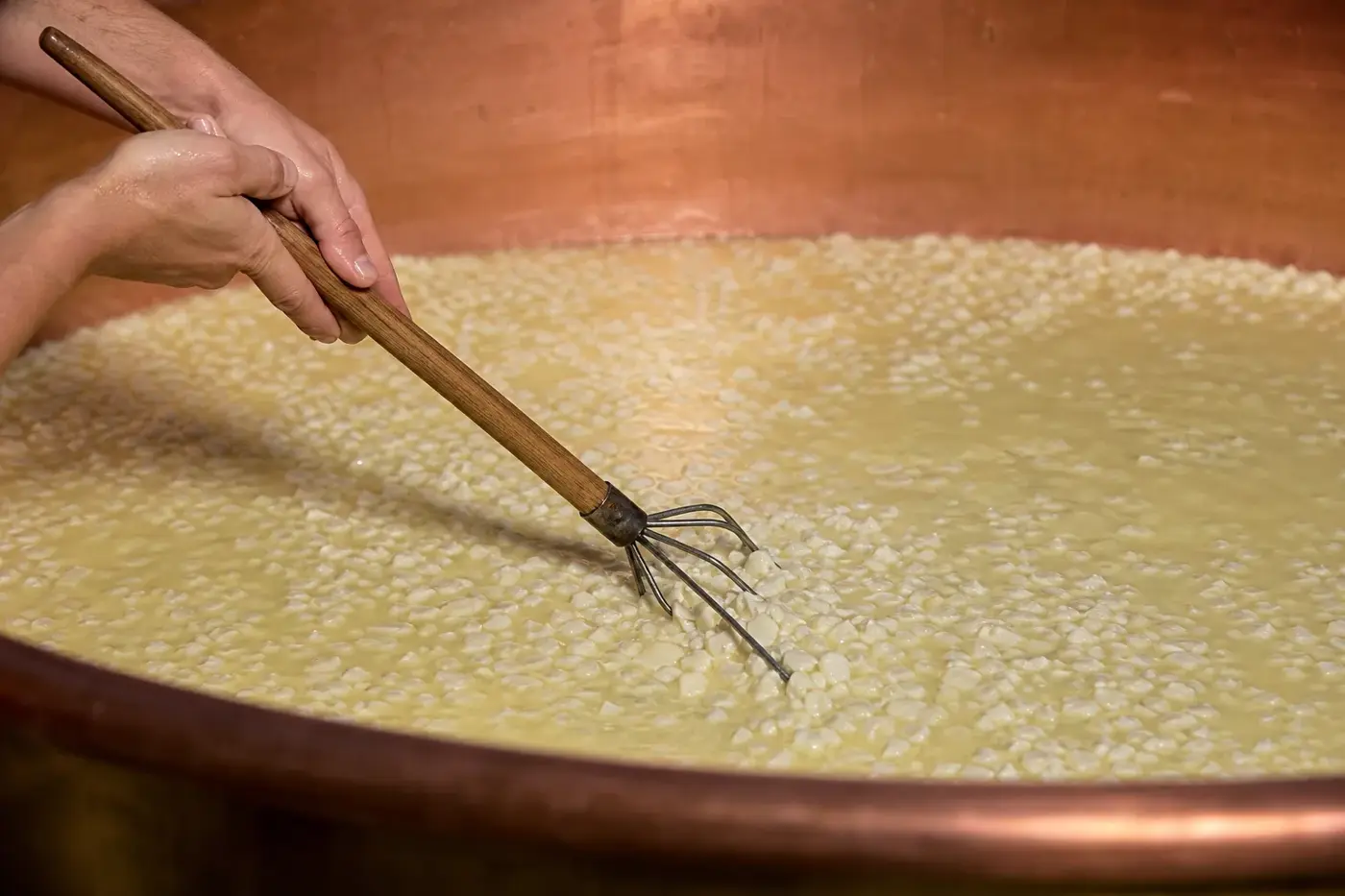
Peer into a Gouda vat and you will see small curd particles floating as warm water takes the place of some whey.
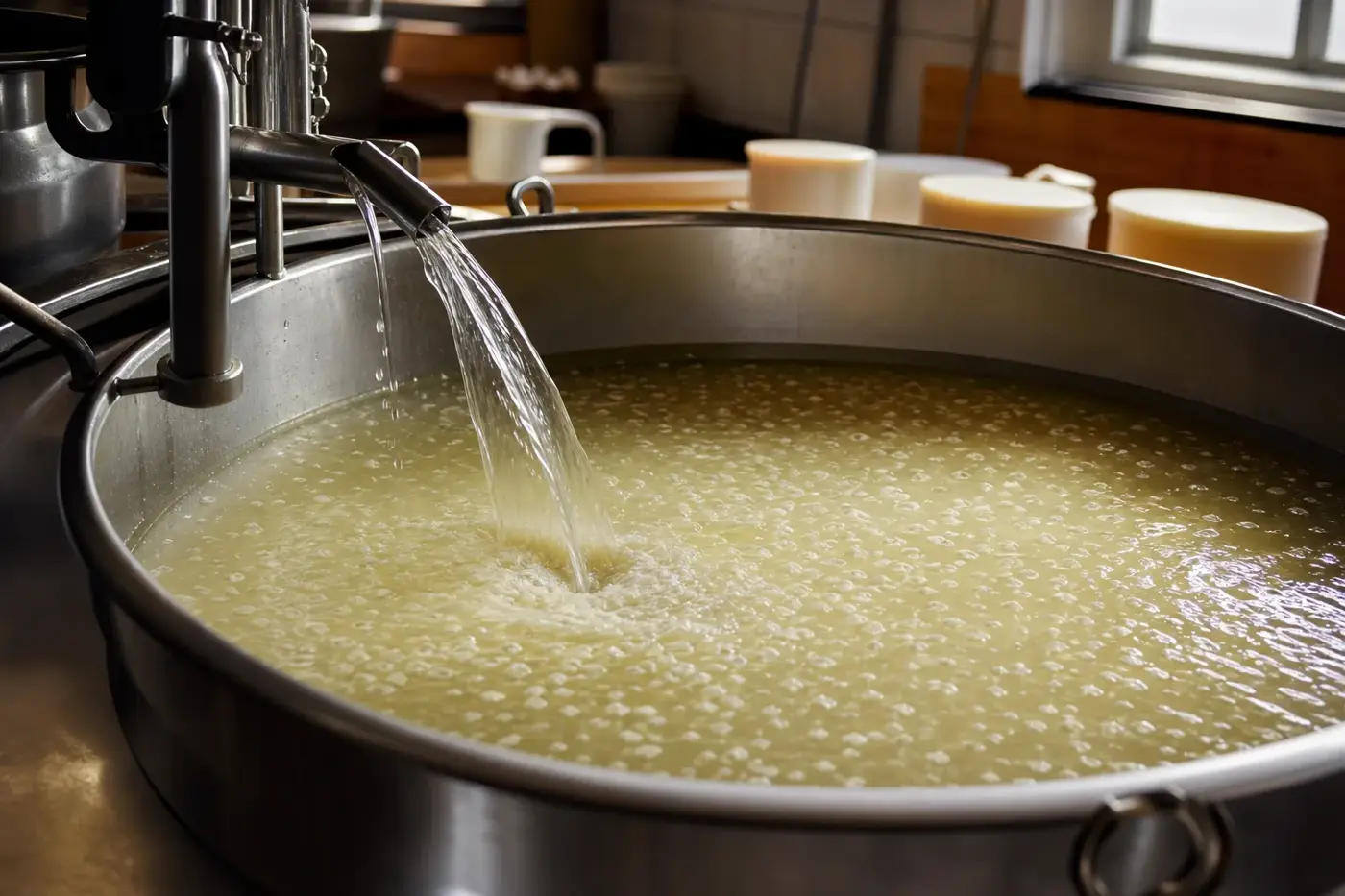
Peer into a Gouda vat and you will see small curd particles floating as warm water takes the place of some whey. It looks almost uneventful. Yet this quiet exchange carries away milk sugar and helps shape the cheese’s eventual acidity, texture and flavour, beginning with how much lactose remains for fermentation.[1,3]
Before there is a wheel to admire
At this stage, you are looking at separate pieces, not a formed cheese. Curd begins as a gel of milk proteins created during coagulation, the setting stage. Cutting breaks that gel into pieces; stirring and heating help them release whey, the liquid surrounding them.[3,7]
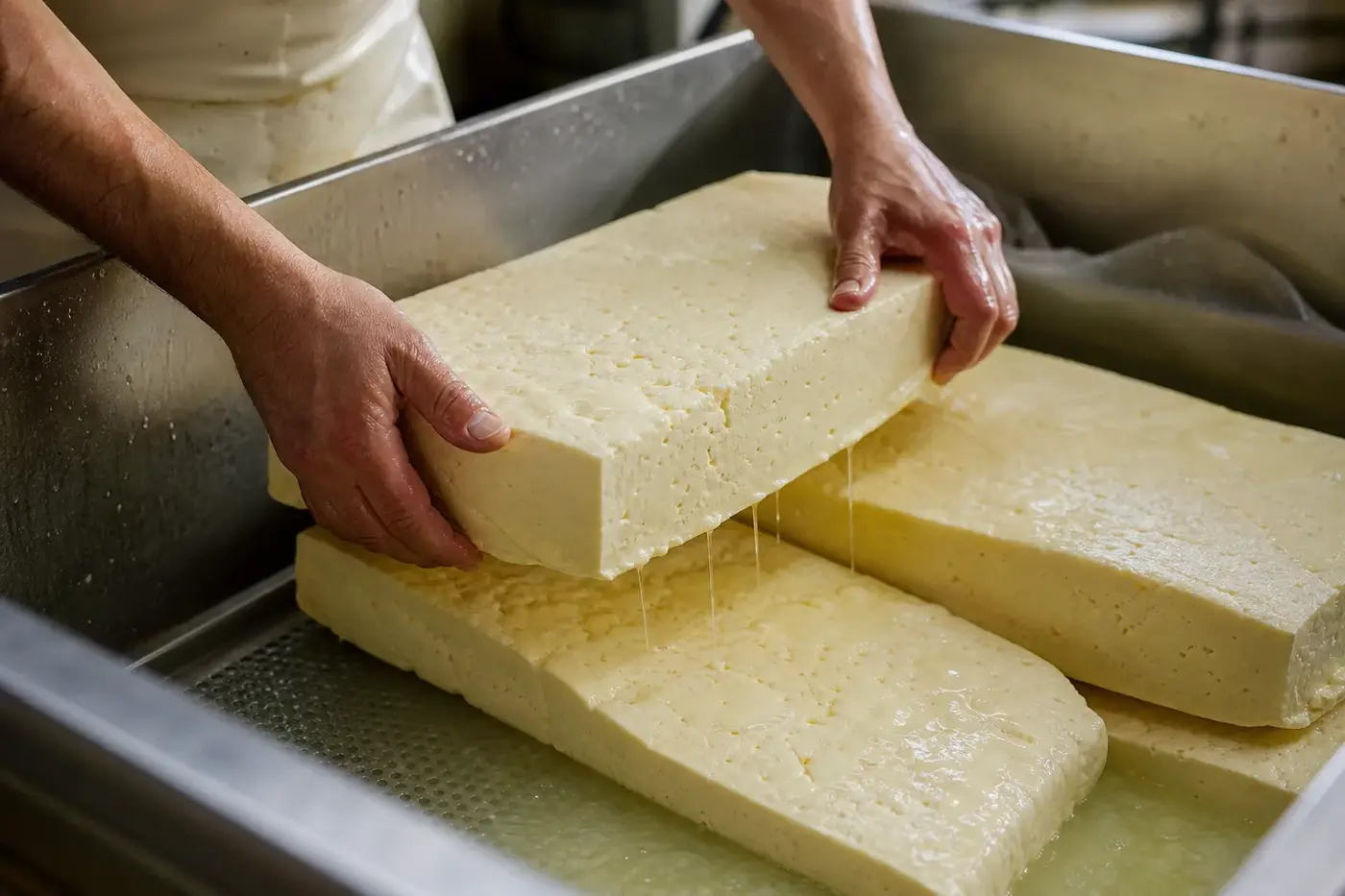
Washing happens before moulding and pressing, while those particles can still float in liquid. The maker removes some whey first to make room for washing. Later, drainage gathers the curds for shaping into a continuous body: two distinct steps, even if your thoughts have already wandered towards the cheeseboard.[2,3]
To see where this moment fits, follow how cheese is made.
Some whey leaves, water takes its place
The maker draws off some whey, leaving the curd particles behind, then replaces part of that liquid with water. Stirring distributes the water through the mixture. If you are picturing a freshly rinsed surface, think again: the important change happens in the liquid around each particle.[2]
There is another route: washing after the whey has drained away. In Colby research, cheesemakers compared holding drained curds in a batch of cold water with rinsing them under continuously running water. Both are washing, but the contact conditions, and the effects, differ.[4]
Following the milk sugar out of the vat
Lactose, milk’s sugar, is dissolved in the watery phase. Remove whey and you remove lactose with it. Add water and you dilute the lactose left behind, so less can enter the cheese with its retained moisture.[1,10]
Here is the useful part for the maker: less sugar need not mean less moisture. Curds can hold the moisture their intended texture needs while carrying less lactose within it. The University of Guelph’s cheesemaking teaching material identifies washing as a way to combine relatively high moisture with controlled final acidity.[7]
How the water meets the curd matters, too. In the Colby comparison, batch-washed cheese held less residual lactose than continuously rinsed cheese, despite similar water use. The volume passing through the vat tells you only part of the story; contact helps determine how much lactose leaves.[4]
Less sugar, a different path for acidity
Starter cultures are the bacteria added to guide fermentation. They turn lactose into lactic acid, so less lactose limits the potential for further acid production. Washing can restrain continuing acidification and leave cheese at a higher pH, meaning lower acidity on that scale.[10]
The bacteria do not simply stop working. In controlled Cheddar trials, increasing washing reduced residual lactose and lactic acid, and raised pH during ripening. What changed was the acid balance, not merely how cool or wet the curd became.[1]
Nor does less sugar guarantee that pH falls more slowly at every moment. Temperature and culture activity influence its course; a separate trial found that calcium level changed the response to washing. The maker follows the acidification curve rather than trusting one addition of water to settle the final pH.[11]
Finding the right temperature for the curd
Warm water can help heat the curd. Cold washing can cool it and reduce further whey expulsion, known as syneresis. Guelph’s teaching material describes hotter washing as a way to dry Gouda curd and develop its texture, but incoming water temperature and mixed curd temperature are separate measurements.[7]
You cannot lift a single temperature from the research and use it for every make. Each figure below belongs to its own experimental process.[3,4]
| Research process | Water and timing | What happens in the vat |
|---|---|---|
| Cheddar whey dilution [3] | Water at 35 °C replaced whey equivalent to 28.8% of the original milk weight | A measured replacement during cooking |
| Colby batch washing [4] | Water at 10 °C contacted curd for five minutes | Curds held in cold water |
| Colby continuous washing [4] | Running cold water rinsed curds for approximately seven minutes | Whey draining during washing |
Timing changes what the water can do. Early dilution during cooking acts on curds still exchanging liquid with their surroundings; later washing of drained curds combines lactose removal with cooling. Quantity needs an equally clear basis, such as original milk weight: a percentage without that explanation leaves you short of useful information.[4,10]
Firm, sweet or mild? The whole make matters
Washed curd does not automatically give you softer cheese. Washing changes the conditions in which the protein structure develops, while moisture, acidity and calcium balance interact. The result depends on how the maker combines washing with stirring, heating and drainage.[7,10]
In one controlled full-fat Cheddar study, washing changed overall composition little, yet the cheeses were generally firmer and less brittle. Those qualities can sit happily together. Resisting compression is different from being ready to fracture: a cheese can resist pressure while bending further before it breaks.[2]
Tasting results from the same research programme described washed cheeses as less acidic and sweeter than unwashed controls. “Sweeter” is the tasting panel’s flavour description here: removing lactose removes sugar, but can also reduce sourness. Teagasc also reported changes in aroma compounds and in descriptors associated with the unwashed cheeses.[11]
Experimental directly acidified mozzarella tells another part of the story. Double washing reduced volatile compounds and gave a milder taste and aroma, which the researchers considered relatively weak in flavour. Washing shapes character, but the intensity you want depends on the cheese being made.[8]
Gouda and Edam: a shared step, different recipes
Gouda and Edam are familiar Dutch-style washed-curd cheeses, but their manufacturing schedules differ. Dairy science literature describes adjusting whey withdrawal and water addition to the milk’s lactose level. That level itself changes with the stage of lactation.[3]
For Gouda Holland, the published EU production description places curd washing before pressing and brining, explicitly linking it to the intended moisture and pH. It specifies neither one wash-water temperature nor a replacement quantity. The named cheese’s production framework gives you one level of detail; the maker’s vat schedule supplies another.[5]
EU registration instruments distinguish the compound names Gouda Holland and Edam Holland from Gouda and Edam. For a taste of the broader style, read Gouda. Washing belongs to its production, but does not tell you the whole recipe.[5,6]
Washed curd or washed rind? Know the difference
The shared word can lead you astray. Curd washing happens during manufacture, before shaping, acting on particles and changing their associated liquid and fermentable sugar. Rind washing comes during maturation, treating the developing exterior of an already formed cheese.
So these terms tell you different things. Washed-curd describes part of the make; washed-rind describes surface ripening. They are separate operations, not two names for the same job.
Read the curd, not just the clock
A washing schedule needs temperature and acidity readings to tell you much. The maker tracks both the incoming water and the curd mixture after mixing. Acidity checks follow fermentation, with pH measured at defined manufacturing stages.[3,10]
Drainage pH is particularly useful to record. The same time on the clock can mean different acid development in different vats. The curd, inconveniently for anyone fond of a rigid timetable, does not work by the clock alone.[3,10]
Its physical condition matters just as much. During stirring and cooking, the maker follows moisture release and texture development, then checks readiness for drainage and forming. Guelph’s teaching material warns that overly rapid cooking can toughen particle surfaces, hindering both moisture release and smooth knitting during pressing.[7]
Temperature, acid development and curd condition guide the work together. Washing must fit the cooking and stirring already under way. The water addition belongs to the make, rather than standing apart from it.[7,10]
On to pressing, brine and ripening
After washing and further handling, drainage gathers the curds for moulding and pressing. Gouda Holland’s published production description then places the formed cheese in brine. By the time salt begins moving into it, washing has already helped establish the sugar supply.[3,5]
That order matters especially for brine-salted Dutch-style cheeses. Salt reaches the interior gradually, leaving starter bacteria there time to keep fermenting lactose. Controlling lactose before shaping helps control that later acid production; pressing, salting and ripening continue the work begun in the vat.[3]
What washing can and cannot tell you
Washed-curd does not necessarily mean lactose free. Analysis in the Colby study found residual lactose after both washing treatments, at concentrations that differed by method. In the directly acidified mozzarella experiments, lactose reduction also depended on the washing treatment and subsequent storage.[4,8]
For the finished cheese, look for a measurement or a substantiated declaration. You can explore the analytical differences in lactose in cheese.[4,8]
Washing is also separate from hygienic production. The Food Standards Agency provides food safety management guidance for food businesses in England, Wales and Northern Ireland.[9]
These are two distinct jobs: washing adjusts curd composition; the food safety system controls hazards throughout production. For the wider official guidance, turn to the cheese food safety guide.[9]
General information only, not medical advice: follow the official guidance where you live.
Questions people ask
What does washing the curd mean?
A cheesemaker removes some whey and replaces part of it with water while the curd particles remain in the vat. Washing can also happen after the whey has been drained.
Why do cheesemakers wash curds?
Removing whey and adding water reduces the lactose that can travel into the cheese with its retained moisture. With less lactose available to starter cultures, washing can limit further acid production.
Is washed curd the same as washed rind?
No. Curd washing happens before shaping, while rind washing treats the exterior of an already formed cheese during maturation.
Is washed curd cheese lactose free?
Not necessarily. The Colby study found residual lactose after both washing treatments, so look for a measurement or substantiated declaration for the finished cheese.
What temperature is used to wash Gouda curd?
Guelph’s teaching material describes hotter washing as a way to dry Gouda curd and develop its texture. The published Gouda Holland production description does not specify a single wash water temperature.
Sources
-
Teagasc and University College Cork. Effect of curd washing on composition, lactose metabolism, pH, and the growth of non-starter lactic acid bacteria in full-fat Cheddar cheese. International Dairy Journal, volume 25, pages 21 to 28, 2012. Retrieved journal record and indexed abstract. Source.
-
Teagasc and University College Cork. Effect of curd washing on cheese proteolysis, texture, volatile compounds, and sensory grading in full fat Cheddar cheese. International Dairy Journal, volume 34, pages 190 to 198, 2014. Retrieved journal record and indexed abstract. Source.
-
Teagasc and University College Cork. Effect of curd washing on the properties of reduced-calcium and standard-calcium Cheddar cheese. Journal of Dairy Science, volume 97, pages 5983 to 5999, 2014. Full research paper. Source.
-
University of Wisconsin-Madison. Effect of different curd-washing methods on the insoluble Ca content and rheological properties of Colby cheese during ripening. Journal of Dairy Science, volume 94, pages 2692 to 2700, 2011. Published abstract retrieved through PubMed. Source.
-
European Commission. Commission Regulation (EU) No 1122/2010 of 2 December 2010 entering a designation in the register of protected designations of origin and protected geographical indications [Gouda Holland (PGI)]. Annex II, particularly section 4.5, 2010. Source.
-
European Commission. Commission Regulation (EU) No 1121/2010 of 2 December 2010 entering a designation in the register of protected designations of origin and protected geographical indications [Edam Holland (PGI)]. 2010. Source.
-
University of Guelph. Cheese Making Technology ebook. The relevant chapter and its URL must be verified before publication.
-
University of Bari. An attempt at producing a “lactose-free” directly acidified mozzarella (high moisture type) by curd washing and pressing: A chemical and sensory study. International Dairy Journal, volume 136, article 105499, 2023. Published journal record and university repository manuscript. Repository manuscript.
-
Food Standards Agency. Managing food safety. Updated 21 August 2026; applies to England, Northern Ireland and Wales. Source.
-
University College Cork and Wisconsin Center for Dairy Research. Effect of standardizing the lactose content of cheesemilk on the properties of low-moisture, part-skim Mozzarella cheese. Journal of Dairy Science, 2016. Retrieved journal record and indexed passages. Source.
-
Teagasc. Teagasc Technology Updates: Food Programme. Research update on controlling residual sugars in Cheddar cheese, including experimental studies, main results and associated publications, 2014. Source.
This desk-researched article brings together controlled cheesemaking experiments, university teaching material, published EU production descriptions and attributed food safety guidance.
Last checked: November 2026
Last checked November 2026.
The editors suggest you read next
Cutting the Curd: Why the Size of the Pieces Matters
At dairy Boselli, a spino breaks the set milk for Parmigiano Reggiano into minute granules.