Cutting the Curd: Why the Size of the Pieces Matters
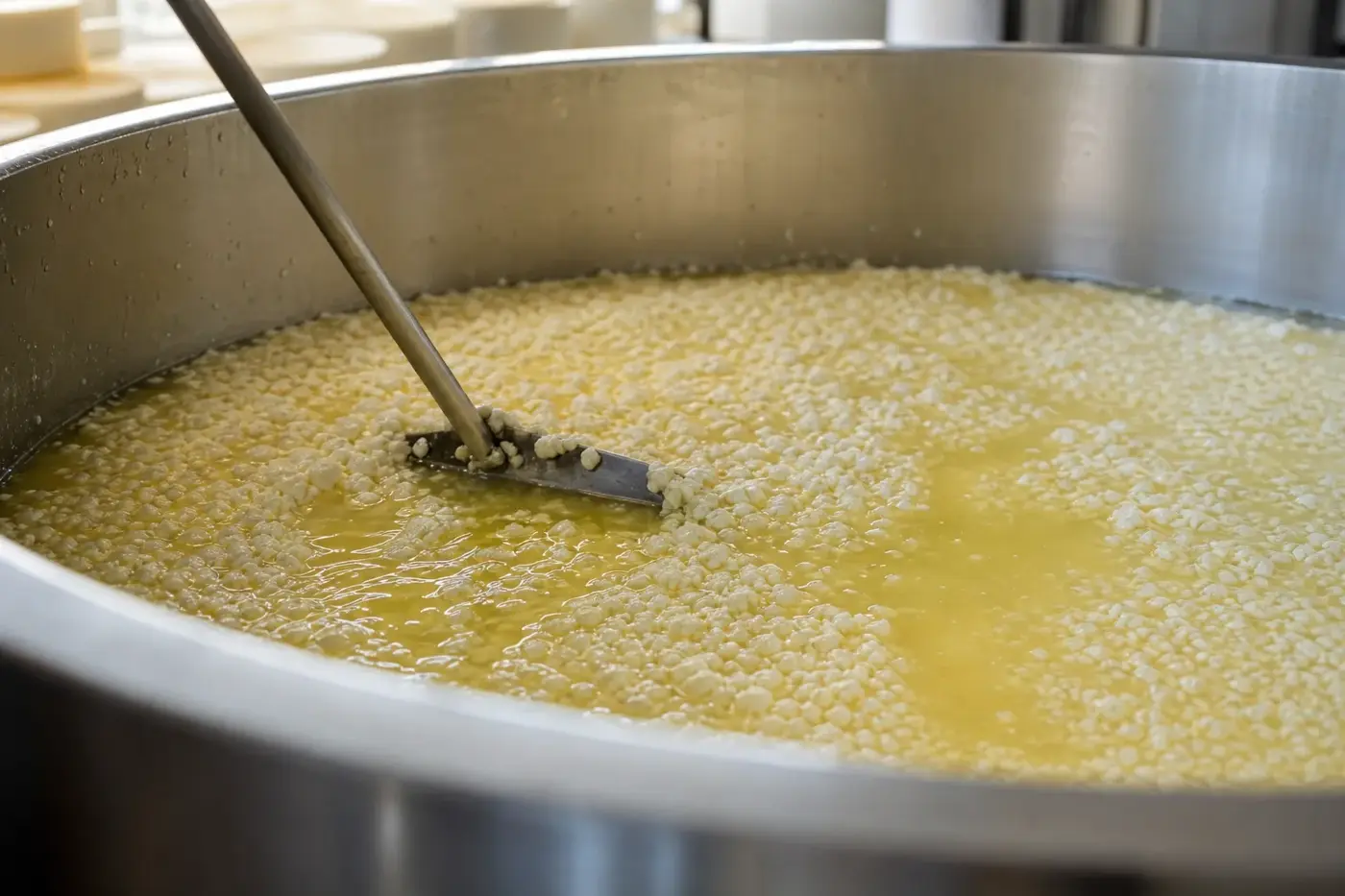
At dairy Boselli, a spino breaks the set milk for Parmigiano Reggiano into minute granules.
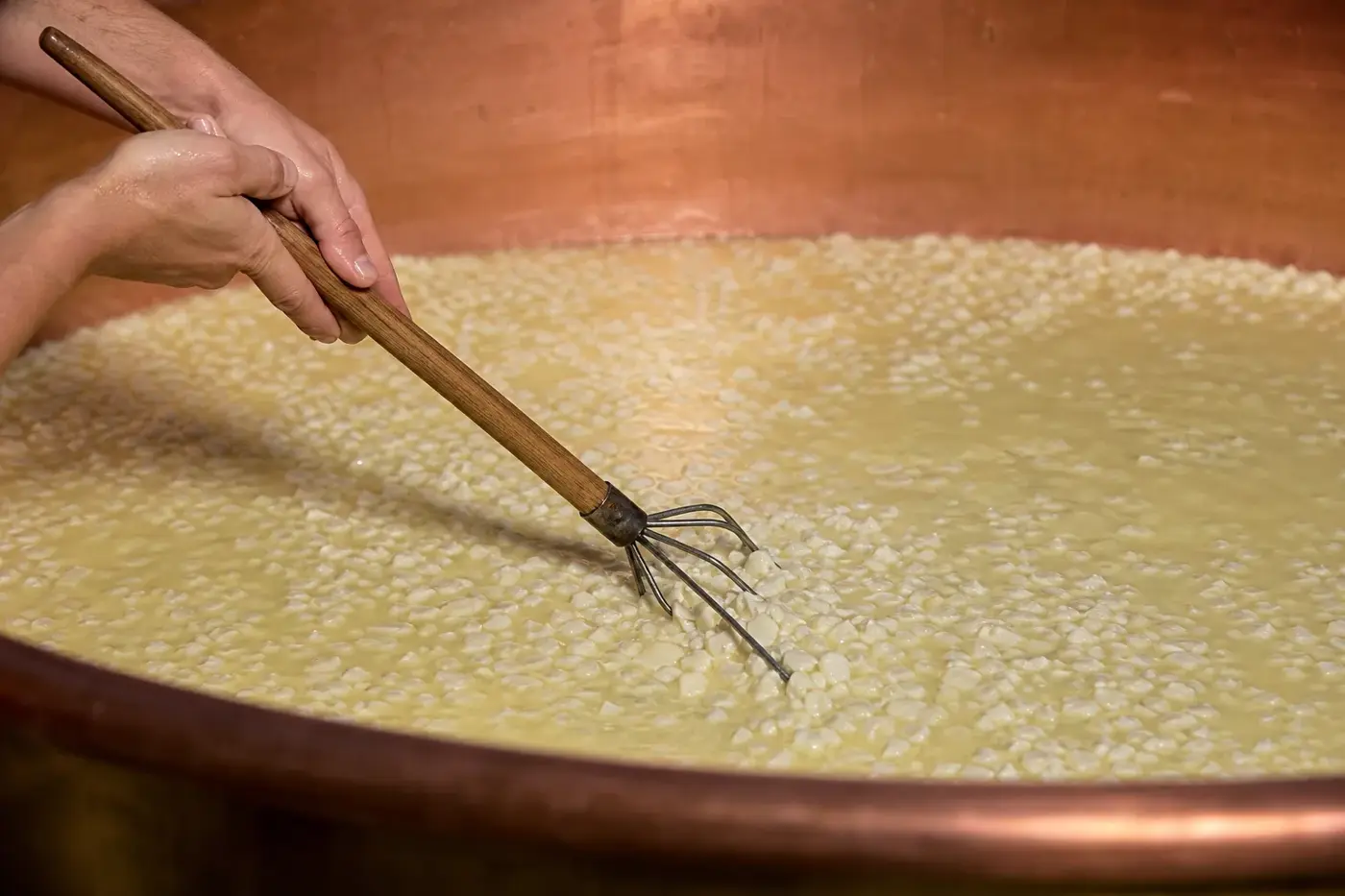
At dairy Boselli, a spino breaks the set milk for Parmigiano Reggiano into minute granules. Picture rice-sized grains, ready for cooking. Long before you reach for the grater, those tiny pieces are giving whey a way out and helping establish the character of a hard grating cheese. [1][5]
Every cut opens another escape surface for liquid trapped inside the milk gel. Smaller pieces generally surrender moisture more readily than larger ones. But firmness, acidity, heat and handling decide how far drainage goes. The knife starts a job that the rest of the make must finish. [1][2]
There's more liquid in that curd than you think
Set milk looks solid, but appearances only tell you so much. It still holds much of the milk's liquid, caught in a gel formed during coagulation. In rennet coagulation, enzymes act on casein, the main cheese-forming milk proteins, allowing their particles to join into a continuous network. Water and fat remain tucked into its spaces. [3]
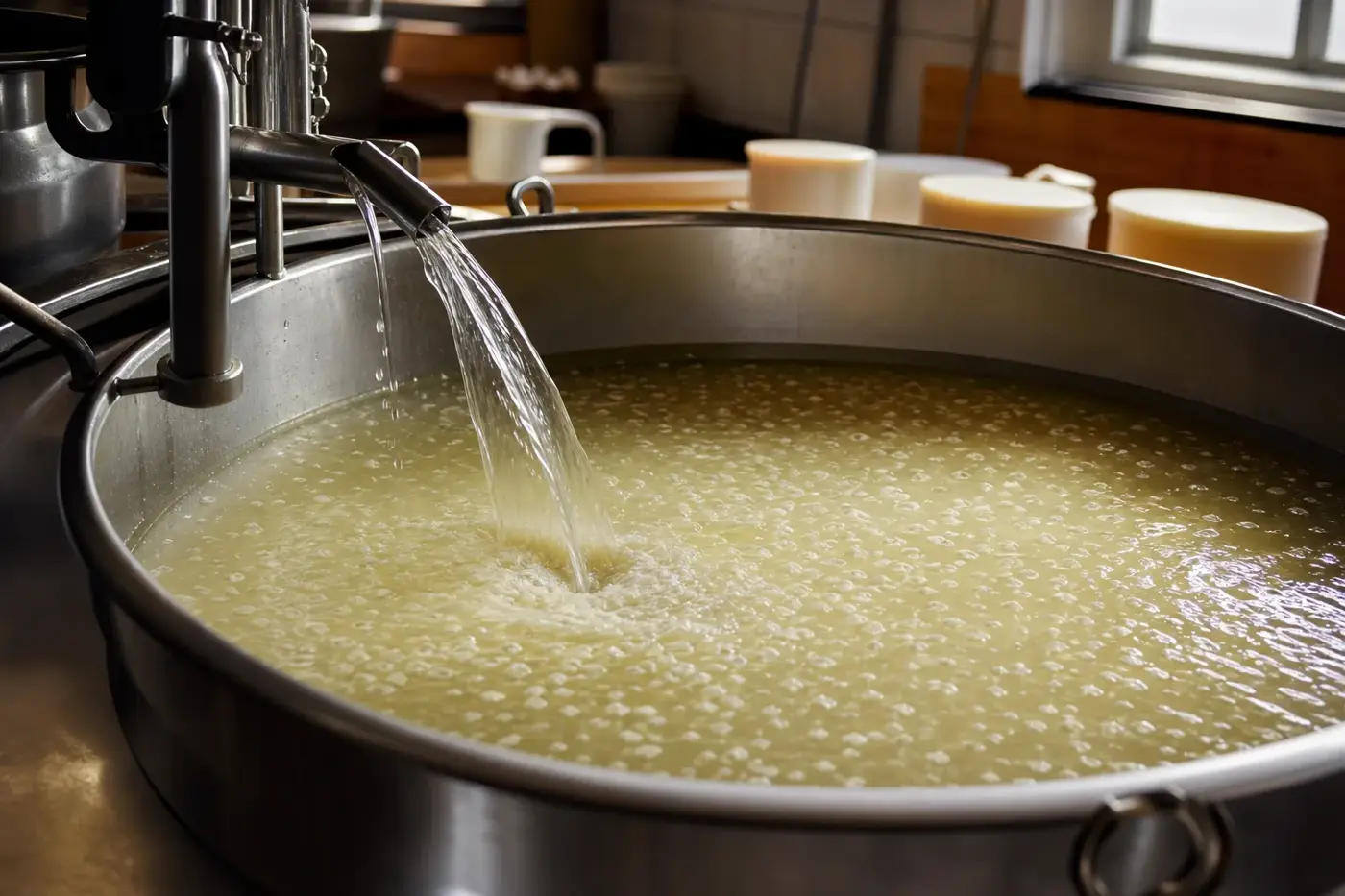
Curd is the protein-rich material destined to become cheese; whey is the liquid released from it. That whey carries dissolved milk components too. Draining therefore concentrates the retained fat and protein, rather than simply removing pure water. For the step that builds the gel, see rennet explained. [3][6]
Give the whey a shorter journey
Cutting exposes the gel's interior to the whey around it. As the protein network contracts and rearranges, liquid moves out through those newly exposed surfaces, a process called syneresis. A smaller piece has more surface relative to its volume and a shorter journey from centre to cut face. With everything else equal, it can release whey more readily. [2][6]
Picture dividing one cube into eight equal smaller cubes. The total volume stays the same, but the exposed surface doubles. Geometry has finally found a way to improve your cheese board. That extra surface creates an opportunity, not a guaranteed drainage rate: internal structure controls how easily liquid moves, while the remaining stages determine how much leaves. [2][6]
A controlled study explored this by varying milk protein concentration, cut size and setting temperature. Researchers measured moisture loss during stirring and cooking, finding that smaller cuts were associated with faster loss in both phases. Temperature and milk composition mattered too. Cut size has company; it cannot deliver dryness all by itself. [2]
Brie and Parmesan go their separate ways
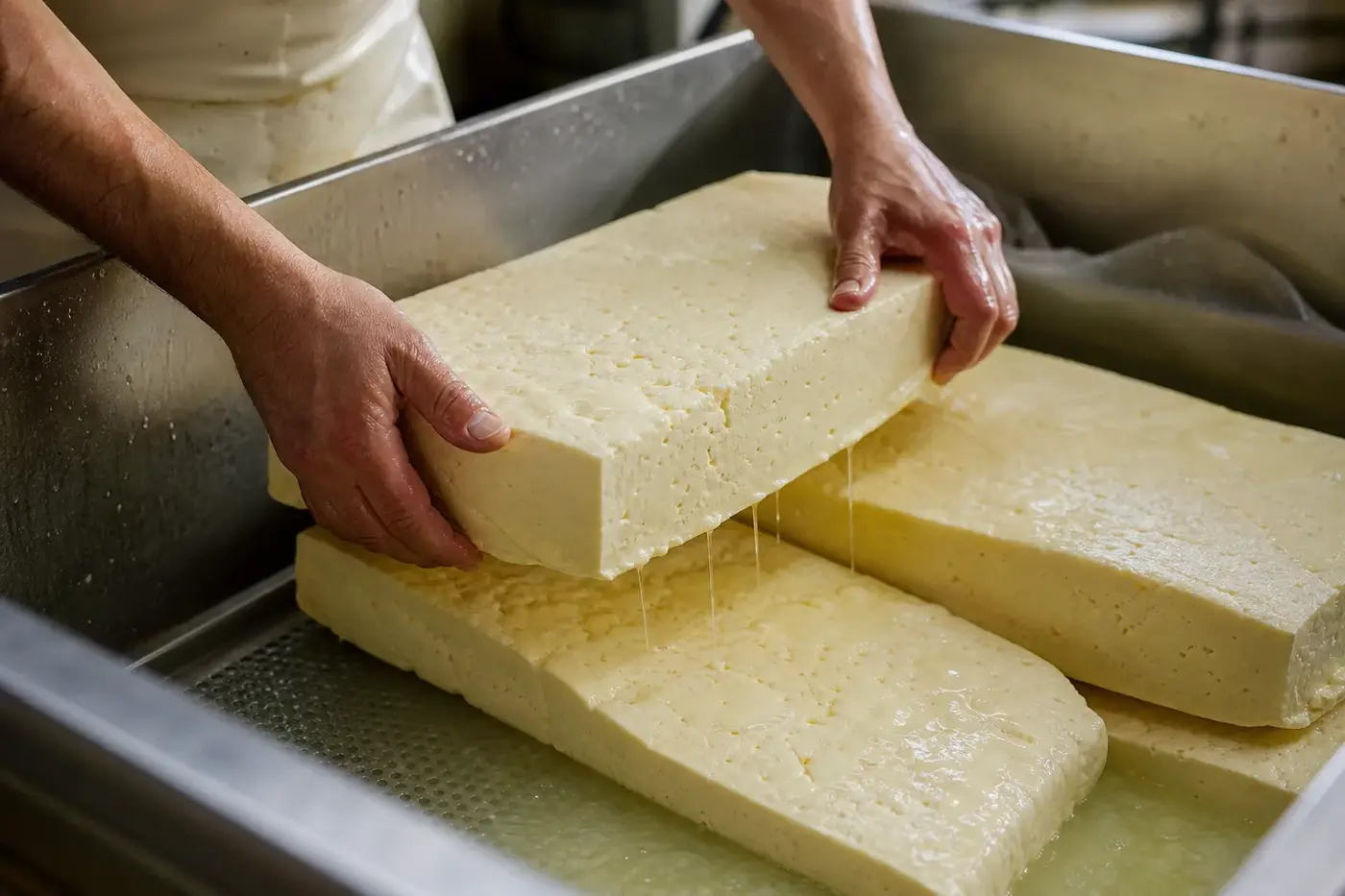
Set Brie de Meaux beside those tiny Parmigiano Reggiano grains and you can see the contrast. A published French specification sets its vertical cutting lines at least 1 cm apart. A broad, perforated pelle à brie makes the horizontal division as the curd is transferred by hand into moulds, where the specification describes spontaneous drainage. Soft Brie-style cheeses generally start with larger pieces than hard grating cheeses. [4]
Parmigiano Reggiano is the useful hard-cheese comparison, because cheeses sold as Parmesan do not all follow one method. Boselli's production account describes its characteristic rice-sized grains as minute granules cut with the spino, then cooked. Substantial pieces kept for gentle mould drainage and small grains prepared for further whey expulsion in the vat have different jobs ahead of them. [1][5]
The cutter tells only part of this story. These production systems also differ in acid development, heating, draining and ripening. You can explore the wider makes in the individual guides to Brie and Parmigiano Reggiano. [4][5]
Meet the knives and harps behind an even cut
Parallel blades or taut wires turn a continuous gel into separate pieces. Curd knives may use blades, while harps hold wires at fixed spacing within a frame. Passing them through the gel in different directions divides the mass, with horizontal and vertical wire arrangements cutting through its depth as well as across its surface. Powered systems tackle the same broad task mechanically. [1][3]
The aim is a consistent spread of sizes, not a vat of geometrically perfect cubes. No one is marking their corners. Even cutting gives grains a more similar starting point for drainage. Mix large lumps with very small fragments and the smaller pieces can lose moisture quickly while the larger ones stay wetter, widening the range of drainage behaviour. [2][6]
When the curd is ready, not just when the clock says so
The clock cannot make this decision alone: firmness matters more. The American Cheese Society describes checking for a clean break by gently lifting the gel with a sanitised finger or knife. Gel-firmness measurements can also help cheesemakers decide more consistently. The target is a network strong enough to divide without excessive shattering. [3][7]
Cut too early and the weak structure can break into fines, tiny curd fragments, while fat and casein escape into the whey. Waiting changes the network too, so later is not automatically better. Experimental work varying cutting time, temperature and calcium found interactions between these factors in fat retention and moisture. The right moment depends on the particular milk and process. [7]
Give fragile curd a little breathing space
Freshly cut curd is fragile, and what happens next needs care. A brief resting or healing stage can make each piece's outside more resistant to breakage before stirring gathers pace. The American Cheese Society describes this as development of the particle's outer shell, helping limit the escape of solids during early whey release. [3][8]
Healing protects the pieces; it does not stick them back together. Whether a separate pause helps depends on the equipment and cutting programme. If cutting itself takes a substantial time, another pause may add little and encourage matting. Gentle early movement needs to keep grains apart without unnecessarily damaging those fresh surfaces. [3][8]
Look beyond size to what's happening in the vat
You can have grains of the same apparent size that drain differently because milk composition or vat conditions have changed. Cut size operates within a changing gel, not in isolation. These relationships describe rennet-curd processes, with their strength and timing governed by the cheese being made. [2][7][9]
| Factor | What's happening? | What it means for your curd |
|---|---|---|
| Acidity | Acid development alters the protein network and mineral balance. | Experimental acidification changed firming, whey release and fat retention. [9] |
| Temperature | Setting temperature affects gel formation; cooking encourages further drainage. | Research shows interactions with cutting time and cut size. [2][7] |
| Stirring | Movement keeps grains separate but puts them under mechanical stress. | Faster stirring can increase breakage and losses into whey. [8][10] |
| Time | Grains keep losing moisture during treatment. | The timing of whey drainage helps determine the curd's remaining moisture and lactose. [3][8] |
More whey coming out need not mean more fat going with it. In experiments with deliberately modified milks, acidification increased curd firming and syneresis while improving fat retention. A successful make brings curd towards its intended moisture while keeping the milk solids wanted in the cheese. Those goals are related, but they are not the same thing. [9]
Small fragments can mean a substantial loss
Fines can carry fat and protein away from the main curd, reducing the recovery of cheese solids. Larger pieces are not necessarily safe either: vigorous stirring can shatter them before they become sufficiently resilient. Particle size, strength and the stresses imposed after cutting all work together. Size alone will not tell you how well the curd will hold up. [7][10]
A factorial experiment using recombined whole milk explored that combination. Researchers kept pH, setting temperature and cutting firmness constant while varying cutting intensity and stirring speed. Lower cutting intensity combined with faster stirring increased fines and fat losses, attributed to greater shattering of larger particles. Yet the treatments did not significantly change curd moisture during syneresis. [10]
That leaves you with two practical questions: how much liquid leaves, and how much curd goes with it? Uneven drainage can make moisture and texture less consistent. Excessive fragmentation can reduce solids yield even when measured moisture barely changes. The amount of whey released cannot, on its own, tell you both stories. [2][10]
From moisture in the vat to texture on your plate
Moisture helps shape a cheese's body and the conditions for ripening. More retained water generally means a less concentrated protein structure. Acidity, minerals, fat and protein breakdown during maturation also influence texture. Cut size helps establish the starting material for all those later changes. [3][9][11]
In a study of thirty cheeses from one Évora production batch, researchers combined chemical measurements with sensory assessment at three ripening stages. As the cheeses matured and lost moisture, the panel reported a firmer, more granular texture. Salt, acidity and ripening time changed alongside moisture. You are seeing these influences develop together, not water singled out as the sole cause. [11]
Keeping qualities depend on that wider composition too. Water activity measures how available water is, rather than simply how much a cheese contains. Research on experimental Cheddar linked water activity with moisture, salt in the moisture phase and changes during ripening. Two cheeses with similar moisture can therefore offer different conditions for microbial activity and quality change. [12]
A finer cut can contribute to a cheese intended for prolonged maturation. Its keeping qualities, though, are built through the whole make, salting and ripening conditions. For the broader classification, see cheese styles. [11][12]
Follow the curd beyond the first cut
First comes setting, followed by cutting and any healing period, then the chosen combination of stirring, cooking and draining. The curd is gathered into moulds, where more whey can leave, and pressing follows where the cheese's method requires it. Some soft-cheese methods instead transfer gently divided curd directly into moulds, without a hard-cheese cooking programme. [3][4][5]
Cutting is an early moisture decision whose consequences continue through the make. The cheesemaker needs grains strong enough to withstand their next treatment, yet able to drain towards the intended cheese body. Piece size helps set that course; the handling that follows carries it through. You can follow the progression in how cheese is made. [2][7][10]
Questions people ask
Why does the size of cheese curds matter?
Smaller pieces have more surface in relation to their volume and a shorter route from their centres to a cut face. They can therefore release whey more readily under otherwise equal conditions, although firmness, acidity, heat and handling also affect drainage.
What is syneresis in cheese making?
Syneresis is the process in which the protein network contracts and rearranges, moving liquid out through exposed curd surfaces. The liquid, called whey, also carries dissolved milk components.
How are curds cut for Brie and Parmigiano Reggiano?
Brie de Meaux curd is divided into substantial pieces and transferred by hand into moulds for spontaneous drainage. Parmigiano Reggiano curd is cut into rice sized grains and cooked after cutting.
How do cheesemakers know when curd is ready to cut?
Firmness matters more than the clock alone. The American Cheese Society describes checking for a clean break by gently lifting the gel with a sanitised finger or knife. The network needs to be strong enough to divide without excessive shattering.
Why is curd sometimes rested after cutting?
Freshly cut curd is fragile, and a brief resting or healing stage can make the outside of each piece more resistant to breakage before stirring gathers pace. A separate pause may add little when cutting itself takes a substantial time and can encourage matting.
Sources
-
Cheese Science Toolkit. Cutting, undated educational account, sections “Cut size” and “Instruments”. Supports the general style comparison, cutting tools and surface-area explanation.
-
Journal of Dairy Science. Response surface methodology modeling of protein concentration, coagulum cut size, and set temperature on curd moisture loss kinetics during curd stirring, 2019. Retrieved publisher extract includes the discussion of initial stirring and cooking, with moisture-loss rate inversely related to cut size.
-
American Cheese Society. Best Practices Guide for Cheesemakers, second edition, February 2017, sections 5.6, 5.7 and 6.4. Technical descriptions are used here, not its historical legal or safety summaries.
-
French Ministry of Agriculture. Cahier des charges de l’AOP « Brie de Meaux », specification associated with the 2020 approval notice, section 5.2.2, “Moulage” and “Egouttage”. Retrieved through INAO’s official product record.
-
Boselli. Production, undated producer account, stages “Rennet”, “Cooking” and “Resting”. A commercial producer’s description of its own making practice.
-
Cornell University repository. Systematic evaluation and analysis system for yield, thesis extract; publication date not verified. Retrieved repository text discusses surface area, particle size, cutting, stirring and losses.
-
Journal of Dairy Science. Effect of Cutting Time, Temperature, and Calcium on Curd Moisture, Whey Fat Losses, and Curd Yield by Response Surface Methodology, 2007. Retrieved publisher text discusses fragile early-cut gels and interactions between cutting time, temperature and fat retention.
-
University of Guelph. Cheese Making Step-by-Step, Cheese Making Technology e-Book, undated online edition. Retrieved chapter extract describes larger cuts for high-moisture styles and minimal initial agitation during healing.
-
Journal of Dairy Research, Cambridge University Press. Effect of manipulation of milk composition and curd-forming conditions on the formation, structure and properties of milk curd, volume 54, issue 2, 1987, pages 303 to 313. Original experimental research; publisher summary retrieved.
-
Journal of Dairy Science. Effects of Cutting Intensity and Stirring Speed on Syneresis and Curd Losses During Cheese Manufacture, volume 91, issue 7, July 2008, pages 2575 to 2582. Original factorial experiment; publisher abstract retrieved.
-
Foods. Evolution during Three Ripening Stages of Évora Cheese, 2020, sections 2 and 3, Tables 1 to 4. Original chemical and sensory study of thirty cheeses from one production batch.
-
International Dairy Journal. Effects of variation in cheese composition and maturation on water activity in Cheddar cheese during ripening, publisher record, publication year not verified. Retrieved research extract identifies relationships between water activity, moisture, salt-in-moisture and ripening-related composition.
This desk-researched explanation brings together experimental dairy science, published technical guidance, a French production specification and an attributed producer account.
Last checked: November 2026
Last checked November 2026.
The editors suggest you read next