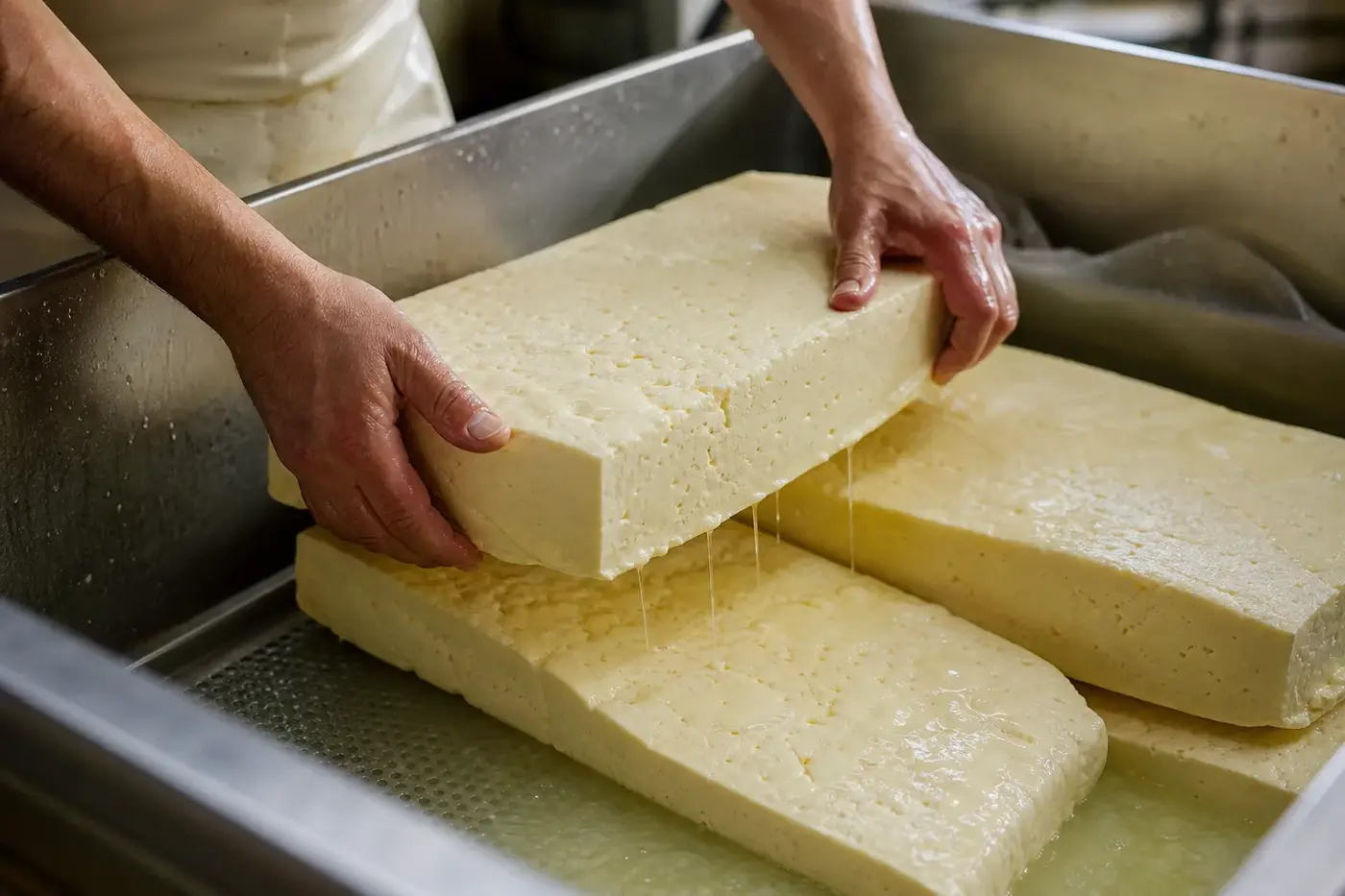
Lift a rectangular slab of curd. Turn it, settle it on another, and you can watch Cheddar taking shape before it becomes a cheese. The slabs’ own weight encourages whey to drain, while developing acidity changes the protein network inside them. Between cooking and milling for salting, this handling makes drained curd more aligned, cohesive and pliable. Not bad for a little rearranging. [1,2]
Before the slabs, a vat of possibilities
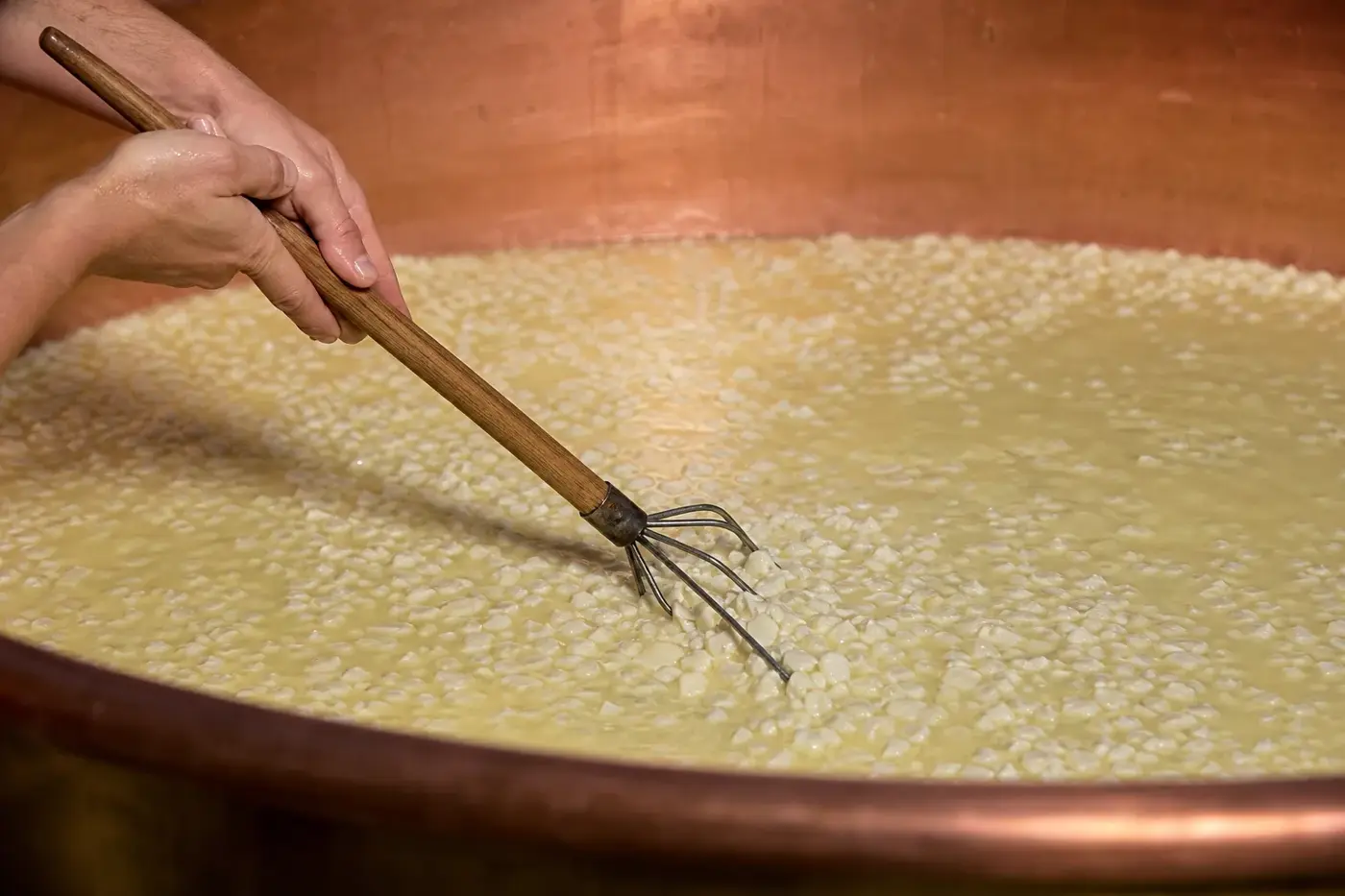
First, the maker needs a gel. Coagulation sets the milk’s proteins: rennet, a preparation containing milk-clotting enzymes, produces a gel that the maker cuts into curd particles. Around those particles lies whey, the liquid released from the gel. You can follow that earlier transformation in the guide to rennet. [3]
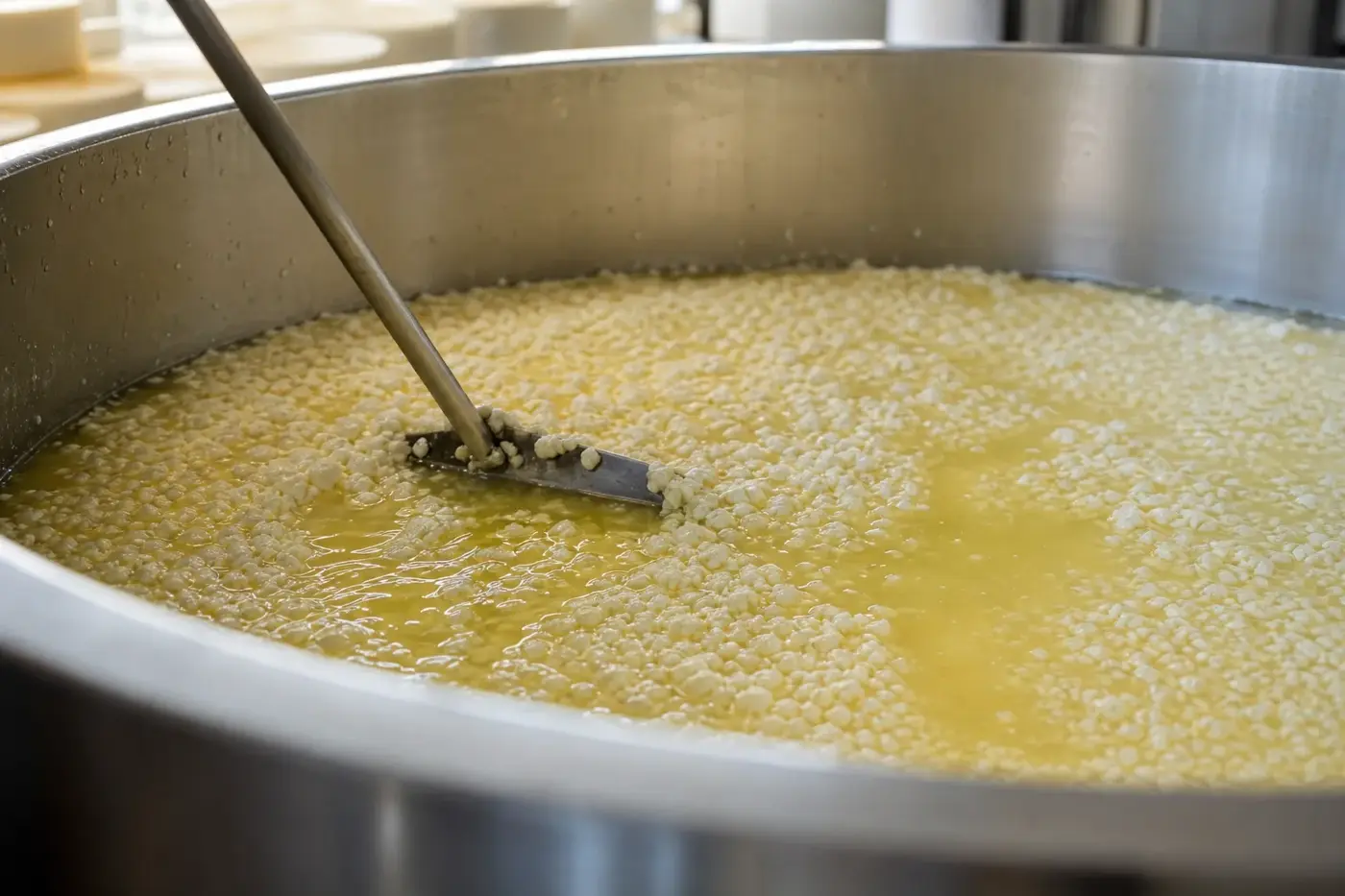
Heating and stirring the curd and whey encourage syneresis: the protein network contracts and releases whey. By draining time, the curd has lost considerable moisture. Yet it still holds liquid, milk sugar and active starter bacteria, all with work ahead of them. [3,4]
Cheddaring develops this drained curd before it takes its final shape. Traditionally, the maker lets the particles mat together, cuts the mass into slabs, then turns and stacks them as acidity develops. Milling, salting and pressing follow afterwards. For the wider picture, follow the milk-to-cheese process. [1]
Watch the loose curds come together
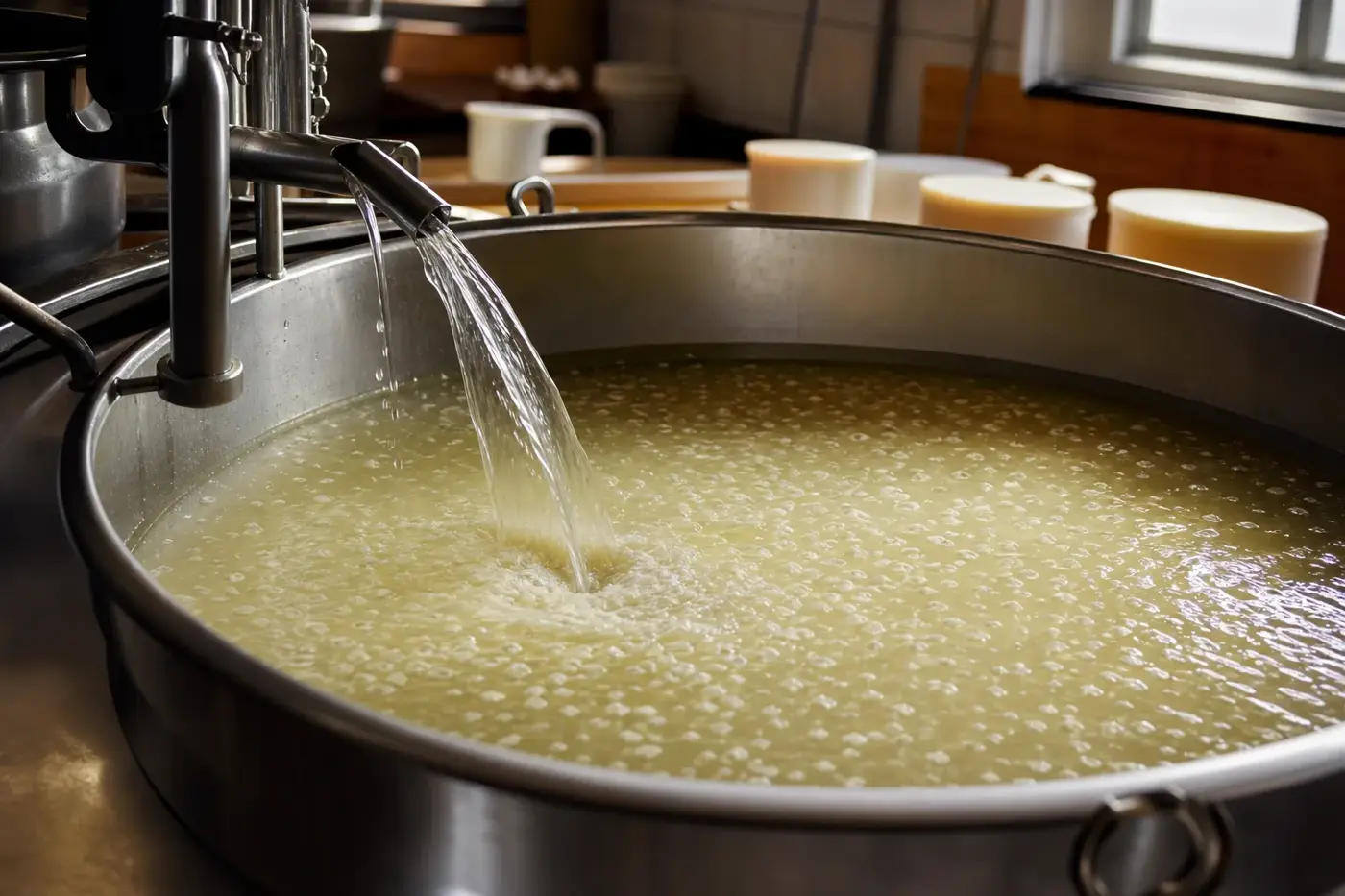
Here is a change you can picture: separate curd particles become a mass you can lift and turn. Once stirring stops and the surrounding whey drains away, the particles settle against one another and begin to join. Clear drainage routes give newly released whey somewhere to go, rather than leaving it to collect around the curd. [1,5]
The specification linked from the Great Britain register for West Country Farmhouse Cheddar Cheese brings the scene into focus. The maker draws curds back from the centre of the vat or table, opening a drainage channel. The mass is then cut into large rectangular pieces, ready for cheddaring. Now you have those familiar slabs. [1]
Each slab still holds moisture inside its protein structure. Removing surrounding whey and releasing moisture from within the curd are connected jobs, but they are not quite the same thing. Drainage carries liquid away; syneresis releases it from the contracting protein network. Both matter as the curd develops. [4]
The quiet work of turning and stacking
At the bottom of the stack, a slab carries the weight of those above it. Repeated turning and stacking use that load to encourage further drainage, while the curd keeps knitting together. Inside each slab, acidification changes the structure throughout the operation. [1,2]
Picture someone squeezing a sponge and you have only part of the story. Physical handling and bacterial activity work together: gravity loads a material whose properties keep changing. The maker follows the developing texture and acidity, rather than simply counting turns and movements. [1,4]
To make sense of the action, follow the curd and liquid separately. Here is what each is doing as the slabs develop.
| Traditional stage | What happens to the curd | Where the whey goes |
|---|---|---|
| Draining | Particles settle and start joining together | Much of the surrounding liquid leaves |
| Cutting into slabs | The matted mass becomes manageable pieces | Drainage routes stay open |
| Turning and stacking | Slabs consolidate under their own weight | More whey drains away |
| Milling, afterwards | Slabs become small pieces ready for salting | More liquid can separate during later handling |
This sequence follows the West Country Farmhouse Cheddar Cheese specification. Milling deserves its own row because it ends the slab handling and prepares the curd for salt distribution. [1]
Inside each slab, fermentation carries on
Draining the vat does not call time on fermentation. Starter bacteria, selected microorganisms introduced earlier in manufacture, turn lactose, milk’s principal sugar, into lactic acid. Some lactose leaves with the whey, but enough sugar and bacteria remain inside the curd for fermentation to continue throughout cheddaring. [3,4]
So the drained slab you see is still biologically busy. As the bacteria produce acid, its pH falls and the curd becomes more acidic. This influences both moisture release and the mineral balance within its protein network. [4]
What happened before drainage matters, too. A small-scale Cheddar manufacturing study tracked lactose, lactic acid, calcium and phosphorus between curd and whey. While the curd remained immersed, lactose fermented inside it could be replaced by lactose diffusing in from the surrounding liquid. [6]
Cheddaring therefore begins with conditions already established in the vat. Two batches can reach a similar acidity reading by different routes, with consequences for their composition and later behaviour. The study identified both the rate of acid development and time spent in whey as important influences on cheese quality. [6]
The chemistry beneath your fingertips
Acidity changes the very framework holding the curd together. Casein, the main group of milk proteins retained in rennet curd, forms a network that holds fat and moisture. Calcium phosphate associated with that framework helps organise it. As acidity rises, some of this mineral becomes soluble, changing the interactions between proteins. [4,7]
That helps explain why freshly drained curd and well-cheddared curd feel different to handle. Acidification alters the network’s mineral balance, while loading and turning encourage its physical reorganisation. Tetra Pak’s technical handbook describes cheddaring as aligning the protein strings. The structure becomes more directional, developing the fibrous quality associated with cheddared curd. [2]
Soluble calcium does not all leave the cheese. Some leaves with draining whey; some stays dissolved in liquid held inside the curd. A commercial Cheddar study following four vats through manufacture and early ripening measured substantial further changes in soluble calcium after block formation. Becoming soluble, in other words, does not mean calcium immediately leaves the cheese. [8]
Nor does greater acidity guarantee ever more pliable curd. In an experiment that acidified already-made Cheddar, lowering pH changed calcium solubility and protein interactions, but stronger acidification made the structure more crumbly. It offers you a useful glimpse of the chemistry, though the subject was finished cheese, not slabs undergoing cheddaring. [7]
Knowing when the slabs are ready
Readiness comes down to both texture and acidity. The slabs must have consolidated and developed physically, while fermentation must have progressed far enough for the next stages. The West Country specification explicitly connects readiness for milling with reaching the correct acidity. [1,4]
As cheddaring proceeds, the slabs become cohesive, pliable and fibrous. The maker judges those physical changes alongside an acidity measurement. What the curd feels like and how fermentation has progressed inform the same decision. [1,2,4]
You will not find one milling pH that suits every process. The University of Guelph’s teaching table gives examples of pH 5.40 and 5.50 for Cheddars with different moisture targets. Those values belong to particular manufacturing profiles, rather than providing instructions for every Cheddar. [4]
The route to that endpoint matters as much as the reading itself. In the small-scale manufacturing research, excessive acid development before whey separation disrupted normal cheddaring and affected the finished cheese. A final reading tells you most when you consider it alongside the record of the batch’s progress. [6]
Coming together, then breaking apart
Having encouraged the curd to join, the maker deliberately breaks it apart again. Cheese does ask for a certain tolerance of changing plans. Milling divides the slabs into smaller pieces of similar size, allowing salt to be distributed more evenly. Slab development is complete; preparing the curd for salting is now the job. [3]
Dry salt is mixed through the milled pieces. It contributes flavour, slows acid production and influences how the curd behaves afterwards. Think of its effect on fermentation as a change of pace, not an instantaneous halt to every bacterium’s activity. [3,8]
The salted curd goes into moulds and is pressed into its intended shape. Pressing removes residual whey and consolidates the pieces. Cheddaring develops drained curd before milling; pressing brings the salted pieces together into the cheese that will mature. [3]
Industrial block-forming systems can achieve that later consolidation differently. In Tetra Pak’s documented system, gravity and vacuum bring milled, salted curd into a continuous column, from which blocks are cut. The earlier texturisation of slabs and the final formation of blocks remain separate operations. [2]
Where Cheddar gets its body and flavour
The foundations of Cheddar’s firm body are laid during manufacture. Cheddaring plays its part alongside moisture control, salting and final consolidation. Together, these operations influence how closely the curd joins and how the cheese behaves as it matures. [3,4]
A “close” body need not be completely without openings. Tetra Pak illustrates mechanical openings in Cheddar, while the West Country Farmhouse Cheddar Cheese specification describes a firm body with a slightly open texture. You can have firmness and small gaps in the same cheese. [1,2]
Mature Cheddar’s sharpness takes more than a stack of slabs. Starter activity, composition and ripening all contribute. During maturation, enzymic breakdown of proteins and fat develops flavour and changes texture further, building on important starting conditions established during cheddaring. [3,8]
Want to follow those changes into the finished cheese? Explore Cheddar for its range of styles and maturation characteristics.
From hands on slabs to curd on conveyors
With hand cheddaring, you can watch the transformation unfold as the maker moves, turns and piles rectangular slabs of curd. As of November 2026, the specification linked from the Great Britain PDO register for West Country Farmhouse Cheddar Cheese expressly describes turning and stacking by hand. [1,9]
Mechanised systems can reproduce drainage, mat formation and texturisation using conveyors. Equipment documentation describes enclosed machinery that drains, acidifies, textures and mills curd, then salts and mellows it. Even inside a single machine, these remain distinct jobs. [10]
The Society of Dairy Technology describes large-scale Cheddar manufacture in which curd forms a mat on successive belts before reaching a mill. Commercial research has also documented Cheddar made using a draining and matting conveyor. The handling arrangements differ, but they can serve the shared objectives of Cheddar production. [3,8]
Why washing and stretching lead elsewhere
Wash the curd and you change the sugar supply available to bacteria. Whey containing lactose is removed and liquid replaced with water, limiting the sugar available for later acid production. That differs from allowing drained Cheddar curd to acidify while it mats and is handled. For a finished-cheese reference point, try the Gouda guide. [2,4]
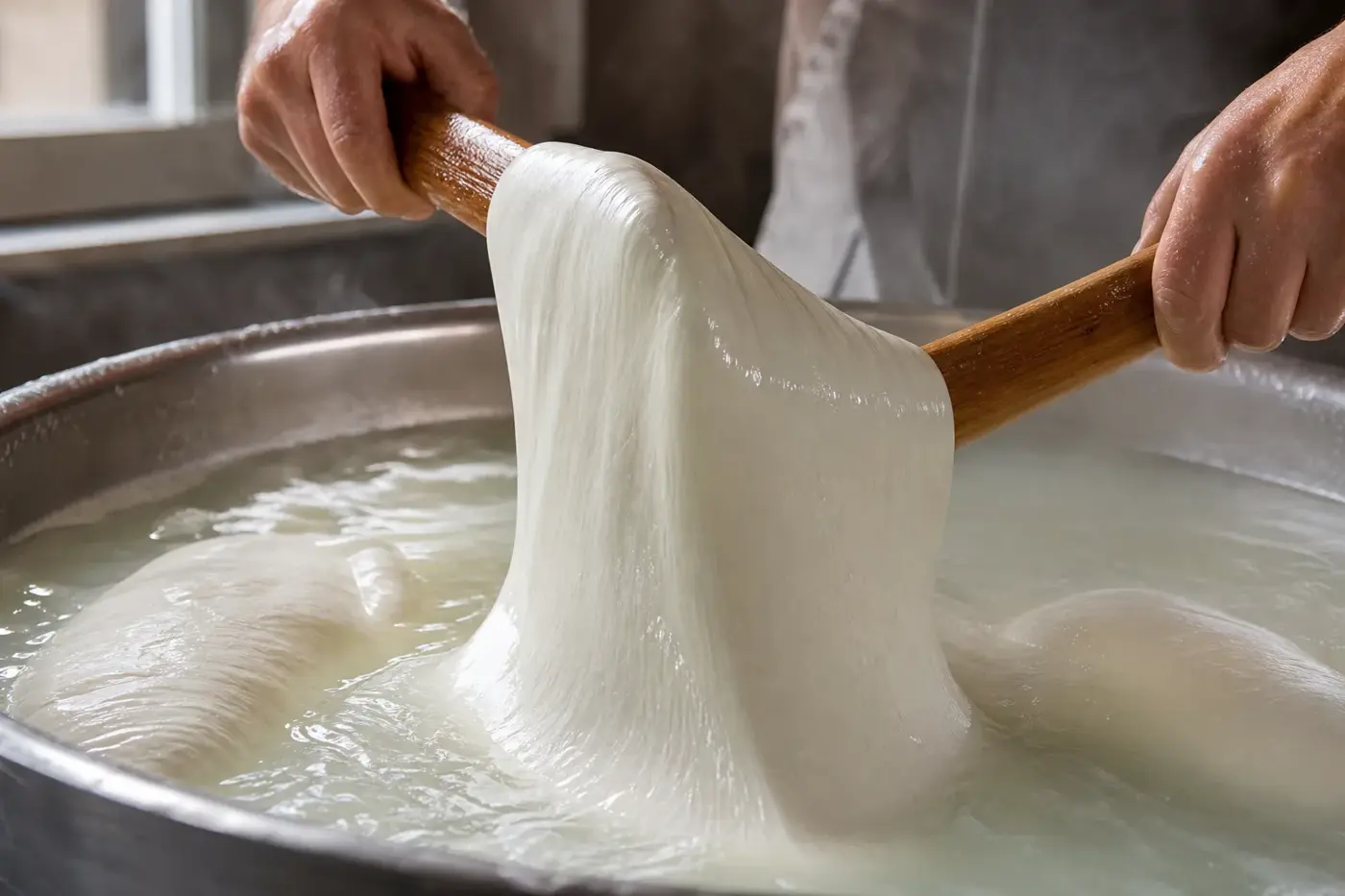
Stretching takes suitably acidified curd in another direction. Heat and mechanical working develop the elastic structure of pasta filata, meaning spun-curd cheeses. Some equipment can prepare acidified curd for either Cheddar or pasta filata production, but the later operations diverge. Cheddar curd is milled and dry-salted, while stretching curd is cooked and stretched. [2,10]
For that contrasting texture, continue to Mozzarella. To see how these operations relate to one another, return to the production overview above.
Questions people ask
What is cheddaring?
Cheddaring is the process of matting drained curd into a mass, cutting it into slabs, then turning and stacking them as acidity develops. The slabs become more cohesive, pliable and fibrous before milling.
Why are Cheddar curds stacked and turned?
The lower slabs bear the weight of those above them, encouraging more whey to drain. Turning and stacking also help the curd knit together while acidity changes its structure.
How do cheesemakers know when cheddaring is complete?
They judge the texture of the slabs alongside an acidity measurement. The curd must have consolidated and developed physically, while fermentation must have progressed far enough for milling.
What happens after cheddaring?
The slabs are milled into smaller pieces so salt can be distributed more evenly. The salted curd is then put into moulds and pressed into its intended shape.
How is cheddaring different from washing or stretching curd?
Washing replaces whey with water, limiting the sugar available for later acid production. Stretching uses heat and mechanical working to develop the elastic structure of spun curd cheeses, whereas Cheddar curd is milled and dry salted.
Sources
- Department for Environment, Food & Rural Affairs. West Country Farmhouse Cheddar Cheese product specification, document currently linked from the Great Britain register, undated edition, checked November 2026. Sections 4.2 and 4.5. Official specification.
- Tetra Pak. Dairy Processing Handbook, online chapter “Cheese”, edition displayed at access, November 2026. Sections on cheddaring, block-forming, washing and pasta filata production. Equipment supplier’s technical account. Technical handbook.
- Society of Dairy Technology. Handbook of Dairy Technology, third edition, October 2018. Chapter 9, especially Table 9.1 and the accompanying manufacturing description. Handbook.
- University of Guelph. Cheese Making Technology e-Book, “Process Control”, undated online edition, checked November 2026. Table 15.1 and sections on moisture, pH and mineral control. Teaching reference.
- Tetra Pak. Cheddaring machine 5, 4300 series, undated equipment documentation, checked November 2026. Drainage screens, mat handling and drainage-boosting stirrer. Equipment documentation.
- CSIRO dairy research, published in Journal of Dairy Research. “Lactose, lactic acid and mineral equilibria in Cheddar cheese manufacture”, volume 36, issue 1, 1969, pages 93 to 101. Original research; publisher’s summary retrieved. Research summary.
- Utah State University research, published in Journal of Dairy Science. “Effect of pH on the Chemical Composition and Structure-Function Relationships of Cheese”, volume 86, 2003, pages 2751 to 2760. Original research; institutional abstract retrieved. Institutional research record.
- Journal of Dairy Science. “Factors Affecting Calcium Lactate and Liquid Expulsion Defects in Cheddar Cheese”, volume 87, 2004. Original commercial-manufacturing research, full text retrieved. Research paper.
- Department for Environment, Food & Rural Affairs. West Country Farmhouse Cheddar Cheese, Great Britain protected food name register entry, published 4 January 2021, checked November 2026. Official register entry.
- Tetra Pak. Cheddar cheese production, undated technical product overview, checked November 2026. Equipment supplier’s account of manufacturing sequence and continuous processing. Production documentation.
Researched through official product documentation, dairy technology manuals, equipment documentation and original experimental research, distinguishing manufacturing observations from experiments on finished cheese.
Last checked: November 2026
Last checked November 2026.
The editors suggest you read next
Cutting the Curd: Why the Size of the Pieces Matters
At dairy Boselli, a spino breaks the set milk for Parmigiano Reggiano into minute granules.