Cornish Yarg
White mould traces a pale pattern across overlapping nettle leaves.
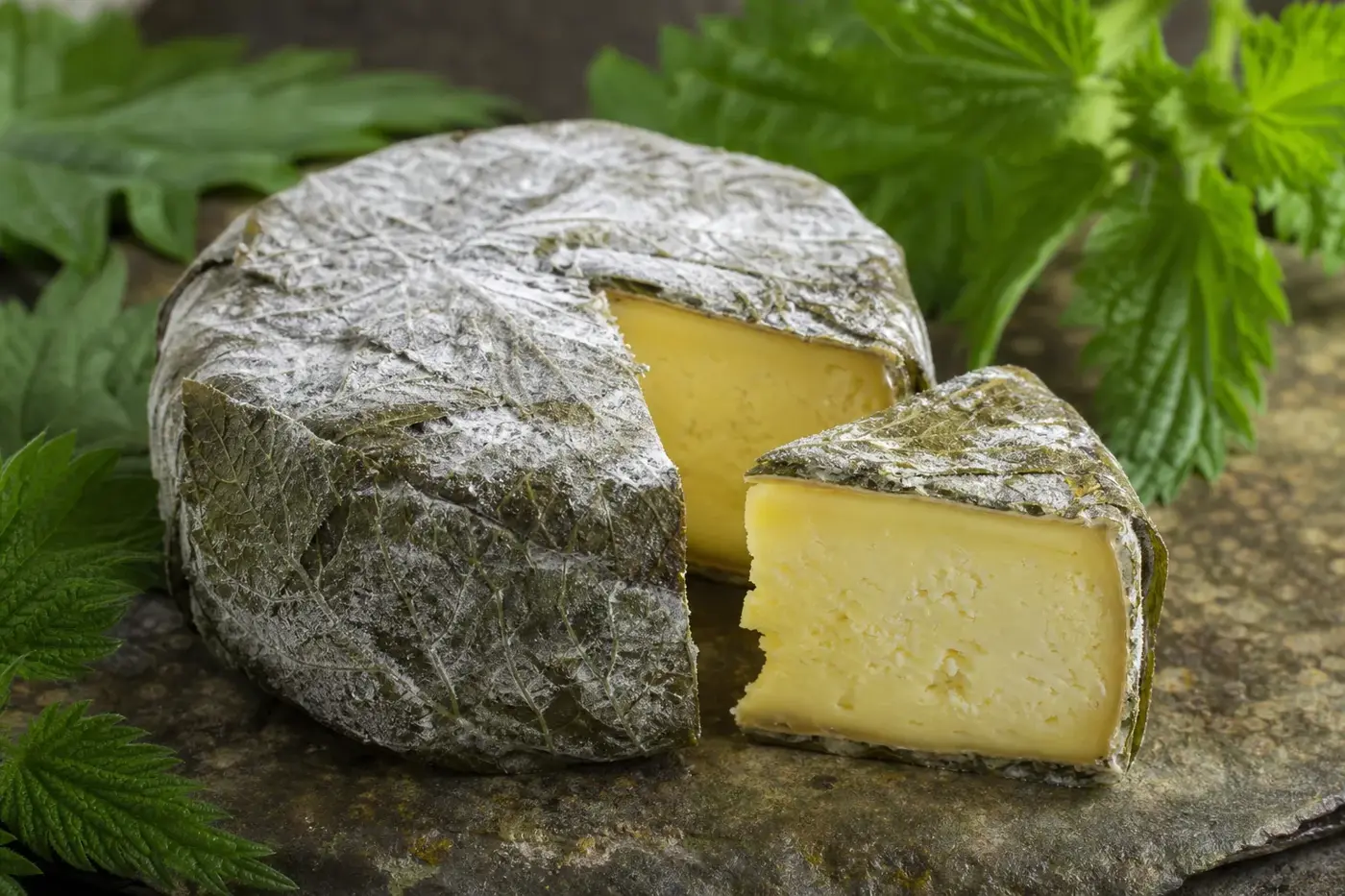
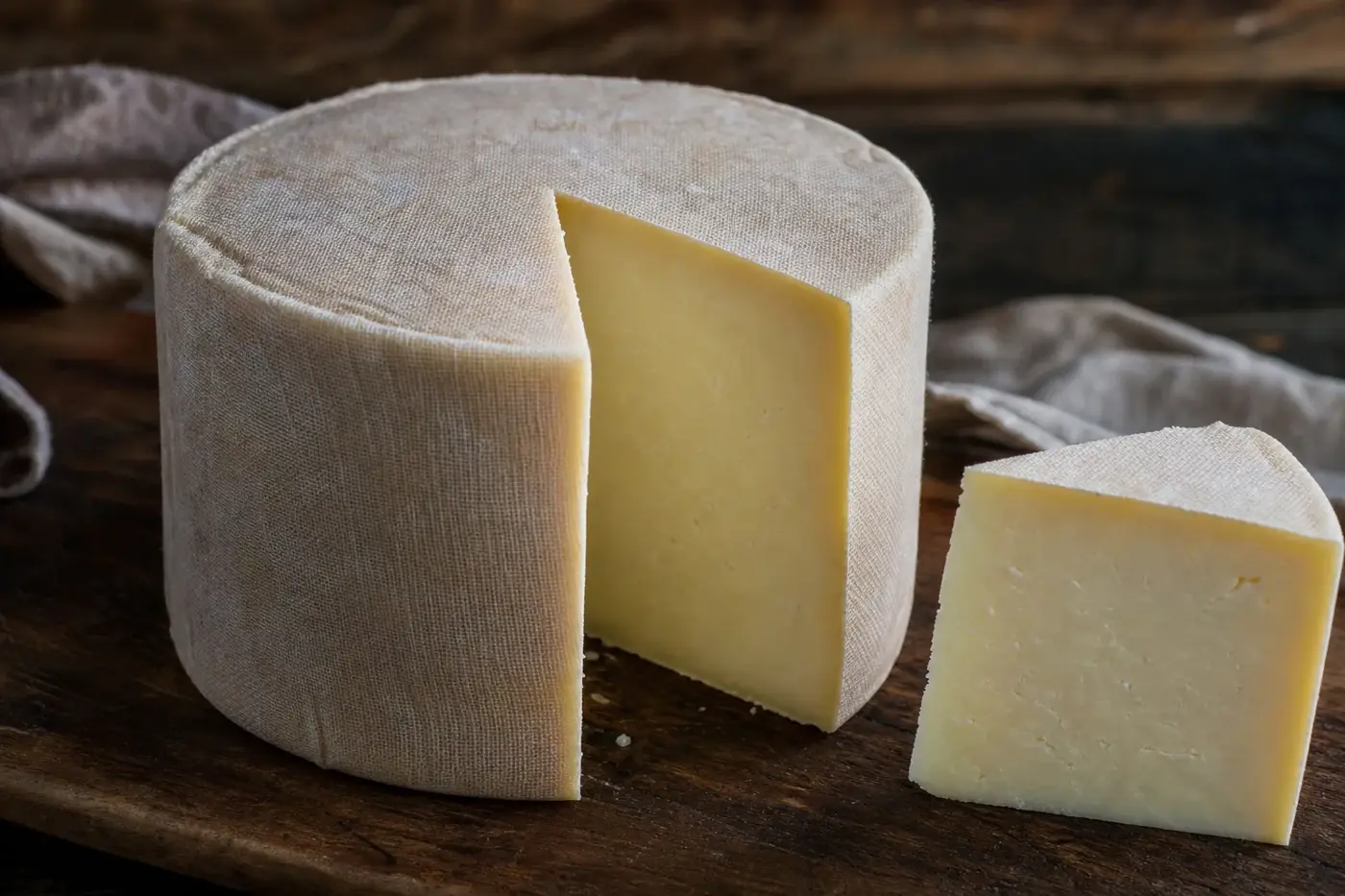
White mould traces a pale pattern across overlapping nettle leaves. Cut into a wedge of Cornish Yarg and you find a crumbly heart inside a creamy edge. This semi-hard Cornish cows’ milk cheese gives you two textures in one slice, with a living rind that deserves a moment’s attention before you reach for the knife. [1,2]
| Your quick guide | Cornish Yarg |
|---|---|
| Made by, and where | Lynher Dairy, Ponsanooth, Cornwall, England. [3] |
| Milk | Pasteurised cows’ milk. [1] |
| What sets the milk | The maker’s standard cheese is vegetarian; Neal’s Yard Dairy sells an animal-rennet version. [2,4] |
| Style | Semi-hard, nettle-wrapped, surface-ripened cheese. [1] |
| Time to mature | Maker’s guidance: 4 to 6 weeks. [1] |
| The leafy rind | Nettle leaves with a white mould bloom. [1,5] |
| Declared allergen | Milk. [1] |
| Registered name, GI authority and register ID | Undetermined |
Meet the Grays, whose name became Yarg
Read Yarg backwards and you get Gray. Lynher Dairy traces the name to the Gray family, who developed the modern cheese near Bodmin Moor in the 1980s. Production later moved to Ponsanooth in the early 2000s. [6]
Then comes the attic recipe. Lynher tells of an old cheesemaking recipe found there, although the dairy’s published accounts place it in different centuries. Keep those strands separate: the cheese developed in the 1980s, and the older inspiration claimed for it. [1,2,6]
The name has a steadier story. Both Lynher and Neal’s Yard Dairy, its longstanding cheesemonger customer, connect Yarg with Gray. A family name, turned round and given a leafy jacket. [1,2,6]
Start with Cornish milk, then ask about rennet
Your wedge begins at Lynher Dairy’s working dairy in Ponsanooth, near Truro. Lynher describes using full-fat milk from its own pedigree Ayrshire herd and selected Cornish farms. Its cheeses are made with pasteurised milk. [3,4,7]
There is an important fork in the story: rennet, the setting agent that helps turn milk into curd. Lynher identifies its standard Cornish Yarg as suitable for vegetarians. Neal’s Yard Dairy commissions an animal-rennet version and says that particular cheese uses milk solely from Lynher’s own Ayrshire herd. [2,4]
Buying for a vegetarian guest? Check the actual cheese on the counter, not just the name. The guide to rennet explains the different setting agents; with Yarg, you need to know which of these two versions you are being offered.
Follow the milk on its way to cheese
The maker’s account does not tell the full making sequence. If you would like to follow the stages that turn milk into cheese, start with how cheese is made.
Watch hedgerow nettles become a living rind
The leafy wrapping begins in local hedgerows. Neal’s Yard Dairy describes nettles gathered in spring and frozen for use throughout the year. By the time those leaves meet the cheese, they have lost their sting. [2,5]
Next comes the handwork. Lynher describes leaves being painted onto the dried cheeses, with white mould blooming across the nettle covering during maturation. The overlapping leaves stay on the finished cheese, rather than being stripped away like a temporary cloth or mould. [1,5]
Before you cut, give that surface a moment. The rind and the cheese just beneath it are central to Yarg’s character. The cut face reveals the rest of the story.
Taste your way from creamy edge to crumbly heart
Lynher’s current product guidance gives Cornish Yarg 4 to 6 weeks to mature. Its general making account gives about 4 to 5 weeks for leaf-wrapped Yarg. Think of those overlapping descriptions as a window, rather than one appointed release day. [1,5]
Cut from rind to centre and the texture changes along the way. Lynher describes a slightly open, crumbly core, with increasing creaminess beneath the rind as the cheese matures. Neal’s Yard Dairy likewise describes a softened outer layer around a crumbly centre, so choose a portion that lets you taste both. [1,2]
For flavour, Lynher points to lactic, creamy and buttery notes, with a delicate mushroom aroma. Neal’s Yard Dairy adds lemon, yoghurt and an earthy rind. Together, these descriptions suggest fresh acidity in the centre, gentler dairy character towards the edge and earthiness at the surface. [1,2]
Give those nettles a taste, too
The Cornish Cheese Co, which sells the cheese, describes the nettle covering as edible. Neal’s Yard Dairy also includes the earthy rind in its flavour description. Try a little with the paste, the cheesemaker’s word for the body of the cheese, and notice what the leaves and surface bring to your mouthful. [2,8]
That description of earthiness comes from Neal’s Yard Dairy. Whether the maker intends the covering to be eaten remains an open question. [2]
Choosing nettles or wild garlic? Read the name
Wild Garlic Yarg wears wild garlic leaves instead of nettles. Lynher lists it separately from Cornish Yarg and identifies both cheeses as vegetarian and pasteurised. In the dairy’s making account, the garlic leaves darken during maturation, while nettle-wrapped Yarg develops its characteristic white bloom. [4,5,7]
Check the full product name before choosing your wedge. Cornish Yarg is the familiar nettle-covered cheese; Wild Garlic Yarg has a different leafy covering. To explore what each treatment contributes, taste matching portions of the two, keeping the portions alike for a clear comparison.
Share the creamy edge fairly
Bring out only the portion you intend to serve. Leave the rest refrigerated, ready for another occasion.
Cut each portion to include the crumbly centre and softened outer edge. That way, everyone gets the contrast that defines Yarg. Even the most devoted cheese lover need not quietly annex all the creamy outside.
| Put it alongside | A simple way to serve it | Who suggests it |
|---|---|---|
| Pear | Fresh slices beside your cheese. | Recommended by Lynher. [1] |
| Quince | Offer separately so you can each choose your amount. | Recommended by Lynher. [1] |
| Apple and walnuts | Alongside a wedge or in a salad. | Published in Lynher’s recipe collection. [10] |
Let the cheese have the first word. Taste the centre alone, then the softened edge and rind, before reaching for an accompaniment. You will find those differences easier to notice without anything else competing for your attention.
Bring Yarg into your cooking
Soda bread, salad, a burger: Lynher’s recipes offer three quite different starting points. There is grated Yarg in soda bread, pieces in an apple and walnut salad, and melted cheese on a burger. Between them, you can explore your wedge cold, grated or melted. [10,11,12]
For your first attempt, choose a dish where you can still recognise the cheese, rather than mixing it with several strongly flavoured cheeses. Decide whether you want visible leafy pieces before adding the rind. Follow a complete recipe for quantities and cooking instructions, especially if the dish contains meat or is for someone at higher risk from foodborne illness.
Take three questions to the cheese counter
Ask whether you are buying nettle-wrapped Cornish Yarg or Wild Garlic Yarg, which rennet version it is, and when the piece was cut. Then ask to see the cut face. You can choose the balance of crumbly centre and softened edge that appeals to you. [1,2,4]
At home, Lynher recommends wrapping your cheese in waxed paper. Follow the Food Standards Agency’s consumer guidance for England, Wales and Northern Ireland: keep your fridge between 0 and 5 °C and follow the pack’s storage instructions. [1,9]
Keep the label or the cheesemonger’s written instructions with your cheese. UK government guidance distinguishes use-by dates, which concern safety, from best-before dates, which concern quality. Follow any earlier instruction for using the cheese after opening or cutting, rather than relying on the date alone. [13]
Need help with wrapping or choosing a place in the fridge? See how to store cheese at home for practical guidance.
This page summarises published guidance from the official sources it cites. It is not medical advice. Guidance differs between countries and changes over time, so check the current source for where you live, and ask your doctor, midwife, pharmacist or dietitian about your own circumstances.
Pregnant? Let the cheese category guide your questions
The NHS guidance for November 2026 lists pasteurised semi-hard cheeses among those you can eat during pregnancy. Separately, it says pasteurised or unpasteurised mould-ripened soft cheeses with a white coating must be thoroughly cooked. Any cheese cooked until steaming hot is also listed among the options you can eat. [14]
Lynher describes Cornish Yarg as semi-hard, pasteurised and mould-ripened at the surface. NHS advice works by category and does not name Cornish Yarg. If you are unsure where your particular product fits, show its label to your midwife or another appropriate health professional. [1,14]
For current wording and cooking exceptions, consult the NHS foods to avoid in pregnancy guidance, the reference here for November 2026. If you live elsewhere, follow your own national authority’s guidance.
Questions people ask
What does Cornish Yarg taste like?
Lynher describes lactic, creamy and buttery notes with a delicate mushroom aroma. Neal’s Yard Dairy also notes lemon and yoghurt flavours and an earthy rind. The centre is crumbly, while the cheese becomes creamier towards the rind.
Can you eat the nettle rind on Cornish Yarg?
The Cornish Cheese Co, which sells the cheese, says the nettle covering is edible. Neal’s Yard Dairy describes the rind as earthy, but confirmation from the maker that the covering is intended to be eaten remains unverified.
Is Cornish Yarg vegetarian?
Lynher identifies its standard Cornish Yarg as suitable for vegetarians. Neal’s Yard Dairy commissions an animal rennet version, so check which cheese you are being offered.
Can you eat Cornish Yarg during pregnancy?
The NHS lists pasteurised semi hard cheeses among those that can be eaten during pregnancy, but says mould ripened soft cheeses with a white coating must be thoroughly cooked. Lynher describes Cornish Yarg as pasteurised, semi hard and mould ripened at the surface, while the NHS guidance does not name it. See the NHS foods to avoid in pregnancy guidance and, if unsure how your product fits the categories, show the label to your midwife or another appropriate health professional.
How should Cornish Yarg be stored?
Lynher recommends wrapping it in waxed paper. The Food Standards Agency advises keeping the fridge between 0 and 5 °C and following the storage instructions on the pack. Follow any earlier instruction for using the cheese after opening or cutting.
Sources
- Lynher Dairy, Cornish Yarg, undated current product page, retrieved November 2026. Maker’s product, maturation, tasting, pairing and storage information.
- Neal’s Yard Dairy, Cornish Yarg, undated current product page, retrieved November 2026. Direct account of its commissioned cheese, ingredients, nettles and sensory character.
- Lynher Dairy, Our Cheese Shop near Truro, Cornwall, undated, retrieved November 2026. Working dairy and production location.
- Lynher Dairy, FAQ’s, undated, retrieved November 2026. Pasteurisation and vegetarian status.
- Lynher Dairy, How We Make Our Cheese, undated, retrieved November 2026. Setting, cutting, milling, pressing, brining, wrapping and maturation.
- Lynher Dairy, About us, undated, retrieved November 2026. Producer’s historical account and relocation.
- Lynher Dairy, Cheese by Post, undated, retrieved November 2026. Milk supply and named products.
- The Cornish Cheese Co, Cornish Yarg, undated, retrieved November 2026. Cheesemonger’s account of the edible nettle covering.
- Food Standards Agency, How to chill, freeze and defrost food safely, published 18 December 2017, current online text retrieved November 2026. Applies to England, Northern Ireland and Wales.
- Lynher Dairy, Apple, Walnut and Yarg Salad with a Honey Dressing, 4 July 2023, retrieved November 2026. Commercial producer’s recipe.
- Lynher Dairy, Yarg Soda Bread with Homemade Butter, 10 March 2026, retrieved November 2026. Cited only for the use of grated Yarg in bread.
- Lynher Dairy, Recipes & News, undated current index, retrieved November 2026. Includes its burger with melted Cornish Yarg.
- GOV.UK, Understanding food labelling: Best before and use-by dates, current online edition retrieved November 2026.
- NHS, Foods to avoid in pregnancy, current online edition retrieved November 2026, cheese and dairy section.
Researched by comparing the maker’s production and product accounts, a commissioning cheesemonger’s records, and official UK consumer guidance.
Last checked: November 2026
Last checked November 2026.
The editors suggest you read next
West Country Farmhouse Cheddar Cheese
Large pieces of curd turn and stack under the cheesemaker’s hands.