DMK Group
Scatter grated mozzarella over a pizza, pick up a pack of MILRAM or reach for a supermarket’s own-label cheese.
Scatter grated mozzarella over a pizza, pick up a pack of MILRAM or reach for a supermarket’s own-label cheese. Three everyday gestures, potentially one dairy business behind them: DMK, whose milk travels from German farms into all these products. Your cheese drawer may have more connections than you do.[5]
On 1 June 2026, that German dairy business joined Arla Foods. It became part of a larger farmer-owned cooperative, while its operating companies kept their legal identities.[1][2]
| Field | The essentials |
|---|---|
| Operating company | DMK Deutsches Milchkontor GmbH.[2][3] |
| Ultimate parent | Arla Foods amba, following completion on 1 June 2026.[2] |
| Ownership model | Farmer-owned cooperative group.[1][2] |
| Headquarters and administration | Headquarters in Zeven; central administrative office in Bremen.[4] |
| Parent headquarters | Viby J, Denmark.[1] |
| Principal cheese brands covered here | MILRAM and Oldenburger, within the combined Arla portfolio.[1] |
| Latest annual revenue reported here | 5.3 billion euros for DMK in 2025.[9] |
| Milk processing scale | Around 5.1 billion kilograms annually, according to DMK’s current company overview.[6] |
| Annual cheese production | No confirmed figure |
| Ownership position | November 2026.[1][2] |
The company quietly filling your cheese drawer
You might recognise the pack without recognising the processor. DMK connects farmer ownership with large-scale dairy processing, supplying branded cheese, supermarket own-label ranges, foodservice customers and ingredients for food manufacturers. Beyond cheese, its work takes in drinking milk, quark, cream, ingredients and other dairy categories.[5][6]
The group came together in 2011, combining Humana and NORDMILCH. These were established dairy businesses, rather than the beginnings of a company devoted to one cheese, one locality or one consumer brand. That broad foundation helps explain its reach today.[6]
Here is the distinction worth taking shopping: DMK is the company, MILRAM is a brand, and Gouda and mozzarella are cheese styles. One processor can serve several markets. Its corporate name does not need a starring role on every finished pack.[5][7]
Who owns the business behind your cheese?
By November 2026, DMK’s operating business belonged to the Arla Foods group. A DMK statement dated 1 July 2026 confirms that DMK GmbH and its subsidiaries became subsidiaries of Arla Foods amba on 1 June.[2]
Before completion, DMK GmbH had two cooperative owners. The European Commission recorded 90% for Deutsches Milchkontor eG and 10% for the Dutch cooperative Drents Overijsselse Coöperatie Kaas U.A., usually called DOC Kaas. Those percentages describe ownership before the transaction.[3]
Farmer ownership continues, but bringing the cooperatives together happens in stages. DMK reported that its German and Dutch cooperatives became cooperative members of Arla from 1 June. Their representatives subsequently approved an intermediate European cooperative structure, intended to merge into Arla during the agreed two-year transition.[2]
The operating business has therefore changed hands, while the underlying farmer memberships follow their own timetable. If you are untangling the ownership, keep those two strands separate. They belong to the same story, but move at different speeds.[1][2]
How DMK and Arla came together
The combination completed on 1 June 2026, but that date tells only part of the story. Cooperative representatives gave their approval first, followed by an EU competition review. Further work on the cooperative structure came afterwards.
| Date | What happened | Why it mattered |
|---|---|---|
| June 2025 | Cooperative governing bodies approved the intended combination.[10] | Members gave their approval before regulatory clearance. |
| 17 April 2026 | The transaction was notified to the European Commission.[3] | The formal EU merger review began. |
| 28 May 2026 | The Commission cleared the acquisition unconditionally.[3] | EU competition clearance required no remedies. |
| 1 June 2026 | Arla and DMK announced completion.[1] | The businesses came together under the Arla name. |
| 1 July 2026 | DMK announced approval of the intermediate European cooperative structure.[2] | The farmer-membership integration took its next step. |
Arla’s August 2026 results captured the first month together. Its first-half accounts included one month of DMK activity, corresponding to June. The completed transaction had moved from the announcement into the financial reporting.[11]
Completion also marked the start of practical work. Arla’s transaction documentation identifies the challenges: harmonising systems, retaining members and employees, and maintaining customer relationships. For a business of this size, each is a substantial undertaking.[10]
Behind the pack: Edewecht, Hoogeveen and beyond
Edewecht in Lower Saxony is DMK’s largest cheese production location. Its published site information names DMK Deutsches Milchkontor GmbH as the operator and gives the establishment identification DE-NI 086 EG. If you want to trace cheese beyond its brand, that is a useful place to start.[8]
The milk network has German roots and a substantial Dutch connection. In the Commission’s account, DMK eG collected milk from its German farmer members, while DOC collected from members in both the Netherlands and Germany. Both cooperatives supplied the DMK processing business.[3]
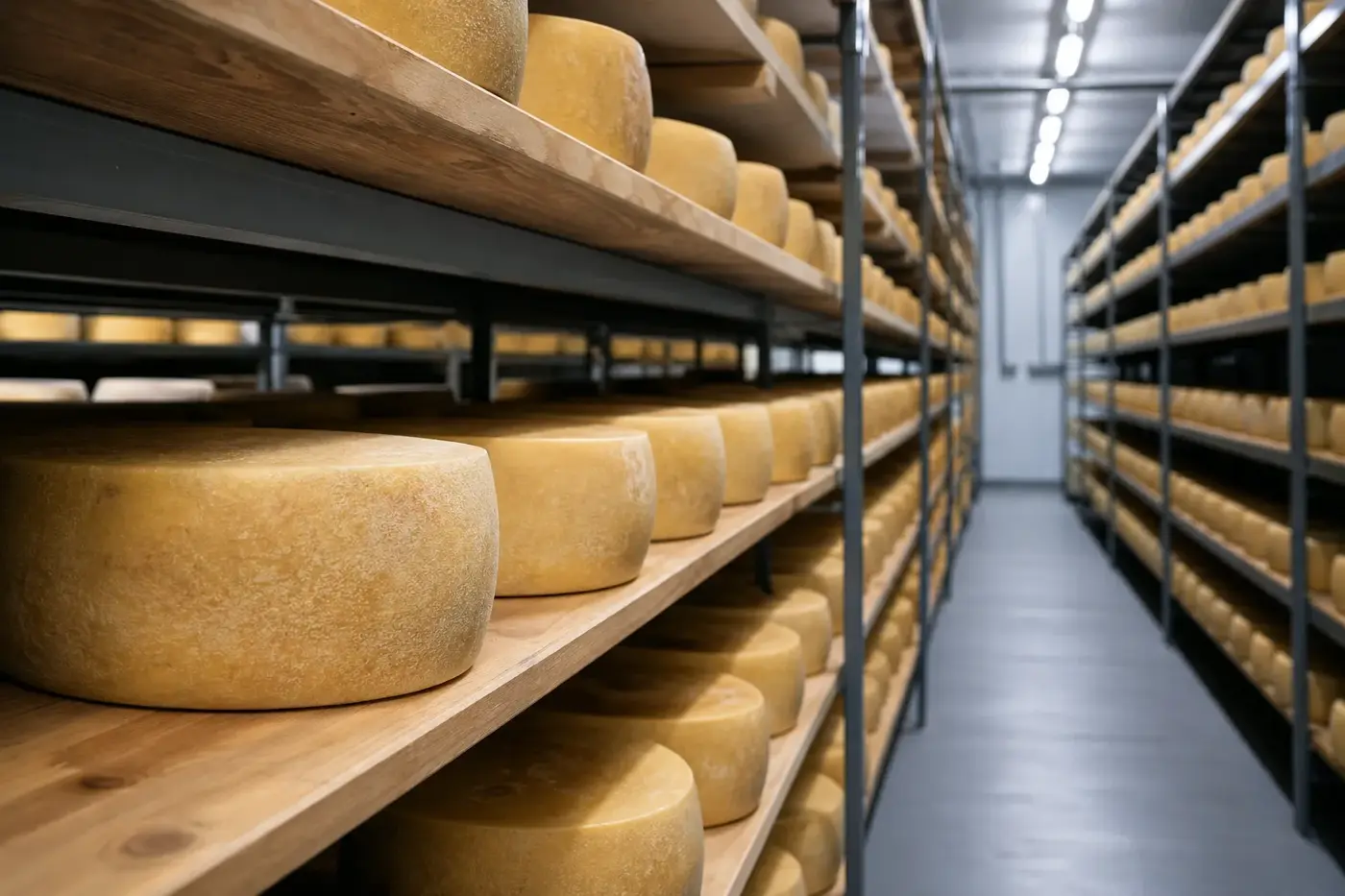
Then comes the space cheese needs after it is made. DMK’s April 2026 review of 2025 describes a new natural-cheese warehouse at Hoogeveen in the Netherlands, alongside capacity investments at Edewecht and Altentreptow in Germany. Production, storage and maturation are connected parts of the operation.[12]
Tracing your particular product therefore means looking beyond the nearest dairy. Milk collection, processing, warehousing and customer delivery form a linked network. Each stage has its own place and purpose.[3][12]
From tonight’s pizza to the factory floor
Grated mozzarella for pizza is one of DMK’s own examples of cheese supplied as a manufacturing ingredient. Alongside it sit consumer products, contract manufacturing, private-label supply, ingredients, and services for hotels, restaurants and catering. The cheese aisle gives you only part of the picture.[5]
As a shopper, you encounter recognisable packs and named ranges. Retailers can commission products for their own supermarket labels. Food manufacturers put the cheese into another food, where it must suit their production and packaging systems.[5]
Those customers need different things from the same dairy business. You might want cheese for a sandwich or tonight’s meal; a manufacturer needs it to work with factory processes. DMK describes its business service as developing tailored product and packaging solutions for those needs.[5]
That breadth makes DMK larger than its visible brands might suggest. You can meet it through branded cheese, a supermarket’s own-label product or a prepared food containing its ingredients. The company name may remain quietly behind the scenes.[5]
Meet MILRAM, at home and in the professional kitchen
Open MILRAM’s German catalogue and you will find Gouda, Edamer, Butterkäse, Emmentaler and Mozzarella. Alongside those familiar styles sit separately named products: Müritzer original, Müritzer herzhaft, Sylter, Benjamin and Rahmkäse. Plenty of choices, even before you begin negotiating space in the fridge.[7]
The catalogue also separates cheese by how you buy and use it. There is cheese for the chilled cabinet, cheese sold at the counter, and products intended for grilling, frying or an air fryer. These describe different retail presentations and kitchen uses, not interchangeable names for a single cheese.[7]
MILRAM reaches professional kitchens too. DMK identifies MILRAM Food-Service as part of its catering offer for Germany and the Netherlands. Its professional website puts cheese alongside quark, cream and other kitchen products.[5][13]
Choosing a pack? Start with its product name and label, which tell you more than the brand alone. The guide to reading a cheese label helps you separate the food’s identity from the branding around it.
Oldenburger carries German dairy further afield
Oldenburger gives DMK another route to consumers and professional kitchens. Its consumer website presents dairy products made in Germany and links to a dedicated Vietnamese website. DMK identifies Oldenburger Professional as its offer for international catering customers.[5][14]
A shared name does not mean identical needs. A family-facing dairy range and a professional kitchen supplier may use different pack formats, distribution arrangements and customer specifications. Keep that distinction in mind as you move between the consumer and professional catalogues.[5][14]
Both MILRAM and Oldenburger appear among the combined group’s brands in Arla’s completion announcement. For an individual cheese, turn to the relevant market’s catalogue and the packaging. That is where the details of your particular product come into focus.[1]
Follow the milk to the finished pack
The documented route begins with cooperative milk collection and delivery to the processing business. From there, it branches towards consumer cheese, retailer-labelled cheese, catering supplies or manufacturing ingredients. The destination depends on the product and the customer.[3][5]
Matured cheese needs somewhere to wait, not just somewhere to be made. The Hoogeveen warehouse investment illustrates that quieter part of the journey. Beyond vats and packing equipment, the network needs suitable holding and maturation arrangements before dispatch.[12]
Packaging brings another set of decisions. DMK’s product and packaging development service lets business customers shape the finished food. It may then reach you under a DMK brand or the customer’s own label.[5]
You can explore the underlying stages in how cheese is made. What distinguishes DMK is the coordination around them. Farms, processing sites, storage and several routes to the customer all have to connect.
What the big numbers actually tell you
DMK reported annual revenue of 5.3 billion euros in its published 2025 review. Its current company overview describes processing around 5.1 billion kilograms of milk annually. One is a dated financial result; the other describes the company’s operating scale.[6][9]
The combined cooperative is larger again. At completion, Arla reported approximately 11,200 farmers, 28,800 colleagues and an annual combined milk pool of 19.4 billion kilograms. Those figures describe the combined organisation, not DMK alone.[1]
If you compare results, pay attention to what each figure covers. Arla’s first-half 2026 accounts included DMK only from June, when it contributed 409 million euros. Comparing those half-year accounts directly with a full year of the former standalone DMK would mix reporting periods and the businesses covered.[11]
Food safety: start with the pack in your hand
For a precise product investigation, begin with the cheese, its packaging and the establishment identified on it. Edewecht’s published establishment identifier provides one concrete reference point. Keep the legal operator and manufacturing location alongside the batch record: each is a separate, useful tracing detail.[8]
For German cheese operations, a legal review must establish the applicable EU requirements for hygiene, traceability, establishment approval, labelling and microbiological controls. Publication of the current consolidated requirements calls for specialist legal review.
| Regulatory area for German operations | Current position |
|---|---|
| Current EU hygiene and establishment-approval requirements | Confirmation outstanding |
| Current EU food traceability and withdrawal requirements | Confirmation outstanding |
| Current EU labelling and microbiological requirements | Confirmation outstanding |
The competition review concerns a different part of the business. Before clearing the combination, the Commission examined raw-milk procurement, dairy-product supply, private-label products and whey ingredients. That decision concerns market competition; food-production controls require a separate assessment.[3]
Giving heat another job, and changing farm practices
At Edewecht, heat gets another job. DMK reports that the site’s heat-recovery system has operated since March 2023 and reduced its carbon dioxide emissions by 5,436 tonnes in 2025. It captures heat, stores it and redirects it to processes that can use warm water instead of hotter steam.[16]
The wider framework is DMK’s Strategy 2030. Its 2025 reporting places emissions, energy, water and animal husbandry within that strategy. It describes work with farmers on housing, feeding and management, alongside efficiency projects in processing plants.[15]
On animal welfare, DMK says it converted substantial parts of its German retail range to Haltungsform level 3. This involves specified housing and management criteria and, for participating farms, QM++ certification. The company’s statement includes Dutch DOC members in the programme.[17]
Measuring consistently across farms, factories and the merged business remains a challenge. Arla’s October 2026 announcement schedules an expanded FarmAhead incentive programme from 2027, adding action areas covering forage, manure treatment, fertiliser and grazing-related methane. Keep those planned changes separate from DMK’s reported 2025 results.[18]
What does it mean for farmers, retailers and you?
For farmers, a larger cooperative must offer a dependable route for milk and a workable way to participate as members. The Commission considered Arla’s cooperative purchasing arrangements when assessing the transaction’s effect on milk procurement. Ownership matters, but so does the everyday business of membership.[3]
Retailers gain access to a broader supplier portfolio. In its review, the Commission found that credible competing suppliers would remain important competitive constraints. So would retailers’ practice of buying from several sources.[3]
For you as a cheese buyer, the most useful questions stay close to the pack. What is the cheese, who made it, and what does the label say? Cooperative ownership tells you who ultimately owns the business; each cheese still has its own composition, manufacturing history and intended use.[2][5]
Questions people ask
Who owns DMK Group now?
DMK GmbH and its subsidiaries became subsidiaries of Arla Foods amba on 1 June 2026. Farmer ownership continues through a staged cooperative integration.
Which cheese brands does DMK have?
MILRAM and Oldenburger are among the brands in the combined Arla portfolio. MILRAM’s German catalogue includes Gouda, Edamer, Butterkäse, Emmentaler and Mozzarella.
Where is DMK’s largest cheese production site?
DMK’s largest cheese production location is Edewecht in Lower Saxony. DMK’s headquarters are in Zeven, and its central administrative office is in Bremen.
How much milk does DMK process?
DMK’s current company overview says it processes around 5.1 billion kilograms of milk annually. Its annual cheese production figure has not been verified.
When was DMK Group formed?
DMK took shape in 2011 through the combination of Humana and NORDMILCH. It brought established dairy businesses together rather than growing around a single cheese, locality or consumer brand.
Sources
- Arla Foods, Arla Foods and DMK Group officially unite to create Europe’s leading dairy cooperative, 1 June 2026.
- DMK Group, DMK eG Members’ Meeting Approves Merger with DOC Kaas U.A. to Form a European Cooperative Society (SCE), 1 July 2026.
- European Commission, Commission unconditionally approves Arla’s acquisition of DMK and DOC, IP/26/1165, 28 May 2026.
- DMK Group, Overview of our locations, current company webpage, undated.
- DMK Group, Nourishment, current company webpage, undated.
- DMK Group, Company, current company webpage, undated.
- MILRAM, Alle Milram Produkte, current German product catalogue, undated.
- DMK Group, Edewecht: Unser größter Produktionsstandort für Käse., current site profile, undated.
- DMK Group, Das Jahr 2025 im Überblick, 2025 reporting edition, published 2026.
- Arla Foods, Base Listing Particulars, 8 May 2026, “Expansion risk” and “Description of the DMK Merger”.
- Arla Foods, Surging brands and strong protein demand drive Arla Foods to a standout first half, 27 August 2026.
- DMK Group, Preliminary financial results 2025: DMK Group reports strong year, 15 April 2026.
- MILRAM Food-Service, Startseite, current professional website, undated.
- Oldenburger, Oldenburger Dairy, current international consumer website, undated.
- DMK Group, Auf dem Hof & im Werk, 2025 reporting edition, published 2026.
- DMK Group, Mit Abwärme intelligent gespart, company interview reporting 2025 results, undated.
- DMK Group, DMK Group converts large parts of its product range to housing form 3, current company statement, undated.
- DMK Group, Arla expands climate action programme to accelerate progress on farms, 12 October 2026.
This desk-researched article brings together company records, brand catalogues and the European Commission’s merger assessment, separating completed ownership changes from continuing cooperative integration.
Last checked: November 2026
Last checked November 2026.
The editors suggest you read next
Who Makes the World's Cheese? The Big Dairy Groups
You pick up Galbani at the cheese counter, then pause over Kerrygold.