Feta vs Halloumi
Into whey hotter than 90 °C goes the halloumi, for at least 30 minutes.
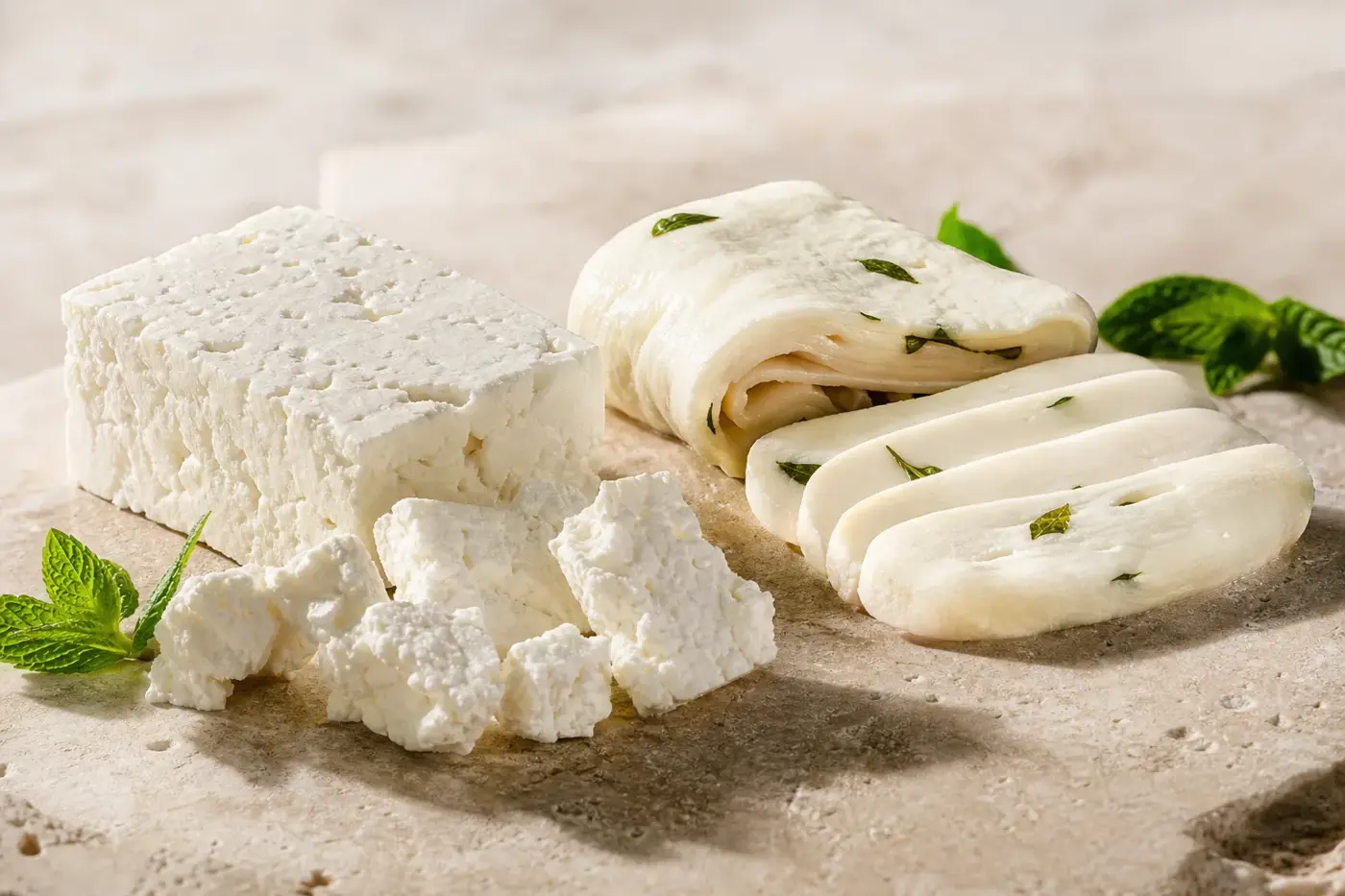
Into whey hotter than 90 °C goes the halloumi, for at least 30 minutes. Next comes that characteristic fold and the scent of Cypriot mint. Feta takes a quieter route: draining without pressing, then salt, brine and at least two months of maturation to develop its crumble. Brine connects them, but it hardly tells you the whole story. [2][3][4]
You taste the difference immediately. Greek feta, made from sheep’s milk with optional goat’s milk, brings salt, acidity and a yielding texture. Cypriot halloumi, which can also contain cow’s milk, gives you a firmer, elastic bite suited to grilling and frying. Choose feta to mingle with a dish; choose halloumi to hold its own in distinct pieces. [1][2][3][4]
Meet your cheeses at the chopping board
Break feta and you get irregular pieces. Cut fresh halloumi and you get cohesive slices. That small kitchen moment is your best starting point for understanding why these two brined cheeses are not interchangeable. [2][3][4]
| What to look for | Feta | Halloumi |
|---|---|---|
| Protected production origin | Defined areas of Greece [2] | Cyprus [3] |
| Permitted milk | Sheep, with optional goat [2] | Sheep or goat, or both, with cow permitted; consult current requirements for proportions [3] |
| Texture when cold | Soft enough to crumble [2] | Fresh: semi-hard and elastic; mature: firmer and less elastic [4] |
| What happens when you cook it | Softens but keeps its crumbly character [2] | Keeps its shape during grilling or frying [4] |
| Where it shines | Seasoning scattered through a dish, fillings and toppings | Slices, skewers and substantial pieces |
Texture matters as much as flavour. Your salad can welcome either cheese, but feta scatters mouthfuls throughout the vegetables. Halloumi makes a more definite centrepiece. Same vegetables, rather different lunch.
Follow them home to Greece and Cyprus
Feta’s protected identity belongs to specified areas of mainland Greece and Lesbos. Halloumi’s production area covers the Cypriot districts of Nicosia, Limassol, Larnaca, Famagusta, Paphos and Kyrenia. Those names tie each cheese to its home and to a prescribed way of making it. [2][3]
A protected designation of origin, or PDO, sets requirements for both origin and production. It tells you something more precise than “white cheese” or “grilling cheese”. For a closer look at what those names mean, explore the guide to protected names.
| Where protection applies, November 2026 | Feta | Halloumi |
|---|---|---|
| European Union | PDO, identified by the European Commission [2] | PDO, registered under Regulation (EU) 2021/591 [5] |
| Great Britain | Φέτα / Feta, registered PDO; UK scheme registration dated 31 December 2020 [1] | Consult the current GB PDO register for registration status |
| Northern Ireland | EU GI framework applies [5] | EU PDO protection applies [5] |
You may also meet halloumi under the name “Hellim”. The published specification registers it as Χαλλούμι / Halloumi / Hellim. Hellim is another registered name for this Cypriot cheese, not a separate style to add to your shopping list. [3]
Let the milk tell its story
Feta PDO uses sheep’s milk, either alone or with up to 30% goat’s milk. Cow’s milk is outside the specification. The European Commission permits both pasteurised and unpasteurised milk, so the name alone cannot tell you which is in your packet. [2]
Halloumi’s published specification lists sheep’s milk, goat’s milk or their mixture, with or without cow’s milk. That milk must be Cypriot. Where species are mixed, the specification says the label lists them in descending order of proportion. Consult the current requirements for the proportions themselves. [3]
This is why a cow’s milk white cheese is not necessarily feta, and another grilling cheese is not necessarily halloumi. Looking similar or doing a similar job in your pan does not establish compliance with either protected specification. Look at the actual name, origin and ingredients, with reading a cheese label as your guide. [1][2][3]
Follow feta from curd to crumble
Feta starts with coagulation: milk setting into curd. The curd goes into perforated moulds, where whey, the liquid, drains away without pressing. Once out of the moulds, the cheese is cut and salted on its surface. [2]
Then comes the waiting. The European Commission describes two maturation stages: brine is added during the first, and the second takes place under refrigerated conditions. Together, they must last at least two months. Brine helps develop feta; it is not simply liquid poured around a finished block. [2]
The result is a cheese you can divide into chunks or break into smaller fragments. Each fragment brings salty acidity to the ingredients around it. Keep pieces large for separate mouthfuls, or crumble finely to spread that character further. You can follow the fuller story in feta. [2]
Into the hot whey with halloumi
Halloumi begins with rennet coagulation before its formed curd meets hot whey. Rennet is the preparation that helps milk proteins form a curd, not an acid seasoning. That whey cooking is a defining step, rather than a finishing flourish. [3][4]
The published specification calls for whey cooking above 90 °C for at least 30 minutes. Afterwards comes the characteristic fold, with fresh or dried Cypriot mint contributing its aroma. Traditionally, the fold helped producers fit cheeses into storage containers while holding mint leaves between the layers. A practical solution with a fragrant bonus. [3][4]
You can buy fresh or mature halloumi, and it pays to notice which. Fresh halloumi is elastic and semi-hard; mature halloumi spends at least 40 days in salted whey, becoming harder and less elastic. Look for the form on the packet. The name alone does not reveal its maturity. [4]
Take a taste before the pan
Feta’s pale, crumbly structure makes it easy for you to scatter over a dish. Its acidity gives a sharp contrast to vegetables, bread and other relatively mild ingredients. Even a small piece makes its presence felt in the mouthful. [2]
The halloumi specification describes fresh cheese as white to light yellowish, closely textured and readily sliced. Its sensory descriptions give the aroma as milk or whey and mint, with a pungent, salty taste. Mature halloumi is described as stronger, slightly bitter and very salty. [4]
For either cheese, let the packet tell you about salt concentration, rather than relying on the name. Maturity and formulation matter. Compare the nutrition labels, then taste before adding more seasoning to your dish. Your salt pot can wait its turn. [4][7]
Why halloumi holds its ground in the pan
Halloumi holds together because of its protein structure, not simply because it feels firm straight from your fridge. Whey cooking is a defining production step. The protected specification explicitly names resistance to spreading or melting at high temperatures as a characteristic. [3][4]
Acidity plays a part too. A 2025 experimental study made cow’s milk halloumi-type cheeses at different pH values and examined their structure, rheology and melting behaviour. Changing pH altered calcium distribution and protein interactions, producing substantial differences in melt flow. It helps explain why structure matters, rather than assuming all brined cheeses behave alike. [6]
Feta softening in a baked dish is doing something different from halloumi browning as a cohesive slice. Softening, crumbling and flowing into a smooth pool are separate behaviours. Think about what your dish needs: neither cheese should be treated as a general-purpose melting cheese. [2][4][6]
Find the right job for each cheese
Reach for feta when you want salty acidity dispersed through other ingredients. Choose halloumi when you want the cheese to remain in substantial pieces. These suggestions follow their documented textures and cooking properties. You are building a dish, not asking the cheeses to compete for a trophy. [2][4]
| What you’re making | Reach for feta when… | Reach for halloumi when… |
|---|---|---|
| Tomato or cucumber salad | You want cheese throughout the vegetables | You want substantial slices alongside them |
| Roasted vegetables | You want a crumbly finishing ingredient | You want separately browned pieces |
| Pastries | You want a filling that breaks up readily | You want firmer pieces in the filling |
| Sandwiches and wraps | You want small pieces throughout the filling | You want a distinct sliced layer |
| Grain or pulse dishes | You want a salty, acidic accent | You want visible pieces that hold together |
With feta, decide how far you want the cheese to travel through the dish. A fine crumble spreads it around; larger pieces preserve separate mouthfuls. With halloumi, choose slices or smaller pieces to suit the other ingredients. Their different structures are useful once you put them to work. [2][4]
Picture a loosely mixed tomato salad: feta is the natural choice for scattered cheese. Now think of a sandwich built around browned cheese and grilled vegetables. Halloumi gives you that distinct layer.
Before you swap, picture the texture
In salads, grain bowls and wraps, either cheese can bring cheese flavour. The real change is how you encounter it. Swap feta for halloumi and you get a firmer, more separate component. Swap halloumi for feta and it disperses more easily, but is less suited to a substantial sliced layer. [2][4]
Direct grilling is another matter. Feta is a poor substitute for a cohesive halloumi slice because its crumbly structure changes the support and handling it needs. Going the other way, halloumi will not give you feta’s readily broken texture in a mixed filling. [2][4]
Before you swap, ask: does this dish need scattered cheese, or intact pieces? Settle that first. Then adjust the surrounding ingredients and seasoning to suit your replacement.
Compare nutrition on equal terms
At equal weight, DODONI’s standard halloumi has more fat, protein and salt than its standard feta. These are the manufacturer’s published UK values for those products, not averages across producers. The 30 g figures come from multiplying the values per 100 g by 0.3. [7]
| Nutrient | Feta, per 100 g | Halloumi, per 100 g | Feta, per 30 g | Halloumi, per 30 g |
|---|---|---|---|---|
| Energy | 257 kcal | 317 kcal | 77.1 kcal | 95.1 kcal |
| Fat | 21 g | 24 g | 6.3 g | 7.2 g |
| Protein | 17 g | 23 g | 5.1 g | 6.9 g |
| Salt | 2.5 g | 3 g | 0.75 g | 0.9 g |
Here, fat means grams of fat in the whole food, not fat in dry matter. Check your own packet, especially if you are comparing standard products with reduced-salt versions. The 30 g column gives you a comparison quantity. It is not a serving recommendation. [7]
This page summarises published guidance from the official sources it cites. It is not medical advice. Guidance differs between countries and changes over time, so check the current source for where you live, and ask your doctor, midwife, pharmacist or dietitian about your own circumstances.
Bring them home and store them well
Start with the job you want the cheese to do. Then check its exact name, milk ingredients, storage instructions and use-by date. Both cheeses contain milk. For halloumi, look for fresh or mature, since the specification describes appreciable differences between them. [2][3][4]
For home storage in England, Wales and Northern Ireland, the Food Standards Agency advises keeping your fridge between 0 and 5 °C. Follow the packet’s instructions after opening. If they tell you to retain the cheese in its original brine, keep that liquid. Brine does not replace refrigeration or override the stated date. [8]
An opened packet and a cooked leftover dish need different storage decisions. FSA guidance says to cool cooked food and refrigerate it within one to two hours, then eat leftovers within 48 hours or freeze them. Apply that to your whole salad, pastry or cooked dish, not just its cheese. For the wider principles, see storing cheese at home. [8]
Choosing cheese in pregnancy: UK guidance
The NHS lists pasteurised feta and pasteurised halloumi among cheeses you can eat during pregnancy. Look for pasteurisation on the packaging, and keep pre-packed sandwiches and salads containing dairy chilled and within their use-by dates. This guidance is dated November 2026; consult the NHS’s current guidance and ask your midwife or doctor about your circumstances. [9]
Questions people ask
What is the difference between feta and halloumi?
Feta is a crumbly Greek cheese with a salty, acidic character. Halloumi is a Cypriot cheese that holds its shape when grilled or fried.
What milk are feta and halloumi made from?
Feta PDO is made from sheep’s milk, with up to 30% goat’s milk permitted. Halloumi can be made from sheep’s milk, goat’s milk or both, with cow’s milk also permitted.
Can I substitute feta for halloumi?
Either can be used in salads, grain bowls and wraps, but the texture will change. Feta is crumbly and easy to disperse, while halloumi makes firmer, more cohesive pieces.
How should I store feta and halloumi?
For England, Wales and Northern Ireland, the Food Standards Agency advises keeping the fridge between 0 and 5 °C and following the packet instructions after opening. Consult the Food Standards Agency’s guidance for storing food.
Can I eat feta or halloumi during pregnancy?
The NHS lists pasteurised feta and pasteurised halloumi among cheeses that can be eaten during pregnancy. Consult the current NHS guidance and ask your midwife or doctor about your circumstances.
Sources
- Department for Environment, Food & Rural Affairs. Φέτα / Feta. GB protected food name register, published 2021; live record checked November 2026. Establishes the registered name, PDO status and UK scheme registration date.
- European Commission, Directorate-General for Agriculture and Rural Development. Feta PDO. Undated explanatory account, checked November 2026. Covers origin, milk, draining, salting and two-stage maturation.
- European Commission. Publication of a communication of approval of a standard amendment to a product specification, including the single document for Χαλλούμι / Halloumi / Hellim. Official Journal C 53, 13 February 2023, CELEX 52023XC0213(02). Covers milk, production area, labelling and production characteristics.
- European Commission. Published amendment documentation and single document for Χαλλούμι / Halloumi / Hellim. Official Journal C 407, 24 October 2022, CELEX 52022XC1024(02). Describes fresh and mature forms, sensory characteristics, whey cooking, folding, mint and maturation.
- European Commission. Commission Implementing Regulation (EU) 2021/591 of 12 April 2021. Registration instrument for Halloumi/Hellim PDO, including discussion of protection in Northern Ireland.
- Food Chemistry: X. The effect of pH on the microstructure, rheological and functional properties of halloumi-type cheese: pH-structure-function relationships. Volume 32, article 103341, 2025. Experimental research using cow’s milk halloumi-type cheeses.
- DODONI. Contact us, UK consumer questions and answers, undated; checked November 2026. Manufacturer’s published nutrition figures and suggested uses. DODONI produces and markets these cheeses.
- Food Standards Agency. How to chill, freeze and defrost food safely. GOV.UK, published 18 December 2017; live guidance checked November 2026. Applies to England, Northern Ireland and Wales.
- NHS. Foods to avoid in pregnancy. Live guidance checked November 2026, particularly “Cheese, milk and other dairy”.
- Food Standards Agency. Alerts. Live official recall and allergy-alert listing consulted November 2026.
Researched through official protection records, published specifications, national consumer guidance, experimental dairy research and attributed manufacturer data.
Last checked: November 2026
Last checked November 2026.
The editors suggest you read next
Cheddar vs Gouda: Taste, Texture and How to Use Each
Bite into a long-aged Gouda and, beneath your teeth, something crunches.