Fourme de Montbrison
A cylinder of blue cheese rests in a wooden gutter, its orange rind taking shape against spruce.
A cylinder of blue cheese rests in a wooden gutter, its orange rind taking shape against spruce. You’re in the Forez mountains of France’s Massif Central, where Fourme de Montbrison owes part of its character to this quiet partnership with wood. Salt runs through the cow’s milk curd; beneath the rind waits a relatively gentle blue. [5]
| What you might want to know | The detail |
|---|---|
| Name to look for | Fourme de Montbrison. [2, 4] |
| Registration authorities | European Commission, EU PDO; Defra, Great Britain PDO. [2, 4] |
| EU register identifier | Unconfirmed. Published 2025 amendment identifier: PDO-FR-0542-AM01. [2] |
| Protection status | EU: current register status unconfirmed; PDO recorded in the 2025 amendment publication. Northern Ireland: unconfirmed. Great Britain: registered PDO, November 2026. Switzerland and United States: unconfirmed. [2, 4] |
| Where it comes from | Defined parts of Loire and Puy-de-Dôme, France. [1, 6] |
| French specification | Approved by the order of 5 February 2025, published 9 February 2025. [1, 10] |
| Milk | Cow’s milk; raw milk and heat treatment permitted. [1, 5] |
| Allergen | Contains milk. [1] |
| What sets the curd and brings the blue | Rennet; Penicillium roqueforti. [1] |
| Shape and weight | Cylinder, 17 to 21 cm high, 11.5 to 14.5 cm across, weighing 2.1 to 2.7 kg. [8] |
| Time to mature | Legal minimum: unconfirmed. Producers’ syndicate minimum: 32 days. Typical maturation: unconfirmed. [8] |
| Composition | Minimum 50% fat in dry matter; minimum 52% dry matter in the whole cheese. [1, 2] |
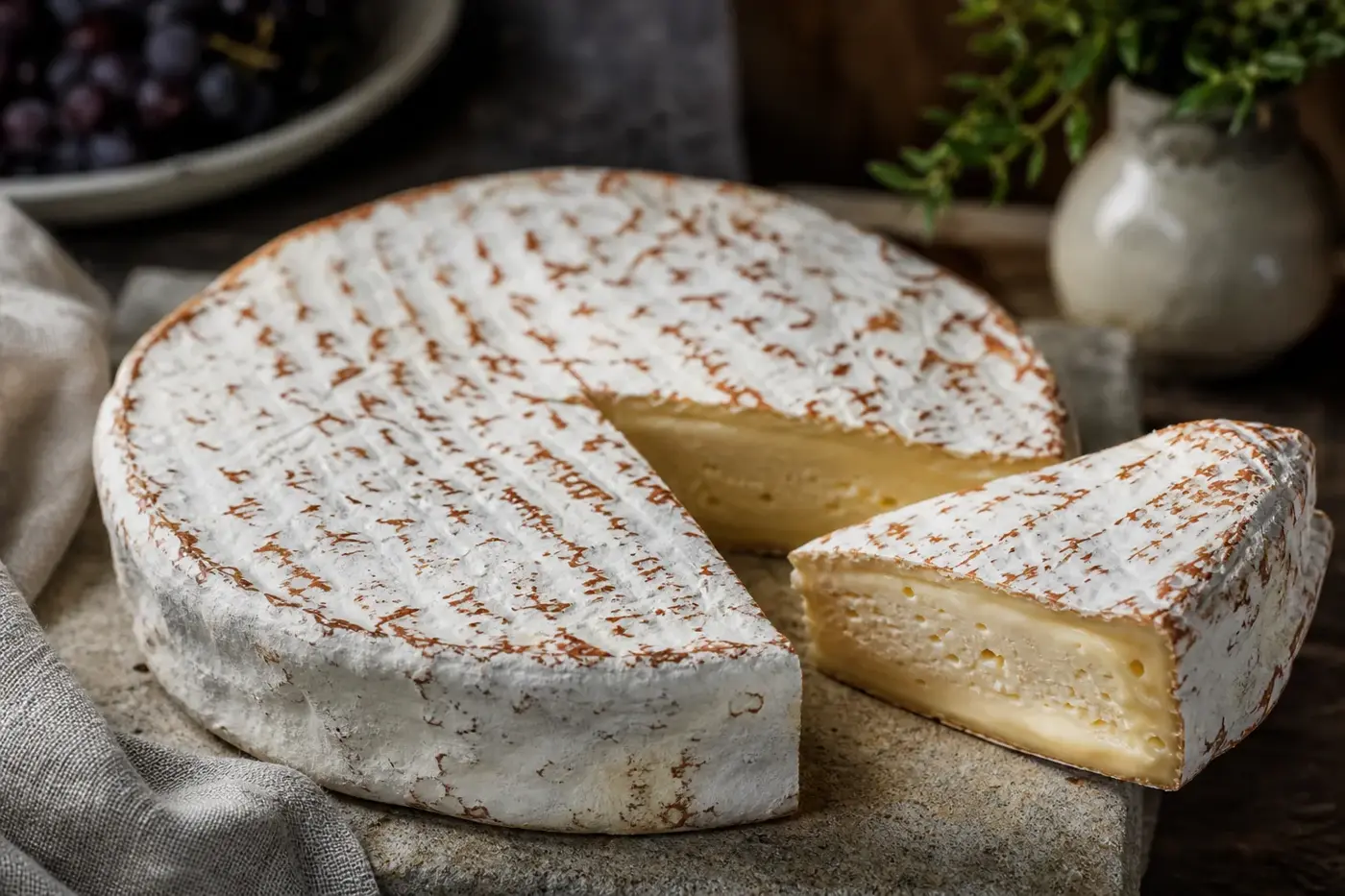
| Rind | Dry, orange natural rind, potentially carrying white, yellow and red moulds. [8] |
From high pastures to Montbrison’s market
Start in the Hautes Chaumes, the high pastures at the heart of Fourme de Montbrison’s production area. From these Forez heights, the area stretches into neighbouring mountain communities across Loire and Puy-de-Dôme. Sauvain, Saint-Bonnet-le-Courreau, Job and Valcivières all fall within its legal boundaries. [1, 6]
Follow the cheese downhill and you reach the story behind its name. The specification identifies Montbrison as an important market where mountain producers sold their fourmes. The name carries that journey with it: from upland cheesemaking to the town where the cheeses found their buyers. [6]
Under one roof in the summer pastures
Step into the story of a jasserie and home, cattle and cheesemaking share a roof. These mountain buildings contained living quarters, cattle accommodation and room for making cheese. The producers’ syndicate describes households moving to the high pastures for summer grazing, with the cheesemaking year following the rhythm of mountain farming. [9]
The specification’s historical account places women at the cheesemaking while men continued agricultural work in the villages. Hollowed conifer trunks supported the cheeses as they drained. When the fourmes were ready, they travelled to markets on either side of the mountains. [6]
Fourme de Montbrison and Fourme d’Ambert first shared recognition as a French appellation in 1972. INAO records their separation into distinct appellations in 2002. That shared history explains why you so often meet their names together, though Montbrison now has its own specification and identity. [5]
What the protected name tells you
Fourme de Montbrison’s protected designation ties a particular place to a prescribed way of making cheese. The specification covers milk production, cheesemaking and maturation. When you see AOP, it means appellation d’origine protégée, the French wording for protected designation of origin, or PDO. [1, 2]
For the current French requirements, turn to the specification approved by the order of 5 February 2025 and published by the agriculture ministry on 13 February 2025. The European Commission’s corresponding amendment communication appeared on 6 May 2025. Read these documents alongside any applicable temporary amendment. [2, 13]
Great Britain has a separate register entry, recording registration under its scheme on 31 December 2020 at 23:00. The name of a cheese and its protection in different jurisdictions are separate questions. You can explore the distinction in protected names. [4]
Start with the cows and their mountain diet
Your Fourme de Montbrison may begin with raw or heat-treated cow’s milk. The specification permits heat treatment, and INAO explicitly describes both raw-milk and pasteurised versions. Check the label or ask the seller which treatment was used for the cheese you’re buying. [1, 5]
Grass underpins the cows’ diet. The standing rules require at least 150 days of grazing annually, and normally require the basic forage ration to come from the designated area. It is a practical connection between what goes into the milk and the mountain landscape around it. [1]
A temporary drought amendment changes the forage-origin requirement from 1 September 2026 to 30 April 2027. During that period, at least 70% of the basic forage ration, measured as dry matter, must come from within the area. This exception forms part of the cheese’s current production rules. [3]
Into the curd, then onto the spruce
Before the wooden gutters come into play, the milk needs to become curd. Rennet, the milk-clotting preparation, creates the solid gel from which the cheese develops. The specification requires renneting at 29 to 34 °C and inoculation with Penicillium roqueforti, the mould responsible for the blue veins. [1]
Then comes one of Montbrison’s defining steps: salt worked throughout the curd. The syndicate describes cutting and stirring to release whey, the liquid fraction, followed by preliminary draining. The curd is broken up, salted throughout and distributed into cylindrical moulds, so the salt is already inside before those tall cylinders take shape. [7]
Now return to those wooden gutters. Once out of their moulds, the cheeses lie horizontally in chéneaux, gutter-shaped pieces of conifer wood. INAO identifies spruce as the traditional material and connects this draining stage with the development of the orange rind. [5, 7]
The syndicate says the cheeses spend at least six days in the draining room, receiving a quarter-turn every 12 hours. Even at rest, a cheese has a surprisingly full diary. The wood supports each cylinder as its surface develops; for the wider story, see how cheese is made. [7]
Let a little air into the blue
Long stainless-steel needles open channels into the cheese. These allow oxygen to reach the interior and encourage blue veining, because blue mould needs air. In its production account, the syndicate places this piercing stage at least ten days after renneting. [7]
When you cut a slice, don’t expect blue from edge to edge. The specification links Montbrison’s restrained blue character to its finely worked curd and relatively small internal openings, which limit the mould’s growth. The cheesemaker’s handling of the curd helps shape the pattern you eventually see. [6]
The syndicate gives a minimum maturation of 32 days. At the counter, ask the age of the particular cheese in front of you. That tells you more about the piece you’re choosing than the minimum alone. [8]
Meet the orange rind and gentle blue
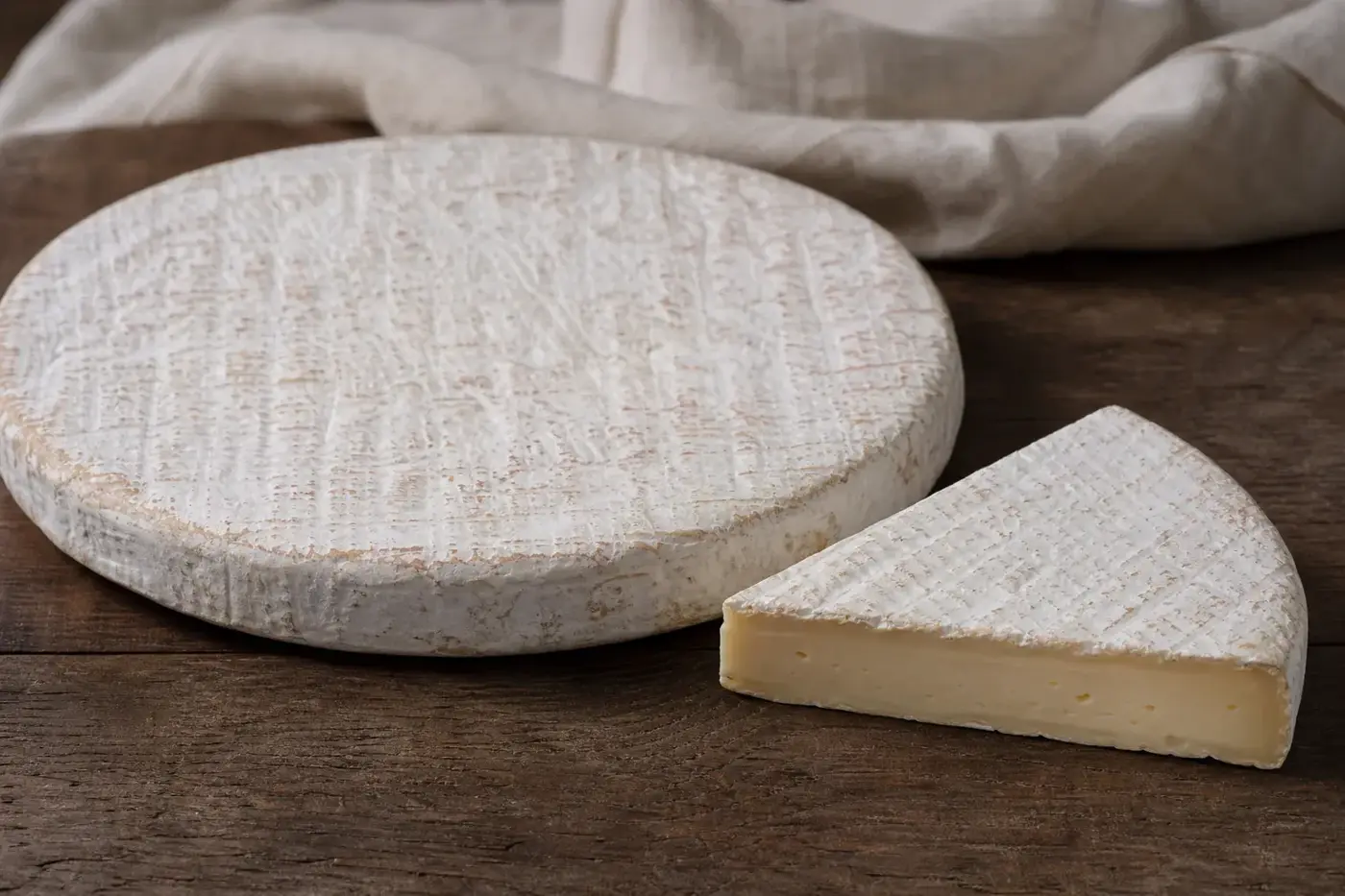
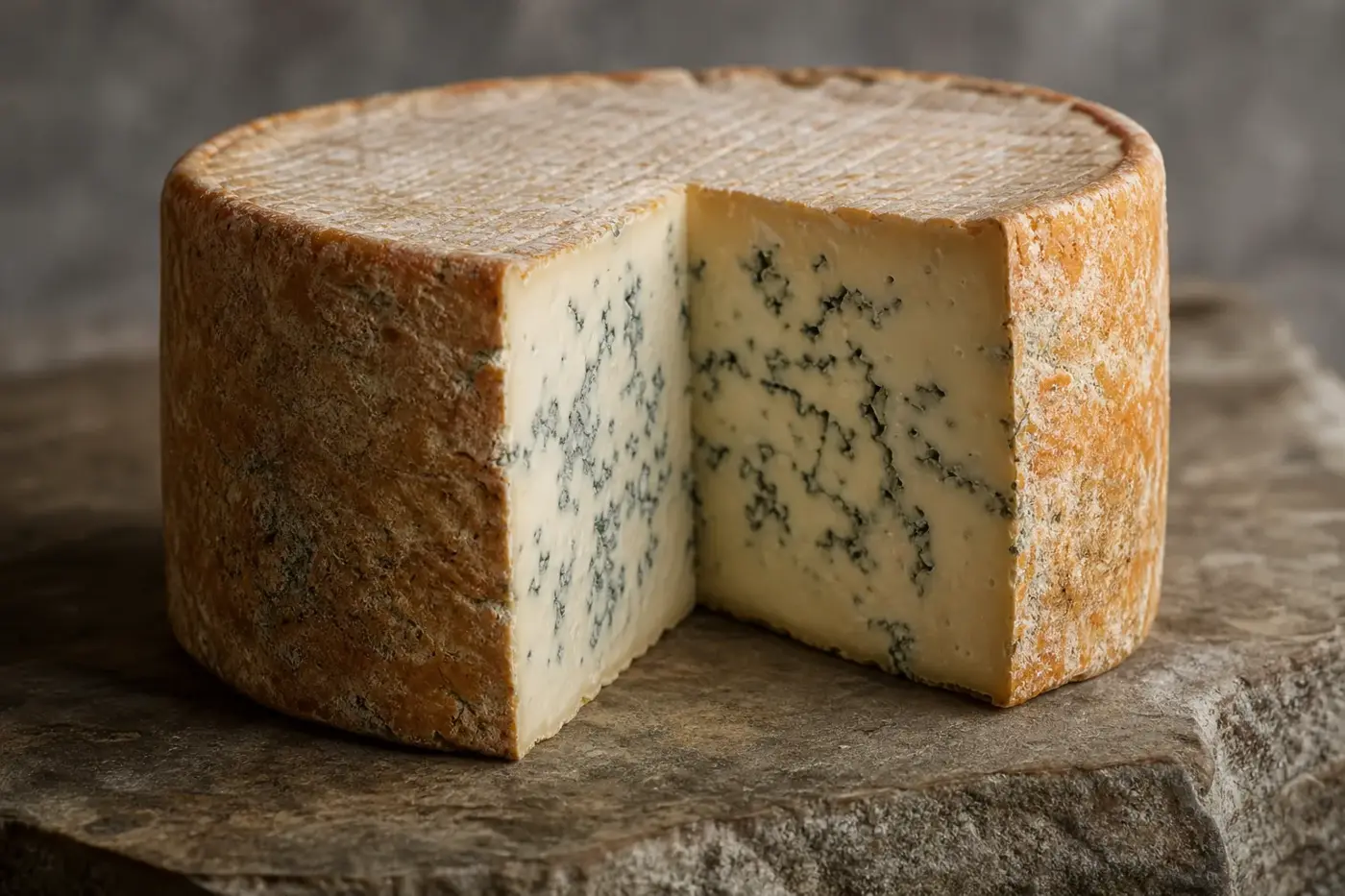
A whole Fourme de Montbrison stands taller than it is wide. Cut through its orange rind and you’ll find a cream-coloured interior, lightly marbled with blue. The producers’ syndicate describes a supple yet firm paste, with light-blue markings rather than broad, densely coloured cavities. [8]
Take a moment with the texture before moving on to the flavour. The syndicate’s published sensory description includes milk, mushroom and bark-like notes, alongside small grains you can feel in the paste. Start with that dairy character, then see how the mushroom and bark-like notes unfold as you taste. [8]
INAO describes a homogeneous, slightly firm texture that softens in your mouth, with a fine, fragrant flavour and fruity dairy character. It connects the relatively mild blue note to limited development of Penicillium roqueforti within the paste. What you see in the modest veining and taste in the gentle blue flavour have the same explanation. [5]
Give Montbrison and Ambert their own moment
Fourme de Montbrison and Fourme d’Ambert became distinct appellations after sharing an earlier designation. Their separation recognised different identities, rather than two names for the same cheese. Keep that shared past, and subsequent parting, in mind when you compare them. [5]
For Montbrison, look at the whole picture: salt worked through the curd, draining on wooden gutters, an orange natural rind and relatively restrained blue character. Together, these documented features tell you far more than “a cylindrical French blue”. You have a cheese with a particular way of being made, and a character to match. [5, 7, 8]
If you have both cheeses to hand, taste them separately before adding either to a dish. Compare the rind, firmness and distribution of blue. Then choose whichever character suits what you want to eat or cook.
Choose your piece and look after it
At the counter, ask for the exact name, maker, milk treatment and age. Ask, too, whether your particular piece is best for eating now or cooking. With packaged portions, reading the label helps you distinguish information about the designation from details of the individual product.
The documented rind is dry and orange, with possible white, yellow or red surface moulds. Those colours belong to the cheese’s description. For advice on eating a particular rind, follow the producer’s instructions or ask your cheesemonger. [8]
For storage, the FSA’s consumer guidance for England, Wales and Northern Ireland recommends a fridge between 0 and 5 °C. Follow the packaging’s storage instructions and dates. If you rewrap a portion, keep that information with it. [12]
The syndicate suggests taking the cheese out two hours before eating. Balance that with the FSA’s advice to keep chilled food out for the shortest possible time, with a maximum of four hours during preparation. Take out only what you need; storing cheese at home covers the broader approach. [8, 12]
For pregnancy in the UK, the NHS says soft blue-veined cheeses made with pasteurised or unpasteurised milk should be cooked until steaming hot all the way through. Check the current NHS guidance. Ask your midwife about your own circumstances. [11]
Bring bread, then think about supper
Begin with plain country bread and a piece of cheese. That gives you room to notice the dairy and mushroom notes described by the syndicate before stronger accompaniments arrive. Then try fruit or a drink; the bread has done its quiet work. [8]
These pairing suggestions take that published character as their starting point. Keep things simple enough to let you pay attention to the cheese, rather than making it compete for the last word.
| Alongside your cheese | What to try |
|---|---|
| Plain sourdough or walnut bread | Start simply, then try a more pronounced contrast. |
| Fresh pear or apple | Add a crisp, juicy counterpoint to the firm paste. |
| Water or an alcohol-free apple drink | Try water for comparison, or apple for a fruit-led pairing. |
For supper, try Fourme de Montbrison as a finishing cheese on a freshly cooked potato or a vegetable tart. You needn’t automatically recruit a heavy sauce. INAO records its use both uncooked and cooked, so begin with a modest amount, taste, then decide whether you need any more salt. [5]
General information only, not medical advice: follow the official guidance where you live.
Questions people ask
What does Fourme de Montbrison taste like?
It is a relatively gentle blue cheese with a fine, fragrant flavour and fruity dairy character. The producers’ syndicate also describes milk, mushroom and bark notes.
Is Fourme de Montbrison made with raw milk?
It can be made with raw or heat treated cow’s milk. Check the label or ask the seller about a particular cheese.
What is the difference between Fourme de Montbrison and Fourme d’Ambert?
They are distinct appellations that emerged from an earlier shared designation. Montbrison is known for salt worked through the curd, draining on wooden gutters, an orange rind and restrained blue character.
How long is Fourme de Montbrison matured?
The producers’ syndicate gives a minimum maturation of 32 days. Ask the seller how old a particular cheese is.
Can you eat Fourme de Montbrison during pregnancy?
The NHS says that soft blue veined cheeses made with pasteurised or unpasteurised milk should be cooked until steaming hot all the way through. Check the current NHS guidance and ask your midwife about your circumstances.
Sources
- French Ministry of Agriculture. Cahier des charges de l’appellation d’origine « Fourme de Montbrison ». Approved text, published 13 February 2025. Sections 2, 3 and 5.
- European Commission. Publication of the communication of an approved standard amendment to a product specification of a geographical indication. C/2025/2613, 6 May 2025, including the single document and amendment identifier PDO-FR-0542-AM01.
- French government. Arrêté du 26 août 2026 relatif à la modification temporaire du cahier des charges de l’appellation d’origine protégée (AOP) « Fourme de Montbrison ». JORF, 29 August 2026, Article 1.
- Defra. Fourme de Montbrison. Great Britain protected food names register, published 4 January 2021, current entry retrieved November 2026.
- INAO. Fourme de Montbrison. Official product record, undated, retrieved November 2026. Product description, territory, recognition history and explanation of spruce draining supports.
- INAO. Cahier des charges de l’appellation d’origine « Fourme de Montbrison ». Version dated 12 April 2013. Used only for historical and explanatory passages consistent with the retrieved 2025 text, not superseded composition requirements.
- Syndicat de la Fourme de Montbrison. Sa fabrication. Undated, retrieved November 2026. Producer-representative account of manufacture, draining and piercing.
- Syndicat de la Fourme de Montbrison. Ses caractéristiques. Undated, retrieved November 2026. Format, rind, sensory descriptions, minimum maturation and serving suggestion. Its superseded fat figure was not used.
- Syndicat de la Fourme de Montbrison. Son histoire. Undated, retrieved November 2026. Seasonal mountain production and jasseries.
- French government. Arrêté du 5 février 2025 relatif à la modification du cahier des charges de l’appellation d’origine protégée « Fourme de Montbrison ». JORF, 9 February 2025.
- NHS. Foods to avoid in pregnancy. Current online guidance retrieved November 2026, cheese and dairy section.
- Food Standards Agency. How to chill, freeze and defrost food safely. Published 18 December 2017, current online text retrieved November 2026. Applies to England, Northern Ireland and Wales.
- French Ministry of Agriculture and French government. Publication record for the amended specification, 13 February 2025, and approving order of 5 February 2025, published 9 February 2025.
Researched through official specifications, legal publications and register records, supplemented by attributed material from the producers’ syndicate; pairing suggestions are editorial desk research.
Last checked: November 2026
Last checked November 2026.
The editors suggest you read next