Generic or Protected? Parmesan, Feta and Gruyère Disputes
Picture yourself at the cheese counter, looking at a Parmesan label.
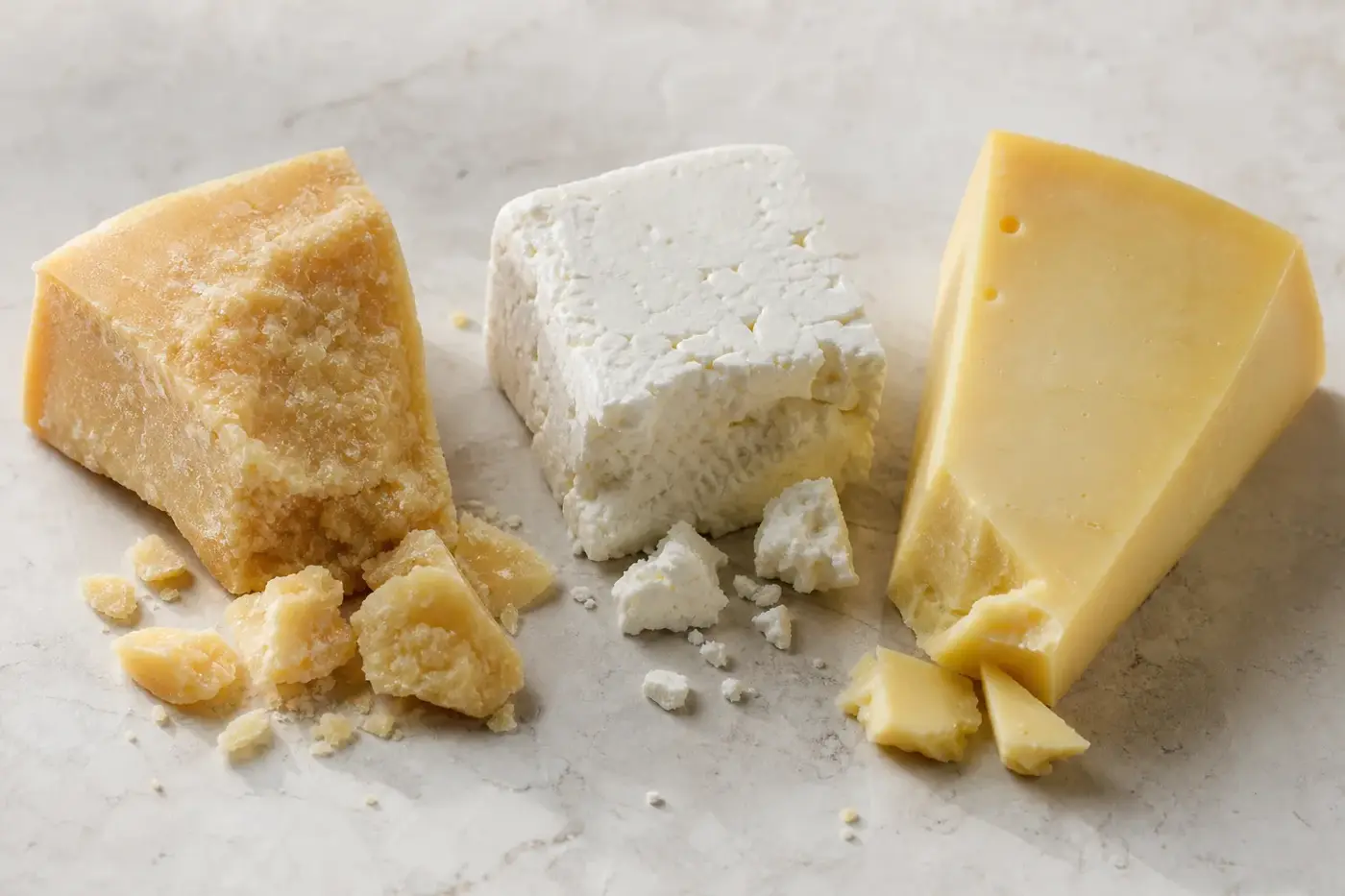
Picture yourself at the cheese counter, looking at a Parmesan label. The name feels familiar. Its legal story is less straightforward: in 2008, the European Court of Justice found that using Parmesan for cheese outside the Parmigiano Reggiano specification unlawfully evoked the protected name, yet dismissed the action against Germany. Germany won, but Parmesan did not escape protection. [1]
The cheese name and the case against the country were different questions. Follow Danish Feta exports or Gruyère labels in American shops and you meet the same puzzle: does a name tell you where a cheese comes from, or what kind of cheese it is? The answer changes with the market, its protection system and what shoppers understand. [1][2][3]
That familiar name on the cheese counter has a history
You recognise a cheese name. But does it describe a category, or reserve that name for producers in a particular geographical area? A generic name does the first job; a geographical indication, or GI, links a product’s qualities, reputation or other characteristics to its origin. Disputes begin when producers disagree about which job a word performs. [4]
Within the EU system, a protected designation of origin, or PDO, requires the specified geographical connection and compliance with a product specification. A protected geographical indication, or PGI, has a different geographical test: at least one relevant production stage must happen in the defined area. Neither designation belongs exclusively to one cheesemaking business. [4][5]
Then you have the standard of identity. This tells you what a food must contain, or how it must be characterised, to carry a particular name. The United States has federal standards for Parmesan and Gruyere without requiring production in their European regions of origin. Composition and geographical exclusivity are separate legal questions. [6]
For the bigger picture, explore the guide to protected names. These three disputes show you what happens when those rules meet words cheese buyers already know.
Parmesan: protection reaches beyond the Italian wording
Start with Parmigiano Reggiano, the registered Italian name. Defra’s Great Britain register lists it as a PDO, with an original EU registration date of 21 June 1996. Its registration under the UK scheme is recorded as 31 December 2020 at 23:00. Where, then, does that leave the Parmesan on your label? [7]
On 26 February 2008, the European Court of Justice addressed that question in Commission v Germany, Case C-132/05. In those proceedings, it found that using Parmesan for cheese outside the Parmigiano Reggiano specification unlawfully evoked the PDO. Germany had failed to establish that Parmesan was generic. [1]
The Court considered similarities between both the words and the cheeses. It did not need to decide whether Parmesan was a translation, because evocation provided the route to protection. A name can bring a registered product to your mind without copying its wording exactly, and still fall within its protection. [1]
Yet Germany won the infringement action. The Commission was involved in a matter concerning an alleged failure of German enforcement under the legislation then applicable. The dismissal concerned the case against the state; the Parmesan finding concerned use of the cheese name. Those were separate questions, with different answers. [1]
If you would rather explore how the cheese is made, turn to Parmigiano Reggiano. There is more to its story than a courtroom.
Feta: a name can carry a place without naming it
You do not need to hear a town or region in a name for it to have geographical protection. Take Feta. The Court’s 2022 judgment records its registration as a PDO through Regulation (EC) No 1829/2002. Using the name is tied to Greek origin and the registered product specification. [2]
Nor can you decide whether a word is generic simply by looking at its spelling. Drawing on earlier Feta litigation, the Parmesan judgment identifies several considerations: production inside and outside the country seeking protection, consumption, consumer perceptions, national legislation and the name’s treatment in Community law. Production elsewhere matters, but it must be considered alongside those other factors. [1]
You can see why the name matters to both sides. Regional producers seek recognition of a geographical identity; producers elsewhere may see an established name for a cheese category. The legal task is to weigh the evidence under the relevant system. Neither age nor familiarity can settle the argument alone. [1][3]
Danish Feta: why the export destination did not settle it
Picture the destination on an export label: outside the EU. For Danish cheese carrying the Feta name, that did not remove the need to respect EU protection. On 14 July 2022, the Court of Justice ruled in Commission v Denmark, Case C-159/20, that Denmark had failed to prevent or stop Danish dairy producers using Feta for cheese outside the PDO specification. The cheese was destined for countries outside the EU. [2]
The crucial point was where the producers operated: Denmark. Denmark’s obligation concerned their conduct there, and sending the cheese overseas did not take that conduct outside EU protection rules. An overseas customer offered no exemption for Danish-made cheese bearing the Feta name without meeting its specification. [2]
What happened at the destination remained a separate question. The judgment enforced an EU obligation against an EU member state; it did not itself establish Feta protection under American or other foreign law. If you sell cheese, you need both sets of rules: those governing production and export, and those governing the market where it arrives. [2]
There was a further distinction in the outcome. The Court dismissed the Commission’s separate complaint concerning sincere cooperation. As with Parmesan, you need to read the operative outcome carefully: a court can uphold one part of an infringement action and reject another without undoing the successful finding. [2]
Gruyère: one familiar word, Swiss and French routes
Swiss and French Gruyère share a familiar word, but their geographical protections are not interchangeable descriptions. The Fourth Circuit’s account of the European arrangements distinguishes the Swiss protected designation of origin from the French protected geographical indication. Each has its own geographical and production requirements, set out in a distinct specification. [3]
For French Gruyère, the EU registration instrument is Commission Implementing Regulation (EU) No 110/2013. Its title expressly identifies Gruyère as a PGI. That date and instrument distinguish the French registration from the Swiss arrangements, even though the same word sits at the centre of both names. [8]
The EU and Switzerland’s agricultural agreement provides another route to protection. Annex 12 concerns geographical indications for agricultural products and foodstuffs. To establish the position of Swiss Gruyère, consult the current agreement list and relevant Swiss specification. For any particular market, consider agreement protection separately from registration of the French PGI. [9]
To get closer to the Swiss cheese itself, explore the story of Le Gruyère. You will find its characteristics and production background there, beyond the shared name.
What did American shoppers see in GRUYERE?
Imagine finding GRUYERE on a label in an American shop. Would you understand it as a cheese from a defined Swiss or French region, or as a kind of cheese? That was the central question when, on 3 March 2023, the US Court of Appeals for the Fourth Circuit upheld the refusal to register the word as a certification mark. [3]
The Swiss and French applicants wanted to reserve it for cheese from their defined regions. The court concluded that GRUYERE was generic for the proposed certification mark in the United States. European origin protection formed part of the background, but the focus was the American marketplace. [3]
To understand what relevant American cheese purchasers understood, the court considered domestic production, sales of cheese made elsewhere, publications and the federal standard of identity. Together, these sources helped show how buyers encountered the term. They also showed how it was used in that market. [3][10]
The standard, 21 CFR 133.149, describes Gruyere cheese without requiring production in Switzerland or France. That helped explain the labels American consumers saw. The court considered the regulation alongside marketplace evidence, rather than letting the cheese’s geographical history alone determine the outcome. [6][10]
If you are looking at marks, one distinction matters. The ruling concerned the proposed word mark; the court also recorded an earlier registration of a distinct stylised certification mark incorporating geographical wording and a design. The generic word and that particular registered mark are different objects of protection. A decision about one cannot simply be transferred to the other. [3]
Your guide to three different legal landscapes
Move between the EU, Great Britain and the United States and the legal answer can change. This table separates the positions established by the cited sources. Where a question remains outstanding, it is identified rather than treated as settled.
| Name | European Union | Great Britain | United States |
|---|---|---|---|
| Parmesan | The 2008 judgment found unlawful evocation of Parmigiano Reggiano for cheese outside its specification. [1] | Parmigiano Reggiano is a registered PDO. Parmesan-specific enforcement remains an outstanding question. [7] | “Parmesan and reggiano cheese” has a federal identity standard without an Italian-origin requirement. [6] |
| Feta | The 2022 judgment concerned Danish export cheese outside the Feta PDO specification. [2] | The current individual register entry remains an outstanding question. | The current name-specific trademark and common-law position remains an outstanding question. |
| Gruyère | French PGI registration and Swiss agreement protection are distinct routes. [8][9] | Current individual entries for Swiss and French products remain outstanding questions. | GRUYERE was held generic for the proposed certification mark in 2023. An identity standard also applies. [3][6] |
Here, Great Britain means England, Scotland and Wales. Defra’s guidance says the UK GI schemes protect registered names sold there, while the EU schemes apply in Northern Ireland and the EU. It also explains continuity of protection for names successfully registered under the EU schemes by 31 December 2020. [5]
If you are in business, start with three details: where the cheese is produced, where it is going and the exact expression intended for the label. Then check the applicable compositional standard, geographical registration and certification mark separately. Meeting one set of requirements does not settle the questions governed by the others. [3][5][6]
When the cheese label becomes evidence
A cheese label can do two jobs in a dispute. It may be the thing being challenged, but it can also offer evidence of what shoppers understand. Dictionaries, production records, advertising, retail descriptions and sales data can all help show whether a name communicates geographical origin or a type of cheese. Their weight depends on the legal test and the market concerned. [1][10]
The US Gruyère case makes that territorial difference clear. A cheese can retain its documented association with a European region while its name acquires a broader meaning among American purchasers. In the EU system, meanwhile, production elsewhere does not automatically establish that a protected expression has become generic. The evidence must answer the question the relevant law asks. [1][3]
Looking for a particular origin? Read a little further
Start with the complete product name and stated place of manufacture. With Gruyère, distinguish the Swiss and French geographical products. With Parmesan bought in the United States, remember that the federal identity standard does not establish Italian origin. Read geographical claims alongside the name: familiarity alone cannot tell you where your cheese was made. [3][6][8]
Next, look for PDO, PGI or certification wording and consult the corresponding official record. A trade mark can identify the commercial source of goods; geographical protection links qualifying products to an origin and specification. Certification marks identify goods meeting defined standards. Defra explains that producers meeting a specification, with the required verification, can use the registered geographical name. [3][5]
For the wider picture, turn to the guide to reading a cheese label. When a particular origin matters to you, ask the seller where the cheese was made and which registered specification or certification supports its description. Your curiosity need not stop at “may I try some?”
Questions people ask
Is Parmesan the same as Parmigiano Reggiano?
Parmigiano Reggiano is the registered Italian name. In 2008, the European Court of Justice found that using Parmesan for cheese outside its specification unlawfully evoked the protected name.
Does Feta have to come from Greece?
In the EU, use of the protected name Feta is tied to Greek origin and the registered product specification. The page does not verify the current position of the name under American trademark and common law.
Why can Gruyère be generic in the United States but protected in Europe?
The US court examined what American cheese purchasers understood GRUYERE to mean and concluded that it was generic for the proposed certification mark. Swiss and French Gruyère have separate geographical protections in Europe, with distinct specifications.
What is the difference between a PDO and a PGI?
A PDO requires the specified geographical connection and compliance with a product specification. A PGI applies a different geographical test: at least one relevant production stage must take place in the defined area.
Does the name on a cheese label tell me where it was made?
A familiar name alone does not establish where a cheese was made. Check the complete product name and stated place of manufacture, and look for PDO, PGI or certification wording in the corresponding official record.
Sources
- Court of Justice of the European Communities, Commission v Germany, Case C-132/05, ECLI:EU:C:2008:117, judgment of 26 February 2008. Official judgment.
- Court of Justice of the European Union, Commission v Denmark, Case C-159/20, ECLI:EU:C:2022:561, judgment of 14 July 2022. Official judgment.
- United States Court of Appeals for the Fourth Circuit, Interprofession du Gruyère v U.S. Dairy Export Council, No. 22-1041, published opinion, 3 March 2023. Official opinion.
- European Parliament and Council, Regulation (EU) 2024/1143, consolidated version dated 18 March 2026. Consolidated text.
- Department for Environment, Food & Rural Affairs, Protected geographical food and drink names: UK GI schemes, updated 8 March 2024. Official guidance.
- US Food and Drug Administration, 21 CFR Part 133: Cheeses and Related Cheese Products, sections 133.149 and 133.165, eCFR text displayed as current to 5 November 2026. Federal standards.
- Department for Environment, Food & Rural Affairs, Parmigiano Reggiano, live Great Britain protected food name entry, published 4 January 2021. Register entry.
- European Commission, Commission Implementing Regulation (EU) No 110/2013 of 6 February 2013 entering a name in the register of protected designations of origin and protected geographical indications [Gruyère (PGI)], 2013. Registration instrument.
- European Community and Swiss Confederation, Agreement on trade in agricultural products, Annex 12, consolidated version dated 1 November 2020. Official agreement text.
- United States Patent and Trademark Office, Generic or not: A dispute over the term “gruyere” comes to an end, IP Policy and International Affairs Bulletin, April 2024. Official bulletin.
Researched through official court records, legislation, federal cheese standards, government guidance and the accessible protected-name register entry.
Last checked: November 2026
Last checked November 2026.
The editors suggest you read next
Cheese Law Around the World: The Complete Guide
GRUYERE reached an American legal border and lost its exclusivity.