French Gruyère
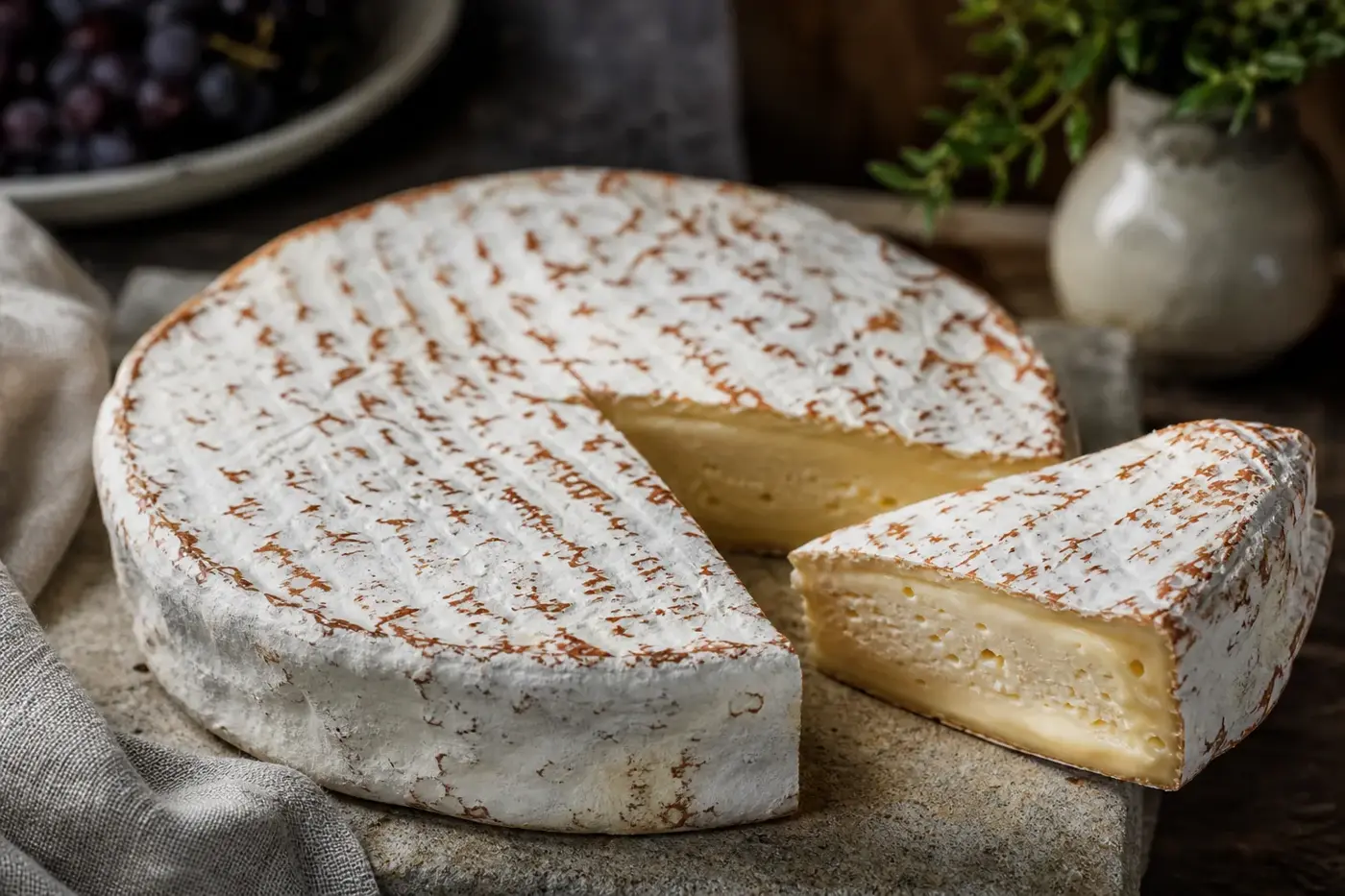
Cut into a wheel of French Gruyère IGP and there they are: openings the size of peas and cherries, scattered through the pale paste.
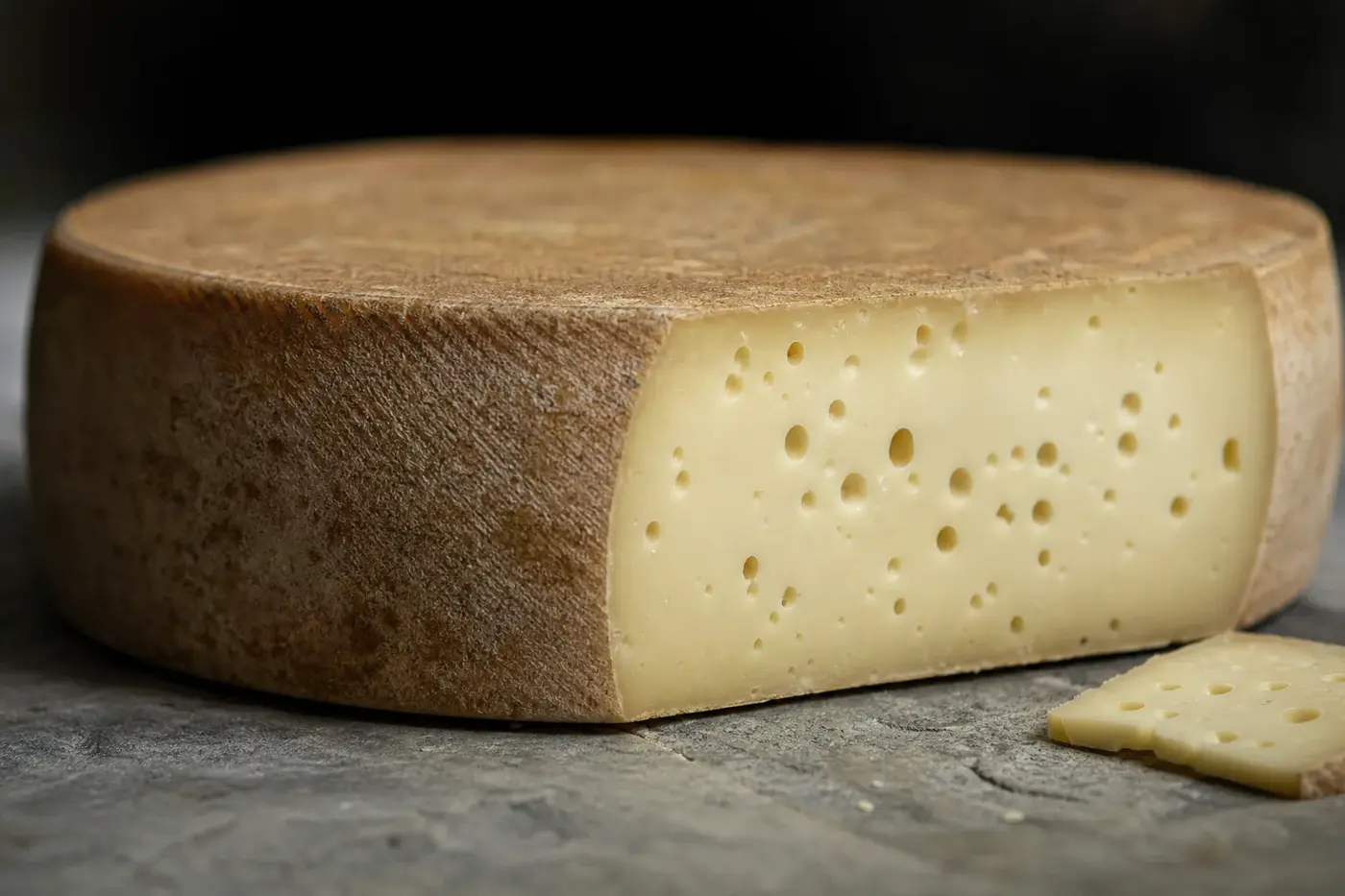
Cut into a wheel of French Gruyère IGP and there they are: openings the size of peas and cherries, scattered through the pale paste. Nothing has gone missing. Those openings are required by the published 2010 specification for this cooked, pressed cheese, made from raw cows’ milk in eastern France.[2]
| What you’re looking for | The details |
|---|---|
| Familiar name | French Gruyère.[3] |
| Exact registered name | Gruyère.[1] |
| EU registration authority | European Commission.[1] |
| EU register record ID | Not established here |
| Registration instrument | Commission Implementing Regulation (EU) No 110/2013, Articles 1 to 3 and Annex.[1] |
| EU registration | Protected geographical indication under Regulation (EU) No 110/2013; current register status not established here.[1] |
| Great Britain register status | Not established here |
| Northern Ireland protection status | Not established here |
| Switzerland protection status | Not established here |
| United States protection status | Not established here |
| Milk | Raw cows’ milk.[2][3] |
| Coagulant | Rennet from calf stomachs.[2] |
| Minimum maturation | 120 days from renneting in the published specification.[2] |
| Wheel dimensions | Diameter 53 to 63 cm; height 13 to 16 cm.[2][3] |
| Characteristic openings | Required, from pea-sized to cherry-sized.[2][3] |
| UK pregnancy guidance | NHS, Foods to avoid in pregnancy, November 2026.[8] |
Two words that tell you where you are
Find “Gruyère” on the label, then look beside it for “France”. Both must appear in the same field of vision, in lettering of the same size. It is a practical rule with an important job: making the country of origin part of the legal distinction between this cheese and its Swiss namesake.[1]
You’ll also meet IGP, the French abbreviation for indication géographique protégée. In English, that is protected geographical indication, or PGI. The EU registration protects Gruyère associated with the French product, rather than registering “French Gruyère” as a separate name.[1]
The Commission adopted the registration regulation on 6 February 2013. Publication followed on 7 February, with entry into force on the twentieth day following publication: 27 February 2013. That final date is the operative one established by the instrument.[1]
Behind the precise label instructions lies a more complicated history. The regulation discusses objections concerning earlier uses of the name, alleged generic status and coexistence with the Swiss name. Its decision establishes protection within the EU; the name’s legal treatment elsewhere is a separate question.[1]
If you want to untangle a geographical indication from a cheese style, start with protected names explained. It is a useful distinction to take to the cheese counter.
Follow the trail from Haute-Saône towards Savoie
Picture an arc along the Swiss frontier, reaching from the Haute-Saône plateaux towards Savoie. INAO, France’s national institute responsible for official origin and quality schemes, describes mountains, limestone plateaux and adjoining valleys. This is the landscape behind French Gruyère.[3]
“Mountain cheese” gives you a starting point, but not the whole picture. These are not simply wheels made on high summer pastures. French Gruyère belongs to a broader regional system of grassland farming, milk collection, cheesemaking and maturation, across the Jura and Alpine surroundings and the lower ground between them.[2][3]
The published specification keeps milk production, cheesemaking and maturation within a defined area. Its boundary takes in whole departments in some places and specified localities in others. The landscape helps you imagine the cheese’s home; the detailed boundary decides whether an individual dairy is eligible.[2]
At the counter, ask for more than French origin. Ask for Gruyère IGP, the producer’s name and the maturation details. A mountain on the wrapper may set the scene, but it is not much of an interview.
Get to know the herds behind the wheel
Abondance, Tarentaise, Montbéliarde, Vosgienne and Simmental française: these are the cattle named in the published production rules. Crosses between those breeds are permitted too. Their feeding system centres on grass and hay, rather than allowing milk without restriction from any herd.[2]
That connection to place begins on the farm, well before the milk reaches the dairy. INAO links the cheese’s identity to local breeds, grass feeding and the exclusion of silage. Cheesemaking and maturation carry that connection through to the finished wheel.[3]
If you are offered “summer cheese”, ask what the description means. It may refer to when the milk was produced, while the piece before you has since spent months maturing. Ask about production period and age separately, then what the producer or affineur finds distinctive about that particular wheel.
Colour offers another clue, though it cannot tell you the whole flavour story. The specification allows paste from ivory to pale yellow. Either colour belongs comfortably within the published description of French Gruyère.[2]
From the copper vat to the maturation cellar
The process starts with raw milk, starter cultures and calf rennet. Rennet sets the milk into curd, a stage called coagulation. Starter organisms begin the fermentations that continue through production and ripening.[2]
The published specification describes natural starter preparations made using whey, the liquid separated from curd. It identifies acidifying bacteria and propionic bacteria within the cheese’s microbial system. For the cheesemaking itself, the setting is an open copper vat.[2]
Once cut, the curd is heated to at least 52 °C. This is what “cooked” means here: heat applied to the curd and whey mixture, not milk that has thereby been pasteurised. A separate rule prohibits heating the incoming milk above 40 °C before this stage.[2]
Pressing comes next and lasts at least six hours. Salting begins no earlier than 20 hours after moulding, using dry salt or brine. These are production requirements for the cheese, not instructions for a kitchen experiment.[2]
Maturation, or affinage, moves the wheel through different conditions. The published rules require an initial period of at least 15 days at 8 to 15 °C, then at least three weeks above 15 °C, with relative humidity above 80%. Total maturation must reach at least 120 days from renneting.[2]
That warm stage helps create the interior you recognise at the counter. The maker is developing the required openings alongside the mature paste and rind. Temperature does more than speed up or slow down ageing: it helps shape the cheese itself.[2]
Take a closer look at those openings
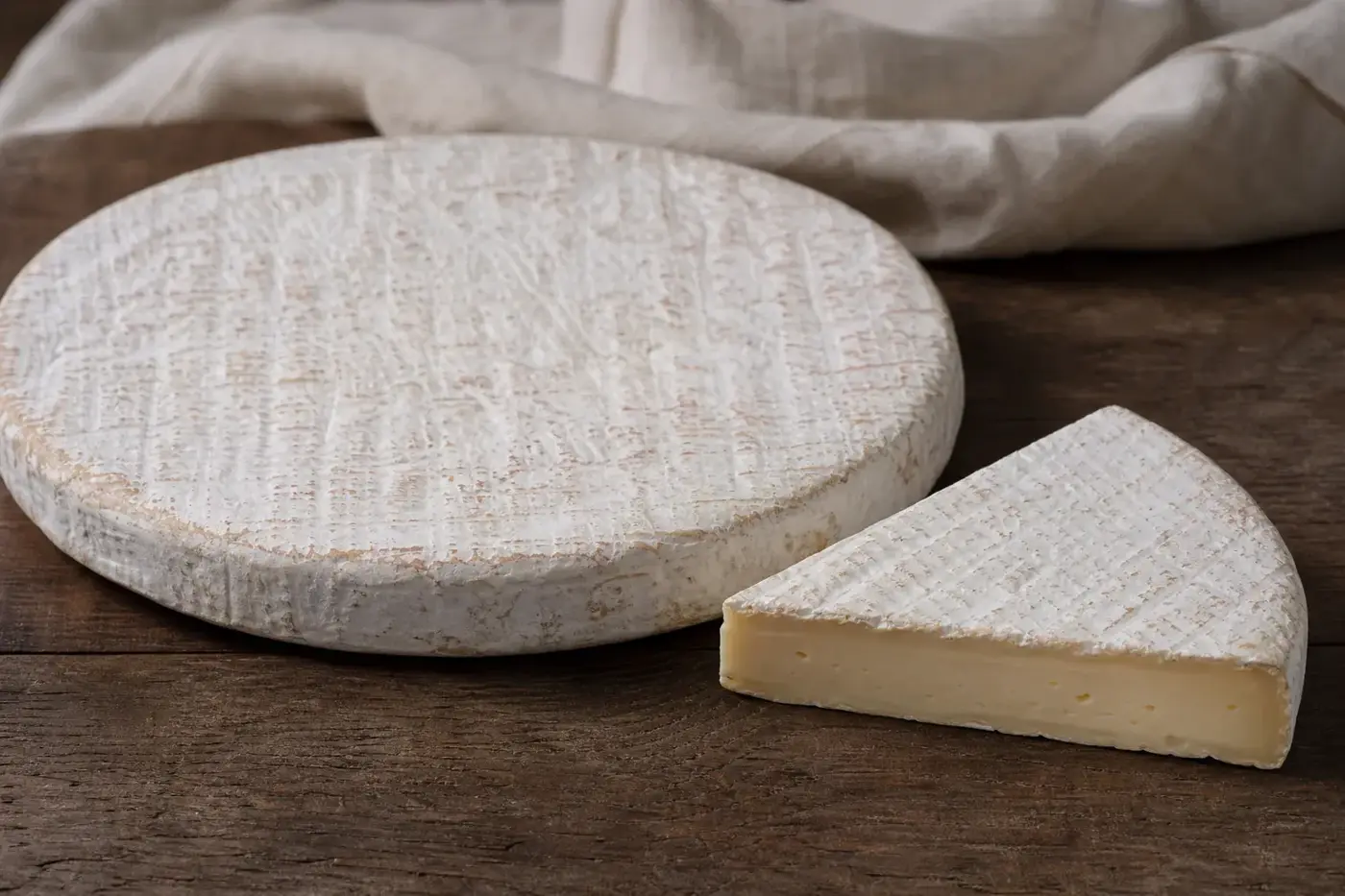
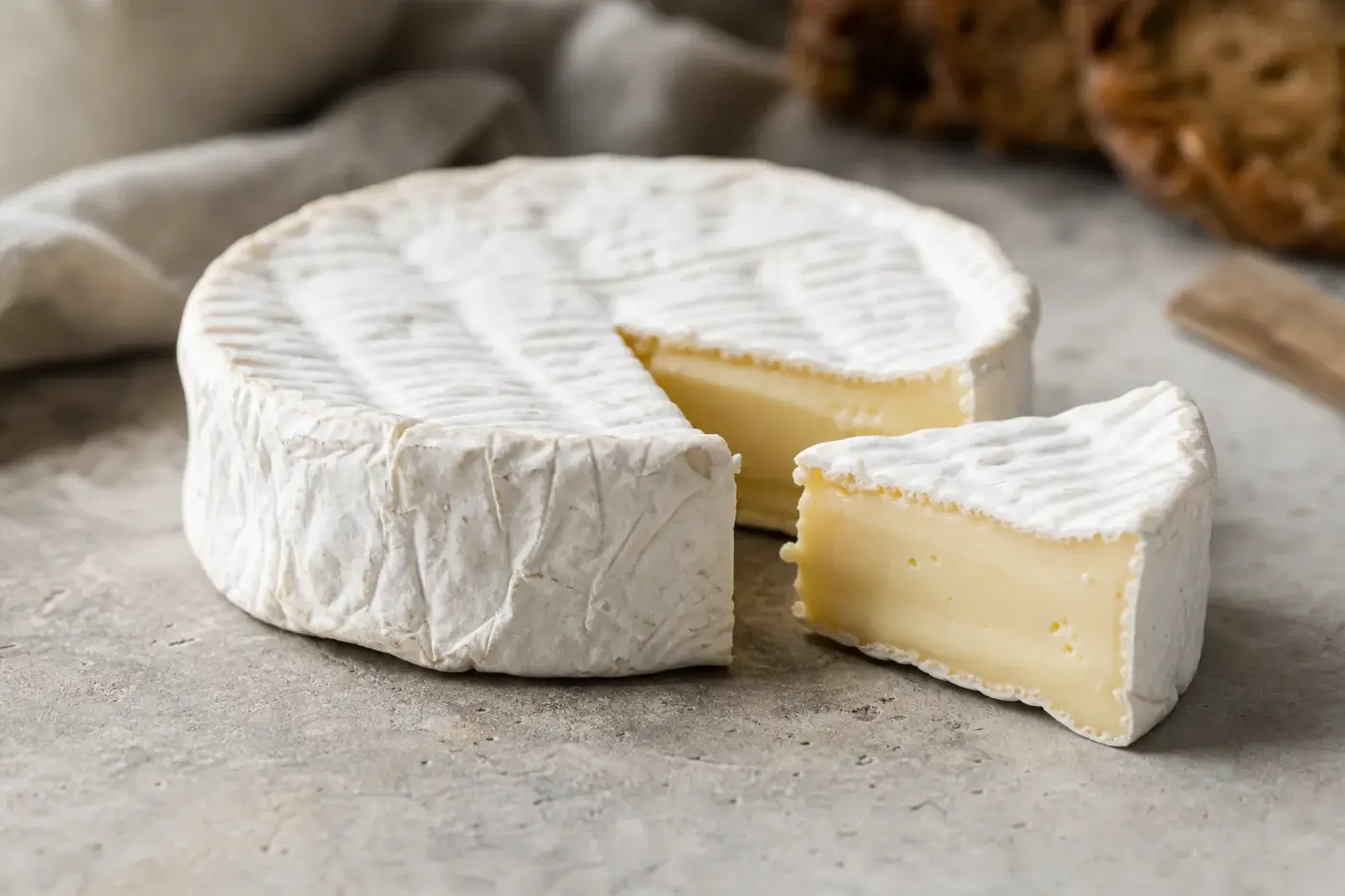
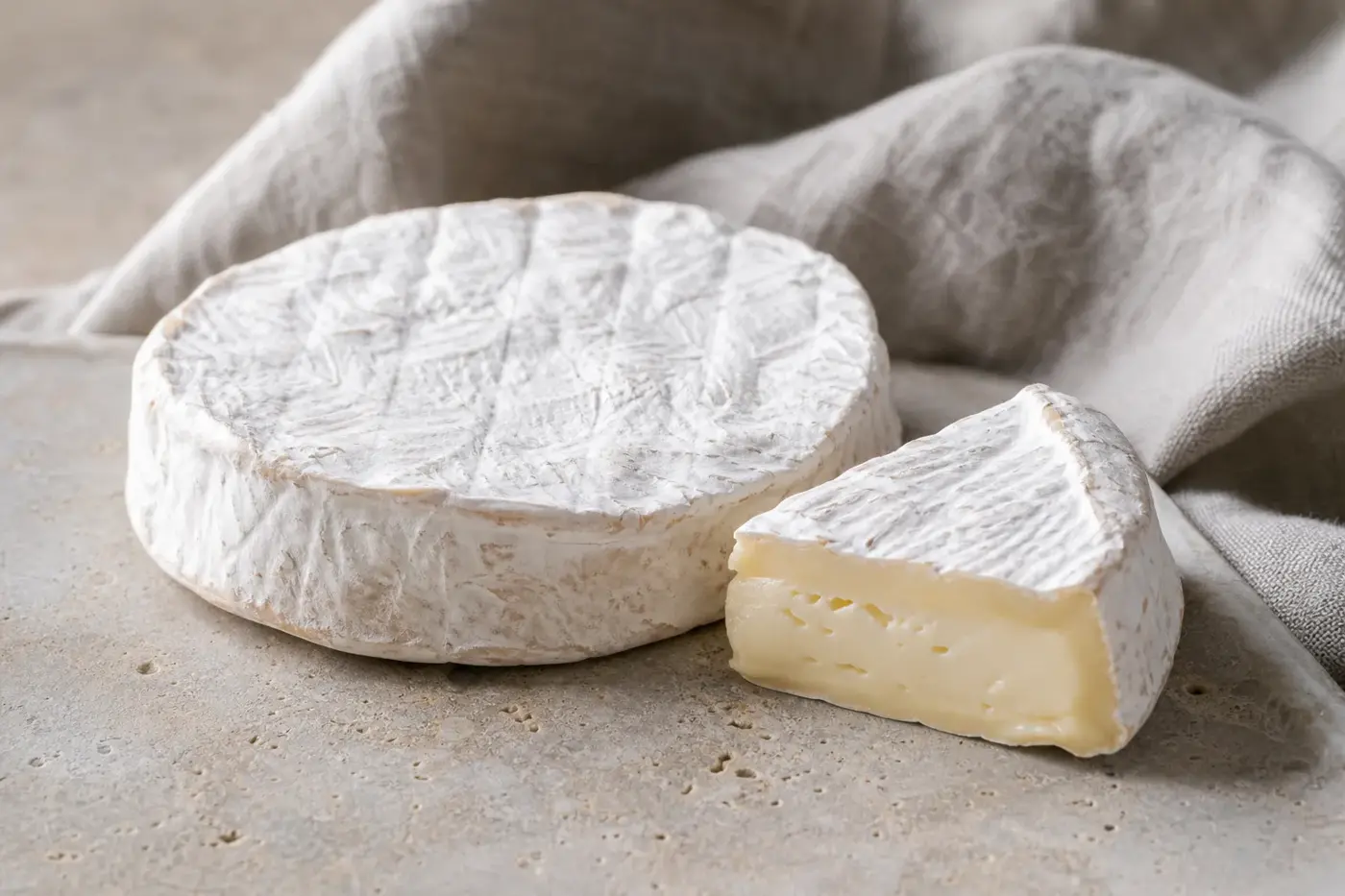
A whole French Gruyère is broad and relatively flat, with a slightly rounded profile. Its firm, granular, rubbed rind ranges from golden yellow to brown. Cut through it and you find firm paste, ivory to pale yellow.[2][3]
The openings, from pea-sized to cherry-sized, are part of the cheese’s required character. Before wheels leave the maturation cellar, the published specification requires an assessment of their number, distribution, size and shape. There is considerably more involved than a quick count.[2]
The specification explicitly connects the cheese with propionic fermentation. Its warm maturation stage continues long enough to achieve the intended opening of the paste. You can see a particularly clear link here between the work in the cellar and the cheese on the counter.[2]
A narrow packaged wedge gives you only a small view of a much larger wheel. If you can, ask to see the cut face. Consider rind, paste and openings together, rather than asking one little corner to speak for the lot.
Those openings can also start a useful conversation. Ask how the affineur judges the wheel’s development, rather than whether more holes mean better cheese. You are looking for an account of this wheel, not a league table of holes.
Find the fruit and butter beyond the firm bite
Mild and fruity, with notes of dried fruits or nuts and butter: that is how INAO describes French Gruyère. It also describes a texture that softens readily in your mouth. There is an appealing contrast between that description and the firm paste you see in a cut wheel.[3]
Firm does not have to mean harsh or brittle. “Cooked and pressed” tells you the cheese’s manufacturing family; INAO’s sensory description tells you about eating the finished piece. Those tasting descriptions are INAO’s, rather than a fromage.co.uk tasting.[3]
When choosing your wedge, bring the conversation back to the cheese in front of you. Ask whether the wheel is relatively gentle or more developed, how the paste feels and which aromas the cheesemonger notices most. The category is a useful beginning, not the whole answer.
To compare maturities, choose pieces with documented ages and taste them under the same conditions. Give aroma, resistance to the bite, sweetness, acidity, salt and persistence of flavour their own attention. Let the individual pieces tell their stories, rather than assuming a particular change in French Gruyère’s aroma or flavour from age alone.
Meet the Swiss namesake across the border
French Gruyère IGP and Swiss Le Gruyère AOP share a name and a long cross-border history. They nevertheless have distinct identities. When you buy, the French registration’s origin-labelling requirement makes that distinction visible.[1]
You may hear that French Gruyère has openings and Swiss Gruyère does not. The French half is an explicit requirement; the Swiss half is too absolute. A Swiss specification reproduced in a 2010 French parliamentary report says openings are desirable but not indispensable.[2][5]
That is a historical text, not a substitute for the current Swiss specification. If openings are part of your comparison of today’s cheeses, turn to that current specification. The familiar shorthand does not tell you enough.
The Swiss interprofession describes its cheeses aged six to nine months as gentler in character. From ten months, its Réserve range has a more pronounced aromatic character. These are the industry body’s descriptions of its Swiss products, not ageing categories for French Gruyère.[6]
If you would like to follow the Swiss cheese’s own story, see Le Gruyère. It deserves attention on its own terms.
Choosing between Gruyère, Comté, Beaufort and Emmental
Start with what you want your cheese to do. Comté, Beaufort and Emmental are useful neighbouring comparisons when you are choosing a large French cheese. Their names still deserve to stay distinct, both on the counter and in your kitchen.
A recipe asking simply for “gruyère” leaves the intended named cheese unclear. For cooking, establish which cheese it means, then ask whether a proposed substitute has worked successfully in that dish. For a cheeseboard, compare the textures and flavours of the actual pieces available.
French Gruyère offers a clear identification checklist: French origin, IGP designation and paste with the required openings.[1][2] That is more helpful than assuming every large mountain-style wheel can stand in for another. Similar company does not make these cheeses interchangeable.
The Comté article gives that cheese its own account. For detailed production distinctions between French Gruyère, Beaufort and Emmental, you’ll need to go beyond the comparison offered here.
Bring home a wedge you know something about
Read the label, then ask about the wheel. Look for Gruyère, French origin and the IGP designation, and ask who made it, who matured it and whether its stated age is documented.[1] The guide to reading a cheese label helps you distinguish product identity from other businesses’ addresses on the pack.
At home, follow the product’s storage instructions. The Food Standards Agency’s household guidance for England, Wales and Northern Ireland recommends a fridge between 0 and 5 °C and keeping dairy products refrigerated.[7] You can find more practical guidance in how to store cheese at home.
Take out only the portion you plan to serve, rather than repeatedly warming the whole piece. If you let it lose its refrigerator chill, keep that time brief. The same FSA guidance says chilled food should stay out for the shortest possible time, with a maximum of four hours during preparation.[7]
For a simple serving, give the cheese the first taste on its own. Then try plain bread and a slice of apple or pear. You can decide whether the accompaniment adds freshness or gets in the way of something you were enjoying.
Water keeps an alcohol-free comparison straightforward. Unsweetened tea is another option with bread and cheese. Let your own taste decide, rather than treating either drink as a fixed regional pairing.
Make room for French Gruyère in the kitchen
Cubes, grated preparations, soufflés, pastries and gratins all appear among INAO’s suggested uses, alongside the cheeseboard.[3] French Gruyère can be something you eat on its own or an ingredient you choose for a particular dish. Begin with what you want from it.
For your first outing, choose a familiar recipe with a method you trust. Grate the cheese for an even topping, or use cubes where you want distinct pieces. Note its full name in your recipe so you can return to the same cheese when something works.
If you are substituting, consider moisture, salt, melting and flavour. Let the dish guide your choice, rather than assuming a particular result from a swap. Taste before adding more salt, and follow the recipe’s handling and cooking instructions for the complete dish.
This page summarises published guidance from the official sources it cites. It is not medical advice. Guidance differs between countries and changes over time, so check the current source for where you live, and ask your doctor, midwife, pharmacist or dietitian about your own circumstances.
Pregnancy: start with the official advice
United Kingdom: the NHS lists pasteurised or unpasteurised hard cheeses, specifically including gruyère, among foods you can eat during pregnancy. It also lists any cheese cooked until steaming hot, including soft or blue cheese. See the NHS pregnancy guidance, November 2026.[8]
French Gruyère is made from raw milk. Consider that alongside the NHS advice for its cheese category and preparation, rather than in isolation. The guidance distinguishes hard cheeses from the soft and blue cheeses for which it gives different instructions.[8]
Read the current NHS page for the complete advice, and ask your midwife or another appropriate healthcare professional about your circumstances. Outside the UK, follow your own country’s official guidance. UK advice should not be assumed to apply everywhere.
Questions people ask
What is the difference between French and Swiss Gruyère?
French Gruyère must have openings ranging from the size of a pea to a cherry. A Swiss specification reproduced in a 2010 French parliamentary report says openings are desirable but not indispensable, though the current Swiss specification needs checking.
Is French Gruyère made from raw milk?
Yes, French Gruyère is made from raw cows’ milk. The published specification calls for rennet from calf stomachs.
How long is French Gruyère matured?
The published specification requires at least 120 days from renneting. This includes an initial period of at least 15 days at 8 to 15 °C, followed by at least three weeks above 15 °C.
What does French Gruyère taste like?
INAO describes it as mild and fruity, with notes of dried fruits or nuts and butter. It also says the texture softens readily in the mouth.
Can you eat French Gruyère during pregnancy?
The NHS lists pasteurised or unpasteurised hard cheeses, specifically including gruyère, among foods that can be eaten during pregnancy. See the NHS guidance, Foods to avoid in pregnancy, and check the current guidance for where you live.
Sources
- European Commission. Commission Implementing Regulation (EU) No 110/2013 of 6 February 2013 entering a name in the register of protected designations of origin and protected geographical indications [Gruyère (PGI)]. Official Journal L 36, 7 February 2013, pages 1 to 2. Articles 1 to 3, Annex and recitals 6 to 9. Official text.
- Syndicat Interprofessionnel du Gruyère. Cahier des charges de l’Indication Géographique Protégée « GRUYERE », version 6 October 2010, published on the industry body’s documentary website. Sections 4, 5, 7.1, 7.3 and 7.4. Published specification. Its relationship to subsequent amendments requires the editorial checks below.
- Institut national de l’origine et de la qualité. Gruyère, official product overview, undated, retrieved November 2026. Product description, aromas and flavours, territory and uses. Official overview.
- Institut national de l’origine et de la qualité. Demande de modification du cahier des charges de l’indication géographique protégée « Gruyère » approuvée par le comité national… en sa séance du 9 avril 2026. Proposed amended specification, 2026. Consultation document. Used for the editorial amendment check, not as proof that proposed changes are operative.
- Assemblée nationale. Rapport d’information n° 2368 sur la demande d’enregistrement de la dénomination « gruyère » en appellation d’origine protégée (AOP), 2010. Search-retrieved passage reproducing the Swiss specification’s provision on openings. Parliamentary report. Full-document verification remains outstanding.
- Interprofession du Gruyère. Le Gruyère AOP, current homepage, 2026. “Nos 4 variétés”, descriptions by maturation period. This is an industry body’s account of its products. Industry source.
- Food Standards Agency. How to chill, freeze and defrost food safely, published 18 December 2017, current page retrieved November 2026. Applies to England, Northern Ireland and Wales. Official household guidance.
- NHS. Foods to avoid in pregnancy, current page retrieved November 2026. “Cheese, milk and other dairy”. Official pregnancy guidance.
- French consumer-safety authorities. RappelConso, current recall portal, retrieved November 2026. Official recall portal. A complete product-specific recall search remains outstanding.
Researched through desk research using the registration instrument, published production documents, official product information and UK food-safety guidance; no visit, tasting or recipe trial was undertaken.
Last checked: November 2026
Last checked November 2026.
The editors suggest you read next