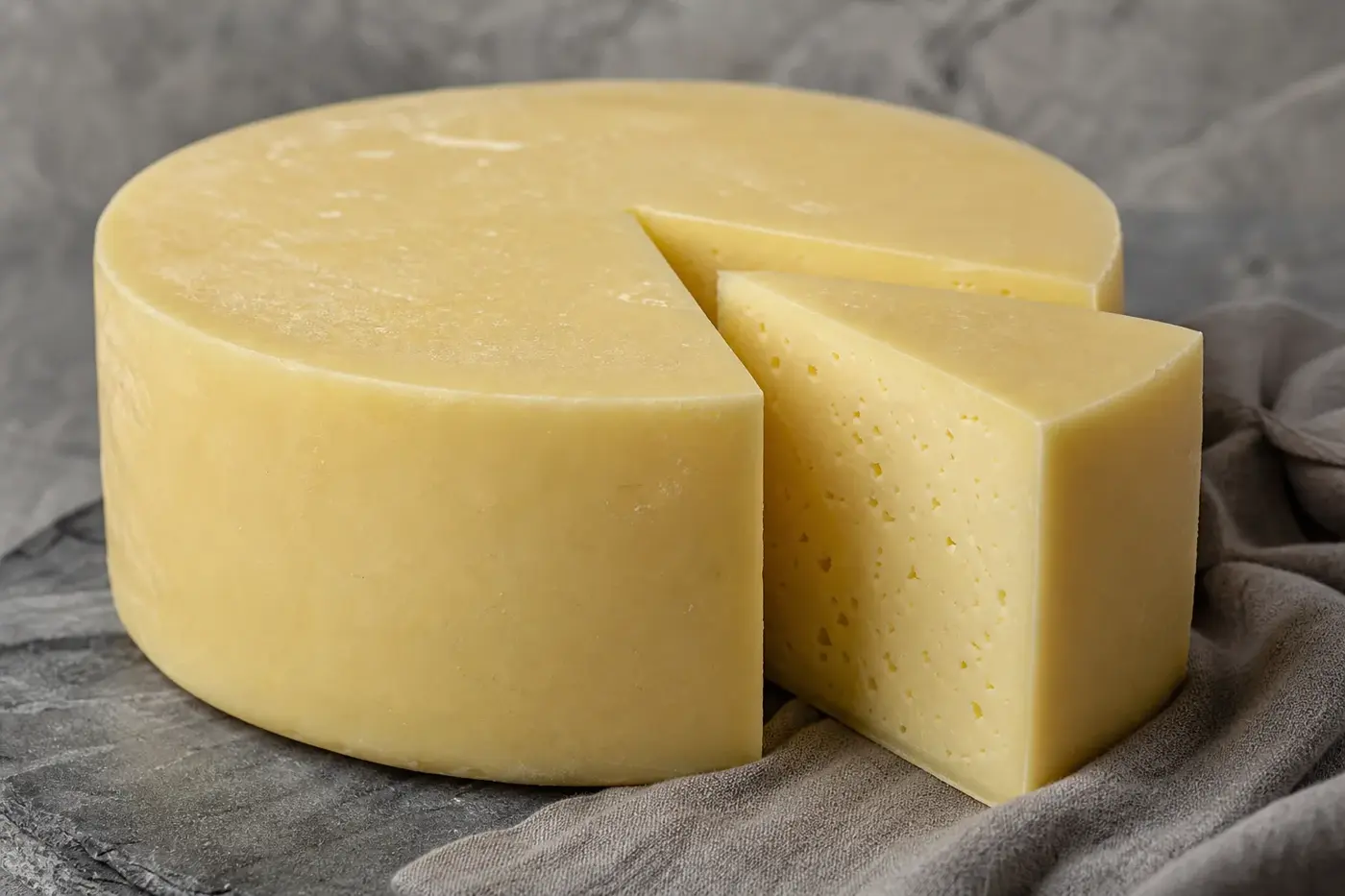
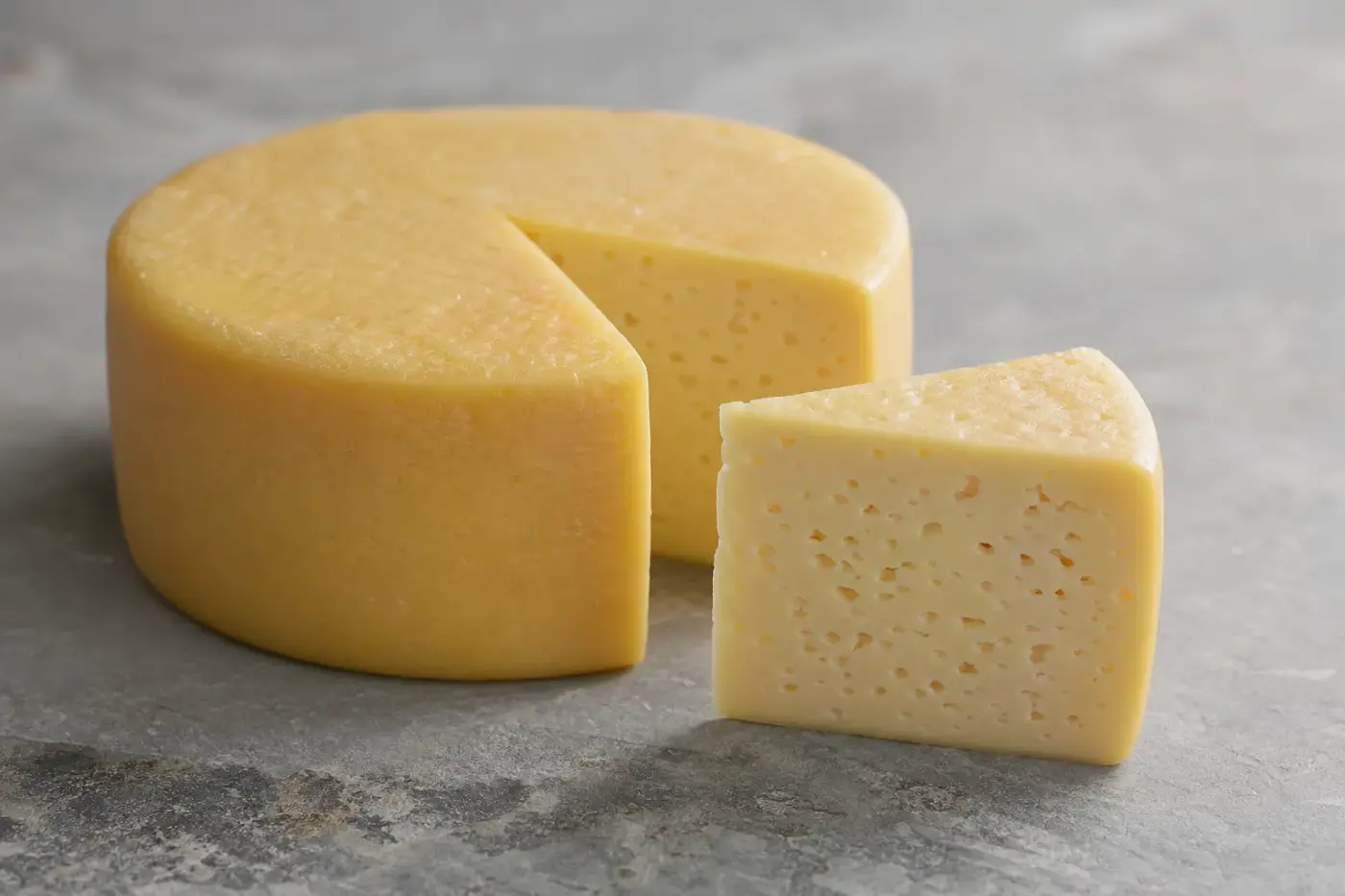
Herrgårdsost
At Marsvinsholm in southern Sweden, a Swiss cheesemaker arrives with a task: make something resembling Emmental.
At Marsvinsholm in southern Sweden, a Swiss cheesemaker arrives with a task: make something resembling Emmental. Arla’s historical account traces Herrgårdsost to that estate dairy. On your bread today, it is a Swedish cow’s milk cheese with a firm, smooth paste, rounded holes, mild sweetness and hazelnut notes. A little manor-house history, sliced for breakfast. [1,2]
| What to look for | What you’ll find |
|---|---|
| Familiar name | Herrgårdsost. [1] |
| Name on the packet | Herrgård®, a registered trademark licensed by Svenska Ostklassiker. [3] |
| Trademark register number | Not stated here |
| EU PDO, PGI or TSG status | Not stated here |
| Where it comes from | Sweden, with historical connections to manor dairies. [1] |
| Milk in the featured products | Pasteurised cow’s milk. [2,4,5] |
| Coagulant in the featured products | Ystenzym, cheesemaking enzyme; origin unspecified on these product pages. [2,4,5] |
| Texture | Firm paste with rounded holes. [2,7] |
| Whole-wheel shape, coating and paste colour | Not stated here |
| One documented maturation | Falbygdens Herrgård matured for 18 months. [5] |
| Legal minimum ageing | Not stated here |
Back to the manor, before breakfast
Herrgårdsost means “manor-house cheese”. In Swedish, herrgård is a manor house or country estate, and ost means cheese. Before you have taken a bite, the name has led you back to the estate dairies where the style developed. [1,7,10]
Arla places its beginnings at Marsvinsholm in Skåne, southern Sweden, with the arrival of that Swiss cheesemaker. Published accounts differ on when this happened. In Arla’s telling, adapting the continental method to Swedish milk produced a cheese that travelled to other estates under several names. [1,7,10]
Agreement on Herrgårdsost came at a Gothenburg exhibition in the 1890s. That manor-house connection tells you about the cheese’s history, rather than a single dairy making it today. The name settled down; the cheese kept developing. [1]
Its familiar rounded holes took time to settle, too. Arla’s archive describes earlier cheeses with smaller rounded holes, alongside larger-eyed and irregularly open versions still encountered in the 1920s. What you see today emerged from that development, not one recipe preserved unchanged. [1]
On a modern packet, it helps to separate the historical cheese name from the trademark. Svenska Ostklassiker presents Herrgård as a licensed trademark used by several dairy businesses. Look beyond the prominent name to the maker and maturity statement: those details help you distinguish one packet from another. [3]
Look for rounded eyes and a hazelnut welcome
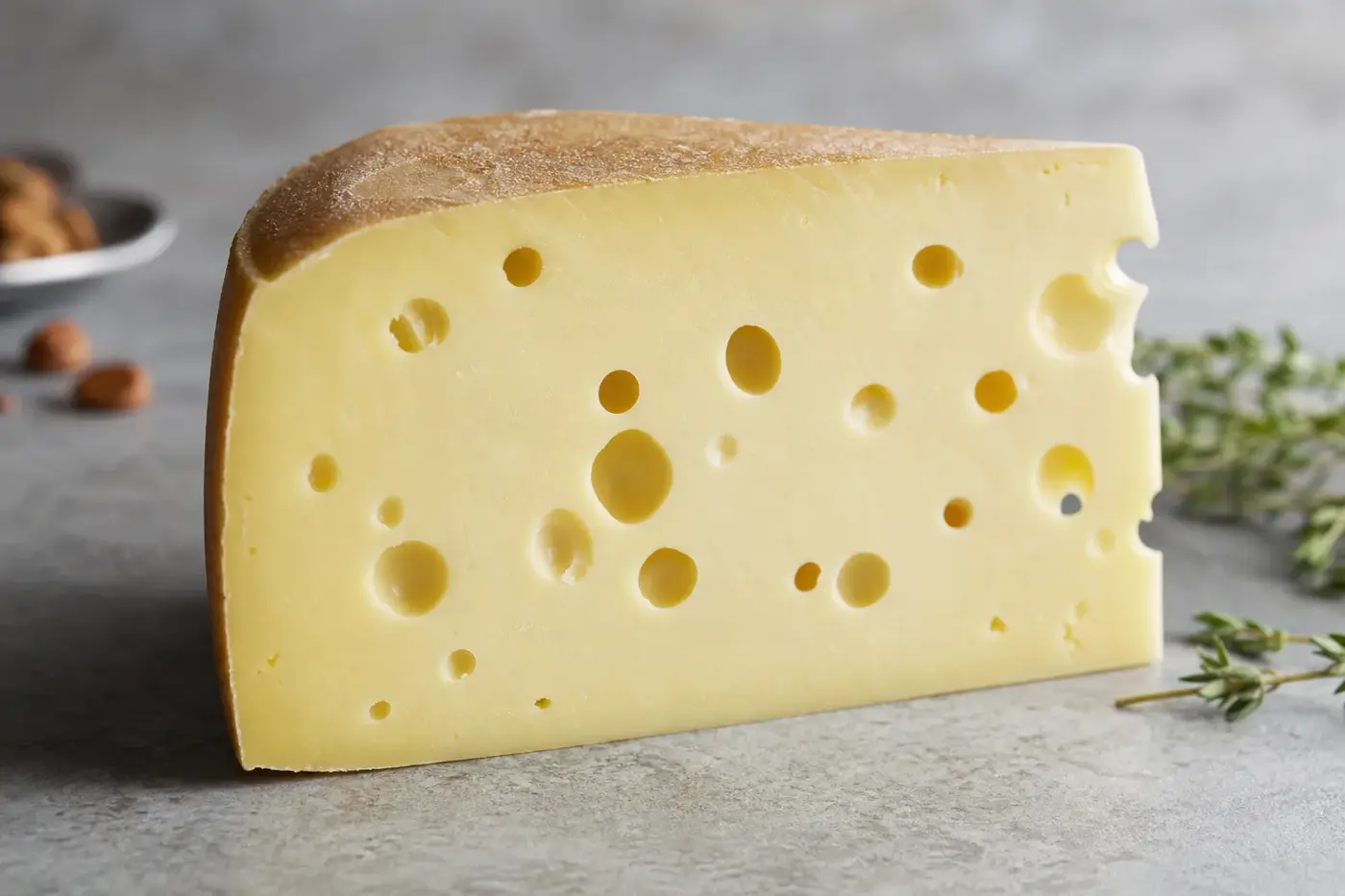
Start with the cut face. Rounded holes are Herrgårdsost’s clearest identifying feature, a texture Swedish cheese descriptions call rundpipig. Around those eyes, Arla describes a firm yet smooth paste, sturdy enough for thin sandwich slices but yielding when you eat it. [2,7]
Those openings tell you more than the outline of your portion. Rounded eyes contrast with the numerous irregular openings of a granular cheese. Your piece’s shape tells you how it was cut and packed, not the dimensions of the wheel it came from. [6]
For flavour, Arla describes its standard version as mild and sweet, with hazelnut notes. Falbygdens also names sweetness and hazelnut, adding that maturation brings a fuller aroma and stronger flavour. Use those maker descriptions as a starting point, then let your own taste have a say. [2,10]
With longer maturation, the flavour can move beyond gentle sandwich cheese. Falbygdens describes its 18-month version with butterscotch, hazelnut and a long finish. Choose a mild version for restrained dairy sweetness; look for a declared longer maturation when you fancy something more developed. [5]
The oldest packet does not automatically win. You might want mild sweetness today and a fuller flavour tomorrow. Age is useful information, not a cheese lover’s competitive sport. [2,5]
How milk becomes your next slice
The featured Arla and Falbygdens ingredient lists include pasteurised milk, salt, starter culture and cheesemaking enzyme. The starter culture contains microorganisms added to guide fermentation. The enzyme sets the milk into curd, the solid material that separates from liquid whey. [2,4,5,6]
Tetra Pak’s technical handbook describes the general method for round-eyed cheese. The curd is cut, stirred and heated to release whey, then gathered beneath the whey before pressing. Keeping those grains submerged helps them join into a close paste; salting and maturation follow. [6]
That gives you the handbook’s general account, rather than a recipe for every Herrgårdsost. Ask the producer if you want the steps behind your particular cheese. For the broader sequence, follow how cheese is made. [6]
The quiet work that makes the holes
Those eyes begin with gas produced during ripening. Gas-producing starter bacteria release carbon dioxide, which gathers in tiny cavities in the paste and expands them. Tetra Pak identifies gas-producing lactococci and related starter organisms in round-eyed cheesemaking. [6]
As ripening continues, the gas can redistribute. Some eyes grow while smaller ones disappear, so curd structure and fermentation both help explain differences in size and number. The featured product pages list starter culture without naming its individual strains. [2,5,6]
When you compare portions, look at the eyes as part of the texture. The paste around them tells you more than counting the holes in a single slice. This is cheese, not a census.
Make room for Svecia, Prästost and Jarlsberg
All four cheeses can earn a place at breakfast. If you want to tell them apart, look at their structures and published flavour descriptions. Their shared usefulness on bread is only the beginning.
Svecia: Arla’s historical account places Svecia in Sweden’s grynpipig, or irregularly open, cheese tradition. That gives you a clear visual contrast with Herrgårdsost’s rounded eyes. At the counter, ask to see the cut surfaces: the openings tell you more than their similar uses as sliced cheese. [1]
Prästost: The Swedish Competition Authority describes Präst as an irregularly open cheese. Arla’s current Präst description highlights saltiness, sweetness and pleasant acidity, while its Herrgård description centres on mild sweetness and hazelnut. Those distinctions give you more to work with than treating both as interchangeable Swedish hard cheeses. [7,8]
Jarlsberg: Its maker describes large rounded holes and a sweet, nutty taste, so you can see why the comparison comes up. That does not make the flavours identical. There is a label distinction, too: the Jarlsberg Original product page explicitly identifies microbial rennet, while the featured Herrgård product pages do not specify the enzyme’s origin. [9]
For a tasting of your own, choose portions of broadly similar maturity where the labels provide that information. Try each plain, then with the same bread. Keeping the accompaniments consistent gives you room to notice the cheeses themselves.
Let the packet point you towards your cheese
Start with the maker, ingredients and declared maturation period. A familiar name can cover different compositions: Arla lists Herrgård versions containing 17 g and 28 g fat per 100 g of cheese. Those figures describe fat in the whole cheese, not fat in dry matter. [2,4]
For pasteurisation, look for pastöriserad mjölk on Swedish packaging. All three Herrgård products featured here list pasteurised milk. Read the packet in your hand nonetheless, particularly if its maker or market differs from these examples. [2,4,5]
The word ystenzym tells you that a cheesemaking enzyme is used. It does not identify its origin as animal, microbial or fermentation-produced. If that matters to you, ask the manufacturer for a product-specific answer; types of rennet explains the terminology. [2,4,5]
Give the added ingredients a glance of their own. The featured standard Arla products list preservative E202, while the 18-month Falbygdens product also lists calcium chloride. Your individual ingredient list is where to find these details. [2,4,5]
Finally, think about what you want to eat. Mildness suits an unobtrusive sandwich filling; the producer’s longer-aged example offers its described butterscotch and hazelnut character. Keep the label until you finish the portion, so the storage instructions and product identification remain close to hand. [2,5]
Bread first, then a little exploring
Begin with a slice and some bread. Arla suggests fruit bread for its Herrgård, while Falbygdens recommends the cheese for sandwiches and cheeseboards. Taste a plain slice before adding anything sweet, then try a mouthful with bread and notice the cheese’s own sweetness. [2,10]
For a board, Falbygdens suggests pear, marmalade or chocolate. Choose one accompaniment rather than surrounding a mild cheese with several assertive flavours. Give yourself a chance to taste the cheese clearly alongside it. [5,10]
You could also set a younger portion beside a longer-aged one. It is a focused way to explore different maturities of the same named cheese. Keep the accompaniments simple and pay attention to the contrast between the two. [5,10]
In the kitchen, Falbygdens recommends melting Herrgård on sandwiches, using it for gratinating or adding it to other dishes. Arla suggests its version for cooking and pies. Those are useful starting points when you want cheese flavour without reaching for a strongly blue or washed-rind style. [4,10]
To drink, try sparkling or still water. That leaves the cheese, and whatever you have chosen to eat alongside it, in the foreground.
Keep it chilled, and slice what you need
In Sweden, Livsmedelsverket recommends refrigerating hard cheese and keeping the fridge at 4 °C. Its guidance also notes that freezing can make hard cheese crumbly. If yours is destined for a gratin or pie, grate it before freezing. Guidance reference: November 2026. [11]
For England, Wales and Northern Ireland, the Food Standards Agency advises a fridge temperature between 0 and 5 °C, alongside following the packet’s storage instructions. Use a fridge thermometer rather than judging by touch. Consult the agency’s current guidance on keeping chilled food out of refrigeration. [12] Guidance reference: November 2026. [12]
Put out the portion you intend to eat and leave the rest refrigerated. Thin slices suit bread; small pieces are convenient for comparing maturities. Follow the applicable agency’s handling advice rather than leaving the whole cheese on display throughout a long meal.
Before you eat, remove the packaging and establish what any outer covering is. Livsmedelsverket’s Swedish guidance distinguishes edible hard-cheese edges from waxed surfaces. If you are unsure about a covering, ask the maker or retailer before serving; for the wider routine, see storing cheese at home. [11]
General information only, not medical advice: follow the official guidance where you live.
Questions people ask
What does Herrgårdsost mean?
Herrgårdsost means manor house cheese. The name recalls the Swedish estate dairies where the style developed.
What does Herrgårdsost taste like?
Arla describes its standard version as mild and sweet, with hazelnut notes. Falbygdens describes its 18 month version as having butterscotch, hazelnut and a long finish.
Why does Herrgårdsost have holes?
During ripening, gas producing starter bacteria release carbon dioxide, which gathers in tiny cavities and expands them. As ripening continues, some holes can grow while smaller ones disappear.
Is Herrgårdsost made with pasteurised milk?
All three Herrgård products examined on the page list pasteurised cow’s milk. Check the packet, particularly if the maker or market differs from those examples.
Is Herrgårdsost suitable for vegetarians?
The product pages checked list cheesemaking enzyme, or ystenzym, but do not state its origin. Ask the manufacturer for a product specific answer.
Sources
-
Arla, Osttillverkning i Sverige, Arlas Historia, undated online historical account, accessed November 2026.
Read at arla.se -
Arla, Arla Ko® Herrgård® ost 28% ca 730g, current online product information, accessed November 2026.
Read at arla.se -
Svenska Ostklassiker AB, Public, current company statement about its cheese trademarks and licensing, accessed November 2026.
Read at svenskaostklassiker.se -
Arla, Arla Ko® Herrgård® ost 17% ca 730g, current online product information, accessed November 2026.
Read at arla.se -
Arla, Falbygdens® Herrgård® lagrad 18 mån hårdost ca 540g, current online product information, accessed November 2026.
Read at arla.se -
Tetra Pak, Dairy Processing Handbook, chapter 16, Cheese, current online edition, accessed November 2026.
Read at dairyprocessinghandbook.tetrapak.com -
Konkurrensverket, Beslut, Dnr 661/2018, 30 April 2019, particularly paragraphs 47, 50 and 202.
Read at konkurrensverket.se -
Arla, Arla Ko® Präst® ost 31% ca 720g, current online product information, accessed November 2026.
Read at arla.se -
Jarlsberg, Products, current online specifications for Original, Lite and Special Reserve, accessed November 2026.
Read at jarlsberg.com -
Falbygdens Ost, Herrgård®, en svensk ostfavorit, undated producer and seller account, accessed November 2026. Its commercial interest is in selling the cheese described.
Read at falbygdensost.se -
Livsmedelsverket, Sweden, Ost (hårdost), reviewed 25 September 2026, accessed November 2026.
Read at livsmedelsverket.se -
Food Standards Agency, How to chill, freeze and defrost food safely, published 18 December 2017, current online text accessed November 2026; applies to England, Northern Ireland and Wales.
Read at gov.uk -
European Commission, eAmbrosia geographical indications register, accessed November 2026; the interface returned no readable registration results in this research session.
Read at ec.europa.eu
Research combined producer specifications, a dairy technical handbook, an official competition decision, published dairy history and national food safety guidance; serving suggestions labelled as editorial suggestions are desk research, not a recorded tasting.
Last checked: November 2026
Last checked November 2026.
The editors suggest you read next
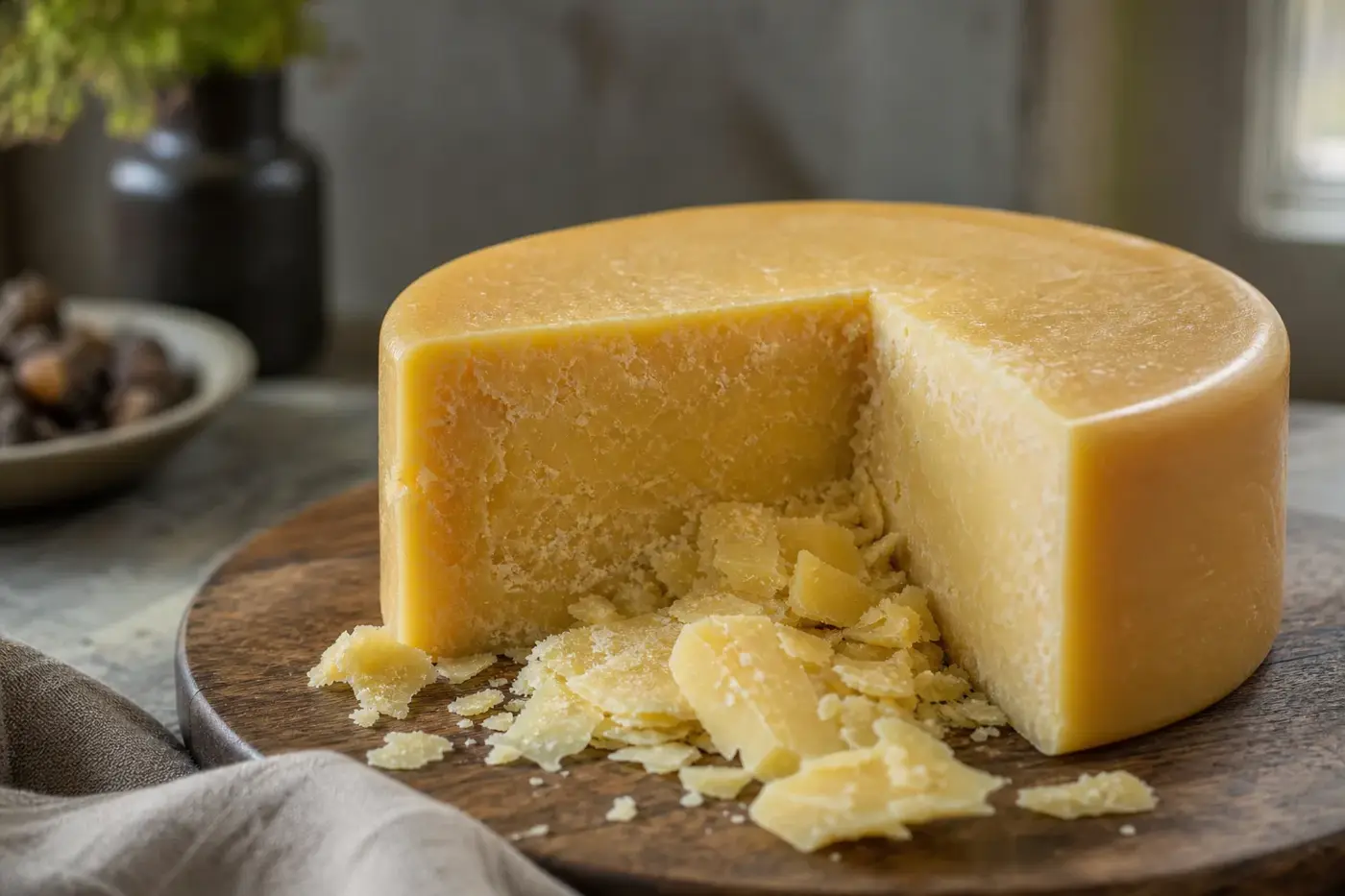
Västerbottensost
Your cheese plane meets Västerbottensost and a neat slice becomes a tumble of brittle flakes.