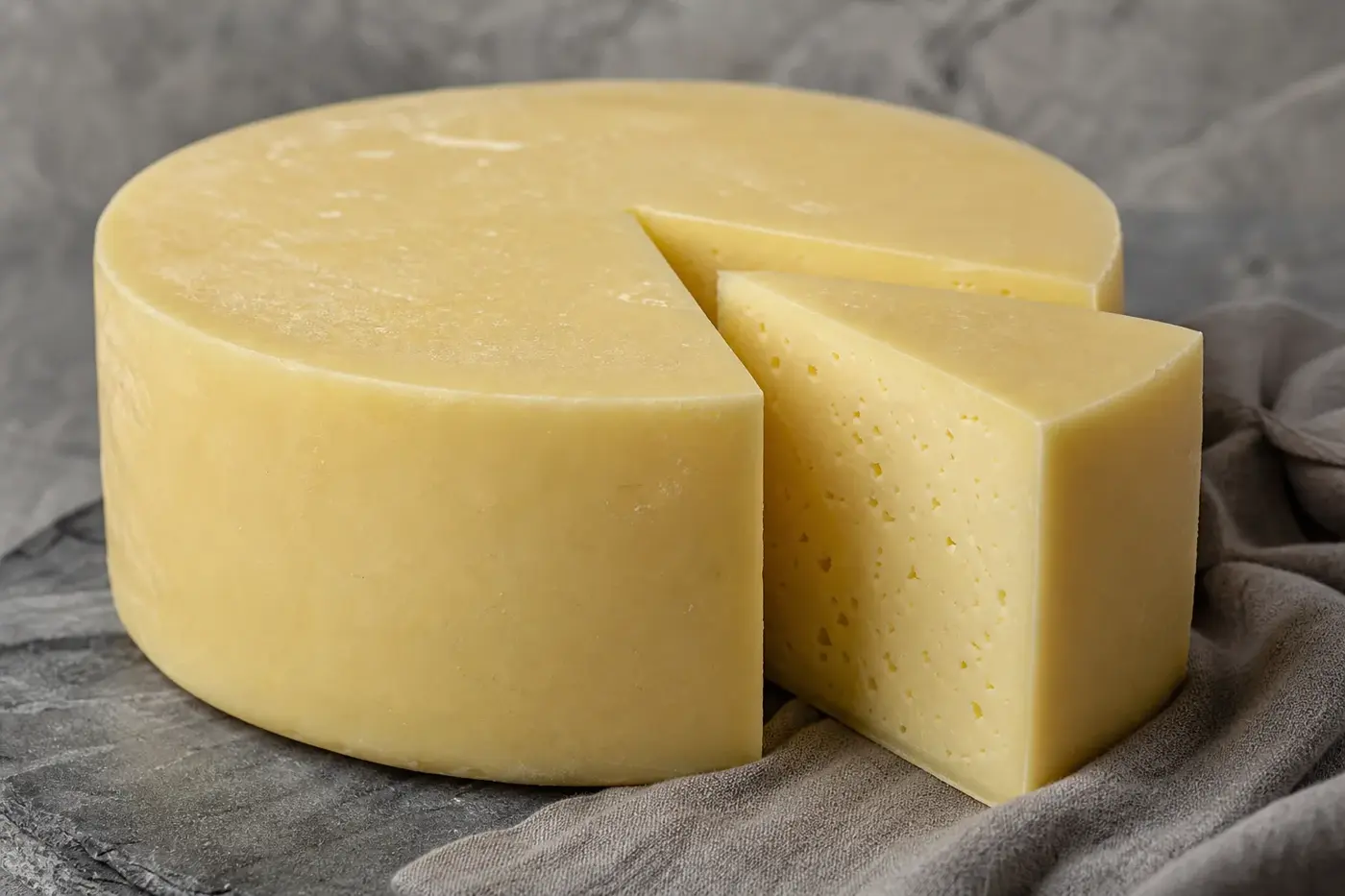
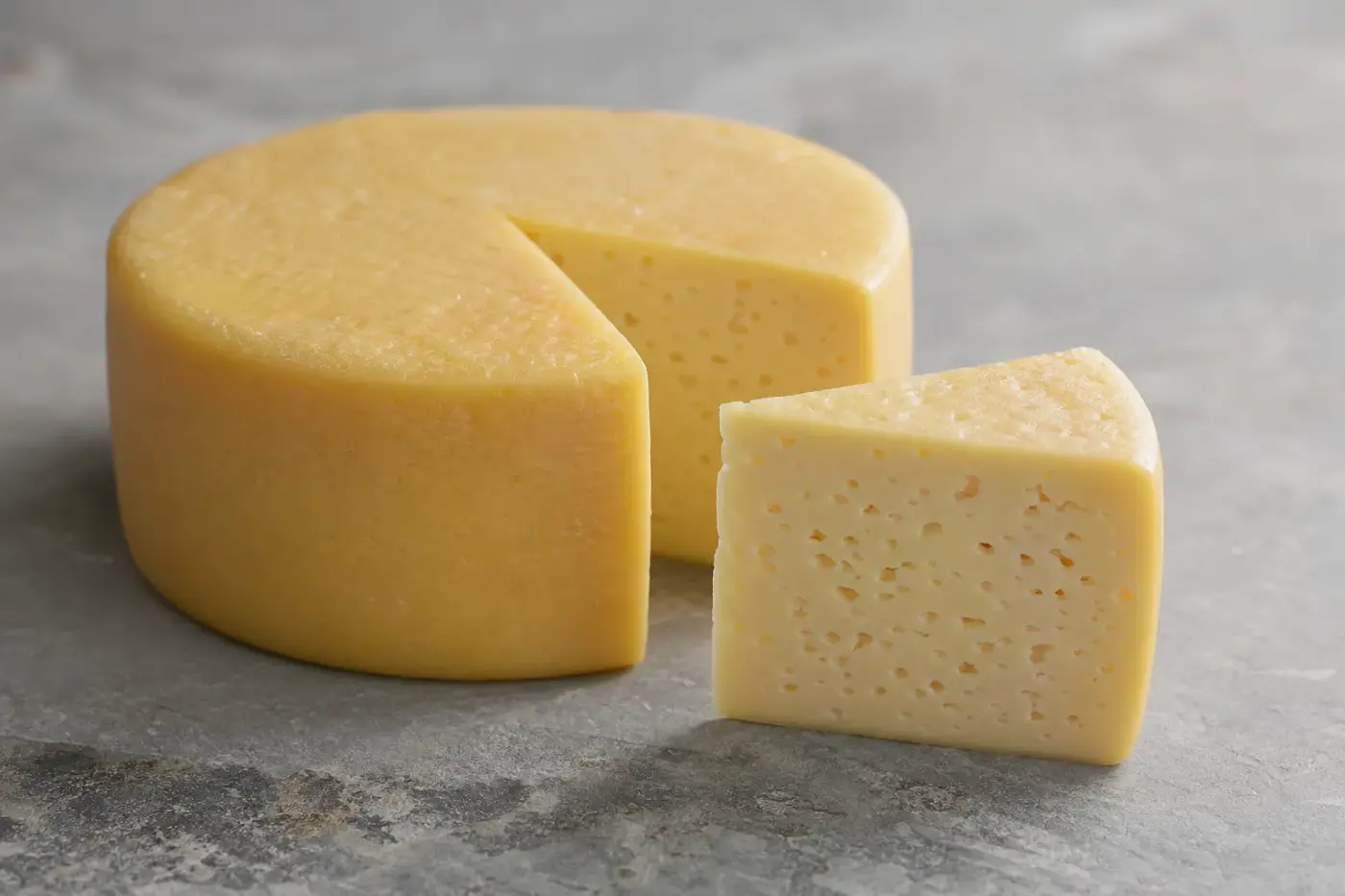
Västerbottensost
Your cheese plane meets Västerbottensost and a neat slice becomes a tumble of brittle flakes.
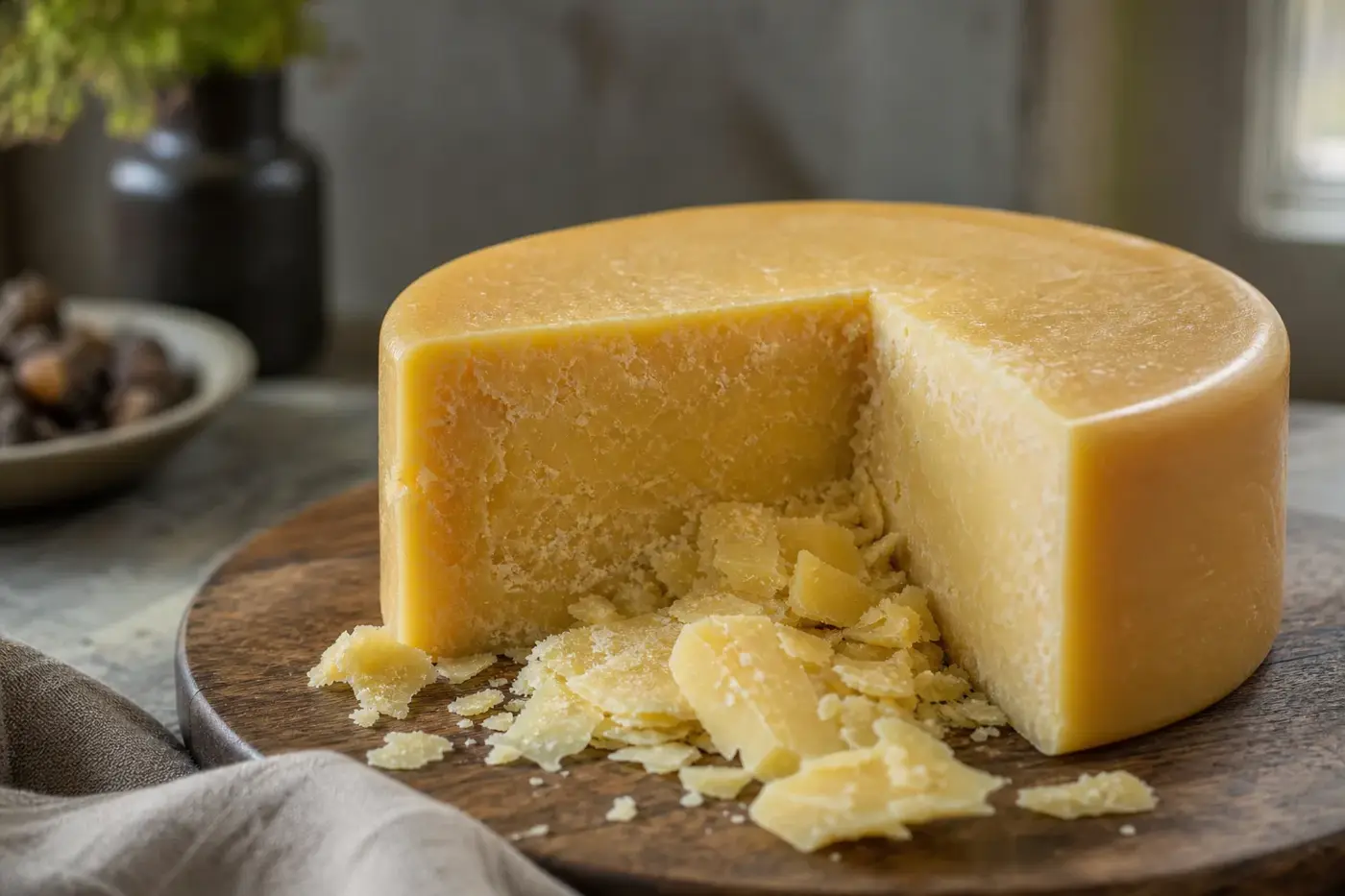
Your cheese plane meets Västerbottensost and a neat slice becomes a tumble of brittle flakes. So much for precision. Those crystals and grains are part of the pleasure: made by Norrmejerier from cow’s milk in Burträsk, a village in northern Sweden, this firm cheese matures for at least 14 months in round, 18 kg wheels. Its savoury depth is as welcome on your bread as at the heart of a Swedish celebration pie.[1][3][5][8]
| Get acquainted | The details |
|---|---|
| Name | Västerbottensost.[1] |
| Made by | Norrmejerier.[1] |
| Home | Burträsk, Sweden.[5] |
| Milk | Pasteurised cow’s milk.[3][10] |
| Coagulant | Rennet; source unspecified.[3] |
| Cultures | Lactic acid culture; strains unspecified.[3] |
| Maker’s minimum maturation | 14 months.[5] |
| Shape and size | Round wheel, 18 kg.[5] |
| Outer covering | Paraffin coating.[2] |
| Inside | Firm and granular; colour and holes unspecified.[3] |
| Declared preservatives, whole wheel | E202, E235 and E251.[3] |
| Protection by jurisdiction | Sweden and EU: unconfirmed; Northern Ireland: unconfirmed; Great Britain: unconfirmed; Switzerland: unconfirmed; United States: unconfirmed |
Follow the flakes into the flavour
Västerbottensost breaks into grains and flakes rather than offering you an effortlessly flexible slice. That texture is central to its charm. The producer describes the whole cheese as brittle and crystalline, with milk sweetness, bitterness and umami, the savoury taste that gives it depth and persistence.[3]
Visit Umeå adds a tart, fruity aroma with hints of nuts, and a spicy flavour suggesting caramel and truffle. Start with savoury, tangy and nutty, then taste a piece and see what comes forward for you.[4] Time changes the balance: the producer links longer ageing with deeper flavour and a more brittle texture.[2]
Meet Ulrika Eleonora Lindström, before the legend takes over
Norrmejerier traces the cheese’s beginnings to 1872 and credits dairymaid Ulrika Eleonora Lindström with creating the recipe. Its history brings her to Gammelbyns dairy in Burträsk after training in cheesemaking.[1][2] Keep that training in mind as you meet the next character in the story.
Enter the courting milkman. In the popular legend, he distracts Lindström from the vat, heating and stirring become irregular, and the cheese looks like a failure. Maturation supplies the surprise: an unexpectedly successful result.[1]
Norrmejerier itself calls this a myth.[1] Enjoy the story, certainly, but give Lindström’s cheesemaking expertise the credit. The milkman has had quite enough publicity.
Travel with the milk from Burträsk to Ånäset
The milk comes from farms around Burträsk, according to the maker. After pasteurisation, it separates into curd, the solid portion that becomes cheese, and whey, the liquid released from it. The product information names rennet as the coagulating ingredient but does not specify its origin.[2][3][5]
Next come round moulds and 18 hours of pressing, with scheduled turning by hand in Norrmejerier’s production outline. The cheeses then go into brine. Shaping, draining and salting each do their work before a wheel reaches the maturation store.[5]
That warehouse stands in Ånäset, also in Västerbotten. The producer describes turning the cheeses during early storage and dipping them in protective paraffin.[2] Remove that coating when you prepare a piece: it is separate from the edible cheese inside. You can follow the wider journey in how cheese is made.
Give it fourteen months, then let taste decide
The maker requires at least 14 months of maturation, but a calendar cannot taste cheese. Before release, the cheesemaking team takes a core sample and assesses flavour, aroma, consistency, texture and appearance. Some wheels need longer. Readiness depends on both time and how the cheese has developed.[1][5]
Longer maturation brings a more fragile texture and sometimes more crystals, Norrmejerier explains. That is why your cheese plane may deliver fragments rather than tidy slices.[2] Put them in a sandwich or grate them for cooking. Crumbliness can be exactly what you should expect.
The producer also lists a grated version matured for 24 months.[6] Choose that stated age to suit your dish, not because a larger number automatically means better cheese. If you want pieces to eat as they are, ask a cheesemonger about texture and flavour balance. Those answers tell you more about what you will enjoy.
Pull up a chair at a Swedish celebration
At a kräftskiva, the Swedish crayfish party, Västerbottensost sits alongside the shellfish. The Swedish Institute’s cultural guide describes August gatherings with crayfish, toast and Västerbottenpaj, a pie filled with aged cheese from Västerbotten.[7] Here, you need not wait for a cheese course afterwards. A substantial cheese dish is part of the main event.
Inside the pie, grated cheese flavours an egg and cream filling held in pastry. Norrmejerier publishes a version with leeks and a browned butter accompaniment, suggesting it for Midsummer, Easter and Christmas.[8] Its recipe collection offers the producer’s culinary perspective, with a commercial interest in the ingredient alongside that enthusiasm.
For your first encounter, try the cheese plain and in a pie on separate occasions. Alone, its texture takes the spotlight; in a filling, you discover its role as a seasoning. If a pie recipe requires Västerbottensost specifically, it should say so. You should not have to guess which cheese belongs in the filling.
Start with a flake and keep the plate simple
Give the cheese your attention before adding accompaniments. For guidance on how long chilled food can stay out of refrigeration, turn to the Food Standards Agency advice for England, Wales and Northern Ireland.[9]
- Taste a small flake on its own. Does sweetness, saltiness, tang or bitterness arrive first? Notice how the texture breaks down, then try another piece with an accompaniment. You now have a clear starting point for the contrast.
- Try crispbread with a slice of apple or pear. You get a crisp bite and fresh fruit without turning the plate into a project. Keep it simple, then decide whether you fancy something sweeter or would rather carry on with bread alone.
- For the producer’s recommendation, try cloudberry chutney or a slightly sweet marmalade.[10] Put a little beside the cheese, not over it. Water makes a straightforward drink; an alcohol free apple drink is another option if you want to echo the fruit on your plate.
Put it to work in pie, pasta or gratin
Make Västerbottensost the principal flavour in a pie, grate it over pasta, or use it to top a gratin. The producer’s grated product information specifically suggests pasta, pizza and pies.[11] Start with a recipe written for your dish. Add the cheese before adjusting the seasoning.
A wedge gives you pieces for the table and cheese to grate into dinner. A ready grated pack saves you that preparation, but the formulation differs: the producer’s version includes potato starch as an anti-caking ingredient.[11] Read the ingredients on your particular pack. A wedge and a bag do not necessarily contain exactly the same things.
Missing Västerbottensost? Choose a substitute with purpose
For a savoury pie, begin with a mature Cheddar chosen for pronounced flavour, rather than a particular age label. For a grated finishing cheese, consider an aged hard grating style. Treat either as a substitute to explore in the dish, and call the replacement by its own name.
First, decide what you need the cheese to do: fill the pie, top the surface or provide the final seasoning. Compare the replacement’s texture and declared salt content with the original ingredient before changing quantities. You can explore the first option in Cheddar.
Keep the recipe’s egg and liquid balance intact unless its author gives you an alternative. Changing the cheese need not mean rebuilding the whole filling. Let the job you need it to do guide your choice.
Choose your piece and get to know the label
Match the format to your plans. The producer lists wedges, larger pieces, whole wheels and grated packs.[12] For a cheeseboard, ask to see the cut surface and talk about how readily the piece slices. For cooking, decide whether you want to grate it yourself or reach for the prepared version.
The whole wheel’s published ingredient list declares pasteurised milk, salt, lactic acid culture, rennet and preservatives E202, E235 and E251.[3] Look at your own pack for its ingredients, any additions and handling directions. How to read a cheese label helps you separate the different kinds of information and find what matters for your needs.
If you need vegetarian cheese, ask the producer or supplier to confirm the rennet’s source for that specific product. “Rennet” alone does not answer the question. Look for an explicit statement about that product, rather than relying on the cheese’s country or age. Rennet explained gives you the background to that distinction.
This page summarises published guidance from the official sources it cites. It is not medical advice. Guidance differs between countries and changes over time, so check the current source for where you live, and ask your doctor, midwife, pharmacist or dietitian about your own circumstances.
Save the rest for another day, safely chilled
Follow the storage instructions and date marking on your pack. Food Standards Agency advice for England, Wales and Northern Ireland is to keep the fridge between 0 and 5 °C (32 to 41 °F), check it with a thermometer, and keep dairy products refrigerated.[9] Serve a portion and leave the remaining cheese chilled.
Follow the pack’s directions after opening, too. There is no single shelf life that fits every piece. If cooking is your main aim, choose a format to suit, or plan your table portions and grated uses before opening it. For the wider guide, see how to store cheese at home.
Questions people ask
What does Västerbottensost taste like?
The producer describes milk sweetness balanced by bitterness and umami. Visit Umeå describes a tart, fruity aroma with hints of nuts and a spicy flavour suggesting caramel and truffle.
Where is Västerbottensost made and how long is it matured?
Norrmejerier makes it in Burträsk, northern Sweden, using milk from nearby farms. It is matured for at least 14 months, and the cheesemaking team assesses each wheel before release.
Is Västerbottensost vegetarian?
The cheese contains rennet, but its source has not been verified. Ask the producer or supplier to confirm the rennet source for the specific product.
What can I use Västerbottensost for?
It can be eaten on bread, grated over pasta or used in a pie or gratin. Norrmejerier also suggests its grated version for pizza.
How should I store Västerbottensost?
Follow the storage instructions and date marking on your pack, including directions after opening. The Food Standards Agency advises keeping dairy products refrigerated and the fridge between 0 and 5 °C; see its advice for England, Wales and Northern Ireland.
Sources
- Norrmejerier, The story of the beloved Swedish cheese, undated live edition, checked November 2026. Producer account of origins, Lindström, the legend and maturation. Source.
- Norrmejerier, Frågor & svar, undated live edition, checked November 2026. Producer information on local milk, history, Ånäset, paraffin and texture variation. Source.
- Norrmejerier, Västerbottensost Cheese wheel 18kg, undated live product information, checked November 2026. Ingredients and producer tasting description. Source.
- Visit Umeå, The Västerbottenost story, undated live edition, checked November 2026. Regional destination organisation’s sensory description. Source.
- Norrmejerier, Crafts, undated live edition, checked November 2026. Producer’s manufacturing outline and maturation assessment. Source.
- Norrmejerier, Västerbottensost Grated 24mån 120g, undated live product information, checked November 2026. Source.
- Swedish Institute, Switch to Sweden: The Insider’s Guide to Moving and Living in Sweden, December 2024 edition, “Traditional Swedish Food”, printed page 19. Source.
- Norrmejerier, Västerbottensostpaj with browned buttercream, undated live recipe, checked November 2026. Used for ingredients and cultural positioning, not as a reproduced or independently tested recipe. Source.
- Food Standards Agency, How to chill, freeze and defrost food safely, published on GOV.UK, 18 December 2017, live edition checked November 2026. Applies to England, Northern Ireland and Wales. Source.
- Norrmejerier, Västerbottensost Gourmet piece 165g, undated live product information, checked November 2026. Producer’s accompaniment suggestions. Source.
- Norrmejerier, Västerbottensost Grated 150g to 2kg, undated live product information, checked November 2026. Cooking uses and potato starch declaration. Source.
- Norrmejerier, The assortment, undated live catalogue, checked November 2026. Product formats. Source.
This piece combines desk research of producer information, Swedish cultural material and official food handling guidance, with editorial serving and substitution suggestions identified in the text.
Last checked: November 2026
Last checked November 2026.
The editors suggest you read next