How to Make Smooth Cheese Sauce and Stop It Splitting
The cheddar slips into the pan.
The cheddar slips into the pan. For a moment, you have silk. Then come the grains and little pools of oil: the cheese has become too hot. Your best defence comes before that first handful goes in: take the pan off the heat.[1][2]
Simmer the butter, flour and milk base until it thickens. Then let its warmth do the gentler work of melting the cheese. Same pan, two jobs, and cheese would very much prefer the quieter one.[1][2]
A silky sauce starts here
Recipe status: adapted from Booths’ published roux method and Good Food’s technique of adding cheese off the heat, with the cheese increased to 150 g. Independent testing by fromage.co.uk: none. Booths is a food retailer, so its recipe is a commercial source.[1][2]
Serves: 4 as a sauce. Preparation: about 5 minutes. Cooking: about 15 minutes, guided by the consistency below. Equipment: medium saucepan, scales, measuring jug, whisk, spoon and grater. Oven: not needed.[1][2]
Get everything ready by the hob
- 30 g (1.1 oz) butter
- 30 g (1.1 oz) plain flour
- 500 ml (16.9 US fl oz) milk
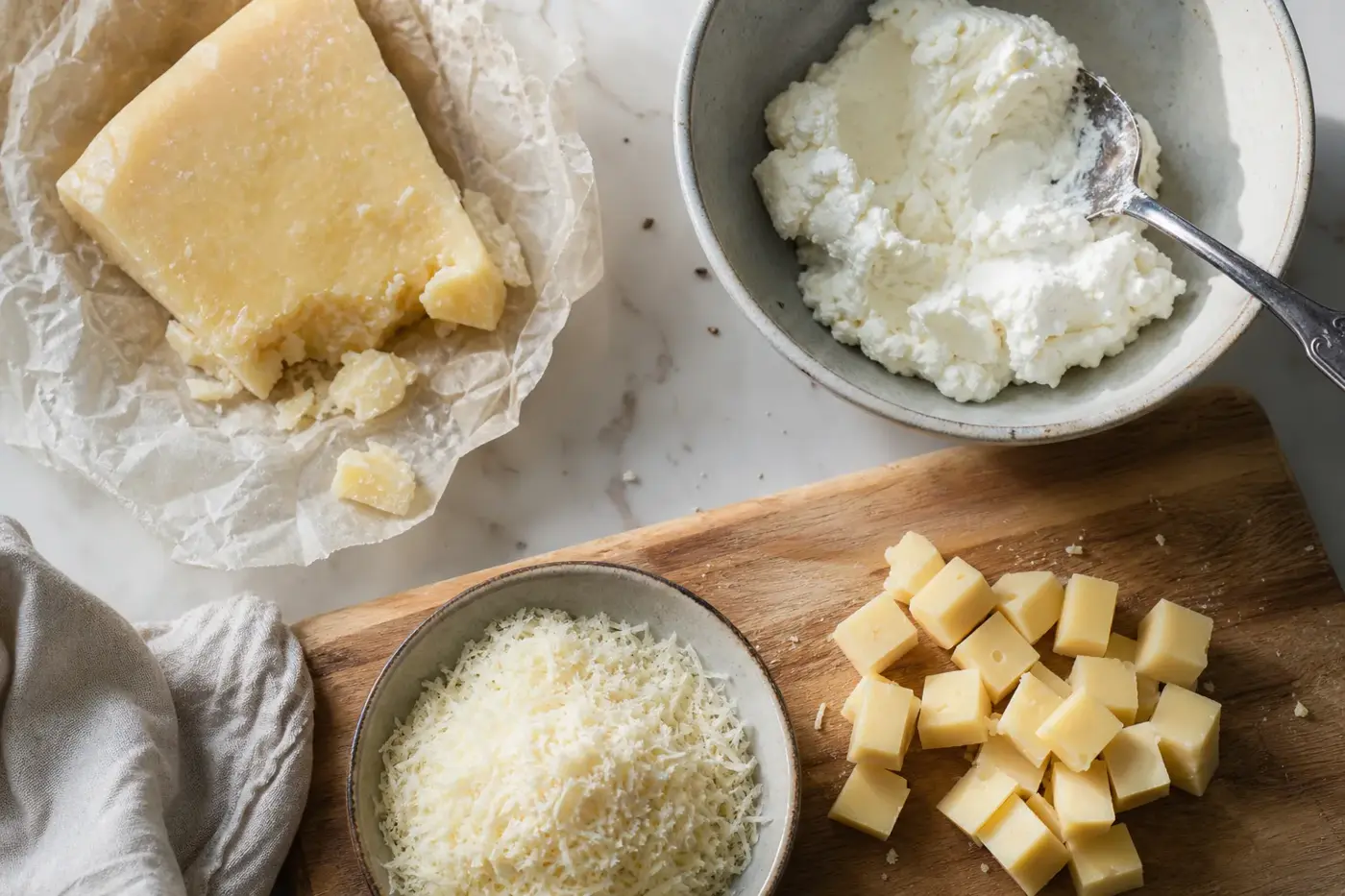
- 150 g (5.3 oz) cheddar, freshly grated
- Optional: mustard, black pepper and salt, added after tasting
From butter to sauce, gently does it
- Melt the butter over a low to medium heat. Stir in the flour and cook for 1 to 2 minutes, stirring continuously. That pale paste is your roux. Keep it pale; do not let it brown.[1]
- Whisk in a small splash of milk until smooth. Repeat, gradually loosening the paste. Once it flows easily, whisk in the remaining milk in a steady stream. Scrape the pan’s corners so no thick paste stays behind.[1]
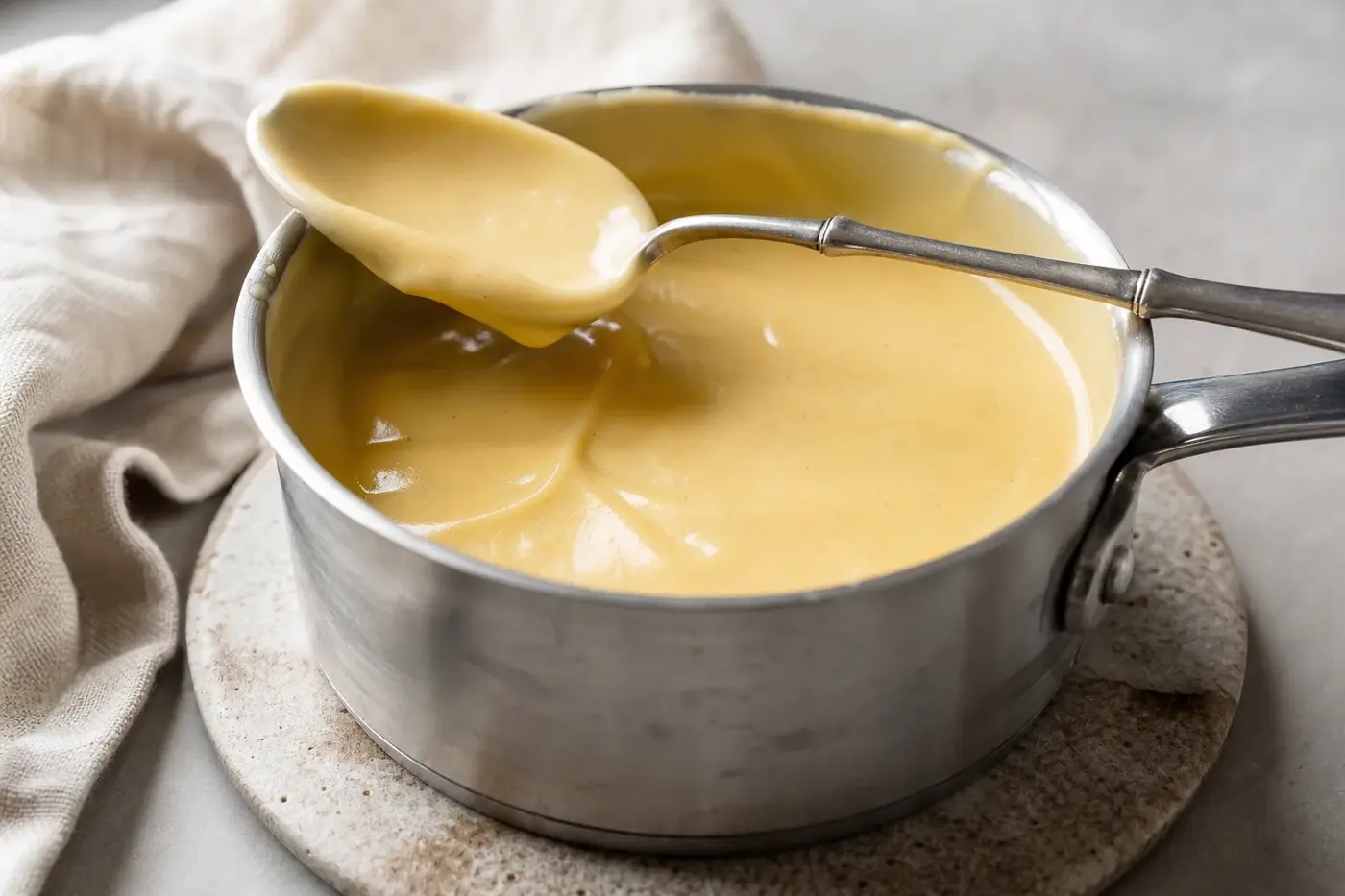
- Bring to a gentle simmer, stirring, then cook for about 5 minutes until the sauce thickens and coats your spoon. Finish this stage before adding cheese. Flour needs cooking; cheese needs only enough warmth to melt.[1][3]
- Take the pan off the heat. Add the grated cheddar in handfuls, stirring each one into the sauce before adding more. If shreds remain, return briefly to the lowest heat while stirring, then remove the pan again. Avoid boiling.[2]
- Check the thickness. Whisk in a little warm milk if the sauce needs loosening. Stop when it pours as you want it. Taste before adding mustard or pepper, and add salt only if needed.[2][4]
- Serve promptly. For cooling and reheating, follow the Food Standards Agency guidance below. It applies to England, Wales and Northern Ireland.[8][9]
Let flour take the heat, not your cheese
Your sauce stays smooth when the cheese’s fat remains dispersed through the water supplied by the milk. That is emulsification. Too much heat can encourage proteins to gather into tighter clumps, giving you graininess. Oily droplets or a greasy layer also signal that the smooth structure has broken down.[2][5][6]
Flour brings starch to the pan. As it cooks, that starch thickens the milk and helps hold the sauce together evenly.[5]
Researchers explored this with controlled experiments using cheese, water and different starch concentrations. They heated the mixtures and measured the resulting protein aggregates: more starch delayed clumping and reduced aggregate size. That supports starch’s stabilising role, although they used corn starch and sheep’s milk cheese, not this wheat-flour roux.[5]
Think of your cooking in two stages. First, cook the flour in milk to build thickness; once the cheese goes in, you only need to melt and combine. Taking the pan off the burner makes that change clear. It matters especially on an electric hob, which stays hot after you switch it off.[1][2]
Choose your cheddar and give it a fresh grate
Younger cheddar gives you a gentler cheese flavour. Mature cheddar makes a more pronounced sauce. Good Food’s recipes use strong or mature cheddar, including in a baked macaroni sauce; get to know the cheese itself in cheddar.[2][3]
Maturity is not a promise of smoothness, though. Young and mature cheddar can melt differently, and research following cheddar through ripening found several factors working together. Calcium, residual lactose, salt-to-moisture ratio and age all interacted to affect melting behaviour.[7]
Grate your cheese just before cooking. Good Food’s test kitchen notes that pre-grated cheese can contain anti-clumping ingredients that make melting less smooth. Fresh grating gives you small shreds to add evenly, too. A large piece needs longer in a pan that keeps heating.[3]
Looking beyond your usual cheddar?
Another block of cheddar, used at the same weight, is your closest substitute. Adjust the milk and seasoning to suit it: changing maturity changes flavour and can alter melting behaviour.[2][7]
Good Food also suggests replacing half its cheddar with crumbled blue cheese. Moisture, salt and melting behaviour vary between cheeses. Check the consistency and flavour before reaching for the salt.[2][7]
Find the right pour for your supper
For cauliflower, you might want a sauce that pours freely. For binding a filling, something thicker makes sense. Start with the recipe as written, then stir in warm milk a little at a time.[1][4]
Mix thoroughly before deciding whether you need more. A succession of generous splashes can take you past your ideal consistency surprisingly quickly. The milk jug is not a precision instrument when you are feeling optimistic.[1][4]
Mustard takes the flavour in a sharper, savoury direction; pepper brings warmth. Salt can wait until you have tasted the melted cheese. For baked pasta, leave the sauce loose enough to coat everything generously, because, as Good Food notes, pasta absorbs some sauce in the oven.[2][3]
Read the clues: lumps, grains or oil?
Think back to when the texture changed. Lumps that appeared before the cheese went in point towards the flour stage. If your sauce was smooth until you added cheese, it needs a different response.[1][2]
Use the table to work out what happened and what to try next. The storage limits below still apply, however promising a texture rescue might look.[8][9]
| What you see | What it tells you | Likely cause | Your next step |
|---|---|---|---|
| Pale flour lumps | A quality problem | Milk mixed unevenly into the roux | Take off the heat and whisk smooth before continuing.[1] |
| Fine graininess after adding cheese | A quality problem | Protein aggregation, often linked to excess heat | Take off the heat and try the milk rescue below.[2][5] |
| Oily droplets or a greasy layer | A quality problem | Fat separating from the mixture | Stop heating and recombine gently; severe separation may persist.[5][6] |
| Leftovers kept beyond the official limit | A possible safety concern | Storage outside the FSA guidance below | Throw away. Fixing texture cannot make unsafe storage safe.[8][9] |
Give a troubled sauce a gentler landing
Lift the pan off the hob immediately. Whisk in a small splash of warm milk, then check the texture before adding more. Your aim is to loosen and recombine the sauce, not subject it to another blast of fierce heat.[2][5]
There are limits to this rescue. Badly aggregated proteins and a large pool of separated oil may leave your sauce permanently coarse. Sometimes it will not come back together.[2][5]
Resist adding more cheese to disguise the trouble. Instead, retrace your steps to the last moment everything looked right. Was the flour sauce smooth, and was it still bubbling when the cheese went in? Did you keep cooking after the cheese had melted?[1][2]
Those answers will help your next batch more than turning up the heat and hoping the granules disappear. Here, more heat is not the answer.[1][2]
Sodium citrate: another route to smoothness
Sodium citrate offers another way to make a stable cheese sauce. It binds calcium and changes protein interactions, helping cheese proteins disperse and fat stay emulsified.[5][6]
Research on processed cheddar found improved fat emulsification and casein dispersion as trisodium citrate concentration increased. Separate cheese-and-water experiments also found that citrate suppressed visible aggregation.[5][6]
If you are curious, choose a recipe developed specifically for sodium citrate. The balance of cheese, liquid and emulsifying salt matters. Keep the roux recipe above unchanged while you learn the alternative: its flour already provides a stabilising system. Adding cheese off the heat remains the simplest control to practise.[1][5][6]
Put your sauce to work at supper
Toss your freshly made sauce through cooked pasta, pour it over well-drained cooked cauliflower, or use it in a baked pasta dish. Give vegetables time to drain carefully before you add the sauce.[3][10]
Good Food’s cauliflower recipe drains the cooked florets before coating them. Its macaroni recipe combines cooked pasta with sauce before baking. Either gives your sauce a place at the table.[3][10]
Make it close to serving time and serve promptly. If you keep it hot, use gentle heat and stir rather than letting it boil. Cool any leftovers promptly, following the guidance below.[2][8]
This page summarises published guidance from the official sources it cites. It is not medical advice. Guidance differs between countries and changes over time, so check the current source for where you live, and ask your doctor, midwife, pharmacist or dietitian about your own circumstances.
Keep leftovers safely, reheat them carefully
The Food Standards Agency’s published guidance below applies to England, Wales and Northern Ireland. Guidance review date: November 2026.[8][9]
Divide leftover sauce into smaller portions to help it cool quickly. The FSA advises cooling leftovers as quickly as possible, ideally within 1 to 2 hours, then putting them in the fridge or freezer.[8]
Keep your fridge between 0 and 5 °C (32 to 41 °F). Use refrigerated leftovers within 48 hours or freeze them.[8]
Reheat only the portion you need. Stir frequently on the hob so the centre heats as well as the edges, adding a little milk if the consistency needs it. Continue until the sauce is steaming hot throughout.[4][9]
The FSA says to reheat leftovers only once. Thorough reheating takes priority over a perfectly smooth texture.[9]
For wider handling advice, see cheese food safety. Follow the storage instructions on your milk and cheese packaging too.[8]
Cooking for someone with an allergy? Read every label
Butter, milk and cheese all bring milk into this recipe. Plain flour brings wheat, and optional mustard adds another allergen. The FSA lists milk, cereals containing gluten such as wheat, and mustard among the allergens requiring declaration in food information.[12]
If you are cooking for someone with an allergy, check every ingredient label, including replacement cheeses and seasonings. Keep their requirements in mind throughout preparation, including the utensils and surfaces you use.[12][13]
The FSA’s allergen guidance is your official starting point. For the distinction between two different conditions, read cheese allergy vs lactose intolerance.[12][13]
Questions people ask
How do I make cheese sauce smooth?
Cook the butter, flour and milk base until it thickens and coats a spoon. Take the pan off the heat, then stir in freshly grated cheddar a handful at a time.
Can I fix a split cheese sauce?
Take the pan off the hob and whisk in a small splash of warm milk. Check the texture before adding more, but a badly separated sauce may remain coarse.
Which cheddar is best for cheese sauce?
Younger cheddar gives a gentler flavour, while mature cheddar makes a more pronounced sauce. Maturity alone does not tell you which will make the smoother sauce.
How should I store and reheat leftover cheese sauce?
For England, Wales and Northern Ireland, the Food Standards Agency advises cooling leftovers quickly, ideally within 1 to 2 hours, then refrigerating or freezing them. It advises keeping the fridge between 0 and 5 °C, using refrigerated leftovers within 48 hours and reheating them only once until steaming hot throughout. See the Food Standards Agency’s guidance on leftovers and reheating.
What allergens are in this cheese sauce?
The butter, milk and cheese contain milk, the plain flour contains wheat, and the optional mustard adds another allergen. The Food Standards Agency lists milk, cereals containing gluten such as wheat, and mustard among the allergens requiring declaration in food information. See the FSA’s allergen guidance.
Sources
- Booths. 4 Foolproof Sauces, undated online recipe, cheese sauce ingredients and method. Gives 30 g butter, 30 g flour and 500 ml milk, with 100 g cheddar. Published recipe.
- Good Food. Cheese sauce, undated online edition. Cheese addition, seasoning and avoiding graininess. Published recipe.
- Good Food. Best ever macaroni cheese recipe, originally published January 2009, current online edition. Roux method, off-heat cheese addition and test kitchen tips. Published recipe.
- Food for Life Get Togethers. Take a white sauce…, undated recipe resource, pages 1 to 4. Roux method, pouring consistency and adaptations. Recipe resource.
- arXiv. Phase behavior of Cacio e Pepe sauce, manuscript 2501.00536, first submitted 2024, retrieved version. Controlled heating experiments, starch-dependent aggregation and trisodium citrate experiments. Research manuscript.
- Journal of Dairy Science. Effect of Trisodium Citrate Concentration and Cooking Time on the Physicochemical Properties of Pasteurized Process Cheese, volume 89, issue 1, 2006, pages 15 to 28. Retrieved abstract. Research record.
- Journal of Dairy Science. Effect of calcium and phosphorus, residual lactose, and salt-to-moisture ratio on the melting characteristics and hardness of cheddar cheese during ripening, 2007. Retrieved indexed abstract, PMID 17995768. Research record.
- Food Standards Agency, GOV.UK. How to chill, freeze and defrost food safely, published 2017, current online text. Official guidance.
- Food Standards Agency, GOV.UK. Cooking your food, published 2017, current online text, section 7. Official guidance.
- Good Food. Cauliflower cheese, originally published March 2010, current online edition, method steps 1 to 6. Published recipe.
- GOV.UK. Food hygiene for businesses: Cooking food safely, undated current online edition, “Keeping food hot”. Official guidance.
- Food Standards Agency. 14 Allergens, November 2021 document. Official allergen reference.
- Food Standards Agency. Allergen guidance for food businesses, current online edition retrieved November 2026. Official guidance.
This desk-researched article brings together published cookery methods, original experimental research and official food-handling guidance.
Last checked: November 2026
Last checked November 2026.
The editors suggest you read next

Cooking with Cheese: The Complete Guide
Cut into warm Brie and watch the interior melt while the rind holds its ground.