Cauliflower Cheese
Your fork breaks through the golden top into tender florets, each coated in smooth, savoury sauce.
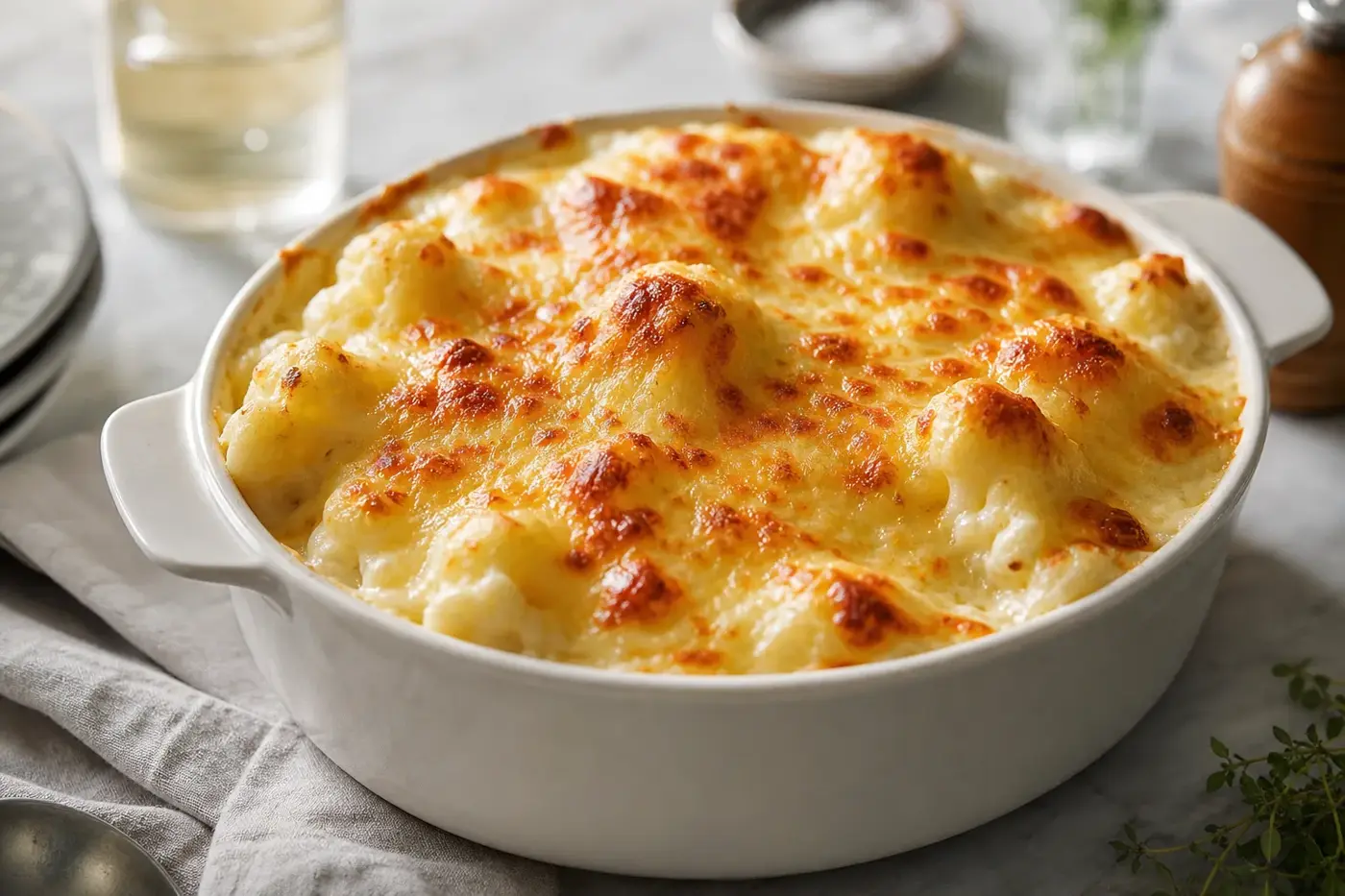
Your fork breaks through the golden top into tender florets, each coated in smooth, savoury sauce. There is an older version of this pleasure in an 1861 household cookbook: recipe 1106, “Cauliflowers with Parmesan Cheese”, brings together cauliflower, white sauce, Parmesan and the heat of a fire or salamander.[3] For your own dish, three habits make the difference: drain thoroughly, thicken the white sauce first, and add the cheese off the heat.[1,2]
Bring a little Victorian comfort to the table
Set cauliflower cheese beside a roast, or give it the centre of the table with salad and bread. Its combination of cooked cauliflower, white sauce and browned cheese has a documented Victorian precedent. That 1861 recipe calls for boiled, drained cauliflower, white sauce, grated cheese, breadcrumbs and melted butter, browned before the fire or beneath a salamander, a tool that applies heat from above.[3]
In that older version, cheese goes both over the cauliflower and into the surrounding sauce. Here, you use mature Cheddar throughout and leave out the breadcrumbs. The cheese has the golden topping entirely to itself, an arrangement few cheese lovers will dispute.[1,3]
Get your golden supper under way
Recipe status: adaptation awaiting independent testing. Based on Riverford’s cauliflower cheese and Good Food’s published methods, with the ingredient quantities requested for this recipe.[1,2]
Serves: four as a side. Preparation: allow about 20 minutes. Baking: around 20 to 25 minutes. Oven: 200 °C conventional or 180 °C fan (392 °F or 356 °F). Use timings as guides, looking for tender stalks and heat throughout.[1,2,9,10]
Equipment: scales, measuring jug, large saucepan, colander, medium heavy-based saucepan, whisk, spoon, grater and an ovenproof baking dish. Choose a dish roomy enough for the florets to sit in a fairly even layer.
Gather the good things
- 800 g cauliflower florets (28.2 oz), weighed after trimming
- 40 g butter (1.4 oz)
- 40 g plain flour (1.4 oz)
- 500 ml whole milk (16.9 US fluid ounces)
- 150 g mature Cheddar (5.3 oz), grated
- 5 g prepared English mustard (0.2 oz), optional
- Small pinch of grated nutmeg, optional
- Salt and freshly ground black pepper
Allergens: the standard recipe contains milk and wheat; adding mustard introduces mustard. Read every ingredient and substitution label, including precautionary allergen statements.[8,12]
Take your florets from saucepan to golden top
-
Get the oven ready. Heat it to 200 °C, or 180 °C fan (392 °F or 356 °F). Bring a large saucepan of water to the boil. Cut the florets into similarly sized pieces, splitting particularly thick stalks so everything cooks evenly.[1]
-
Give the florets a head start. Parboil for four to five minutes. Try a stalk with a knife: it should begin to yield but still offer a little resistance, leaving the oven to finish the job. Drain thoroughly in a colander, then leave uncovered to steam dry while you make the sauce.[1,2]
-
Keep your roux pale. Melt the butter in the medium saucepan over a gentle heat. Stir in the flour to make a roux, a cooked paste of fat and flour. Cook gently for about two minutes, stirring without letting it brown.[1]
-
Pour a little, whisk a little. Add the milk gradually, whisking each addition into the paste before pouring in more. Once all the milk is incorporated, bring to a gentle simmer and stir until thickened. Look for a smooth sauce that coats the spoon and pours in a broad ribbon, rather than running like milk.[1,11]
-
Let the cheese melt gently. Take the pan off the heat and stir in 120 g of the cheese, reserving 30 g for the top. Add the optional mustard or nutmeg, then taste before adding salt and pepper. Stir until the cheese has melted into the sauce.[2,11]
-
Bring everything together. Arrange the dried cauliflower in the baking dish, pour over the sauce and gently turn the florets to coat their sides. Scatter over the reserved cheese. Bake for around 20 to 25 minutes, until bubbling and golden, with tender stalks and a steaming hot centre.[2,4,9,10]
Give the cauliflower time to let off steam
Draining deserves just as much care as boiling. Riverford gives the cauliflower a short first cook and calls for thorough draining; Good Food also drains it before adding sauce. Leave your colander uncovered so steam can escape, and look for water collecting underneath before moving the florets to the dish.[1,2]
The parboil is a head start, not the finish line. You want a floret that holds together when lifted, with a stalk that will finish softening in the oven. Very small pieces and large, thick-stemmed florets need different treatment, so cutting evenly helps them become tender together.[1]
Water clinging to the cauliflower can dilute your sauce in the dish. Making an unusually stiff sauce will not solve that problem: thin sauce runs off, but very thick or lumpy sauce is difficult to spread evenly. Drain well, then aim for a smooth sauce that coats a spoon.[1,2,11]
A little patience makes a smoother sauce
Begin with a small splash of milk. It is much easier to blend into the flour paste than a whole jugful arriving at once. Whisk into the corners of the pan as well as through the middle, smoothing each addition before you continue.[11]
Let the white sauce reach a gentle simmer before judging its thickness. Good Food’s published methods thicken the milk and flour mixture first, then take the pan off the heat to add cheese. Much as you might welcome an excuse, extra cheese is not a rescue plan for thin sauce.[2,11]
Keep those two stages separate: simmer the white sauce to thicken it, then use its residual heat to melt the cheese. Excessive heat can make cheese sauce separate, leaving it grainy or oily. Once the cheese is incorporated, pour the sauce over your cauliflower rather than bringing it back to the boil.[2,11]
Find the cheese balance you love
Start with Mature Cheddar, the cheese used by both Riverford and Good Food in their cauliflower cheese recipes. Mustard and nutmeg appear in those sources too. Add either or both sparingly, tasting before you pour the sauce over the florets.[1,11]
You can replace part of the grated cheese with Gruyère, keeping the total cheese quantity unchanged. Its interprofession publishes a cheese sauce paired with mustard, a documented example of that combination.[5] Explore the named cheese in Le Gruyère. Before publication, each proposed substitution needs a kitchen test for its effects on flavour, salt, moisture and melting.
For blue cheese, think accent rather than takeover. Riverford’s cauliflower and blue cheese macaroni uses a small quantity in a white sauce and describes its contribution as pungent.[4] The suggested variation here replaces a little Cheddar with crumbled blue cheese: taste before adding any salt, and reserve enough Cheddar for the topping.
Make a thoughtful choice for every plate
For a vegetarian version, choose Cheddar explicitly labelled suitable for vegetarians. The Vegetarian Society explains that animal rennet, the enzyme preparation used to set some cheeses, is unsuitable, while non-animal alternatives are available. Follow its advice to read the label or ask the manufacturer.[6] You can explore the different sources in the rennet guide.
If you are blending cheeses, look beyond the Cheddar. The Vegetarian Society lists Gruyère among cheeses that are usually unsuitable for vegetarians, so the product’s own declaration matters when choosing an alternative. Give any blue cheese the same attention.[6]
For a gluten-free version, FREEE publishes a cornflour sauce suggested for cauliflower cheese.[7] A complete, attributed alternative formula, including quantities and method, needs testing and adding before publication. Do not swap cornflour gram for gram into the roux above without an established recipe.
Coeliac UK advises choosing flour labelled gluten free, because even naturally gluten-free flours can be contaminated during milling. It also advises reading labels every time.[8] Read the mustard, cheese and optional additions labels, choose gluten-free bread alongside, and keep preparation equipment clear of ordinary flour and breadcrumbs.[8]
Set it beside the roast, or let it take centre stage
When you serve, give everyone a helping of both cauliflower and sauce, rather than a dry floret from the edge. Good Food specifically suggests baking its version while a roast chicken rests. That gives you a useful way to organise your oven space.[2]
For a main course, try the suggested pairing of a larger scoop with sharply dressed green salad and bread to catch the sauce. Keep the accompaniments simple: something crisp and fresh offers a different texture beside the soft cauliflower. Remember that the four portions above are side servings, not main courses.
Save your leftovers with care
Cool leftovers promptly. The following Food Standards Agency household guidance, dated November 2026, applies to England, Wales and Northern Ireland.[9,10] Divide leftovers into smaller portions to help them cool quickly, then refrigerate within one to two hours. Keep your fridge between 0 and 5 °C (32 to 41 °F), and eat refrigerated leftovers within 48 hours or freeze them if that will not be possible.[9]
Reheat only what you intend to eat, and only once. The FSA says reheated food should be steaming hot throughout. A browned top tells you little about the temperature underneath, so pay attention to the centre as well as the edges.[10]
If you use a microwave, follow its instructions for stirring and standing. The FSA notes that microwaves can leave cold pockets and recommends stirring or turning food for more even reheating. Smaller portions can also heat more evenly than a deep, full dish.[10]
General information only, not medical advice: follow the official guidance where you live.
Questions people ask
Why is my cauliflower cheese watery?
Water clinging to the cauliflower can dilute the sauce. Drain the florets thoroughly after parboiling and leave them uncovered to steam dry before adding the sauce.
How do I stop the cheese sauce becoming grainy?
Thicken the white sauce at a gentle simmer first, then take the pan off the heat before stirring in the cheese. Excessive heat can make the sauce separate, so do not bring it back to the boil.
Is cauliflower cheese suitable for vegetarians?
Choose Cheddar labelled suitable for vegetarians. The Vegetarian Society advises checking the label or asking the manufacturer, and says Gruyère is usually unsuitable for vegetarians. Check every cheese in a blend.
Can I make cauliflower cheese gluten free?
FREEE publishes a cornflour sauce suggested for cauliflower cheese, but the page says a complete alternative formula needs testing before publication. Coeliac UK advises choosing flour labelled gluten free and reading labels every time. See Coeliac UK guidance for more information.
How long can I keep and reheat cauliflower cheese?
The Food Standards Agency advises refrigerating leftovers within one to two hours and eating them within 48 hours, or freezing them if that will not be possible. It says to reheat food only once and make sure it is steaming hot throughout. See the Food Standards Agency guidance for England, Wales and Northern Ireland.
Sources
-
Riverford Organic Farmers. Cauliflower cheese. Undated online recipe, retrieved November 2026. Ingredients and method support the butter, flour and milk proportions, short initial cauliflower cooking, white sauce, seasonings and oven finish. Riverford sells food and ingredients commercially. Source.
-
Good Food. Cauliflower cheese. Recipe originally published in Good Food magazine, March 2010; online version retrieved November 2026. Supports draining, thickening the sauce, adding cheese off the heat, reserving cheese for the topping and baking until bubbling. Source.
-
Victorian London, transcription of a contemporary cookbook. The Book of Household Management, 1861, chapter XXV, recipe 1106, “Cauliflowers with Parmesan Cheese”. Supports the dated historical account and preparation described. Source.
-
Riverford Organic Farmers. Cauliflower and blue cheese macaroni. Undated online recipe, retrieved November 2026. Supports the documented blue cheese combination, attributed sensory description and a 200 °C oven finish lasting 20 to 25 minutes. Riverford sells food and ingredients commercially. Source.
-
Interprofession du Gruyère. Chicken nuggets, Gruyère AOP sauce and a hint of mustard (for the little tough guys). Undated online recipe, retrieved November 2026. Documents the cheese and mustard sauce combination. The interprofession represents the cheese’s producers and trade. Source.
-
Vegetarian Society. Which cheeses are suitable for vegetarians and which aren’t? Published 19 May 2026. Supports the distinction between animal and non-animal rennet, individual product checks and its advice concerning Gruyère. Source.
-
FREEE. Gluten Free and Dairy Free Cheese Sauce. Undated online recipe, retrieved November 2026. Supports cornflour as an alternative thickener, the separate slurry method and its suggested use for cauliflower cheese. FREEE is a commercial flour and food manufacturer. Source.
-
Coeliac UK. Grains and How to read food labels. Undated online guidance, retrieved November 2026. Supports choosing flour labelled gluten free, awareness of contamination and checking ingredients and precautionary statements each time. Grains guidance; label guidance.
-
Food Standards Agency, GOV.UK. How to chill, freeze and defrost food safely. Published 18 December 2017; live text retrieved November 2026. Applies to England, Northern Ireland and Wales. Section 1 supports smaller portions, refrigeration within one to two hours, fridge temperature and the 48-hour leftover limit. Source.
-
Food Standards Agency, GOV.UK. Cooking your food. Published 18 December 2017; live text retrieved November 2026. Applies to England, Northern Ireland and Wales. Sections 1 and 7 support thorough heating, reheating once, microwave stirring and standing instructions, and smaller reheating portions. Source.
-
Good Food. Next-level cauliflower cheese. Recipe originally published in Good Food magazine, January 2022; online version retrieved November 2026. Supports gradual milk incorporation, thickening before cheese, off-heat cheese addition, mustard and nutmeg. Source.
-
Food Standards Agency. Alerts. Live official alert service, retrieved November 2026. Consulted for current notices. Source. The editor must also verify and link the relevant official allergen guidance before publication.
This piece was researched from published recipe methods, a transcription of an 1861 cookbook, specialist dietary organisations and official food safety guidance.
Last checked: November 2026
Last checked November 2026.
The editors suggest you read next