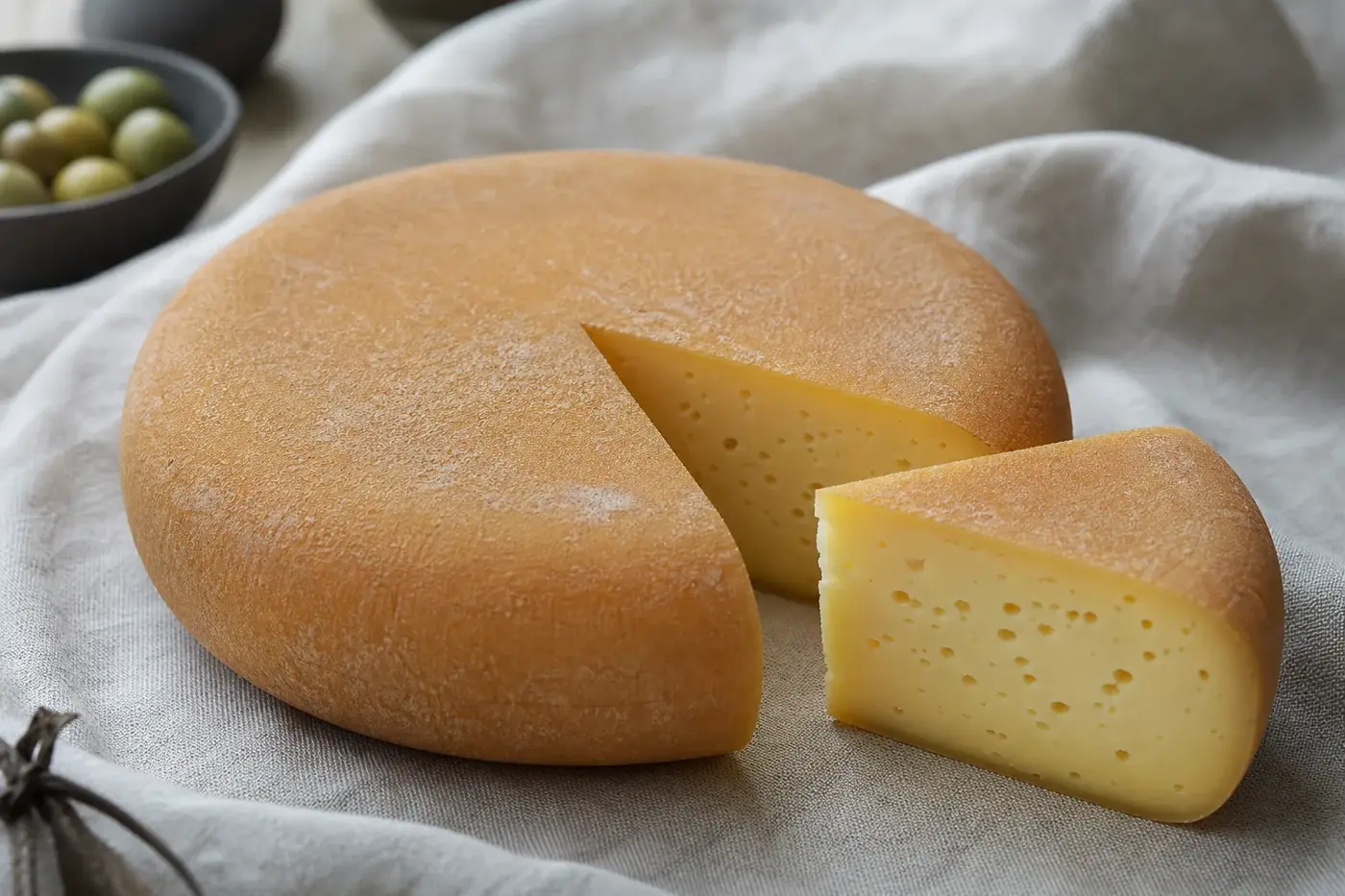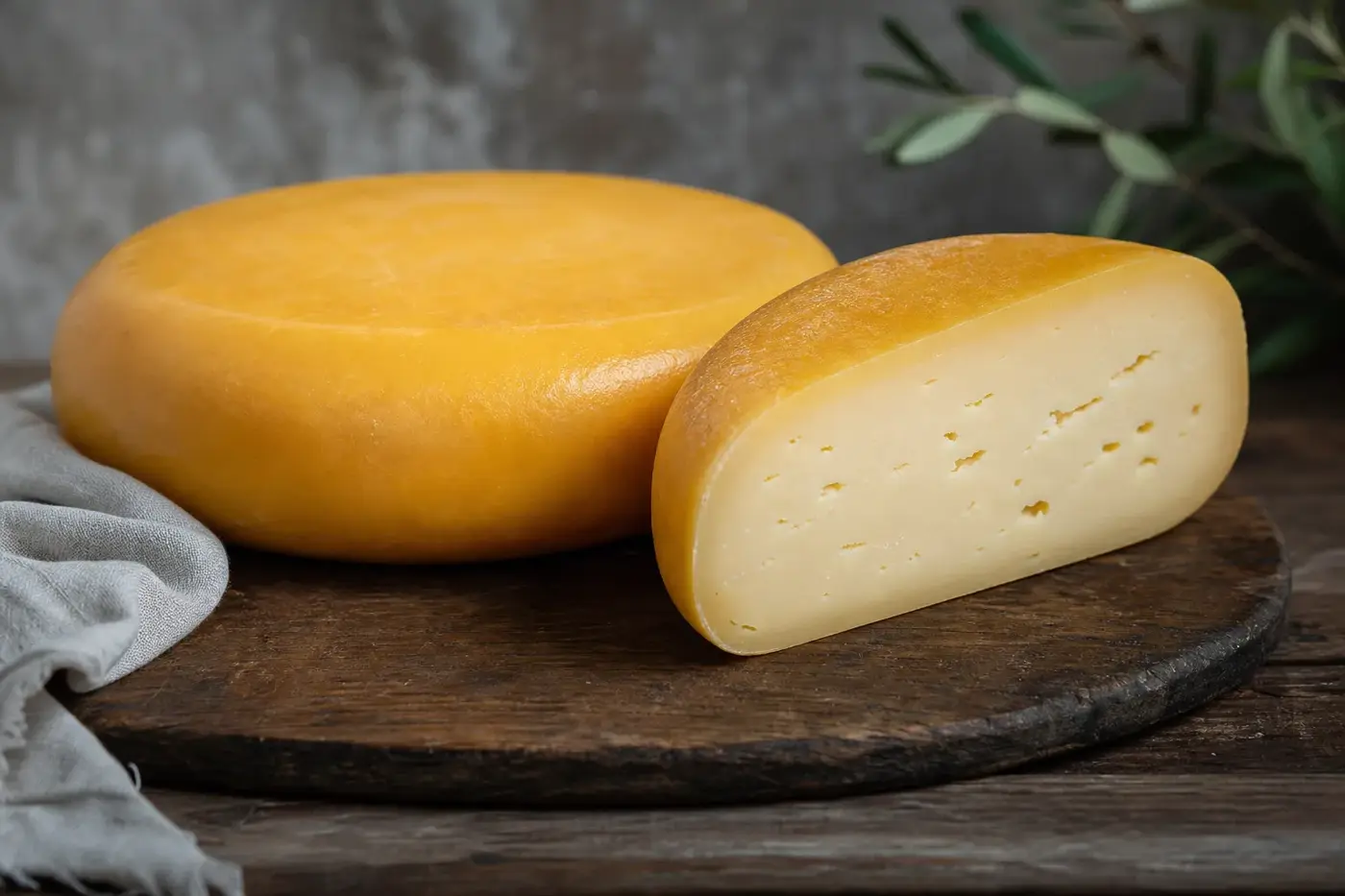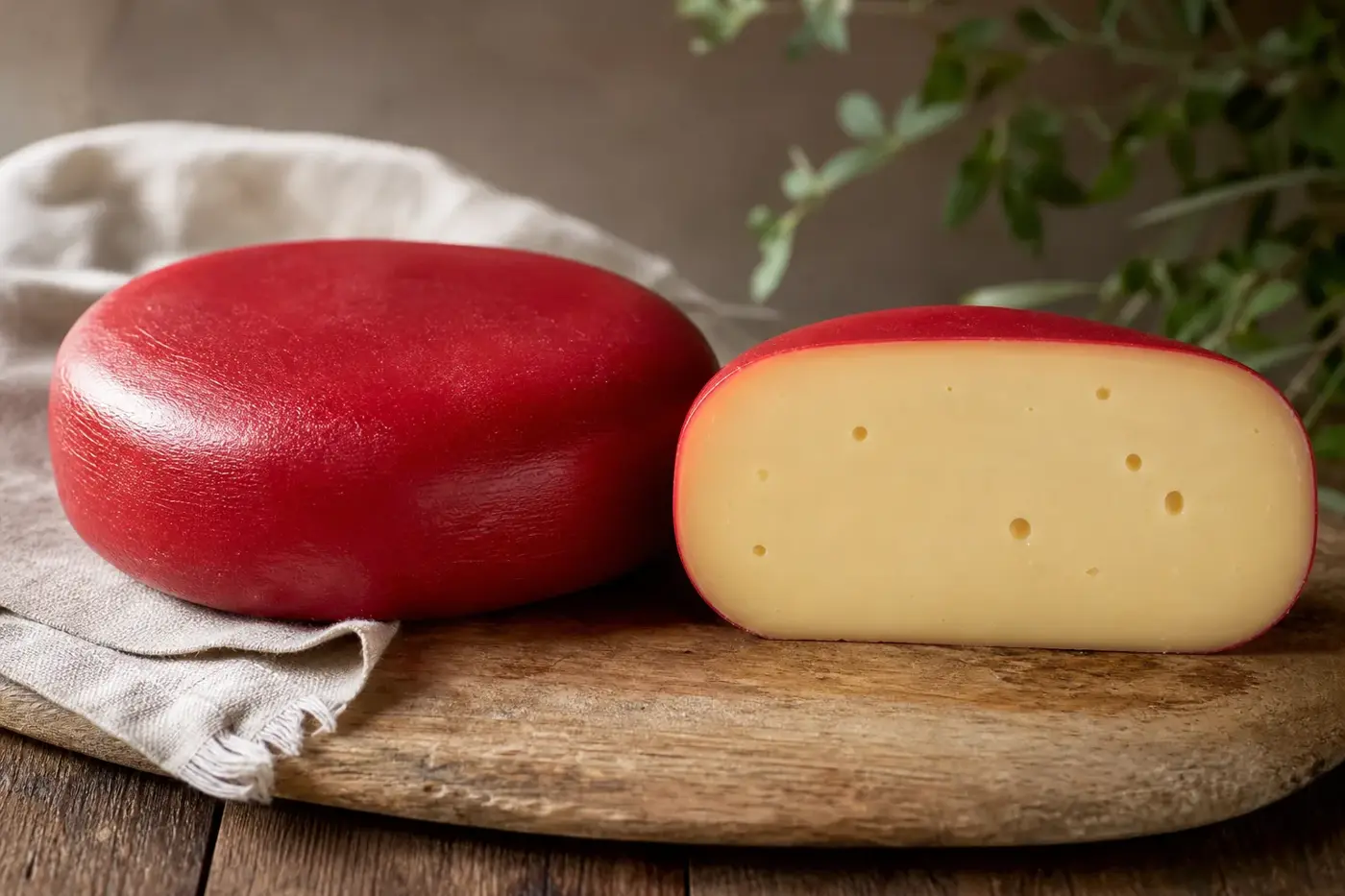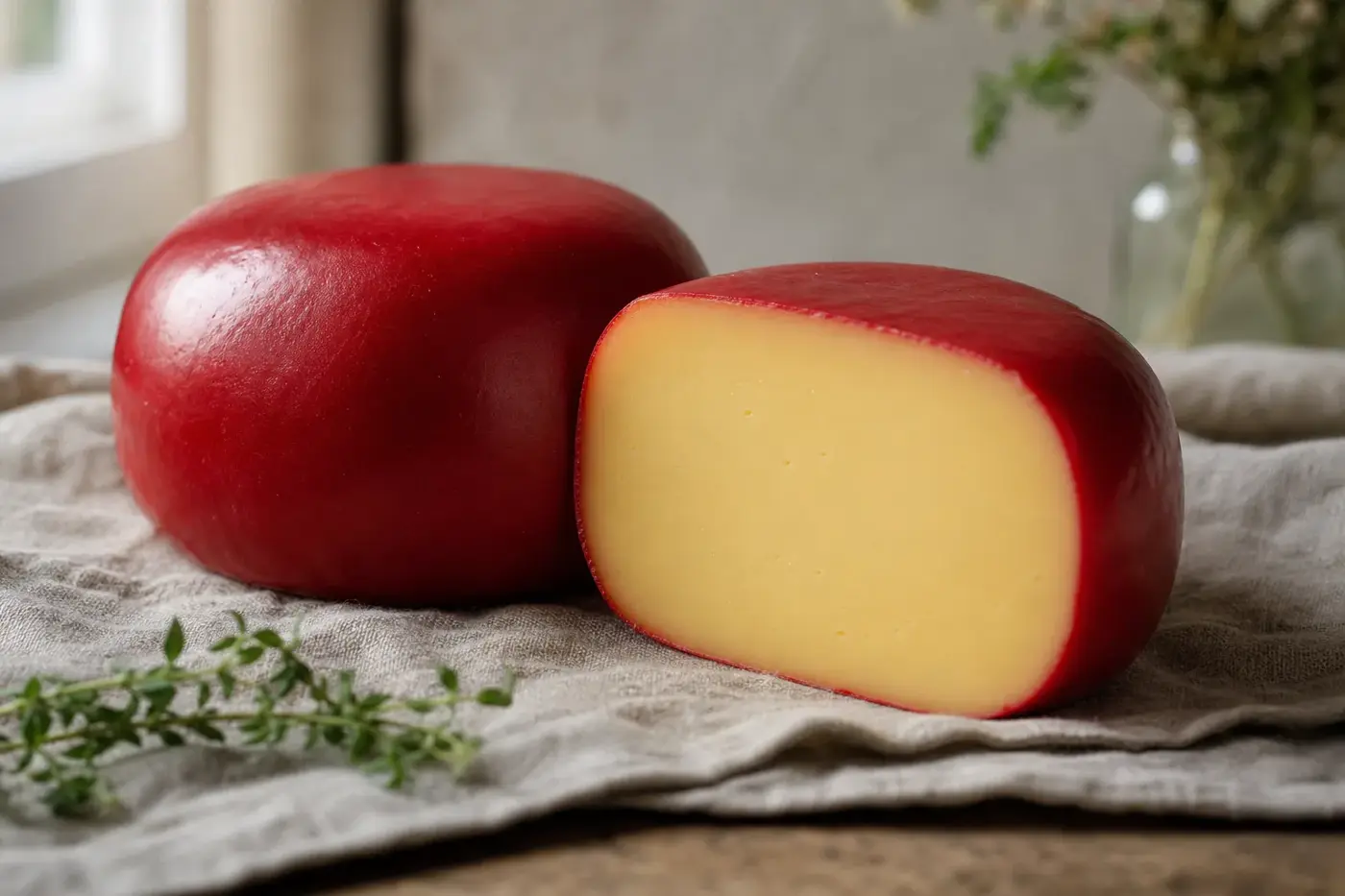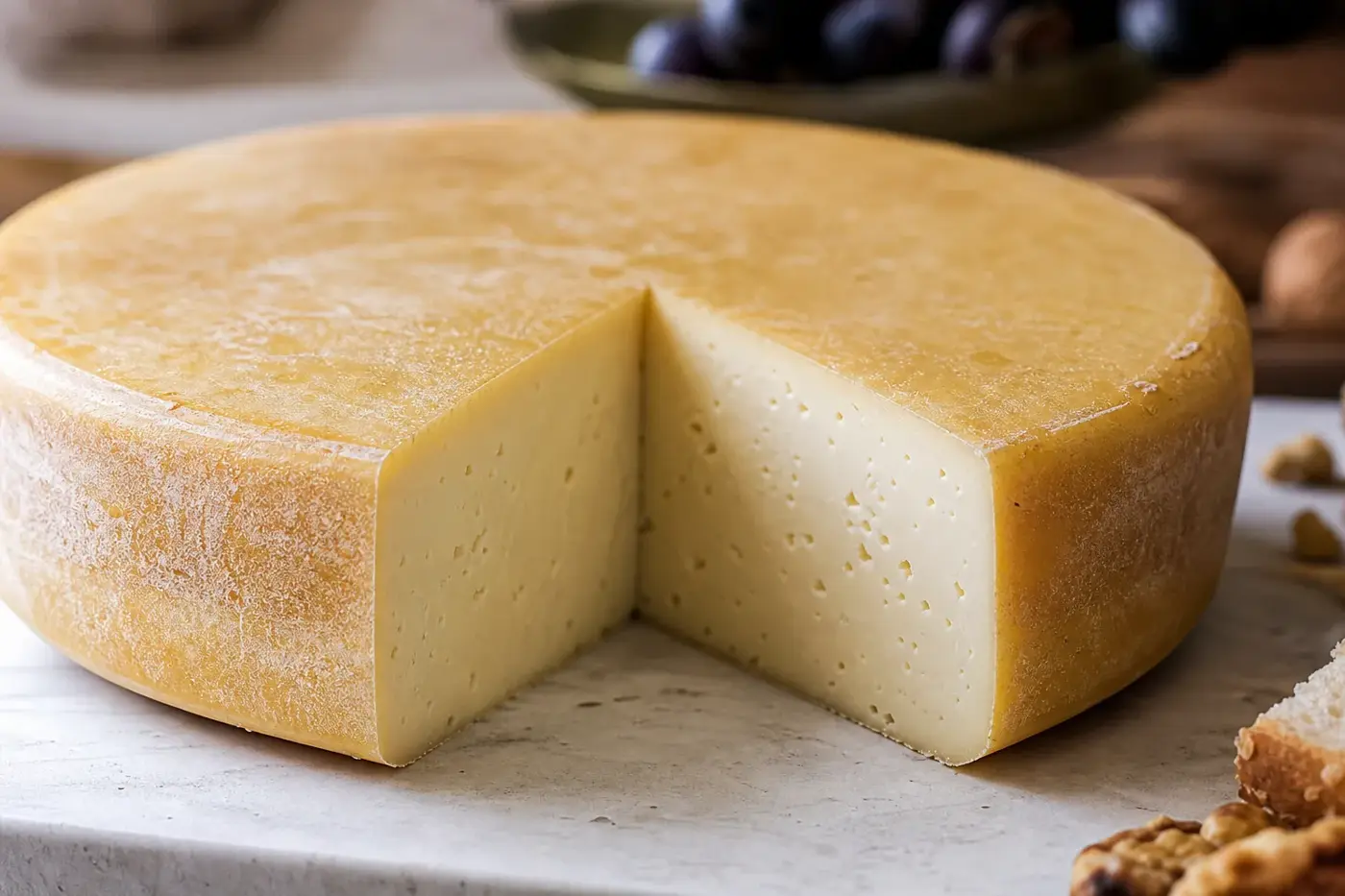
Let your eye travel down a wheel of Kanterkaas. The top edge curves gently, then the upright side meets the flat base at a sharp corner. That corner gives this firm cow’s milk cheese its name. Its home is Friesland and neighbouring Westerkwartier in Groningen, where plain, cumin and clove varieties share a distinctive regional method. [1,2]
Your cheese-counter companion to Kanterkaas
- Familiar name: Kanterkaas. [1]
- Registered name: Kanterkaas / Kanternagelkaas / Kanterkomijnekaas. [4]
- Authority and application: European Commission; Dutch application dossier: 010/98. [1,5]
- Protection: Great Britain: registered PDO, November 2026 register reference. EU: registration effective 8 September 2000. [4,5]
- Home territory: Friesland and Westerkwartier, Netherlands. [2]
- Milk and coagulant: Cow’s milk, standardised and pasteurised; calf or bovine rennet. [1]
- Shape and size: Flat cylinder, 3 to 8.5 kg. [2]
- Minimum maturation: Four weeks at no less than 12 °C, under the published specification. [1]
- Ages to explore: The specification describes cumin cheese eaten from four weeks to over a year. [1,2]
- Composition: 20+: 20 to 25% fat in dry matter; 40+: 40 to 44% fat in dry matter. [1]
Find the corner, then follow the butter
With a whole wheel, or a wedge that still has its base, you can see the name taking shape. Kanterkaas is round from above, but its profile tells another story. The upright side meets the flat bottom at a sharp angle, beneath a rounded upper edge. The published Dutch dossier identifies that abrupt lower junction as the meaning of “kanter”. [1,2]
Behind that shape lies a story of butter-making. As the dossier recounts, cream was removed for butter, while the remaining skimmed milk became hard cheese. This dairy economy found a use for both, giving Kanterkaas its roots. Its regional character comes from that history and its production method, not merely a scattering of spices in a familiar Dutch wheel. [2]
Plain, cumin or clove: meet your three choices
The three names give you a useful clue at the counter. In the Dutch dossier, komijn means cumin and kruidnagelen means cloves. The two spiced versions allow a little overlap, so the names are your starting point rather than the whole conversation. [1]
- Kanterkaas: the plain version, letting the cheese’s own developing sharpness speak first. [3]
- Kanterkomijnekaas: cumin goes into the washed curd, spreading the spice throughout the cheese. [1]
- Kanternagelkaas: cloves go into strips of curd before milling. A very small quantity of cumin may join them. [1]
For your first purchase, choose the spice before the age. If possible, taste the plain cheese beside a spiced version of similar maturity. That gives the seasoning a fair hearing. Asking a young plain cheese to compete with a much older clove cheese rather stacks the cheese board.
Cut a slice and listen to its age
Look at the cut face and you should see a close texture, with only occasional small openings. This is the paste, the cheese beneath the rind. The specification describes ivory to yellow or greenish-yellow tones in plain and cumin cheeses. Clove cheese is greenish-yellow, sometimes with darker patches immediately around the cloves. [3]
Age changes both bite and flavour. The published description runs from firm to hard: younger cheese slices, while older cheese suits grating. The Dutch dossier and French specification summary describe plain Kanterkaas as sharp to strong according to maturity. Clove cheese is fragrant and spicy; cumin cheese ranges from mild to strong. [1,3]
Tell the cheesemonger how you want to eat it, and ask for its age in weeks or months. For sandwiches, choose a piece that slices cleanly. For a finishing sprinkle, ask about something harder and longer-matured. Texture, seasoning and purpose are more revealing than “strong cheese”, a request with considerable room for interpretation.
This page summarises published guidance from the official sources it cites. It is not medical advice. Guidance differs between countries and changes over time, so check the current source for where you live, and ask your doctor, midwife, pharmacist or dietitian about your own circumstances.
Follow the milk into the mould
First, the milk is standardised, adjusting its composition, then pasteurised. Animal rennet, the enzyme preparation that sets milk into curd, works alongside a mixed starter culture of acidifying bacteria. The curd is washed and brought to the required acidity. Then the three varieties take their different paths. [1]
For plain and cumin cheeses, milling breaks up the curd before salting and transfer to moulds. For clove cheese, salt and cloves are mixed into curd strips before milling. Prolonged pressing establishes the wheel’s shape and rind. A brine bath adds further salt, and maturation begins. [1]
Those 20+ and 40+ categories tell you about fat in dry matter: the proportion of fat once water is excluded. They describe composition, not maturity or texture, so ask about those separately. To follow the wider journey from milk to cheese, explore how cheese is made.
Get to know the protected names
The three names entered the EU register together through Commission Regulation (EC) No 1903/2000. It was adopted on 7 September 2000 and published on 8 September 2000. [5] The published specification defines Friesland and Westerkwartier as the geographical area, alongside requirements for shape, composition and production method. [1,5]
In Great Britain’s November 2026 register record, the combined name has a separate registered protected designation of origin, or PDO. Its scheme registration dates from 31 December 2020 at 23:00. [4] For the differences between origin protection and other schemes, turn to protected names explained.
Take three questions to the cheese counter
Start with the exact name on the wheel, label or cheesemonger’s product record. Match it to the registered name in the relevant jurisdiction and the variety you want, then ask where it was made. Under the published PDO specification, production belongs in Friesland and Westerkwartier. “Dutch clove cheese” gives you less to go on than the named designation. [1,2]
Now ask three questions: how old is this piece, which spices does it contain, and what has been applied to the rind? Keep the label, or ask the seller to write down the answers. If you fall for this particular piece, those details make finding something similar much easier. A cheese worth remembering deserves more than “the lovely one from last time”.
Buying a cut wedge? Ask to see the original wheel’s information. Outside colour cannot identify every variety, because the specification permits natural rinds and several coating colours. [3] Find more useful pointers in reading a cheese label.
Give each variety room on your plate
Begin with bread, one accompaniment and the cheese itself. Try a small bite on its own, then add the accompaniment and see which balance you prefer. These suggestions follow the specification’s distinction between plain Kanterkaas’s sharpness and the fragrant character of its spiced companions. [3]
For plain Kanterkaas, try thin slices on bread, with apple or pear alongside. Leave mustard on the side so you can compare a bite with it and a bite without. If this is lunch, let the cheese lead. Several other strongly flavoured ingredients can make that harder.
For cumin cheese, try rye bread, cucumber and a little pickled onion. Keep the pickles separate while you taste. With the clove version, choose pear or a small spoonful of plum preserve on plain bread. Let the fruit accompany the cloves, rather than introducing another spice mixture.
Water is the simplest drink for comparing all three. For an alcohol-free alternative, try unsweetened black tea or diluted apple juice, choosing whichever leaves the cheese clearest to you. A harder piece can also give potatoes or vegetables a light grating. Taste before adding further seasoning.
Keep it well and understand the rind
Follow the seller’s or pack’s storage instructions, and keep the date information. The Food Standards Agency advises a home fridge temperature of 5 °C or below. The guidance reference for England, Wales and Northern Ireland is November 2026. [6]
The specification describes a smooth, closed rind without mould growth. Plain Kanterkaas and Kanternagelkaas may have a natural rind or a colourless or yellow coating. Kanterkomijnekaas may also have a red coating. Ask which outer layer you have, and remove any non-food covering before serving. [3]
Once you cut the cheese, keep its product information, including any instructions for use after opening. If you buy an unwrapped piece, ask the cheesemonger for those details. For wrapping choices and a fuller routine, use how to store cheese at home alongside the instructions supplied with your particular cheese.
Fond of Leyden or Gouda? Start here
If Leyden is your usual choice, ask the cheesemonger to compare the exact products. Start with spice and age rather than the broad label “Dutch cheese”. Boeren-Leidse met sleutels has its own separate PDO entry in Great Britain’s November 2026 register record. It is a distinct named product from Kanterkomijnekaas, and deserves its own introduction. [7]
Gouda Holland has a separate PGI registration in Great Britain’s November 2026 register record. [8] If Gouda is your reference point, begin by tasting it against plain Kanterkaas. Bring in cumin or cloves afterwards. That way, seasoning becomes a second comparison, not your only way of telling the cheeses apart.
Questions people ask
Where does Kanterkaas come from?
Kanterkaas comes from Friesland and neighbouring Westerkwartier in Groningen, Netherlands. Under the published PDO specification, production belongs in Friesland and Westerkwartier.
What is the difference between the three Kanterkaas varieties?
Kanterkaas is plain, Kanterkomijnekaas contains cumin and Kanternagelkaas contains cloves. A very small quantity of cumin may also be added to the clove cheese.
How long is Kanterkaas matured?
The published specification requires at least four weeks at no less than 12 °C. It describes cumin cheese eaten from four weeks to over a year.
What kind of rind does Kanterkaas have?
The specification describes a smooth, closed rind without mould growth. Plain and clove Kanterkaas may have a natural rind or a colourless or yellow coating, while cumin Kanterkaas may also have a red coating.
How should I store Kanterkaas?
Follow the seller’s or pack’s storage instructions and keep the date information. The Food Standards Agency advises a home fridge temperature of 5 °C or below; consult its guidance for England, Wales and Northern Ireland.
Sources
-
Netherlands Enterprise Agency, RVO. Productdossier Kanterkaas, kanternagelkaas, kanterkomijnekaas. National application dossier 010/98, undated document hosted in RVO’s June 2014 directory. Dutch product dossier.
-
European Commission. Publication of an application for registration: Kanterkaas, Kanternagelkaas, Kanterkomijnekaas. Official Journal C 378, 30 December 1999, pages 2 to 4. English specification summary.
-
French Ministry of the Economy, DGCCRF. Avis de mise en consultation d’une demande d’enregistrement d’une appellation d’origine protégée concernant du kanterkaas, kanternagelkaas, kanterkomijnekaas (fromage). BOCCRF No. 4, 31 March 2000. French official specification summary.
-
Department for Environment, Food & Rural Affairs. Kanterkaas / Kanternagelkaas / Kanterkomijnekaas. Protected food and drink names register, published 4 January 2021, accessed November 2026. Great Britain register entry.
-
European Commission. Commission Regulation (EC) No 1903/2000 of 7 September 2000. Official Journal L 228, 8 September 2000, pages 55 to 56. Registration regulation.
-
Food Standards Agency. How to chill, freeze and defrost food safely. Published 18 December 2017, live guidance accessed November 2026; applies to England, Northern Ireland and Wales. Official chilling guidance.
-
Department for Environment, Food & Rural Affairs. Boeren-Leidse met sleutels. Protected food and drink names register, published 4 January 2021, accessed November 2026. Great Britain register entry.
-
Department for Environment, Food & Rural Affairs. Gouda Holland. Protected food and drink names register, published 4 January 2021, accessed November 2026. Great Britain register entry.
Researched through official Dutch and European specification documents, the registration regulation, Great Britain’s register and published food safety guidance; serving combinations are editorial suggestions.
Last checked: November 2026
Last checked November 2026.
The editors suggest you read next