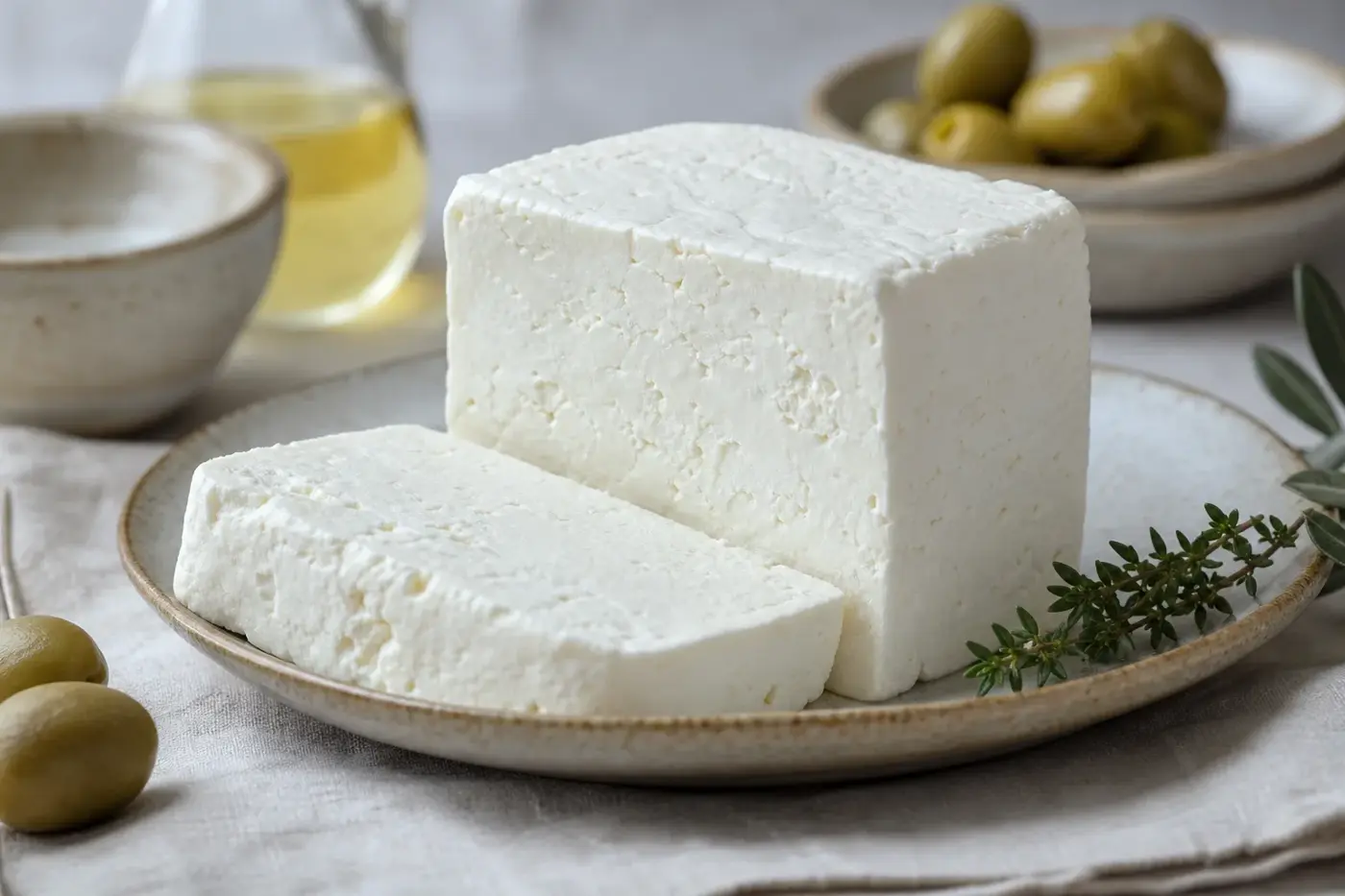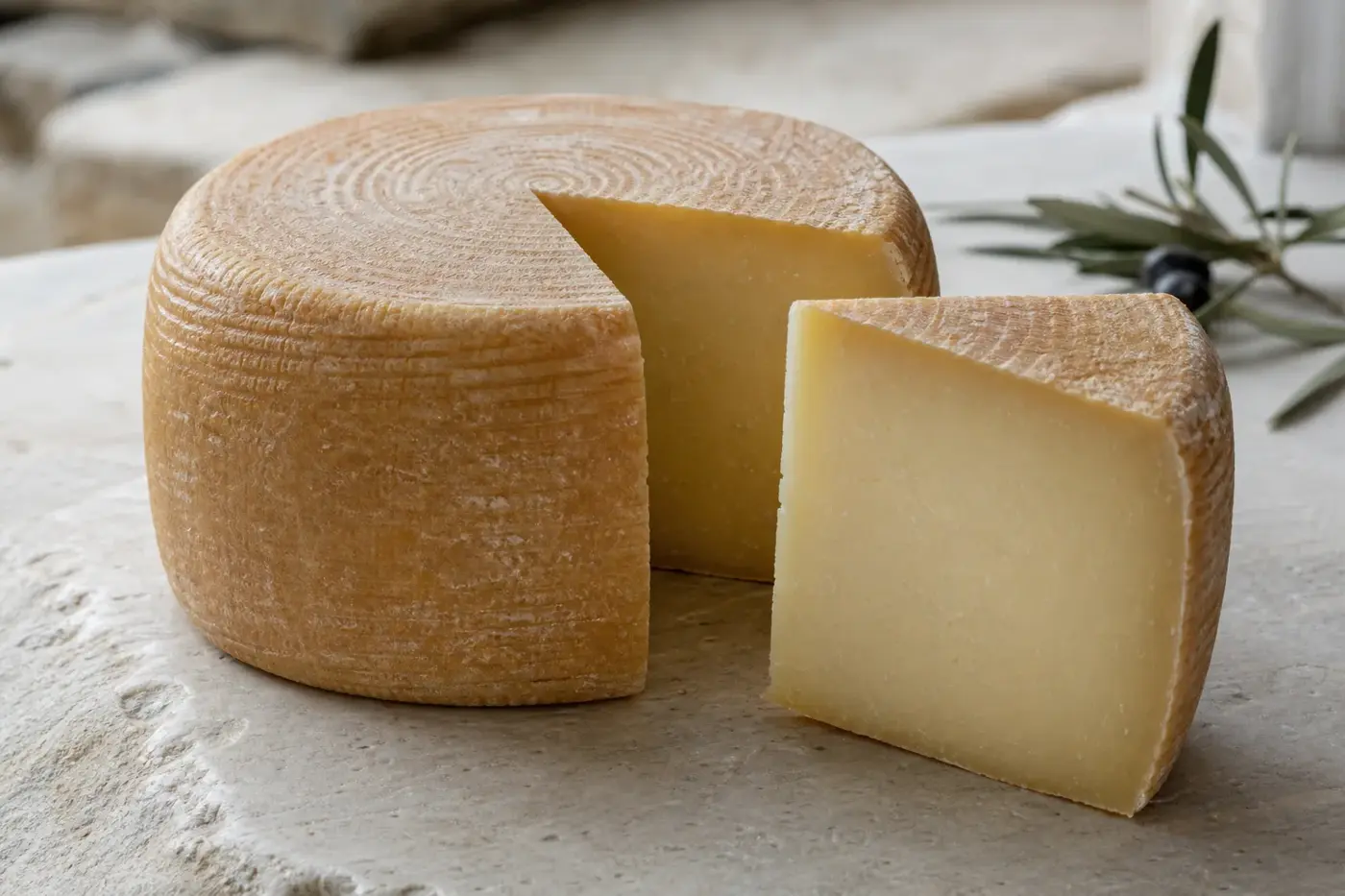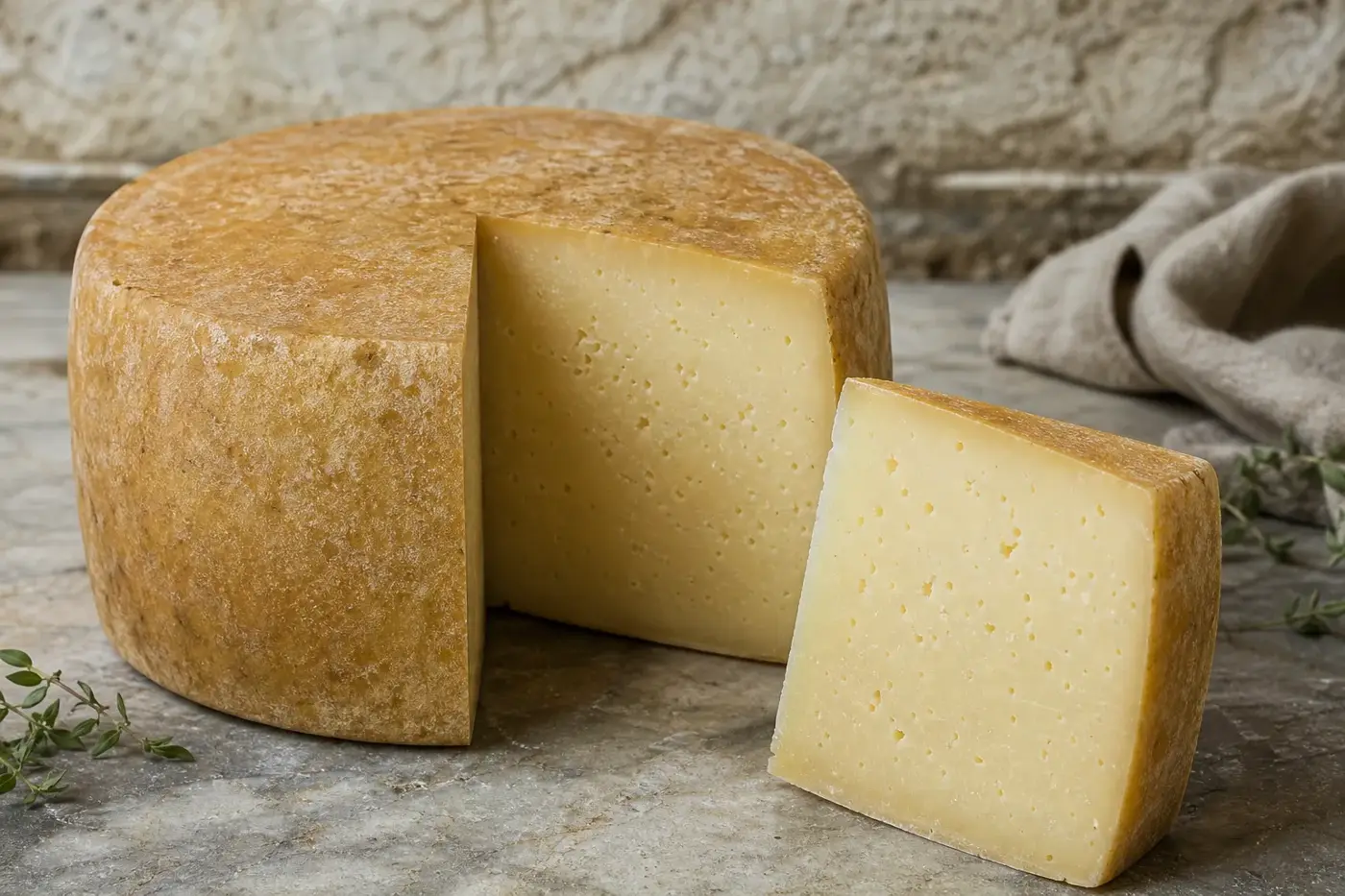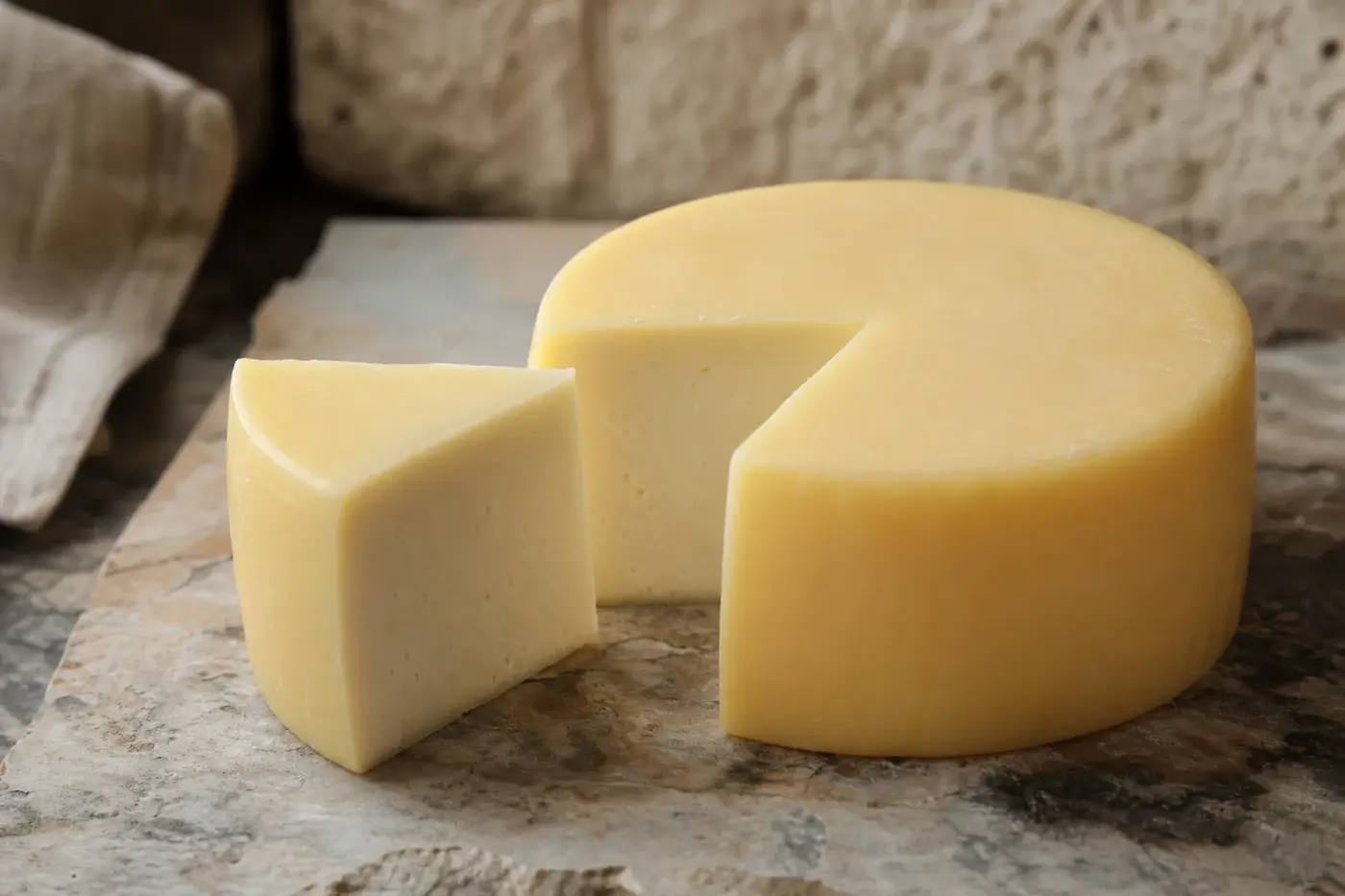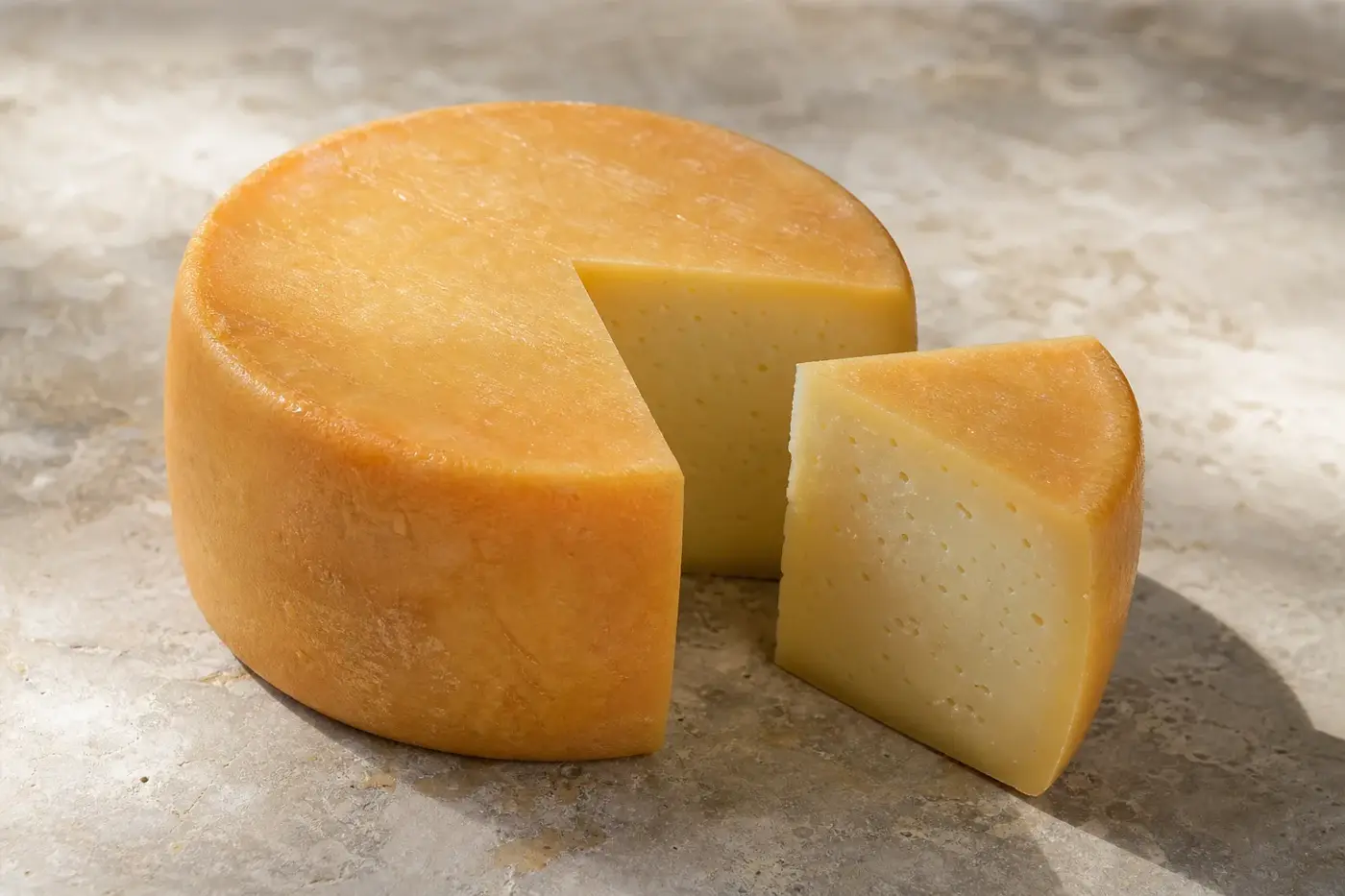
A slice of Kefalograviera hits the frying pan. The outside turns golden; beneath it, the cheese begins to soften. You could grate this firm cheese over pasta instead, but the pan makes a persuasive case. Made from sheep's milk, or sheep's and goat's milk together, it belongs among Greece's piquant hard cheeses in the Greek National Tourism Organisation's guide, and its name carries protected designation of origin, or PDO, registration in Great Britain. [1, 2, 5]
| Get to know it | The useful detail |
|---|---|
| Familiar name | Kefalograviera. [1] |
| Registered name | Κεφαλογραβιέρα / Kefalograviera. [1] |
| Registration authority | Department for Environment, Food & Rural Affairs, GB register. [1] |
| EU dossier identifier | GR/0444/940121, on the original application summary. [2] |
| Current protection | Great Britain: registered PDO, November 2026. Current EU register status: not established here. [1] |
| Recorded registration dates | EU original registration: 21 June 1996. GB registration: 31 December 2020 at 23:00. [1] |
| Where it is made | Western Macedonia, Epirus, Etoloakarnania and Evrytania, Greece. [2, 3] |
| Milk | Sheep's milk, or sheep's milk mixed with goat's milk. [2] |
| Maximum goat's milk proportion | Not specified in this overview |
| Permitted milk treatments and coagulants | Not specified in this overview |
| Minimum maturation | Three months in the official EU application summary. [2] |
| Typical maturation beyond the minimum | Not specified in this overview |
| PDO moisture and fat-in-dry-matter limits | Not specified in this overview |
| Specified rind and hole pattern | Not specified in this overview |
Leave the island postcard and head inland
For this cheese, your map needs mainland Greece. Kefalograviera comes from the west and north-west, with an official milk-producing area defined by the administrative boundaries of Epirus, Western Macedonia, Etoloakarnania and Evrytania. Cheesemaking and ripening must happen within that area too. [2, 3]
Look closer and those broad regions become individual places. The detailed geographical description names Ioannina, Thesprotia, Arta and Preveza in Epirus, and Florina, Kozani, Kastoria and Grevena in Western Macedonia, alongside Etoloakarnania and Evrytania. These are the places behind your wedge, not a general picture of Greek island cheese. [3]
The connection begins with sheep, goats and their food. The dossier describes animals traditionally reared in these areas, adapted to local conditions and fed on the area's flora. Their milk ties the finished cheese to the landscape described in its production rules. [2]
At the counter, ask where the dairy is, rather than simply who packed or distributed the cheese. With its production origin clear, you can move on to age and what that particular piece does best. For help distinguishing a regional name from a brand, see protected names explained.
Let the milk label do the talking
The official application summary gives you two possibilities: sheep's milk alone, or sheep's milk mixed with goat's milk. [2] The name on the wheel does not tell you which is inside. When comparing cheeses, ask for the actual milk declaration on each one.
Milk treatment and rennet deserve their own questions. Rennet is the enzyme preparation that sets the milk, and its source matters if you follow a vegetarian diet. Ask whether your cheese uses raw or pasteurised milk, and which rennet goes into it.
A supplier specification for one Dodoni product, dated February 2019, declares pasteurised sheep's and goat's milk and animal rennet. That describes the particular product, not every Kefalograviera. [4] Let the information supplied with the cheese you are buying guide your choice.
For help with the terminology, turn to the guides to milk treatments and rennet. Keep the original packaging if you have dietary requirements. If your wedge is freshly cut at the counter, request the supplier's ingredient information.
A firm wheel takes patience
Long before you cut a slice, there is milk to set, curd to press and salt to add. The official application summary begins with coagulation, or setting the milk, at 32 to 34 °C. The curd, the solid part of that set milk, is broken up, reheated to about 48 °C, put into moulds and pressed. [2]
Then the pace changes. The cheese spends a day at 14 to 16 °C, followed by approximately two days in brine. Initial ripening takes place at 14 to 16 °C, with repeated dry salting of the surface, before a second stage below 6 °C. [2]
The historical application records at least three months' total maturation; the current requirement is not specified in this overview. [2] When you buy, ask how many months your cheese has matured and how the cheesemonger would use that batch.
An age in months, where available, tells you more than a descriptive maturity label alone. Keep that detail with your tasting notes. It gives you something useful to ask for when you return for another piece.
Take a small slice and pay attention
Dodoni's 2019 supplier specification describes wheels weighing approximately 8 to 10 kg. Inside is a light yellow cheese with a semi-firm texture. Its flavour is described as mild and slightly salty, with the characteristic flavour of sheep's and goat's milk. [4]
The Greek National Tourism Organisation's gastronomy booklet, meanwhile, places Kefalograviera among Greece's piquant hard cheeses. [5] Taken together, these descriptions suggest a firm, savoury cheese with room for variation. Let the piece in front of you introduce itself, rather than expecting every example to have the same sharpness.
If a sample is available, try it plain first. Bread and accompaniments can wait while you notice the resistance of a thin slice, the strength of the salt and how long the flavour lingers. Those small observations help you decide whether your cheese belongs in pieces, over pasta or in a frying pan.
Comparing producers or ages? Note the dairy, declared milk blend and maturation beside your impressions. “Lovely cheese” is an entirely reasonable verdict, but a rather poor filing system when you want that exact wedge again.
Saganaki and the appeal of a golden crust
Frying brings Kefalograviera's contrasting textures into focus: a browned outside around a centre beginning to soften. Epiros publishes a flour-coated method using a nonstick or cast-iron frying pan. The Greek National Tourism Organisation specifies slices approximately 1 cm thick. [5, 6]
The steps below bring those two published approaches together. Treat them as an overview, rather than a complete recipe. Epiros is a cheese producer with a commercial interest in the product it recommends. [5, 6]
- Get the table ready. Put out lemon wedges, bread and serving plates before you start.
- Cut an even slice. Follow the tourism organisation's approximately 1 cm thickness across the whole slice. [5]
- Add a light flour coating. Epiros uses two tablespoons of plain flour for 200 g of cheese. Briefly wet the cheese under cold water, coat every side in flour and shake off the excess. [6]
- Heat the pan and oil. Epiros specifies medium-high heat and a nonstick or cast-iron frying pan. [6]
- Look for a golden surface. Its guide is approximately two minutes per side, until golden and beginning to melt. Once the surface has browned, do not keep cooking simply to satisfy the clock. [6]
- Finish with lemon, then serve. Add the lemon after frying and take the cheese straight to the table. Both published methods finish with lemon. [5, 6]
To reduce sticking, follow the source's pan choice, flour coating and hot-oil method. Have your spatula and plate ready before the cheese goes in, and watch closely so it does not burn. Turn the slice carefully, then lift it out when the second face is golden.
Give the rest of your wedge a plan
Start by treating Kefalograviera as a seasoning cheese, rather than the largest part of a dish. Grate a little over pasta or cooked vegetables, then taste before adding more cheese or extra salt. You will soon get a clearer sense of what your particular piece brings to dinner.
For baking, try a finishing layer on a vegetable gratin or pasta bake. Hold some cheese back until you have tasted the filling. That leaves you room to balance it against the sauce and vegetables, rather than committing the whole lot at once.
At the table, give its saltiness something to play against: fresh pear, ripe tomato, cucumber, plain bread or a little honey. Put the accompaniments alongside the cheese instead of mixing everything together. You can adjust each mouthful to suit yourself, which is one of the quieter pleasures of a cheese plate.
Sweet and sour has a published place here too. The Apollo's recipe, reproduced from The Broadsheet Sydney Cookbook, serves fried Kefalograviera with honey, lemon and oregano. [7] For a less sweet plate, try lemon-dressed tomatoes and bread, with water or sparkling water alongside.
Kefalograviera, Kefalotyri or Graviera? Start with dinner
All three names deserve a little attention at the counter. The Greek National Tourism Organisation lists Kefalograviera, Kefalotyri and Graviera as options for saganaki. Sharing a frying pan does not mean they share identical milk, production rules or flavour. [5]
Tell the cheesemonger what you are making. For frying, ask for a firm piece suited to the published saganaki method; for grating, compare texture and flavour intensity. If you plan to eat it plain, choose the one you most enjoy, not simply the name you recognise.
Swapping in Kefalotyri or a named Graviera? Taste it before seasoning the rest of your dish. Record the full name on the label, especially if it includes a geographical designation, so a successful substitution is easy to repeat.
For a closer comparison, buy separately identified pieces and prepare them in the same way. Keep each label beside its tasting notes. A cheese comparison is much more useful when you can still tell the contestants apart.
Buy thoughtfully, then keep it well
Before buying, establish four things: the registered name, producer, declared milk and available maturation information. Then explain how you plan to use it. An intact slice for saganaki is a different request from a wedge mostly destined for grating, and that distinction helps your cheesemonger help you.
Ask about rind treatments or coatings before putting the outside into a dish. Keep storage instructions and date markings with your wrapped portion; request them from the seller if your piece is cut at the counter. The guide to reading a cheese label helps you identify the details worth keeping.
For home refrigeration in England, Wales and Northern Ireland, the Food Standards Agency advises a fridge temperature between 0 and 5 °C, alongside following the product's storage instructions. Its guidance specifically includes dairy products among foods that need refrigeration. [8]
If you have cooked leftovers in England, Wales and Northern Ireland, consult the Food Standards Agency's current advice on cooling, refrigeration and freezing. Follow package instructions and the instructions for the other ingredients too. [8]
For everyday wrapping and organisation, see how to store cheese at home. Keep the label with whatever remains of your wedge. After that first meal, it is still your best reminder of exactly which cheese you enjoyed.
General information only, not medical advice: follow the official guidance where you live.
Questions people ask
Where is Kefalograviera made?
Its defined production area covers Western Macedonia, Epirus, Etoloakarnania and Evrytania in Greece. The milk, cheesemaking and ripening all come from within that area.
What milk is Kefalograviera made from, and is it vegetarian?
The official application summary permits sheep's milk alone or a mixture of sheep's and goat's milk. Ask which rennet the particular cheese uses: a 2019 specification for one Dodoni product declared animal rennet.
How long is Kefalograviera matured?
The historical EU application summary records at least three months of maturation. The current requirement has not been verified.
How do you make saganaki with Kefalograviera?
The Greek National Tourism Organisation specifies slices approximately 1 cm thick. Epiros coats the cheese in flour, fries it until golden and beginning to melt, and finishes it with lemon.
How should Kefalograviera be stored?
For home refrigeration in England, Wales and Northern Ireland, the Food Standards Agency advises keeping the fridge between 0 and 5 °C and following the product's storage instructions. Consult the agency's current guidance for cooked leftovers.
Sources
[1] Department for Environment, Food & Rural Affairs. Κεφαλογραβιέρα / Kefalograviera. GB protected food name register, published 2021, accessed November 2026.
Read at gov.uk
[2] Greek Ministry of Agriculture, held by the European Commission. Application for registration: Kefalograviera cheese PDO. Original application summary identifying Ministerial Decision 313032/11.1.94 and dossier GR/0444/940121, 1994.
Read at webgate.ec.europa.eu
[3] European Commission, eAmbrosia document archive. Kéfalogravièra, VI/5014/95, dossier 0444. French-language specification dossier, geographical-area section, 1995.
Read at ec.europa.eu
[4] Schuman Cheese. Product specification: Dodoni Kefalograviera RW Wheel 8 to 10 kg, DOD1070. Version 4, effective 26 February 2019.
Read at doclibrary.com
[5] Greek National Tourism Organisation. Gastronomy: Greece All Time Classic. Cheese overview and saganaki recipe, 2018.
Read at pub-mediabox-storage.rxweb-prd.com
[6] Epiros. Fried saganaki Kefalograviera PDO cheese. Undated producer recipe, accessed November 2026.
Read at epiros.eu
[7] Broadsheet. Recipe: The Apollo's Saganaki Cheese with Honey and Oregano. Cookbook extract published 19 January 2018, updated 31 July 2024.
Read at broadsheet.com.au
[8] Food Standards Agency. How to chill, freeze and defrost food safely. Published 2017, accessed November 2026; applies to England, Northern Ireland and Wales.
Read at gov.uk
This desk-researched draft brings together official registration records, an archived production dossier, a dated supplier specification, published cooking methods and official refrigeration guidance.
Last checked: November 2026
Last checked November 2026.
The editors suggest you read next