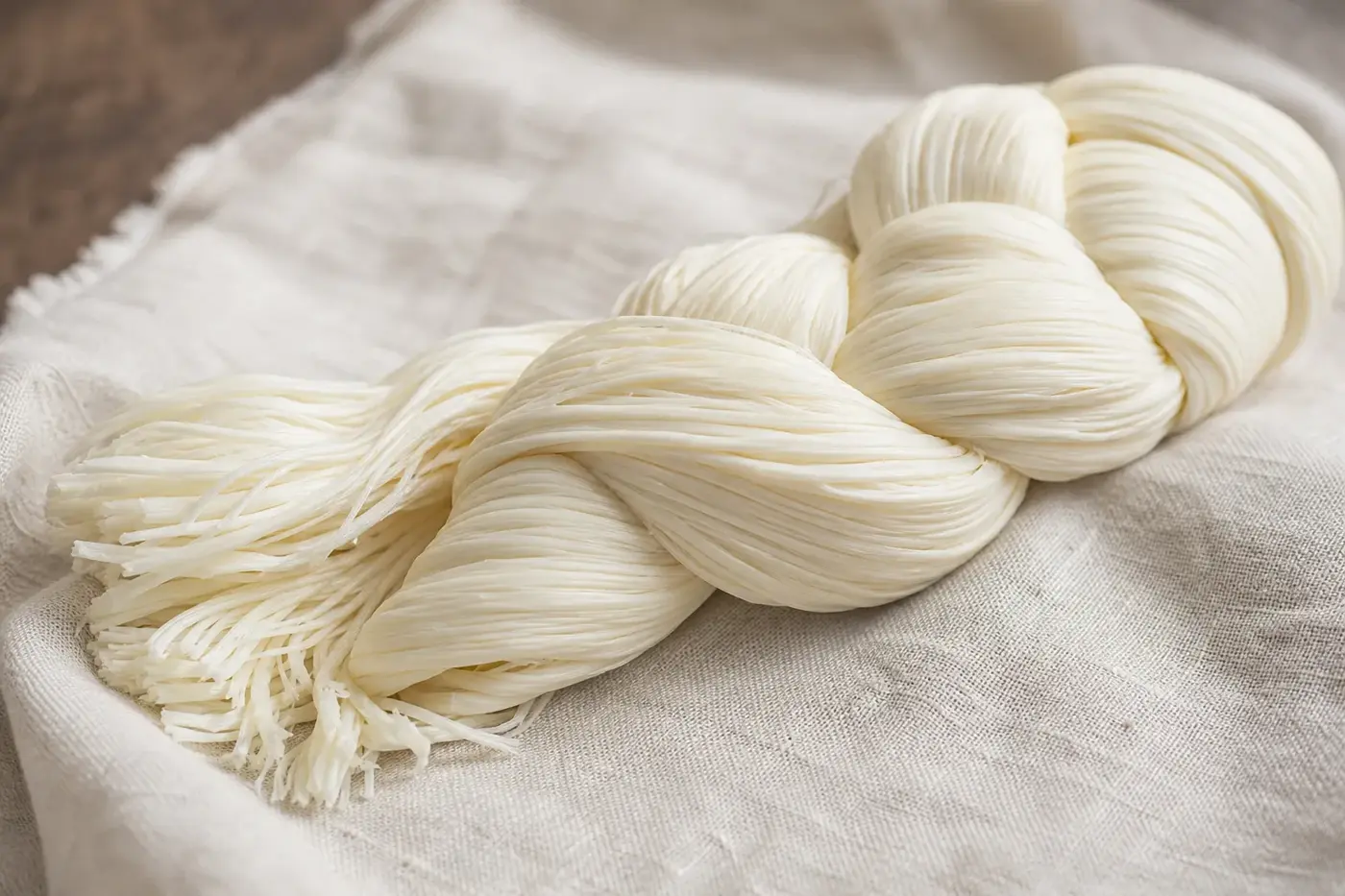
Warm curd stretches into fine threads. Skilled hands gather them into ropes, then braids, giving Chechil its unmistakable shape. Closely associated with Armenia, it belongs to a wider Caucasian tradition of stretched curd cheesemaking. Today, you can follow those threads towards either an unsmoked or a smoky braid. [1][2][4][5]
| Meet your braid | The details |
|---|---|
| Name | Chechil. [1][2] |
| Cultural roots | Armenia; also documented in Georgia. [1][2] |
| Style | Stretched curd string cheese, commonly braided. [2][4] |
| Milk | Skimmed cow's milk in documented Armenian traditions; whole cow's milk in a current producer's recipe. [1][3] |
| Milk treatment | Varies by product; pasteurised examples documented. [3][4] |
| Your two main choices | Unsmoked and smoked. [5] |
| Protection status | Armenia: Not verified; EU: Not verified; Great Britain: Not verified |
A white braid with wishes for a bride
Imagine receiving a white braid of cheese with wishes for long hair and a marriage lasting into old age. Sent to brides at holidays, this custom appears in a 2025 ethnographic study published by Yerevan State University. It brings you close to Chechil's place in Armenian household life, beyond the cheese itself. [1]
The same study describes skilled fingers or sticks drawing out the threads. Cheese was preserved in brine or in pressed preparations, with names and methods differing even between villages in the same Armenian region. Here is household craft with its local character firmly intact. [1]
An FAO account documents Chechil in both Armenia and Georgia, describing curd being soured, stretched and twisted. Read alongside the Armenian study, it opens a window onto a shared regional cheesemaking tradition. Armenian household skills have a particularly important place in that story. [1][2]
Get to know the milk behind the braid
Cow's milk starts many documented Chechil recipes, but there is no single recipe to reach for. The Armenian ethnographic study describes mainly skimmed cow's milk, alongside sheep's and buffalo's milk versions. Dili's current product takes another route, using pasteurised whole cow's milk rather than following that low-fat pattern. [1][3]
Dili also lists salt, microbial starter, rennet and calcium chloride. Rennet is the milk-coagulating enzyme that helps milk set into curd. “Microbial starter” tells you about the culture, not necessarily the source of the rennet, which appears separately in the ingredients list. [3]
Want to untangle milk treatments? See raw milk, thermised and pasteurised cheese. For the braid in your hand, read its own ingredients: another maker's recipe cannot tell you what is inside your pack.
Watch warm curd turn into fine threads
The braid begins before any stretching happens. Milk undergoes acidification, meaning acidity develops or is added, and coagulation, when it sets into curd. The solid curd is then worked separately from some of the whey, the liquid released during cheesemaking. [2]
Warm curd is stretched into strings, gathered and twisted into a braid. Cheesemee describes heating pasteurised cow's milk, forming fine fibres and braiding them before brining. The finished strands separate lengthways. These are worked fibres, not strips cut from a block, and you feel the difference when you eat them. [2][4]
Even the route to acidity varies. The American producer trading as Chechil lists vinegar among its ingredients, while Dili lists a microbial starter. Those two labels offer you a small glimpse of the different methods this tradition accommodates. [3][5]
Into the brine, then perhaps the smoke
Brine is simply salt dissolved in water, but it has an important job here. Brining salts the strands and can preserve them too. The Armenian ethnographic account records Chechil stored in barrels of brine; Cheesemee describes several days of brining before its braided cheese is smoked. [1][4]
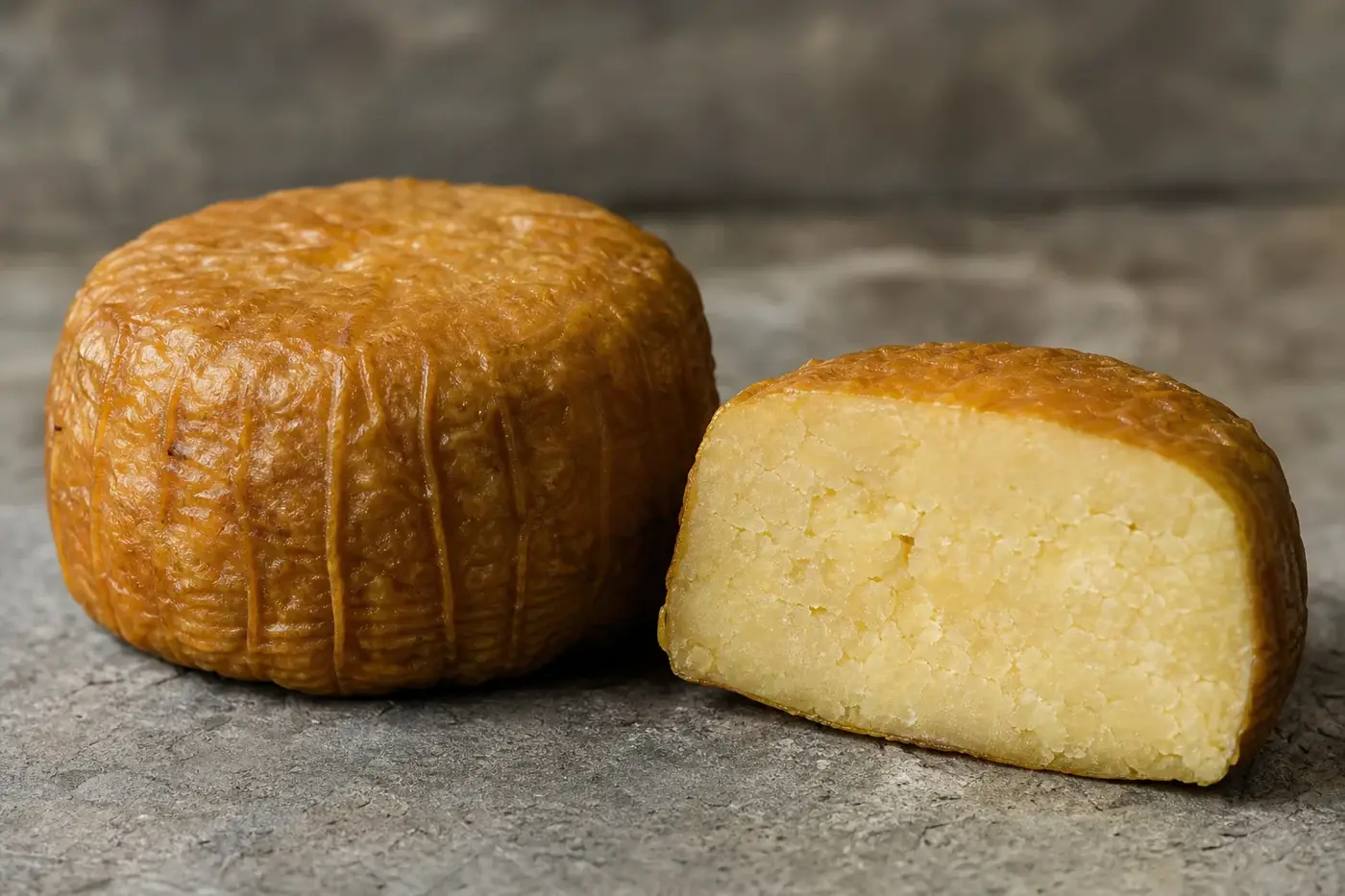
Smoke is a finishing choice, not a requirement for being Chechil. Cheesemee uses wood chips, while the American Chechil producer specifies hickory woodchips for its smoked version and also makes a plain braid. Choose unsmoked for a lighter character, or smoked when you fancy a more assertive aroma. [4][5]
Take your time with the texture
Chechil asks you to notice the pull as much as the flavour. Dili describes its cheese as firm and stringy, with a pronounced salty flavour. The American producer calls its braid chewy and peelable, with a lightly salted plain version and a smoky, savoury hickory-smoked one. [3][5]
Treat those descriptions as clues to each maker's style, rather than a promise that every braid tastes alike. Start with the texture, then notice how much of the experience comes from salt or smoke. For once, pulling your food apart is rather the point. [3][5]
The white braid in the Armenian study records unsmoked Chechil's pale appearance. Smoking changes the surface as well as the aroma: Cheesemee describes its smoked cheese as cream-brown, dense and smoky. A brown exterior on a cheese sold as smoked therefore means something different from an unexpected colour change during storage. [1][4]
Pull up a plate and loosen the plait
Find a loose end, ease the plait apart and pull narrow strands along their length. That approach follows the peelable structure described by the American producer. If you are sharing, loosen only what you intend to serve and keep the rest refrigerated. [5]
Give the strands centre stage with plain bread, sliced cucumber and tomatoes, and a few herbs. Taste before adding much else that is salty. Cheesemee suggests bread, olives and pickles with its smoked version; let the braid in front of you guide the combination. [4]
For your first comparison, put plain and smoked strands on separate small plates and begin with plain. Notice how readily each strand separates, how much resistance it gives as you chew, and whether salt or smoke dominates the finish. Bread and water between the two keep things simple.
For a drink alongside, try sparkling water or unsweetened iced tea. You need not make the occasion any more complicated than that.
Chechil, Sulguni and Korbáčik: meet the other plaits
A braid is a clue, not an identity card. Chechil, Sulguni and Korbáčik all show how warmed, acidified cheese can be worked into a new shape. Their forms overlap: the Georgian Sulguni specification explicitly permits braids and strings alongside its usual low cylinder. [6]
| Cheese | Milk in the documented examples | How it takes shape | What to look for |
|---|---|---|---|
| Chechil | Cow's milk in the examples above | Pulled into fine threads, commonly braided | Individual strands define its presentation. [2][3][4] |
| Sulguni | Cow, buffalo or goat, or mixtures | Kneaded and folded; usually a low cylinder | The specification describes a layered, elastic body. [6] |
| Korbáčik | Cow's milk in the cited production guide | Soured cheese warmed, drawn into threads and plaited | A Slovak tradition with named regional products. [7][8] |
The Czech agricultural training guide describes heating soured cow's milk cheese in hot water, drawing it into threads and plaiting it to make Korbáčik. Here you have another route from warm cheese to a carefully worked shape. [7]
Keep the broader word Korbáčik distinct from Zázrivský korbáčik. The latter is a specific registered name, listed as a protected geographical indication (PGI) on Great Britain's register as of November 2026. That full name matters. [8]
Choose a braid with more than your eyes
Start with the enjoyable decision: plain or smoked? Then look beyond the shape and read the milk species, whether the milk is pasteurised, the ingredients, storage temperature and any instructions after opening. Those details help you compare makers' versions on more than appearance alone. [3][5]
If the coagulant matters to you, look for an explicit declaration. A starter culture does not identify the rennet's source: Dili, for example, lists rennet without specifying where it comes from. For the rest of the pack, turn to reading a cheese label. [3]
Buying at a counter? Ask to see the original packaging or the supplier's product information, then ask separately about milk treatment, coagulant and storage after purchase. These questions tell you more than “Is it traditional?”, since documented recipes already take different approaches to milk and acidification. [1][3][5]
Give the remaining strands a good home
Keep Chechil refrigerated and follow its storage instructions, including those for an opened pack. If you follow UK Food Standards Agency advice, its guidance for England, Wales and Northern Ireland recommends a home fridge between 0 and 5 °C (32 to 41 °F). The American Chechil producer specifies about 3 °C (38 °F) for its own packs. [5][9]
The same FSA guidance says to keep chilled food out of the fridge for the shortest possible time during preparation, with a maximum of four hours. Serve a small portion, then replenish it from the fridge. Keep the remaining cheese refrigerated rather than leaving the whole pack on the table. [9]
Dates deserve your attention too. Under UK official guidance, a use-by date concerns safety, while a best-before date concerns quality. Eat refrigerated Chechil within its use-by date and any shorter limit for the opened pack; the FSA warns that smell cannot establish safety for food carrying a use-by date. [10][11]
For foods with best before dates, the FSA identifies visible mould, altered texture and souring smells as relevant checks. It advises against eating food that is obviously rotten or mouldy. Consult its Home Food Fact Checker and mould on cheese for the wider guidance. [11]
Follow the threads to your next read
- How Cheese Is Made: From Milk to Cheese: follow the main stages behind curd and whey.
- How to Store Cheese at Home: find storage methods for other cheese styles.
General information only, not medical advice: follow the official guidance where you live.
Questions people ask
What is Chechil cheese?
Chechil is a stretched curd string cheese commonly made into braids. It is closely associated with Armenia and is also documented in Georgia.
What milk is Chechil made from?
Documented Armenian traditions mainly use skimmed cow's milk, although sheep's and buffalo's milk versions are also described. Dili's current recipe uses pasteurised whole cow's milk.
Is all Chechil smoked?
No. Chechil is made in both smoked and unsmoked forms. Smoking is an optional finish rather than a defining feature of the cheese.
Is Chechil suitable for vegetarians?
Check the particular product for an explicit declaration of the coagulant. Dili lists rennet without specifying its source, and its microbial starter does not identify where the rennet comes from.
How should Chechil be stored?
Keep it refrigerated and follow the pack's instructions, including those for an opened pack. The UK Food Standards Agency advises a home fridge temperature of 0 to 5 °C in England, Wales and Northern Ireland. For date and spoilage guidance, consult the FSA's Home Food Fact Checker.
Sources
- Yerevan State University Publishing House, Traditional Skills in Chechil Cheese-Making and Preservation Among Armenians, History and Culture, special issue 1, 2025, pp. 247 to 259. Published 29 May 2025; English abstract consulted.
- Food and Agriculture Organization of the United Nations, Gardens of Biodiversity: Conservation of Genetic Resources and Their Use in Traditional Food Production Systems by Small Farmers of the Southern Caucasus, 2010, “Cheese” section.
- Dili, Chechil Cheese Dili 300g, undated product information, retrieved November 2026. Commercial primary source for its own ingredients and tasting description.
- Cheesemee, Smoked Chechil Cheese, undated product information, retrieved November 2026. Commercial primary source for its own production account and sensory description.
- Chechil USA, Chechil FAQ, undated web edition, retrieved November 2026. Commercial primary source for its own plain and smoked products, ingredients and refrigeration instructions.
- National Intellectual Property Center of Georgia, Sakpatenti, Specification of the Protected Geographical Indication Sulguni, official specification available in November 2026, sections II and III.
- MAS Brána Vysočiny, agricultural processing training workbook hosted by the Czech State Agricultural Intervention Fund, undated retrieved edition, section “Korbáčik (Korbáček)”, printed pp. 22 to 23.
- Department for Environment, Food & Rural Affairs, Zázrivský korbáčik, Great Britain protected food names register, published 4 January 2021; live entry consulted November 2026.
- Food Standards Agency, How to Chill, Freeze and Defrost Food Safely, published 18 December 2017; current web edition consulted November 2026, section 1. Applies to England, Northern Ireland and Wales.
- GOV.UK, Understanding Food Labelling: Best Before and Use-by Dates, current web edition consulted November 2026.
- Food Standards Agency, Home Food Fact Checker, updated 21 August 2026, sections on the sniff test and removing mould. Applies to England, Northern Ireland and Wales.
- Food Standards Agency, Alerts, live alerts index consulted November 2026 for the editorial recall check.
Research combined Armenian ethnographic scholarship, an FAO regional account, official comparison documents, individual producers' published information and attributed UK food safety guidance.
Last checked: November 2026
Last checked November 2026.
The editors suggest you read next
Jarlsberg
Cut into Jarlsberg and those great, rounded holes catch your eye before you take a bite.