Kraft Heinz: Kraft Singles and Velveeta
Hot cheese meets cold steel.
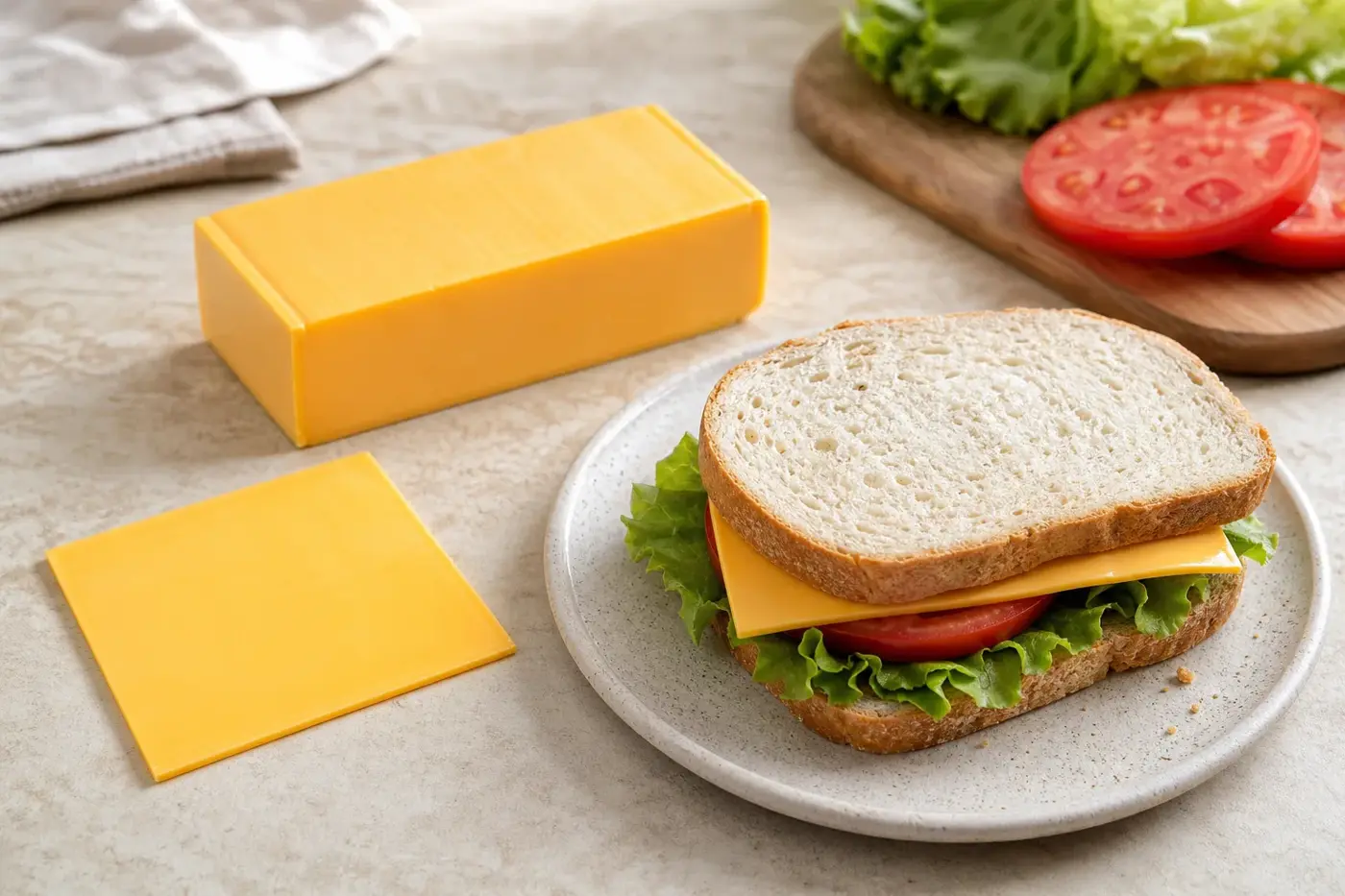
Hot cheese meets cold steel. It sounds like an unlikely kitchen partnership, but Kraft’s brand history puts that experiment in 1935, three decades before individually wrapped Kraft Singles reached shops in 1965. [5] Today, you’ll find Singles ready for sandwich duty and Velveeta in a block made for melting into dishes. Both belong to Kraft Heinz’s US portfolio, but look past the familiar names and their current recipes and American product descriptions tell different stories. [1,2,3]
Get to know the name behind the wrapper
The Kraft Heinz Company lists Kraft Singles and Velveeta among its brands. That tells you which group stands behind them, rather than the name of the food inside each pack. The exact manufacturing entity and production sites sit outside the scope of this page. [1]
Think of the label as three layers. “Kraft Singles” is the brand, “American” identifies the variety, and the longer product description tells you how the food is presented in the US market. Read all three for a fuller picture than the familiar name alone can offer. For more help navigating the small print, see how to read a cheese label. [2]
Before the wrapper, there was a tin
Kraft’s processed cheese story began in tins. Its historical company account dates production in tins to 1915 and its processing patent to 1916. The ambition was practical: cheese that could be packed and distributed reliably. The individually wrapped slice was still several decades away. [4]
Those cold steel experiments of 1935 led, according to Kraft’s brand history, to a Detroit trial in 1947. Commercially packaged DeLuxe slices appeared in the 1950s, followed by individually wrapped Kraft Singles in shops in 1965. Each portion had its own wrapper, so you no longer needed a knife and a block. The sandwich knife could take a brief holiday. [5]
Velveeta takes you to Monroe, New York. The Monroe Historical Society describes experiments using broken or misshapen Swiss cheese returned from another factory. It gives the brand a distinct local starting point, with imperfect cheese at the heart of the story. That account does not supply a primary-record basis for its original launch date. [6]
Is lunch calling for a sandwich or a sauce?
Kraft Singles American comes in individually wrapped slices. Kraft Heinz suggests eating them cold in sandwiches or melting them into dishes, and lists other varieties including Sharp Cheddar and 2% Milk. You get a measured square to lay across bread or a burger, with little preparation required. [2]
Velveeta Original is a block, presented by Kraft Heinz as an ingredient for nachos and casseroles. The wider brand includes slices, sauce pouches and pasta meals, with Queso Blanco and Mexican with Jalapeno Peppers also in the range. Look at the format as well as the name. A pasta meal and a plain block have different ingredient lists and nutritional panels. [3,8]
Two originals with different recipes to tell
Cheddar cheese comes first in the specific US Kraft Singles American ingredient list discussed here. Next come skimmed milk, whey, milkfat and milk protein concentrate. The formulation also contains calcium phosphate and sodium phosphate, plus smaller quantities of ingredients including modified food starch, salt, lactic acid, sorbic acid and colourings. Here, Cheddar appears by name as an ingredient. [2]
Velveeta Original starts with skimmed milk, milk, rapeseed oil, milk protein concentrate and sodium phosphate. Smaller-quantity ingredients include starch, whey protein concentrate, maltodextrin, whey, salt, sodium alginate and sodium citrate. The US label calls that oil “canola oil”. Where Singles names cheese, this Velveeta list describes a blend of dairy ingredients and other components. [3]
Treat these lists as snapshots of particular products, not promises about every pack bearing the name. Read the statement on the one you buy. That matters especially when you change variety or shop in a different market. [2,3]
What makes that melt behave?
An even melt starts with an even mixture. In processed cheese manufacture, ingredients are mixed and heated into a uniform mass, then formed and cooled. Kraft describes Singles as cheese blended and cooked with other ingredients. The aim is to keep fat, water and protein together, rather than leave fat pooling beside a tightening mass of protein. [9,10]
Casein, a major milk protein, is central to that behaviour. To understand the precise contribution of emulsifying salts in these particular formulations, you need the context of the full research source and relevant manufacturer information.
Moisture, protein, the salt system and processing conditions all help shape what happens in your pan. A slice that softens yet holds together and a block intended to become a flowing sauce reflect different design choices. Kraft Heinz describes melted Velveeta as creamy. For the earlier stages of the story, turn to how cheese is made. [3,10]
Read the American wording closely
The Singles listing says “pasteurized prepared cheese product”, while Velveeta says “pasteurized recipe cheese product”. Neither phrase names an FDA standard of identity in the table below. Those US standards set requirements for composition and manufacture. This comparison relates to the text in force in November 2026. [2,3,11]
| US standard | What it requires | Where you’ll find it |
|---|---|---|
| Pasteurized process cheese | Cheese blended with heat and permitted emulsifying agents; composition depends on the cheeses used | 21 CFR 133.169 [11] |
| Pasteurized process cheese food | At least 51% cheese; maximum 44% moisture; minimum 23% fat, all by weight of the whole product | 21 CFR 133.173 [11] |
| Pasteurized process cheese spread | At least 51% cheese; moisture above 44% and up to 60%; minimum 20% milkfat, all by weight of the whole product | 21 CFR 133.179 [11] |
The wording on these listings differs from the names in the table. That distinction alone does not settle either product’s precise legal classification or conformity with applicable requirements. Those questions depend on current US law and product records. [2,3,11]
Familiar brand, unfamiliar pack? Take another look
Before you compare nutritional panels, match the full product name and pack weight. A US product page describes a US item. Another flavour, a reduced-fat version or a prepared meal can bring a different recipe and serving size. A shared brand name does not make two products interchangeable. [2,8]
If you find a pack offered in the UK, look for its food name, ingredient list, responsible business details and storage instructions. Current UK availability and formulations fall outside the information provided by the sources cited here. An American description alone cannot tell you the classification of a product marketed in Britain. [12]
Put the nutrition figures on equal footing
The two packs do not use the same serving size. The Singles panel gives one 21 g slice, while Velveeta’s serving is 28 g, so a direct comparison hides a weight difference. Below, the manufacturer’s published figures have been calculated and rounded to show amounts per 30 g, then per 100 g. Any rounding on the original labels carries into these calculations. [2,13]
| US label measure | Kraft Singles American, 30 g / 100 g | Velveeta Original, 30 g / 100 g | Natural Cheddar comparator |
|---|---|---|---|
| Energy (kcal) | 71 / 238 | 75 / 250 | No established figure |
| Total fat (g) | 5.0 / 16.7 | 4.3 / 14.3 | No established figure |
| Saturated fat (g) | 2.9 / 9.5 | 1.1 / 3.6 | No established figure |
| Sodium (mg) | 329 / 1,095 | 418 / 1,393 | No established figure |
| Protein (g) | 5.7 / 19.0 | 4.3 / 14.3 | No established figure |
| Calcium (mg) | 471 / 1,571 | 246 / 821 | No established figure |
At equal weight, these calculations put Velveeta higher in sodium but lower in saturated fat than Singles. Singles supplies more protein and calcium. Those differences belong to these particular formulations, so give the panel a fresh look whenever your pack changes. [2,13]
There is no current-label comparison with a named Cheddar here. If you want to explore that cheese’s identity and production, head to the separate cheddar guide.
Let your dish make the decision
Start with what you want on the plate. A slice gives you a neat sandwich layer; a recipe block supplies a meltable dairy base. Ready portions and deliberately designed melting behaviour are the clearest practical benefits. Kraft Heinz’s serving suggestions focus on those everyday uses, rather than leaving you to negotiate with a block and hope for the best. [2,3]
That consistency has its limits, too. A standardised formulation delivers a particular flavour and texture, rather than the range you find across different cheeses and maturities. Ask whether your dish needs a cohesive slice, a sauce ingredient or the character of a particular cheese. Compare sodium at equal weight, especially when the other ingredients are salty. [2,3,10]
Both ingredient panels discussed here declare milk, and Kraft’s Singles FAQ says Singles contain lactose. For your dietary requirements, follow the specific pack’s declarations and relevant official guidance. The guide to cheese allergy and lactose intolerance explains why those are different questions. [2,3,9]
This page summarises published guidance from the official sources it cites. It is not medical advice. Guidance differs between countries and changes over time, so check the current source for where you live, and ask your doctor, midwife, pharmacist or dietitian about your own circumstances.
Keep the storage instructions handy
For these US Singles, Kraft Heinz says to refrigerate and not to freeze. Its Velveeta Original page also says not to freeze and gives refrigeration instructions after opening. Follow the instructions and date on your own pack. Keep the outer packaging so you have those details to hand. [2,3,9]
For England, Wales and Northern Ireland, the Food Standards Agency advises keeping your home fridge at 5 °C (41 °F) or below and following the storage instructions on packaging. The guidance referenced here is dated November 2026. [14]
Once you turn the product into a dish, its handling needs change with that dish. A block’s storage directions belong to the block, not automatically to macaroni cheese, a dip or a casserole made with it. Keep recipe and packaging instructions together. For the wider storage principles, see how to store cheese at home. [3,14]
Questions people ask
What is the difference between Kraft Singles and Velveeta?
Kraft Singles American comes in individually wrapped slices, while Velveeta Original comes as a block. Kraft Heinz suggests Singles for sandwiches or melted dishes, and Velveeta for dishes such as nachos and casseroles.
What ingredients are in Kraft Singles and Velveeta?
Cheddar cheese is first on the checked Kraft Singles American ingredient list, followed by skimmed milk, whey, milkfat and milk protein concentrate. Velveeta Original begins with skimmed milk, milk, rapeseed oil, milk protein concentrate and sodium phosphate.
Are Kraft Singles and Velveeta classified as processed cheese in the US?
The checked Singles listing says “pasteurized prepared cheese product”, while Velveeta says “pasteurized recipe cheese product”. Neither phrase is the name of an FDA standard of identity listed on the page, and their precise legal classification requires separate verification.
Which has more sodium, Kraft Singles or Velveeta?
Per 100 g, the page calculates 1,095 mg of sodium for Kraft Singles American and 1,393 mg for Velveeta Original. These figures are based on the checked US formulations and rounded manufacturer panels.
How should Kraft Singles and Velveeta be stored?
For the checked US products, Kraft Heinz says to refrigerate Singles and not to freeze them; it also says not to freeze Velveeta Original and gives refrigeration instructions after opening. For England, Wales and Northern Ireland, the Food Standards Agency advises keeping a home fridge at 5 °C or below and following the storage instructions on packaging.
Sources
- The Kraft Heinz Company. Beloved Global Brands. Current corporate portfolio, undated, retrieved November 2026. Corporate brand list.
- Kraft Heinz. American Slices. US product listing, product identifier 00021000604739, current online version retrieved November 2026. Product description, ingredients and nutrition.
- Kraft Heinz. Original Cheese. Velveeta US product listing, product identifier 00021000616909, current online version retrieved November 2026. Product description, ingredients and storage.
- Kraft Foods. The History of Kraft Foods Inc. Historical company account, undated, copy hosted by MIT. Historical account.
- Kraft Heinz. Kraft Singles: History. Undated brand history, retrieved November 2026. Brand chronology.
- Monroe Historical Society. The History of Cheese Making in Monroe. Undated local historical account, retrieved November 2026. Cheese in Monroe.
- The Kraft Heinz Company. Corporate Social Responsibility Report. 2017, brand chronology. Corporate report.
- Kraft Heinz. Velveeta: Products. US catalogue, current online version retrieved November 2026. Product range.
- Kraft Heinz. Kraft Singles: FAQ. Undated manufacturer guidance, retrieved November 2026. Ingredients, lactose and refrigeration questions.
- Journal of Dairy Science. Manufacture of process cheese products without emulsifying salts using acid curd and micellar casein concentrate. Research article, published online in 2022. PubMed record and abstract.
- US Food and Drug Administration. 21 CFR Part 133: Cheeses and Related Cheese Products, particularly §§ 133.169, 133.173 and 133.179. eCFR text displayed as current to 5 November 2026. Standards of identity.
- GOV.UK. Food labelling and packaging: Food labelling, what you must show. Current guidance retrieved November 2026. Required packaging information.
- Kraft Heinz SmartLabel. Velveeta Original Pasteurized Recipe Cheese Product, 16 oz Block. Product identifier 00021000616893; information confirmed by the manufacturer on 3 October 2026. Nutrition panel.
- Food Standards Agency. How to chill, freeze and defrost food safely. Current online guidance, retrieved November 2026; applies to England, Northern Ireland and Wales. Household refrigeration guidance.
This desk-researched article brings together manufacturer product records, company histories, US standards of identity, published dairy research and official household storage guidance.
Last checked: November 2026
Last checked November 2026.
The editors suggest you read next
Who Makes the World's Cheese? The Big Dairy Groups
You pick up Galbani at the cheese counter, then pause over Kerrygold.