Ladotyri Mytilinis
Small wheels of cheese rest in barrels topped with olive oil.
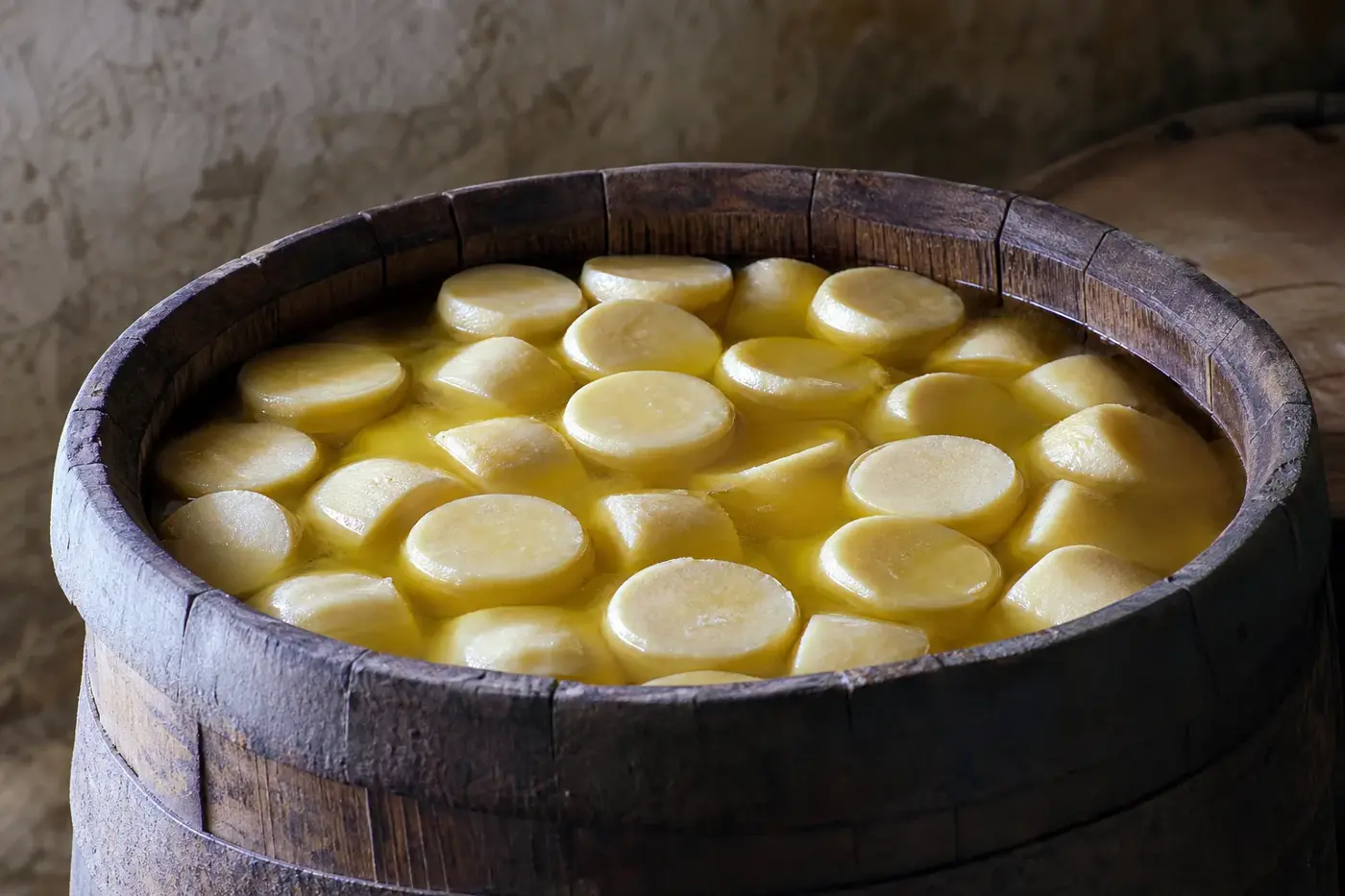
Small wheels of cheese rest in barrels topped with olive oil. You are on Lesvos, also known as Lesbos, and this is the practice that gives Ladotyri Mytilinis its name. The hard cheese’s story begins before the oil, though, with local sheep’s milk, sometimes mixed with goat’s milk, and the cheesemaker’s work. Its EU protected designation of origin ties it to island milk and production, with at least three months of maturation. [1, 2, 4, 5]
| What to know | A closer look |
|---|---|
| Familiar name | Ladotyri Mytilinis. [1] |
| Registered name | Λαδοτύρι Μυτιλήνης / Ladotyri Mytilinis. [1, 4] |
| EU authority and identifier | European Commission; PDO-GR-0445. Published standard amendment: PDO-GR-0445-AM01. [1] |
| Protection | EU PDO, originally registered 21 June 1996; separately registered under the Great Britain scheme on 31 December 2020. Record date: November 2026. [1, 4] |
| Island home | The island of Lesvos, Greece. [1] |
| Milk in the cheese | Sheep’s milk, or sheep’s milk with no more than 30% goat’s milk; raw or pasteurised. [1] |
| Time to mature | At least three months. [2, 3] |
| Composition limits | Maximum whole-cheese moisture: 38%. Minimum fat in dry matter: 40%. [1] |
Let the name take you to Lesvos
The name offers your first clue. Ladotyri means cheese kept in oil, according to the official EU account, with ladi meaning oil. Mytilinis connects it to Mytilini, familiar in English as Mytilene. The specification also uses Mytilini as a customary name for the island, so this geographical reference reaches beyond the town. [1]
Those words bring product, practice and place together. “Ladotyri” alone calls for a closer look at origin; the complete registered name identifies this particular island cheese. A handwritten counter description may leave out details from the original packaging. Ask to see the label: small print occasionally earns its keep.
If you would like to untangle the difference between a regional name and a production specification, explore protected cheese names.
Meet the flock before you reach the barrel
Start on the grazing land, rather than beside the oil barrel. The EU document describes sheep and goats adapted to the production area, with the Mytilini sheep dominant and a diet based on local flora. The animals graze principally in mountainous and semi-mountainous country. During the warm season, they move towards mountain pastures. [1]
Olive oil brings another strand of island farming into the story. Greece’s national tourism organisation places olive oil and cheeses among the foundations of Lesvos’s food culture. The island’s tourism account brings the two together in that memorable sight: Ladotyri resting in barrels topped with oil. [5, 9]
You can follow the same path when choosing a cheese. Where did the milk come from, how was the cheese matured, and was it subsequently kept in oil? Whether your pack contains olive oil is useful to know. It tells you only the last part of a process that begins with island milk and cheesemaking.
From rice-sized curds to a firm little wheel
That compact wheel begins with fine grains of curd. Rennet, the preparation that coagulates milk, sets it into curd; the cheesemaker cuts it finely, heats it and gathers it into a mass before dividing it into individual cheeses. Whey is the liquid released as the curd forms and drains. This is a cooked-curd process, with each stage shaping the next. [2]
Here are the principal stages set out in the specification. You are looking inside dairy production, rather than following a recipe for making the cheese at home. [2]
| Stage | What happens in the dairy |
|---|---|
| Coagulation | Milk sets at 32 to 34 °C; the curd is ready to cut after approximately 30 minutes. |
| Cutting | The curd is cut into grains approximately the size of rice. |
| Heating | Raw-milk curds reach 41 to 43 °C; pasteurised-milk curds reach 42 to 45 °C. |
| Moulding | Portions are pressed into cylindrical moulds, then turned and drained. |
| Salting | Fine salt is rubbed over the surfaces before maturation. |
Source: Greek product specification, section 5. [2]
The mould gives you that small cylindrical shape. Updated rules allow traditional woven moulds or other materials suitable for food contact. The familiar form remains part of the cheese’s identity. Dairies can choose an appropriate mould material, rather than all having to use the same one. [3]
Curious about what cutting, heating and draining actually do? Take a closer look at how cheese is made.
Three months of quiet work in the maturing room
Ladotyri Mytilinis must mature for at least three months. The current amended production wording specifies approximately 85% relative humidity and a temperature no higher than 16 °C. An older account giving a mandatory range of 12 to 16 °C needs updating to reflect the EU specification. [3]
There is a practical reason for removing the lower limit. The amendment explains that developments in milk quality, cultures and production control let cheesemakers work at lower temperatures. This moderates ripening and avoids excessively intense flavours. The three-month minimum remains in place. [3]
When you ask about age, ask how those months were managed, too. Time and storage method belong together: an older cheese is not necessarily stronger, or the one you will enjoy most. Note both details if they are available. Choose the character you want on your plate, rather than asking age alone to stand in for quality.
A barrel of oil, or a neatly sealed wedge?
The traditional barrel is not a shortcut from fresh curd to finished cheese. It holds cheese that has already been made and matured. The island tourism account describes maturation, salting and storage in a barrel topped with olive oil. This is an established preservation practice, not fresh curds put straight into a jar. [5]
Your cheese counter may tell a less visibly oily story. One Lesvos dairy documents vacuum-packed wheels and portions, so Ladotyri Mytilinis can arrive without oil surrounding it. The packaging tells you how the cheese is presented now. It reveals only part of its earlier treatment. [6]
A published research trial compared cheeses stored with olive oil and with paraffin coverings, recording different protective treatments in research. For cheese sold commercially, the applicable specification remains the authority on legal requirements. Research treatments and marketing requirements are separate matters. [7]
Ask two distinct questions: “Was this cheese stored in olive oil?” and “How is this portion packed now?” If the oil-preserved tradition is what caught your imagination, say so. A sealed wedge and a cheese lifted from oil give you different clues before either reaches your plate.
Find the patterned rind and pale heart
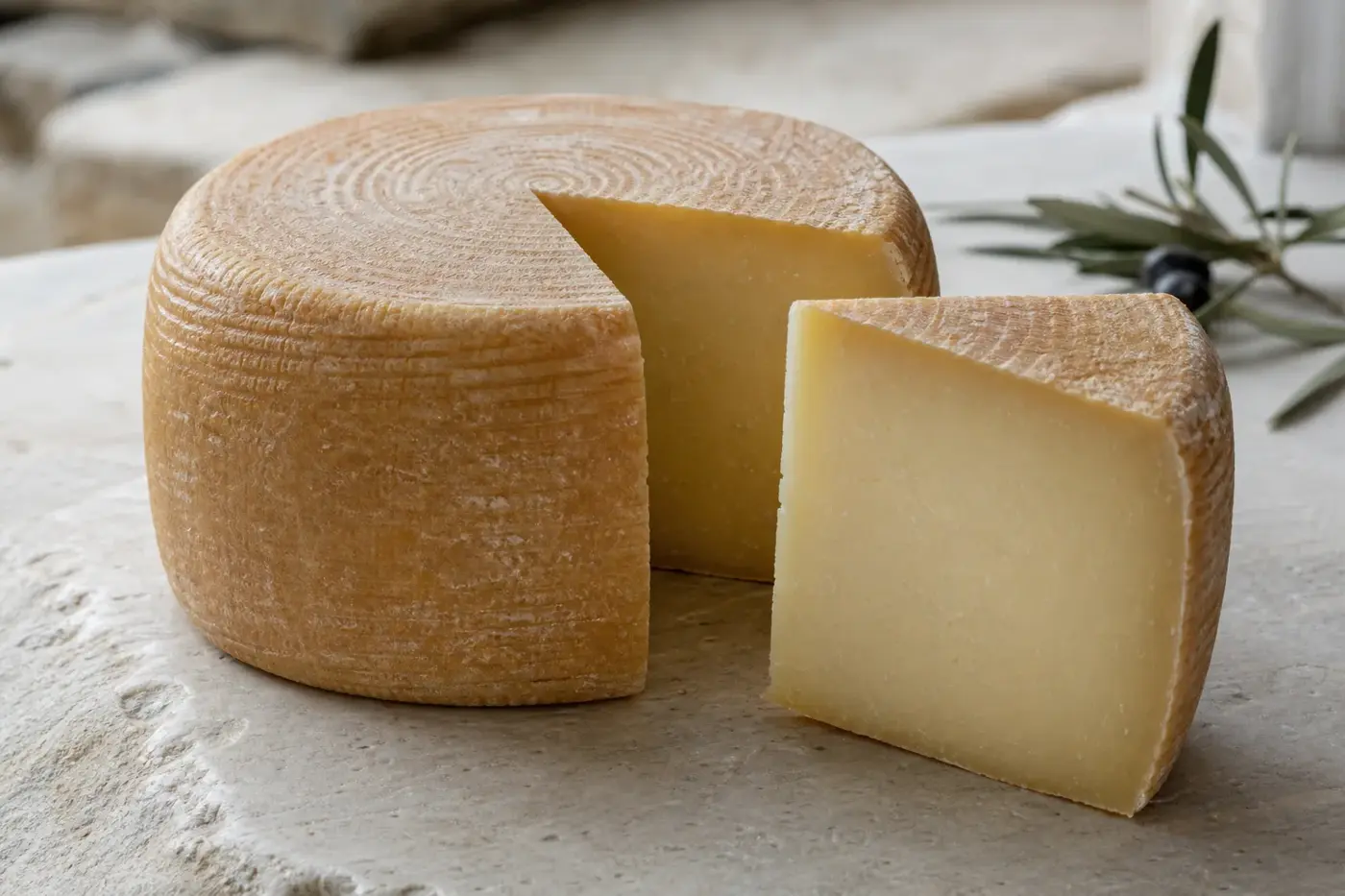
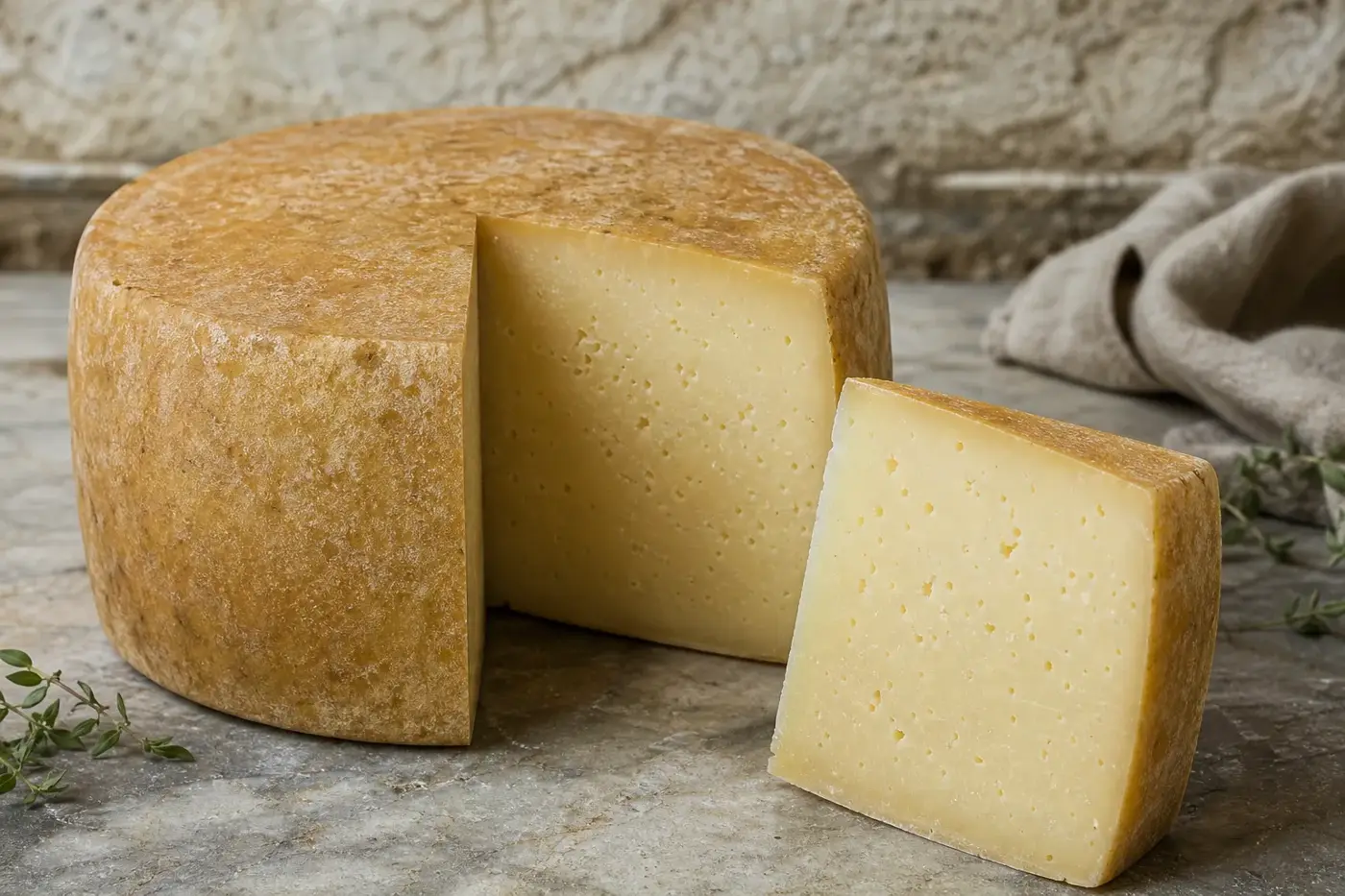
Set aside the image of a broad, flat wheel. Ladotyri Mytilinis is a compact cylinder, usually about 10 cm in both diameter and height, weighing up to approximately 1.5 kg in the EU description. Its hard, dry rind bears a characteristic embossed pattern. [1]
Inside, you find white to yellowish white paste, dotted with small, irregularly distributed holes. A Lesvos producer likewise describes a hard texture, small openings and a pale yellow-white colour. Expect a close, firm structure. A flowing centre or a highly open paste is not what you are looking for here. [1, 6]
If you are buying a cut portion, ask to see the original wheel or its label where possible. A photograph of the whole cheese can also connect your wedge to that cylindrical shape. When making tasting notes, keep the rind’s appearance separate from the paste’s texture. Each tells you something different about the cheese in front of you.
Taste the salt, then give the finish a moment
Saltiness and a pleasant aroma are the official description’s starting points. The island tourism account adds a spicy aftertaste, while the local producer describes a full flavour. Together, those accounts suggest a firm, savoury table cheese with an assertive finish. If you are looking for softness and mildness, this is not their starring role. [1, 5, 6]
Maturation changes the balance. In a field trial of raw and pasteurised milk cheeses across three seasons, researchers analysed 72 samples through production, ripening and storage. Moisture fell and salt content rose during ripening. Those measurements help explain why age can change both texture and your impression of saltiness. [7]
Give yourself four things to notice: the resistance of the paste, the first impression of salt, the aroma after chewing and the length of the finish. With an oil-preserved cheese, assess the surface oil on its own first. Then consider how much of the overall impression comes from the oil, and how much from the cheese underneath. A second thoughtful bite is entirely respectable research.
Choose your portion and make room in the fridge
Begin with the full name, producer information and original label. Ask about age, milk treatment and oil storage, then choose a portion that fits your plans. For the wider details worth considering before you bring it home, turn to reading a cheese label.
In England, Wales and Northern Ireland, the Food Standards Agency advises following the pack’s storage instructions, including any that apply after opening. Its household guidance recommends a fridge at 5 °C or below. Use a thermometer to check the temperature. The fridge dial alone does not provide that reading. [8]
For cheese sold in oil, keep the supplier’s instructions and follow its refrigeration and after-opening requirements. If your portion has been decanted, ask for written directions. Keep the container closed between uses. Remove cheese with clean utensils, in line with the FSA’s general handling advice. [8, 10]
Take out what you expect to eat, rather than repeatedly bringing the whole container to the table. Note the opening date alongside any after-opening instruction, so you have both together. You will find the wider routine in storing cheese at home.
Let the cheese lead, then build your plate
Give the first small piece your full attention. Tasting it on its own gives you a clear impression before you bring in bread and vegetables. Try plain bread, sliced tomatoes, cucumber or roasted peppers. Let the particular cheese on your plate guide you towards the combination you enjoy.
For an oil-preserved portion, lift out what you need with a clean utensil. Let excess oil drain before arranging the cheese on your plate. Follow the supplier’s handling instructions and the refrigeration guidance above. [8, 10]
You can explore its flavour with a grater, too. Add a little to pasta, beans or roasted vegetables, taste, then decide whether the dish needs more cheese or salt. Start modestly, so the cheese supports the food rather than taking over. These are serving suggestions, leaving you room to adjust the amount to your particular cheese and dish.
A local producer recommends Ladotyri alongside wine generally; a dry Greek white or dry rosé is one possible choice, in a small measure for adults of legal drinking age. Offer water or an alcohol-free drink alongside it, and explore cheese and wine pairing for the wider principles. People who are pregnant, driving, taking medicines that interact with alcohol, or recovering from alcohol dependence should not drink. Consult the current NHS advice for your circumstances. [6, 11]
General information only, not medical advice: follow the official guidance where you live.
Questions people ask
What milk is used to make Ladotyri Mytilinis?
It is made from sheep’s milk, sometimes mixed with goat’s milk. Goat’s milk can make up no more than 30% of the milk, which may be raw or pasteurised.
Is Ladotyri Mytilinis always sold in olive oil?
No. One Lesvos dairy documents wheels and portions sold in vacuum packs, without visible oil surrounding them. You can ask whether the cheese was stored in olive oil and how it is packed now.
How long is Ladotyri Mytilinis matured?
It must mature for at least three months. The amended production wording specifies approximately 85% relative humidity and a temperature no higher than 16 °C.
What does Ladotyri Mytilinis taste like?
The official description notes a salty flavour and pleasant aroma. The island tourism account also describes a spicy aftertaste.
How should I store Ladotyri Mytilinis?
For England, Wales and Northern Ireland, the Food Standards Agency advises following the pack’s instructions, including those for after opening. Its household guidance recommends a fridge at 5 °C or below; see the Food Standards Agency’s guidance for details.
Sources
- European Commission. Publication of the communication of an approved standard amendment to a product specification of a geographical indication, C/2026/131, published 12 January 2026, including the single document for Λαδοτύρι Μυτιλήνης / Ladotyri Mytilinis, reference PDO-GR-0445-AM01.
- Greek Ministry of Rural Development and Food. Προδιαγραφές του προϊόντος: Λαδοτύρι Μυτιλήνης / Ladotyri Mytilinis, consolidated specification linked by the ministry’s 2025 approval decision, especially sections 2 and 5.
- Greek Ministry of Rural Development and Food. Αποδοχή αιτήματος έγκρισης συνήθους τροποποίησης των προδιαγραφών του προϊόντος, decision 223481, 7 August 2025, Article 1. Read alongside the EU communication’s explanation of the amended maturation conditions.
- Department for Environment, Food & Rural Affairs. Λαδοτύρι Μυτιλήνης / Ladotyri Mytilinis, Great Britain protected food names register entry, published 4 January 2021; status retrieved November 2026.
- Visit Lesvos. Cheese, undated island tourism account, retrieved November 2026. Used for its description of the oil-storage tradition and attributed sensory wording, not for its historical count of Greek protected cheeses.
- Santziliotis dairy. Λαδοτύρι Π.Ο.Π., undated producer account, retrieved November 2026. Commercial producer source for its own description, vacuum-packed formats and serving recommendation.
- Hellenic Agricultural Organization, Veterinary Research Institute. Microbiological and physicochemical parameters of traditional cheese “Ladotyri Mytilinis”, conference abstract, archive filename dated 2013. Used for the reported experimental design, storage treatments and compositional observations.
- Food Standards Agency. How to chill, freeze and defrost food safely, published 18 December 2017, current retrieved guidance for England, Northern Ireland and Wales, checked November 2026.
- Greek National Tourism Organisation. The Gastronomy of Lesvos, undated tourism account, retrieved November 2026. Used for the association of the island’s cuisine with olive oil and dairy products.
- Food Standards Agency. Food safety in a power cut: advice for consumers, retrieved November 2026, section on cleaning and avoiding cross-contamination. Used only for its general advice on clean utensils and handling.
This piece was researched from official Greek and EU documents, published food authority guidance, an island tourism account, a producer’s description and a primary research abstract; no site tasting was undertaken.
Last checked: November 2026
Last checked November 2026.
The editors suggest you read next