Maltese Cheese
A fresh ġbejna slips into Malta’s winter vegetable soup.
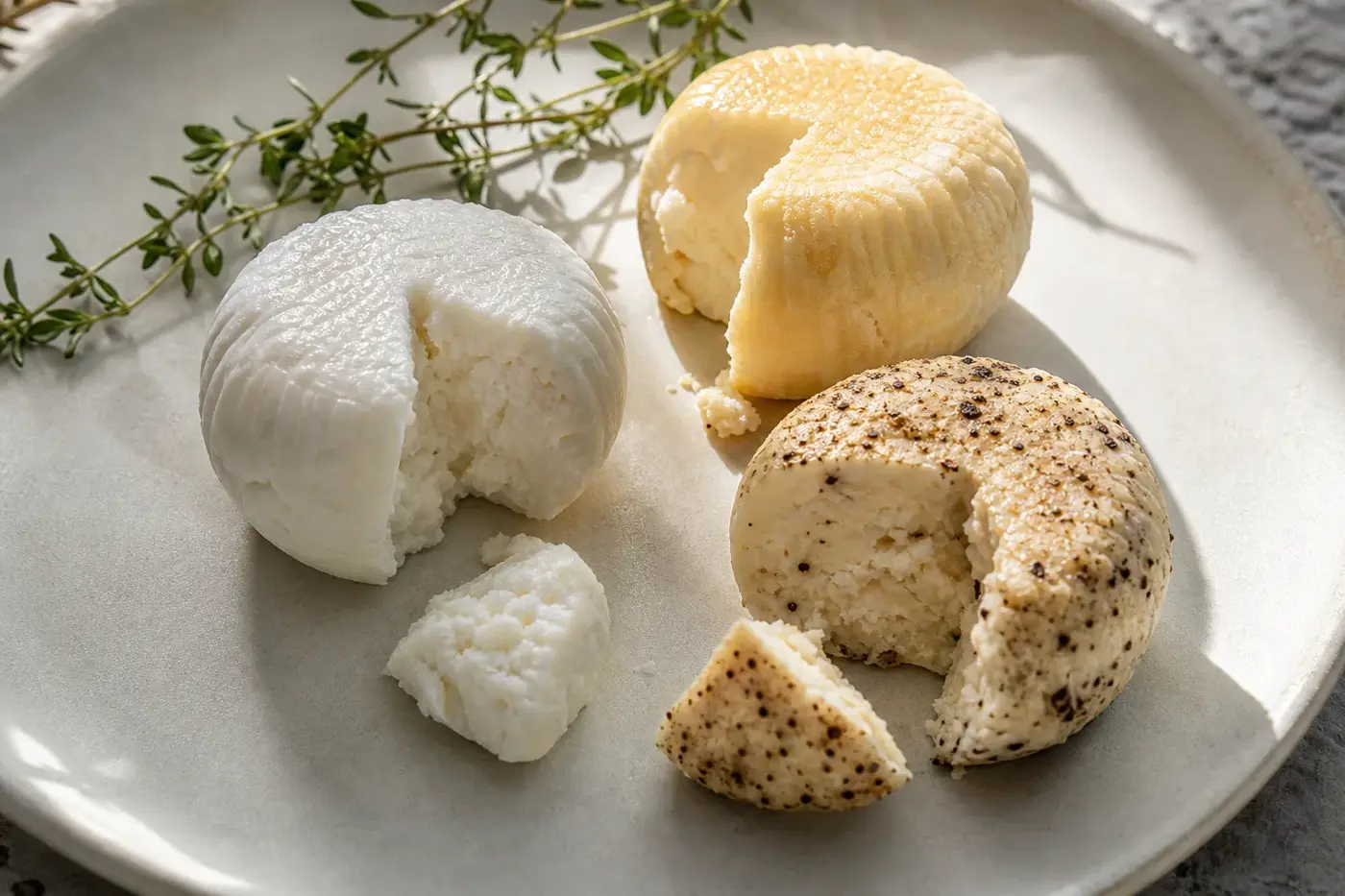
A fresh ġbejna slips into Malta’s winter vegetable soup. Beside it, bread with oil waits for a dried or preserved cheeselet. These small cheeses, collectively called ġbejniet, invite you from cooking pot to breadboard, with fresh, dried and peppered forms to taste, island farmers to meet and the separate pleasures of irkotta to discover. [2,3]
Your Maltese cheese companion
| What to know | Your starting point |
|---|---|
| Country | Malta, including Gozo. [2] |
| Styles to discover | Fresh, dried and peppered ġbejniet; irkotta. [2,8] |
| Local milks | Sheep’s and goat’s milk; cow’s milk in the wider dairy sector. [3,6] |
| Exact PDO name | Ġbejna tan-nagħaġ. [2] |
| EU authority and file | European Commission; PDO-MT-02973. [2] |
| Registration measure | Commission Implementing Regulation (EU) 2025/135, adopted 21 January 2025. [1] |
| Register reference | See the registration measure above. [1] |
Follow a cheeselet from soup to bread
Follow a cheeselet from fresh to dried and its place at the table changes. Fresh ġbejna suits a spoonable filling or a bowl of soup; dried or preserved cheeselets belong beside bread. Malta’s official AgriFair account pairs fresh ġbejna with soppa tal-armla and dried or preserved cheeselets with ħobż biż-żejt, bread with oil. [3]
For your first tasting, choose one cheeselet in each form and ask who made it. Compare the milk, the treatment and how each is served. Small and white does not mean interchangeable. Your breadboard is allowed a little variety.
Meet the flock behind your cheese
Limited rainfall and scarce agricultural land shape Maltese cheesemaking as surely as the animals do. The PDO application describes locally sourced hay from cereals and legumes, supplemented with concentrates. Over a year, up to 45% of feed dry matter may come from outside the production area; at least 55% must be local. Those figures govern the protected sheep’s milk cheese, not every Maltese dairy herd. [4]
Stored forage matters here as much as seasonal green feed. Research published through the University of Malta’s T-cheesimal partnership discusses fresh cut grasses and concentrates in sheep feeding. Ask a farmer what the flock eats that season. On a dry island, the answer includes harvested fodder and bought feed as well as any grazing. [5]
Sheep are central to ġbejniet, while AgriFair also places cheeselets within the goat sector. Cow’s milk belongs to the wider dairy story: Benna’s educational programme follows cow milking and dairy production, and its catalogue lists fresh and dried cheeselets. Ask separately about milk species and pasteurisation when you buy. AgriFair records both pasteurised and unpasteurised cheeselets on the Maltese market. [3,6,7]
Taste ġbejna in three different moods
Start with white, soft and humid, then move towards ivory and straw yellow. The PDO document describes how treatment transforms the cheese. Ġbejna is singular and ġbejniet plural, and the published single document sets out the differences between fresh, dried and peppered preparations for the PDO product. [2]
| Form | How it is prepared | What to look for in the PDO product |
|---|---|---|
| Friska | Fresh | White, soft and humid; fresh milk aroma and light saltiness. |
| Niexfa | Air-dried | Ivory to straw yellow, semi-hard to hard; sweetness and slight acidity. |
| Tal-bżar | Pickled and peppered | Humid to chalky texture, greater acidity and a persistent black pepper sensation. |
Use those descriptions of the specified product as a guide when you taste other local cheeselets. Notice the remaining moisture and the firmness of the centre. Does pepper take charge of the finish?
Give each mouthful a little attention and the differences become more rewarding. For the distinctions behind what you taste, see how to tell cheese styles apart.
Get acquainted with the protected name
Ġbejna tan-nagħaġ names a sheep’s milk product, not every cheeselet you might buy in Malta. Its published EU application sets out that identity under PDO, meaning protected designation of origin. [2]
The specification calls for whole raw sheep’s milk from the Maltese breed and its crosses, including crosses with Friesian sheep. That milk must come from the defined area, where farming, cheesemaking and maturing also take place. The area covers Malta, Gozo and Comino. [2,4]
The published application describes fresh, dried and peppered forms and proposes labelling requirements. Read the full wording when choosing your cheese. To untangle a geographical designation from a style, turn to protected names explained. [2]
Make room for irkotta
Milk, whey or both? That is your opening question with irkotta, which deserves its own place beside the cheeselets. Whey is the liquid left when curds separate during cheesemaking, and whey products begin with that liquid.
Maltese irkotta also includes milk-based preparations. The Agriculture Directorate’s traditional-food inventory records a Żurrieq version made with sheep’s milk, seawater and flour, heated and drained in a mould. The starting ingredient distinguishes the preparation, so ask the maker what goes into it. [8]
At the table, follow the filling. Diar il-Bniet lists ravjul made with sheep irkotta, a documented example of its use inside filled pasta. It offers you quite a different encounter with Maltese cheese from a whole or sliced cheeselet beside bread. [9]
Let your next mouthful lead the way
Bread makes the simplest beginning. AgriFair identifies dried and preserved ġbejniet as an ingredient in ħobż biż-żejt. When you order filled bread or a local platter, ask for the cheese by name, especially if you want to compare sheep’s milk cheeselets with those made from another milk. [3]
For pastry, look for qassatat. Valletta Cultural Agency includes them alongside pastizzi in its 2026 local-food festival guidelines. Ask which fillings are available and which pastries contain irkotta or cheeselets. With ravjul, that question is just as useful: Diar il-Bniet’s sheep irkotta version is one specific preparation to seek out. [9,10]
Then return to soppa tal-armla, the winter vegetable soup AgriFair associates with fresh ġbejna. Here your fresh cheeselet heads into the cooking pot. In Gozo, the Agriculture Directorate records another use: fresh sheep’s milk cheeselets mashed into a parsley and grated-cheese filling for stuffed pasta shells. [3,8]
This page summarises published guidance from the official sources it cites. It is not medical advice. Guidance differs between countries and changes over time, so check the current source for where you live, and ask your doctor, midwife, pharmacist or dietitian about your own circumstances.
From family moulds to a protected name
Family sheep farms give this history its human scale. The T-cheesimal publication, produced through Maltese and Sicilian research institutions, describes how households divided livestock and cheesemaking work, and how traditional moulds gave way to plastic ones. It offers a picture of that research period, rather than every farm today. [5]
The project also records a seminar held on 27 June 2013 and work on feed, packaging and traceability. The later documentary trail leads from the PDO application published on 2 September 2024 to the registration measure dated 21 January 2025. Together, these records follow a familiar household food into research and formal geographical recognition. [1,2,5]
Take your curiosity to Malta and Gozo
Pair a food counter with a booked production visit. At the counter, you can compare the forms side by side. At a farm or dairy, connect what you taste with its milk and method. Consider it a perfectly respectable reason to organise a day around cheese.
- On Malta: Ta’ Karlu Farm in Wardija advertises sheep-farm visits by appointment. Ask what your visit includes, whether cheese tasting is available and which access arrangements suit your group. [11]
- On Gozo: Magro Brothers advertises a factory tour at its Food Village in Xewkija. It includes a cheesemaking centre for ġbejniet and irkotta and an artisan-food centre. Confirm the current programme and book directly with the operator. [12]
- For a prepared dish: Diar il-Bniet’s sheep irkotta ravjul listing gives you a specialist food-shopping lead. Confirm where you can buy or eat it before travelling. [9]
For markets on either island, ask the local visitor information service for the current food-market programme. Then find out which traders sell locally made dairy. At the stall, ask for the maker, milk species, milk treatment and storage instructions. A market’s name tells you little about the particular cheese in front of you.
Before booking a farm visit, ask about step-free access, toilets, footwear requirements and entry to production areas. Arrange accessibility support directly with the operator. Establish, too, whether you are booking an educational demonstration or a public invitation to make cheese.
Bring your cheeselets home safely
Start with the maker’s label, including storage instructions after opening. As an official household benchmark, Food Standards Agency guidance for England, Wales and Northern Ireland, as of November 2026, advises a fridge between 0 and 5 °C and refrigeration of dairy products. Follow any more specific instructions supplied with your cheese. Read the labels on dried and peppered forms too. [13]
Serve a little at a time and keep the rest chilled. The same FSA guidance says chilled food should spend the shortest possible time outside the fridge during preparation, with a maximum of four hours. For your wider routine, see how to store cheese at home. [13]
Ask explicitly about raw milk at the counter. The PDO application specifies raw sheep’s milk, while the broader Maltese cheeselet market includes pasteurised products. Get the treatment confirmed rather than trying to judge it by appearance. [3,4]
For pregnancy, UK NHS guidance, as of November 2026, distinguishes hard cheeses from specified soft cheeses and gives cooking advice for some cheeses. Consult the current guidance for your country and your own clinician when deciding what to eat. [14]
There is more to discover at the counter
- Raw Milk, Thermised and Pasteurised Cheese: get to know the treatments behind the label.
- How to Read a Cheese Label: untangle milk, maker and geographical designation.
Questions people ask
What is ġbejna?
Ġbejna is a small Maltese cheeselet; the plural is ġbejniet. Cheeselets come in fresh, dried and peppered forms.
How do fresh, dried and peppered ġbejniet differ?
Fresh cheeselets are white, soft and humid, while dried ones are ivory to straw yellow and semi hard to hard. Peppered cheeselets are pickled, with greater acidity and a persistent black pepper sensation.
What milk is used for Maltese cheeselets?
Sheep’s and goat’s milk are used for cheeselets, and cow’s milk is part of the wider Maltese dairy sector. The protected sheep’s milk cheese specification calls for whole raw milk from the Maltese breed and its crosses.
How are ġbejniet eaten in Malta?
AgriFair associates fresh ġbejna with soppa tal armla, a winter vegetable soup. In Gozo, fresh sheep’s milk cheeselets are also mashed with parsley and grated cheese to fill pasta shells.
Where can I visit a Maltese cheese producer?
Ta’ Karlu Farm in Wardija advertises sheep farm visits by appointment. Magro Brothers advertises a factory tour at its Food Village in Xewkija, Gozo, including a cheesemaking centre.
Sources
- European Commission. Commission Implementing Regulation (EU) 2025/135 of 21 January 2025 on the registration of the geographical indication Ġbejna tan-nagħaġ (PDO), 2025. Official EUR-Lex search record retrieved; operative text requires the additional check recorded below.
- European Commission. Publication of an application for registration of a name: Ġbejna tan-nagħaġ, C/2024/5348, published 2 September 2024. Single document, EU file PDO-MT-02973.
- Government of Malta, AgriFair. Livestock Produce, undated webpage retrieved November 2026.
- Malta Competition and Consumer Affairs Authority. Technical file related to PDO-MT-02973: Ġbejna tan-nagħaġ, document bearing reference Ares(2023)4784458, 10 July 2023.
- University of Malta and T-cheesimal research partners. T-cheesimal project publication, English section beginning The Maltese Cheeselet from Sheep’s Milk is Highly Valued, associated with the Italia-Malta 2007 to 2013 programme. Publication year not verified. Hosted by MCCAA.
- Malta Dairy Products Ltd., Benna. Benna Experience, undated operator webpage retrieved November 2026. Commercial operator’s account of its educational programme.
- Malta Dairy Products Ltd., Benna. Products, current online catalogue retrieved November 2026. Commercial producer source.
- Malta Ministry for Agriculture, Fisheries, Food and Animal Rights, Agriculture Directorate. Traditional-food inventory, file qp003.pdf, entries 11 and 42. Undated document hosted in the ministry’s May 2024 upload directory.
- Diar il-Bniet. Ravjul tal-Irkotta Ta’Naghna, undated product listing retrieved November 2026. Commercial producer’s description, identifying sheep irkotta ravioli.
- Valletta Cultural Agency. Expression of Interest: Valletta Local Food Festival 2026, Guidelines, 2026, section 2.1.
- Ta’ Karlu Farm. Official farm website, undated visitor information retrieved November 2026. Operator’s account of location and appointment arrangements.
- Magro Brothers. Magro Brothers Factory Tours, undated operator webpage retrieved November 2026.
- Food Standards Agency. How to chill, freeze and defrost food safely, published 18 December 2017, current webpage retrieved November 2026; applies to England, Northern Ireland and Wales.
- NHS. Foods to avoid in pregnancy, current webpage retrieved November 2026, section “Cheese, milk and other dairy”.
This desk-researched article brings together official Maltese agricultural records, EU application documents, institutional research and attributed operator information.
Last checked: November 2026
Last checked November 2026.
The editors suggest you read next
French Cheese: The Complete Guide
Picture Normandy’s pastures, then follow the milk towards the Loire’s goat dairies, the Jura’s shared cheesemaking traditions and the sheep country of the Pyrenees.