Meeny Hill Goat
Up on Meeny Hill, goats browse among gorse and mountain ash.
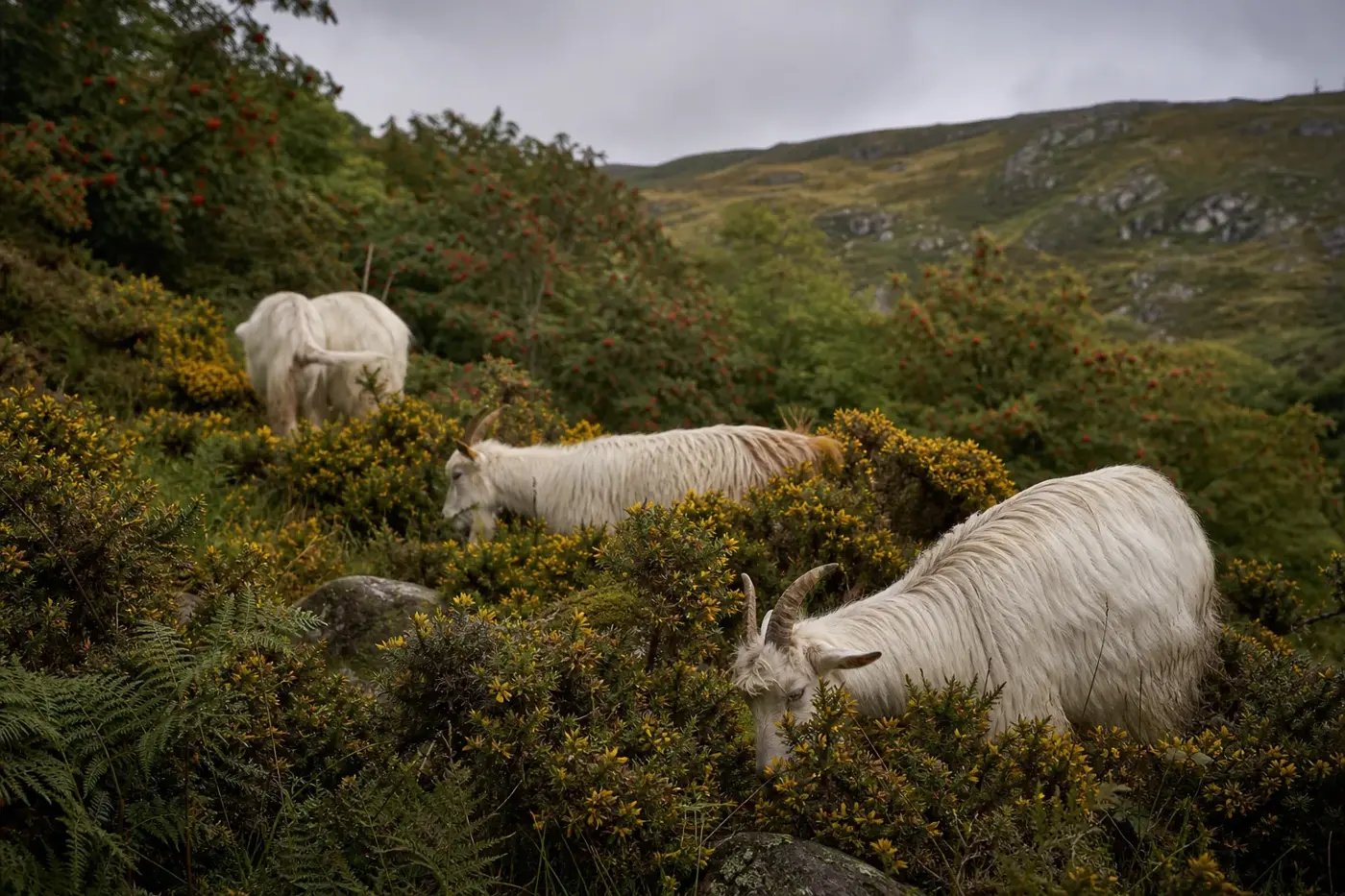
Up on Meeny Hill, goats browse among gorse and mountain ash. It is a fine place to begin a cheese story, and where Dart Mountain Cheese begins this Northern Irish one. By the time a piece reaches your plate, maturation has given it a natural rind, a firm interior and a character the maker captures in two words: lactic and salty.[1,2,3]
| What you might like to know | The detail |
|---|---|
| Name to look for | Meeny Hill Goat.[1] |
| Who makes it | Dart Mountain Cheese.[1] |
| Where it is made | Park, County Londonderry, Northern Ireland; the maker uses County Derry in its address.[4] |
| Milk and treatment | Pasteurised goat’s milk.[1] |
| Rennet declaration | “Vegetable” on the product page; vegetarian rennet on the range page.[1,2] |
| Style and rind | Semi-hard, natural rind.[3] |
| Current maturation period | Unconfirmed; published accounts differ.[1,3,8] |
| Protection status | Northern Ireland and the EU: unconfirmed; Great Britain: unconfirmed |
Bring a knife and make a little room
Reach for a knife, not a spoon. Meeny Hill belongs with cheeses you slice, rather than spoonable fresh goat’s cheeses. The Irish farmhouse cheese directory calls it semi-hard, while Dart Mountain describes the finished cheese as firm.[1,3] Think slices alongside fruit, vegetables or bread.
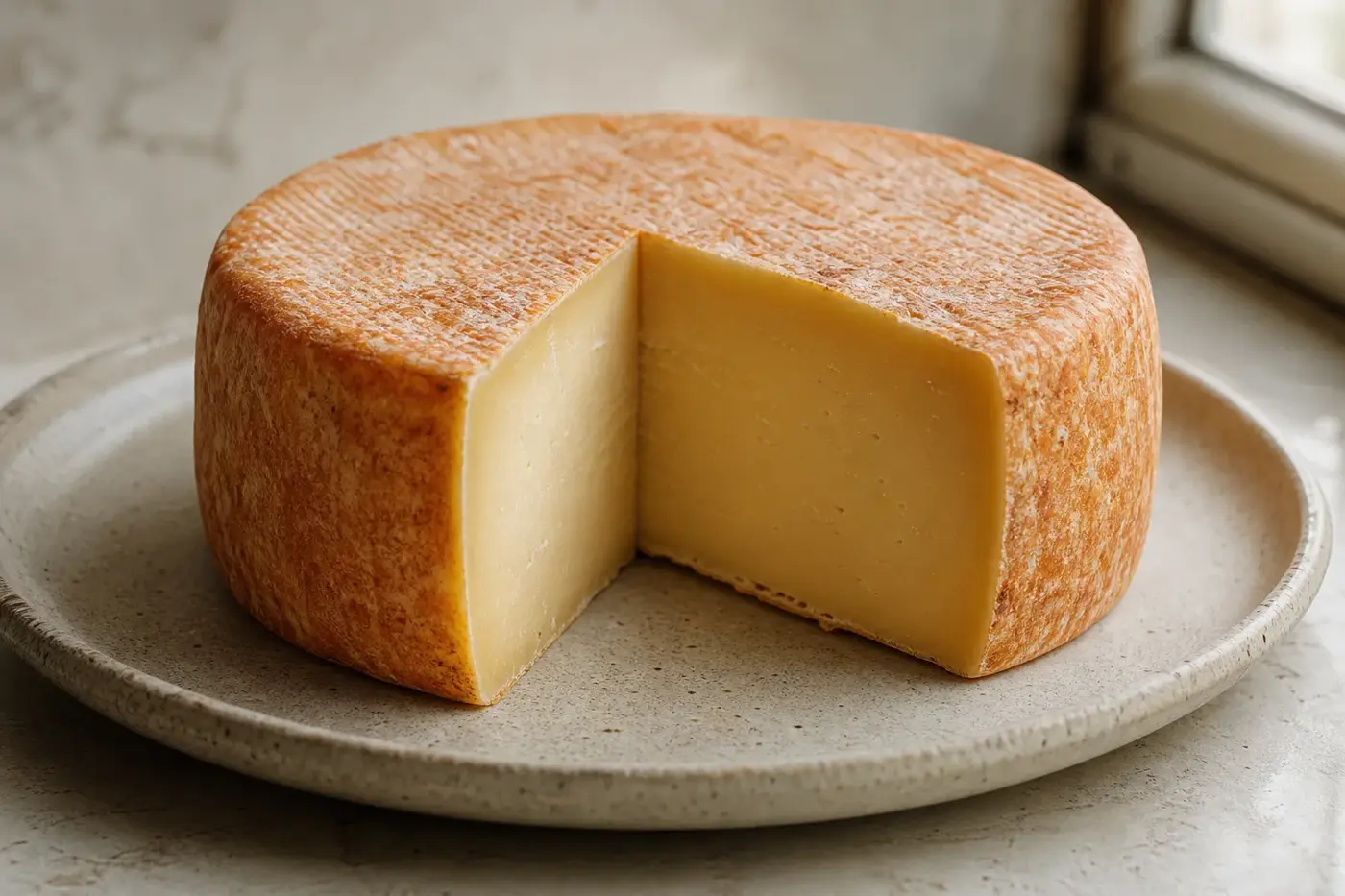
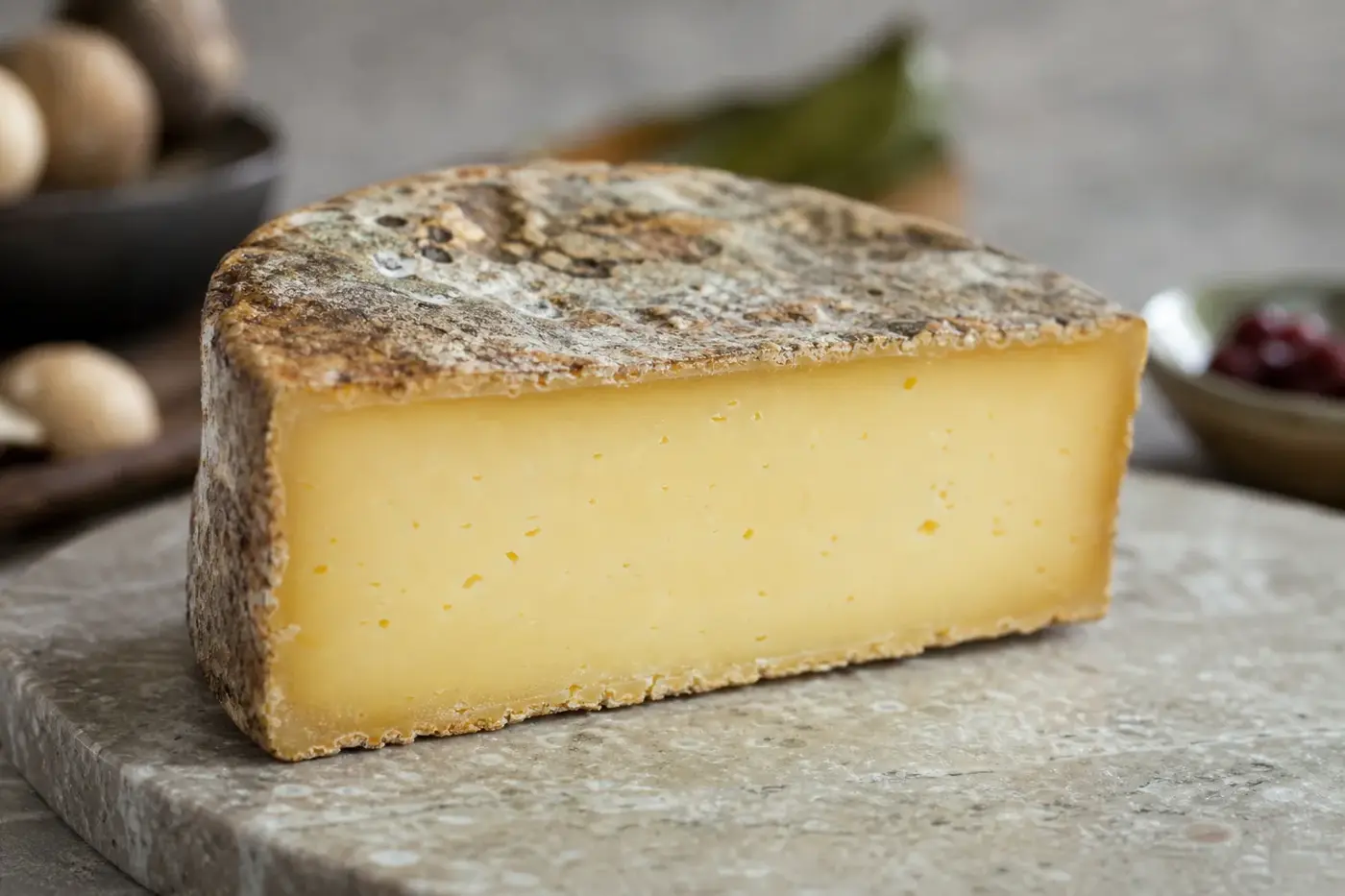
Give the natural rind a moment of your attention, too. Dart Mountain says its cheeses age naturally, developing their own rind and taste.[2] Look at the exterior and matured interior together. That rind is part of the cheese’s identity, not merely its coat.
Goat’s milk, a naturally developed exterior and a semi-hard interior give you three useful bearings. They describe the raw material, the surface and the structure. If you would like to untangle those distinctions, start with how to tell cheese styles apart.
Meet the family beneath Dart Mountain
In 2009, the family behind Dart Mountain Cheese turned a disused agricultural barn into a dairy. They then spent time building their knowledge of cheesemaking and ageing.[4] Both making the cheese and bringing it to maturity remain central to how the business describes its work.
You will find this family-run dairy in the Sperrin Mountains, outside the city of Derry, also known as Londonderry. Its published address is on Tamnagh Road in Park. Dart Mountain says the business takes its name from its position below the mountain.[4]
Meeny Hill Goat sits alongside other cow’s and goat’s milk cheeses in the range. Read the full name when you choose your piece: Dart Mountain lists it separately from Meeny Hill Blue and Carraig Bán.[2] “Meeny Hill” alone leaves two cheeses answering the call.
There is a local farming connection to follow, too. The maker records links with Craigbane Goat Farm through its goat cheese experiences and an account of a television visit.[5,6] These offer glimpses of the farming and cheesemaking businesses. Dart Mountain’s general sourcing statement places its milk supply among family-owned dairy farms in the Sperrins.[7]
Follow the milk from hill to dairy
Meeny Hill Goat is made with pasteurised goat’s milk. That is the declaration on the product page, and the detail to use when you compare it with cheeses whose milk receives a different treatment.[1]
The picture on the hill is more evocative: goats browsing among gorse and mountain ash.[1] Alongside that account of their surroundings, the maker’s broader sourcing statement describes milk supplied by the local farming community.[7] Keep those details distinct as you get to know your cheese.
Your current label belongs in the picture, too. Milk treatment tells you how the milk was handled, the producer’s address locates the dairy, and the browsing account describes the animals’ surroundings. For a closer look at the terminology, turn to raw milk, thermised and pasteurised cheese.
Give your first slice a closer look
The farmhouse cheese directory describes Meeny Hill as semi-hard, with a natural rind.[3] Dart Mountain emphasises the firmness that develops through ageing.[1] Start there when you examine your piece: outside is the rind; inside is the cut interior, known as the paste.
Before you taste, see what a slice actually does. Does it bend, break cleanly or crumble at the edge? Pay attention to the piece in front of you. “Firm” tells you much more once you can describe how it behaves.
Let your eyes be just as specific. Notice the rind colour, the paste colour and any openings in the cut face. A photograph of your purchased cheese, kept with its label, gives you a clearer reference for a later piece than memory alone.
Rennet, patience and a question for the counter
On its product page, Dart Mountain calls the milk pasteurised and the rennet “vegetable”.[1] Its range description says vegetarian rennet.[2] Rennet is the coagulant that sets milk during cheesemaking; you can explore its different sources in rennet explained.
Age is a less tidy story. The maker says Meeny Hill matures for at least three months, a supplier profile gives at least four months, and a 2020 directory records two months.[1,3,8] Those differing accounts make age a useful question to ask when you choose your piece.
What that time does is clearer. Dart Mountain says ageing firms the cheese and develops its flavour.[1] Its range page also describes natural ageing and rind development.[2]
| Making detail | What remains open |
|---|---|
If you are buying a cut piece, ask whether the seller can identify its age or provide the producer’s current information. Keep the answer with your tasting notes. Next time, you will have a better basis for comparing two pieces, rather than simply wondering why their texture and flavour seem different.
Find the tang, then follow the salt
Lactic, salty and firm: that is Dart Mountain’s description of Meeny Hill Goat.[1] The Northern Ireland food supplier directory also describes it as lactic and salty.[8] Consider those words a starting point, not an entrance exam.
Try a small piece on its own first. Notice the balance between milk-derived tang and salt, then put your impression into words. A short, precise note about what you actually taste is more useful than a grand list of flavours you feel obliged to find.
Smell the freshly cut interior before you bite. Then compare that impression with the flavour and finish. Let your nose lead, rather than trying to match what you find to a prescribed aroma.
| Tasting detail | What remains open |
|---|---|
For your second taste, bring in one plain accompaniment. Compare the cheese alone with the cheese as part of a mouthful. With fewer ingredients competing for attention, you can notice exactly what that addition changes.
Build a plate around the cheese
Start with Meeny Hill Goat, plain bread or crackers, and one fresh accompaniment. These serving ideas take their lead from its published firm, lactic and salty profile.[1,8] Give yourself room to taste the cheese before anything stronger joins the plate.
For temperature and handling, follow the package instructions. The Food Standards Agency’s household guidance for England, Northern Ireland and Wales recommends a fridge between 0 and 5 °C. During preparation, chilled food should spend the shortest possible time out, with a maximum of four hours.[10]
Take out only the portion you intend to serve shortly, leaving the rest refrigerated. Choose a cool spot away from direct sunlight. Within that handling guidance, your preference can decide whether you enjoy your portion cooler or less chilled.
Let the shape of your piece guide your knife. Divide a wedge into smaller portions that share its outer edge fairly; cut a rectangular piece into manageable slices. Offer guests a small first slice so they can decide how much they would like.
Keep strong accompaniments in separate dishes. Begin with the cheese alone, then add sweetness, acidity or heat a little at a time. The relish need not take possession of your entire portion at the first spoonful.
Try apples, fennel and a little freedom
Dart Mountain suggests fennel and sausage, apples and hot peppers, sweetcorn and prosciutto, or caramelised onions and mushrooms.[1] That gives you plenty to explore. The simpler arrangements below adapt those ideas while keeping the cheese at the centre of your plate.
| Alongside your cheese | How to try it | Where the idea begins |
|---|---|---|
| Apple slices and plain bread | Taste cheese and bread first, then add apple | A simpler take on the maker’s apple suggestion.[1] |
| Thinly sliced fennel | Add a small pile alongside, without heavy dressing | Draws on the maker’s fennel suggestion.[1] |
| Caramelised onions | Keep them separate and add sparingly | Adapts the maker’s onion and mushroom combination.[1] |
| Still or sparkling water | Start here before trying another drink | A simple editorial starting point |
Bread, apple and a few slices of cheese make an easy lunch. For a vegetable-led plate, choose fennel or onions and keep the components separate at first. You can adjust each mouthful instead of covering the whole portion with dressing or relish.
And water? It is a complete pairing option. You do not need another drink to make your plate feel finished.
Keep the next slice in good order
Follow the current label’s refrigeration instructions, date marking and any directions for use after opening. The Food Standards Agency advises refrigerating dairy products and following their packaging instructions. Its household fridge guidance for England, Northern Ireland and Wales is 0 to 5 °C.[10]
When you cut or divide the cheese, keep its label with the remaining piece. That keeps the product name and handling information close at hand. Bring out smaller portions as you need them, rather than putting your entire supply on the table.
For wrapping choices and a more organised fridge, continue with how to store cheese at home.
General information only, not medical advice: follow the official guidance where you live.
Questions people ask
Where is Meeny Hill Goat made?
It is made by Dart Mountain Cheese in Park, County Londonderry, Northern Ireland. The family dairy is in the Sperrin Mountains below Dart Mountain.
Is Meeny Hill Goat suitable for vegetarians?
The maker describes its rennet as vegetable on the product page and vegetarian on the range page. The cheese is made with pasteurised goat’s milk.
What does Meeny Hill Goat taste like?
Dart Mountain describes it as lactic and salty, with a firm texture. It has a natural rind.
What goes well with Meeny Hill Goat?
Dart Mountain suggests combinations including apples and hot peppers, or caramelised onions and mushrooms. The page also suggests trying it with apple slices and plain bread.
How should I store Meeny Hill Goat?
The Food Standards Agency advises refrigerating dairy products and following the packaging instructions. For its household guidance in England, Northern Ireland and Wales, see the agency’s advice on keeping a fridge between 0 and 5 °C.
Sources
- Dart Mountain Cheese, “Meeny Hill Goat Cheese”, undated live product page, accessed November 2026. Product identity, milk treatment, rennet wording, rind, stated maturation, profile and pairing suggestions.
- Dart Mountain Cheese, “Our Cheese Range”, undated live range page, retrieved November 2026. Pasteurisation, vegetarian rennet, natural ageing and named products.
- Irish farmhouse cheese directory, Irish Cheeses 2020, 2020 edition, entry 218. Meeny Hill’s semi-hard classification and natural rind.
- Dart Mountain Cheese, “About us”, undated live company account, accessed November 2026. Family business, dairy conversion in 2009, location and address.
- Dart Mountain Cheese, “Tours & Experiences”, undated live page, accessed November 2026. Published goat cheese experience involving Craigbane Goat Farm.
- Dart Mountain Cheese, “Featured Press”, undated live account, accessed November 2026. Maker’s account of visits to Craigbane Goat Farm and its cheesemaking premises.
- Dart Mountain Cheese, “Sustainability”, undated live company statement, accessed November 2026. General statement on sourcing milk from local family-owned dairy farms.
- Buy NI Food, “Dart Mountain Cheese Company”, undated supplier profile, accessed November 2026. Product profile and recorded World Cheese Awards result.
- Guild of Fine Food, “Meeny Hill Goat”, product entry and linked award image, accessed November 2026. The embedded image identifies World Cheese Awards 2022/23 Gold.
- Food Standards Agency, “How to chill, freeze and defrost food safely”, published 18 December 2017, live version accessed November 2026. Household guidance applying to England, Northern Ireland and Wales.
- Food Standards Agency, “Alerts”, live official alert index, accessed November 2026. Used for the preliminary recall check recorded below.
Researched through the maker’s published accounts, a farmhouse cheese directory, the awarding organisation’s product record and official food handling guidance, with editorial serving suggestions identified separately.
Last checked: November 2026
Last checked November 2026.
The editors suggest you read next