Mongolian Cheese
Look up towards the roof of a ger, Mongolia’s traditional felt dwelling.
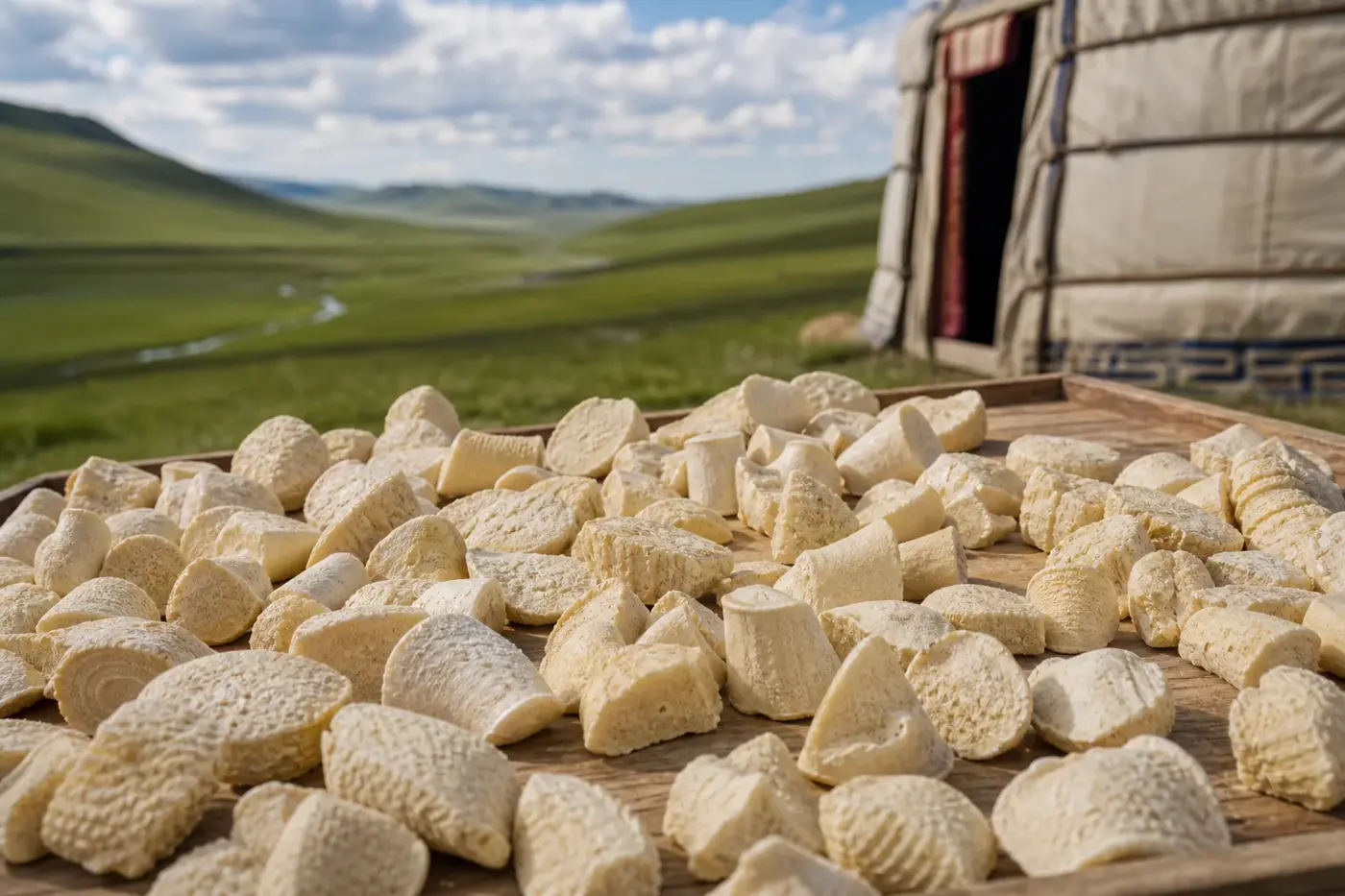
Look up towards the roof of a ger, Mongolia’s traditional felt dwelling. Those pieces of curd drying overhead may be aaruul. In the household account that captures this scene, the milk has already been boiled with yoghurt, drained and pressed; drying now gives it its intended finish. Alongside fresh slices of byaslag and cooked curds called eezgii, it tells you how summer’s abundance becomes winter’s provisions, with a knowing hand deciding what to ferment, drain, heat or dry. [1, 2, 5]
Summer’s milk, put aside for winter
Summer brings abundant milk. Winter gives households good reason to make it last. Mongolia’s dairy foods are often called tsagaan idee, or white foods, and an FAO account describes women taking a leading role in turning that short season’s milk into provisions. Their work feeds the household and its visitors well beyond the immediate meal. [1, 2]
Here, preservation and everyday cooking share the same pot. Fresh cheese and dried curd serve different purposes, even when their beginnings look much alike. Follow each one through the household, and you learn far more than you would by giving every solid milk food the same name. [1, 2]
Place matters, too. Mongolia’s cultural heritage inventory describes dairy knowledge shaped by local climate and livestock, passed on through participation and apprenticeship. Boiling, fermenting, separating and drying form a repertoire, rather than one national recipe for every food. Whether milk becomes cream, a drink, fresh curd or something to keep depends on the animals, what has already been removed from their milk, and what the family wants next. [2, 3]
Meet the animals behind your cheese
Cow and yak milk are important sources for solid dairy foods. A research paper on Mongolia’s dairy traditions includes a photograph of aaruul made from mixed yak and cow milk in Khövsgöl. Northern Mongolian fieldwork also records cattle and goats supplying household dairy production. [2, 4, 5]
Sheep milk has a place here, too. The national heritage account associates it with curds, cheese and eezgii, while the culinary collection All Mongolian Recipes documents both goat and sheep milk for byaslag. Ask which milk went into the piece in front of you. The dairy foods on a stall need not all begin with the same animal. [2, 6]
Horse milk chiefly takes another route, becoming airag, fermented mare’s milk. Archaeological and ethnographic research explains why: its relatively low casein content makes it less suitable for most dried curd products. Casein is the protein that forms cheese curd. [4]
Camel milk has its own preparations. Mongolia’s heritage inventory records khoormog, a fermented camel milk preparation, and camel milk aaruul. Rather than translating “Mongolian dairy” straight into “horse cheese” or “yak cheese”, ask about the food itself. The animal, the processing route and the producer’s ingredients each give you a different part of the story. [3, 4]
Byaslag: a fresh slice or something firmer?
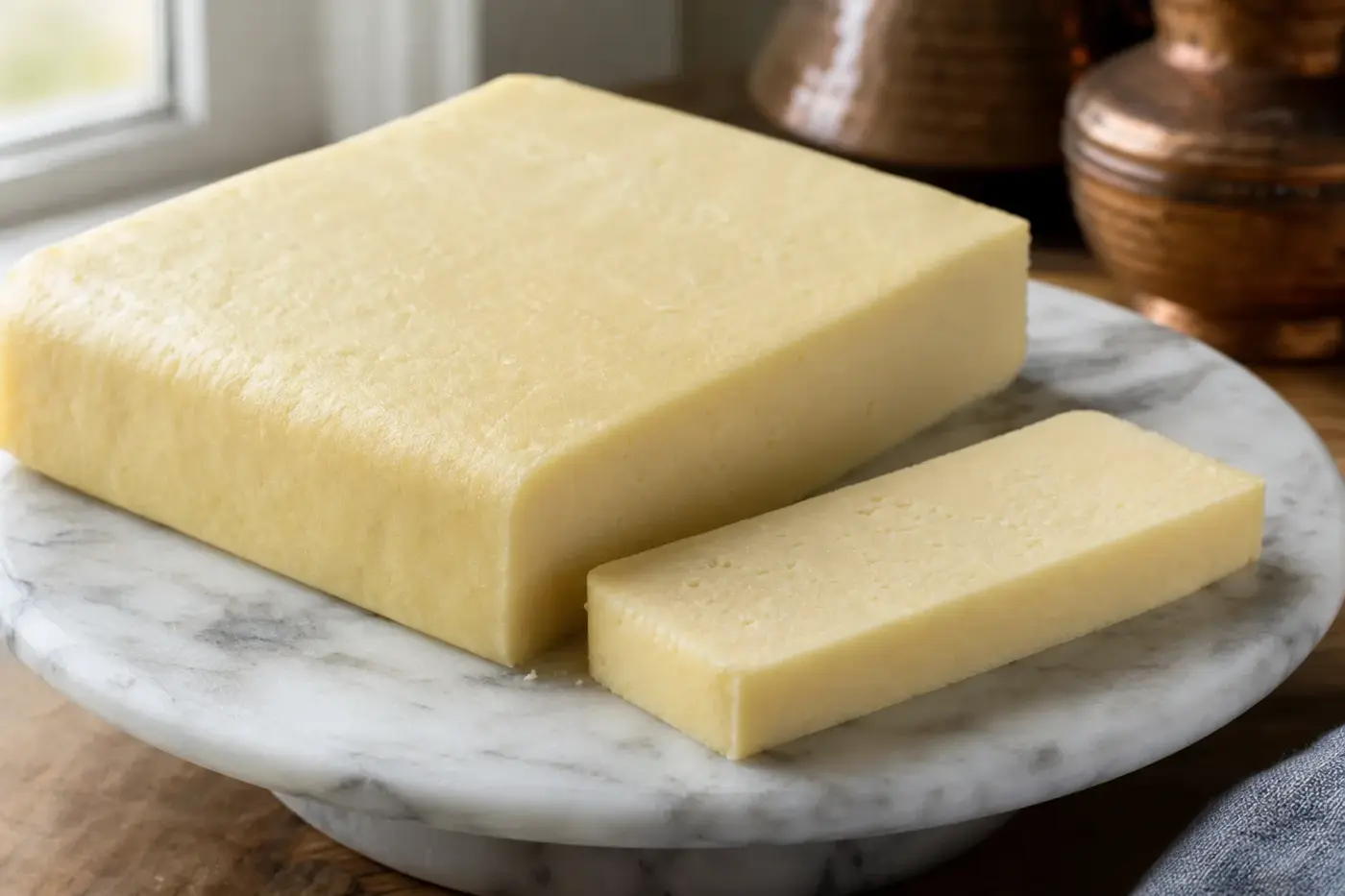
A slice of byaslag, бяслаг, can give you two very different experiences. This is the pressed cheese in the group, described by All Mongolian Recipes as round or roughly square, eaten fresh in slices or sliced and dried. Its flavour is mild, though sheep or goat milk can bring a more pronounced aroma. [6]
Fresh byaslag gives you a piece to slice; drying produces a much harder counterpart. Both the milk and the drying shape what you eat, so the name alone will not answer every question about texture. Start with two useful questions: is this fresh or dried, and which milk went into the batch? [6]
A northern Mongolian field report takes you to the making. Yoghurt goes into boiled milk, the milk curdles, and the solids are gathered in a cloth bag. Draining and pressing between weighted wooden boards give the cheese its shape. [5]
That gathering of milk proteins into solid curd is coagulation; whey is the liquid that separates from it. All Mongolian Recipes records a related version using kefir, so the sour dairy ingredient differs between these household accounts. Both routes lead towards pressed cheese. For the wider process, see how cheese is made. [5, 6]
Aaruul: follow the curd up to the roof
Trace aaruul, ааруул, back to the pot and you find a familiar beginning. The northern field report describes milk boiled with yoghurt, then drained and pressed. The resulting cake is cut for drying on tables or the roof of a ger. This preparation is heading towards dried curd, not fresh byaslag. [2, 5]
The intermediate curd has its own name: arts in that report, aarts in other sources. Keep it distinct from finished aaruul, and the descriptions become much easier to follow. That helps when several different Mongolian foods appear loosely translated as cottage cheese, a name being asked to do rather a lot of work. [5, 7]
Some aaruul is hard enough to suck rather than bite. All Mongolian Recipes describes that texture, alongside sweet and sour tastes that vary with milk and locality. An Australian National University field account, however, found a broader range among samples offered to its visitor. Those pieces ranged from firm and chewy to soft and crumbly. [7, 8]
Sweetened versions are documented, too. Ask about texture before choosing, especially if you are expecting every piece to be brittle. A shaped strand, a pressed slab and a small moulded piece can offer quite different experiences under the same name. [7, 8, 9]
Eezgii: stay by the pot for golden curds
With eezgii, ээзгий, the liquid stays for the cooking. Where byaslag is drained, eezgii keeps cooking until that liquid evaporates, a distinction documented in the northern field report. All Mongolian Recipes describes further cooking that produces small golden pieces. [5, 10]
Expect a slightly sweet taste and a grainy or floury feeling on your tongue, according to that culinary account. Eezgii is a cooked curd preparation with a character of its own, rather than pressed cheese in another form. Look for its golden colour and granular shape. [10]
What stays in the pot makes the difference
Fermenting, heating and drying each have a job. Fermented dairy can supply the sour ingredient that curdles heated milk. Acidification, heating and drying can also help preserve food by changing conditions for microbial growth or reducing microbial populations, though none guarantees safety. [10, 11]
Pressing removes liquid mechanically; drying takes away more afterwards. Eezgii takes another route, with prolonged cooking concentrating the curd and liquid together. Watch what stays and what leaves, and the distinctions become easier to remember: byaslag is drained and pressed into shape, aaruul is identified by its dried curd form, and eezgii cooks towards evaporation. [10, 11]
The starting material matters, but so does the household’s decision about what to retain or remove. Once the food is made, its surroundings matter for storage. The culinary account of eezgii specifically links keeping it in cloth sacks to Mongolia’s dry climate. [10]
That is not a storage instruction for a humid kitchen. Follow the maker’s stated conditions and date marking on packaged products. For an unpackaged product, ask the seller where to keep it and how soon to eat it. Clear handling advice is more useful than assuming every dried curd will keep indefinitely. [10, 12]
Pull up a chair for tea and curds
Milk tea gives you a natural way into these foods. The ANU field account describes tea made with milk, water and salt, sometimes enriched with butter or cream, offered repeatedly during visits. Its host also served aarts mixed with clotted cream and sugar. [8]
Here, curds belong to a spread, not necessarily a separate cheese course. All Mongolian Recipes records fresh byaslag eaten as a snack and dried slices softened in tea. If you are offered a particularly hard piece, ask how your host prefers it eaten before you try it. [6, 8]
White foods also accompany household visits and festival gatherings in the ANU account. The northern ethnographic report, meanwhile, records byaslag in soup and in a locally described pie flavoured with onions and salt. Your tasting board may have to accept that it is not the centre of every cheese story. [5, 8]
Fresh cheese can be an ingredient, dried curds can be provisions, and tea can provide the setting that brings both into focus. Follow the household’s lead on what belongs together. Learning the particular food and its place at the table tells you more than imposing a familiar cheese course on it. [5, 8]
This page summarises published guidance from the official sources it cites. It is not medical advice. Guidance differs between countries and changes over time, so check the current source for where you live, and ask your doctor, midwife, pharmacist or dietitian about your own circumstances.
Strings, moulds and names worth knowing
String, moulds and a homemade extruder bring you close to the work of shaping curds. The Mongolian Digital Ethnography Archive’s recordings from Selenge, dated 23 July 2012, document curds cut with string, pressed into moulds and pushed through the extruder for khorkhoi aaruul. The catalogue also records sugar, chokecherries and drink flavourings used with the curds. [9]
These variations belong to a particular household on a particular date. Sweetened and shaped aaruul sit alongside plainer forms in the documented practice. A moulded piece or cluster of strands can tell you something about preparation, but you still need the seller to explain its ingredients. [9]
Names deserve as much attention as shapes. Sources use both aaruul and aarul, while the intermediate curd appears as arts or aarts. Transliteration can make related descriptions look further apart than they really are. [5, 7, 8]
When you read a label, keep the Mongolian spelling, the maker’s wording and the product description together. Ask about origin separately: was it made in Mongolia, or labelled as from Inner Mongolia, China? Shared names can conceal differences in production. Ask where it was made, which local tradition it follows and what the actual product is called. [5, 7, 8]
Choose your piece, then give it the right home
Begin with the name and texture of the food you are buying. Is this fresh byaslag, dried byaslag, aaruul or eezgii? Next, ask about the milk species, milk treatment and ingredients. Those documented sweetened and flavoured curds make the last question particularly worthwhile. [6, 9]
Read the label as a description of this particular product, not a definition of all Mongolian dairy. If the wording leaves you puzzled, see how to read a cheese label. Look for packaging and seller information that explain what you are buying and how to store it in your kitchen. [6, 9, 12]
For chilled products, the Food Standards Agency’s household guidance for England, Wales and Northern Ireland recommends a fridge between 0 and 5 °C, alongside following packaging instructions and date marking. Apply that advice to fresh dairy bought there. The outdoor drying and storage arrangements in ethnographic accounts are not a substitute. [12]
Keep chilled cheese refrigerated until you need it, then return it promptly after serving. For dried products, follow that particular pack’s directions, including instructions after opening. You can find the wider handling principles in storing cheese at home. [12]
- Start with a small fresh slice of byaslag, if available. Notice how firmly it holds together.
- Ask whether the aaruul is hard, chewy or crumbly. Follow the seller’s or host’s advice for eating that form.
- Taste eezgii on its own. Notice its granular texture and the slightly sweet character described in the culinary account.
- Have tea alongside if you wish. Softening dried byaslag in tea follows a documented serving practice. [6, 7, 8, 10]
Choosing unpasteurised dairy: start with UK guidance
Before choosing unpasteurised dairy in the UK, consider who will be eating it. The NHS says children, pregnant women, older people and people who are unwell are particularly vulnerable to food poisoning. It advises that they should not have unpasteurised milk or cream and some dairy products made from them. [13]
Consult the current NHS guidance for your product and circumstances. Separately, the FSA guidance for England, Wales and Northern Ireland warns that raw drinking milk and cream may contain harmful bacteria. It advises against them for pregnant women, people aged 65 or over, infants and small children, and people with compromised immunity. [13, 14]
The FSA advice concerns drinking milk and cream, not a blanket restriction on cheese. November 2026 is the reference point for both sources here; use their current guidance when making your choice. [13, 14]
Ask the producer to confirm the milk treatment of the product you are buying. A traditional name, or a description of household heating, cannot tell you the treatment of a particular packet. The NHS advises checking cheese labels because some cheeses use unpasteurised milk. Consult the linked official guidance and raw milk, thermised and pasteurised cheese for the distinctions between treatments. [13]
Questions people ask
What is the difference between byaslag, aaruul and eezgii?
Byaslag is drained and pressed cheese, eaten fresh or dried. Aaruul is dried curd, while eezgii is cooked with its liquid until the liquid evaporates.
What milk is used to make Mongolian cheese?
Cow and yak milk are important sources for solid dairy foods, and goat and sheep milk are also documented for byaslag. Camel milk aaruul is recorded too, so it is worth asking which milk a particular product contains.
What does aaruul taste and feel like?
Aaruul can taste sweet or sour, with flavour varying by milk and locality. Some is hard enough to suck rather than bite, while other pieces can be chewy or crumbly.
How should I store Mongolian cheese at home?
For chilled products in England, Wales and Northern Ireland, the Food Standards Agency recommends a fridge between 0 and 5 °C and following packaging instructions and date marking. For dried products, follow the pack’s directions, including any instructions after opening.
Can vulnerable people eat Mongolian cheese made with unpasteurised milk?
The NHS says children, pregnant women, older people and people who are unwell are particularly vulnerable to food poisoning, and advises that they should not have unpasteurised milk or cream and some dairy products made from them. Check the cheese label and the current NHS guidance at https://www.nhs.uk/live-well/eat-well/food-types/milk-and-dairy-nutrition/ for the product and your circumstances.
Sources
- Food and Agriculture Organization of the United Nations. Mongolia: Rebuilding the dairy industry. Undated online chapter, incorporating field information from 2007. Background and household retention definitions. Source.
- National Center for Cultural Heritage, Mongolia, through the IRCI Research Database. The traditional technique of preparing the dairy milk products. 2022 heritage record. Source.
- Mongolia cultural heritage inventory, ichLinks. Traditional technique of preparing the dairy products. Record displaying 2019 as its designated year. Source.
- Nature Ecology & Evolution. Dairy pastoralism sustained Eastern Eurasian Steppe populations for 5000 years. Volume 4, 2020, pages 346 to 355. Figure 1 and discussion of horse milk. Full text.
- Smithsonian Institution and National Museum of Mongolian History. American-Mongolian Deer Stone Project: Field Report 2007. Published March 2008. Part V, ethnographic field report, especially printed pages 96 to 98. Report.
- All Mongolian Recipes. Byaslag, Бяслаг. Undated culinary account, footer copyright 2005 to 2010. Preparation and use sections. Source.
- All Mongolian Recipes. Aaruul, Ааруул. Undated culinary account, footer copyright 2005 to 2010. Preparation, use and strand-shaped variation. Source.
- Australian National University, Mongolia Institute. White Foods. Undated first-person field-course account. Milk tea, curd foods, hospitality and photographed aaruul samples. Source.
- Mongolian Digital Ethnography Archive. Field recordings from Selenge, item
4a64370b-a4a8-4098-aab9-a234a148f2e1, recorded 23 July 2012. Catalogue description and timed contents. Archive record. - All Mongolian Recipes. Eezgii, Ээзгий. Undated culinary account, footer copyright 2005 to 2010. Preparation, texture and use. Source.
- Japan Agricultural Research Quarterly. Screening Research Methods for α-glucosidase Inhibitors and Angiotensin-converting Enzyme Inhibitors in Fermented Soybean Products and Fermented Milk Products. Volume 48, issue 1, 2014, pages 41 to 49. Processing descriptions on printed page 46. Paper.
- Food Standards Agency. How to chill, freeze and defrost food safely. Published 18 December 2017, current retrieved text. Applies to England, Northern Ireland and Wales. Official guidance.
- NHS. Dairy and alternatives in your diet. Current retrieved version, November 2026. Pasteurisation and unpasteurised dairy sections. Official guidance.
- Food Standards Agency. Raw drinking milk. Published 9 January 2018, current retrieved text. Advice on raw drinking milk and cream, applying to England, Northern Ireland and Wales. Official guidance.
- Food Standards Agency. Alerts. Live official index, accessed November 2026 for the editorial recall check. Official alerts.
This desk-researched article brings together Mongolian heritage records, documented household observations, published research, attributed culinary descriptions and current UK agency guidance.
Last checked: November 2026
Last checked November 2026.
The cheeses of Mongolia
The editors suggest you read next
French Cheese: The Complete Guide
Picture Normandy’s pastures, then follow the milk towards the Loire’s goat dairies, the Jura’s shared cheesemaking traditions and the sheep country of the Pyrenees.