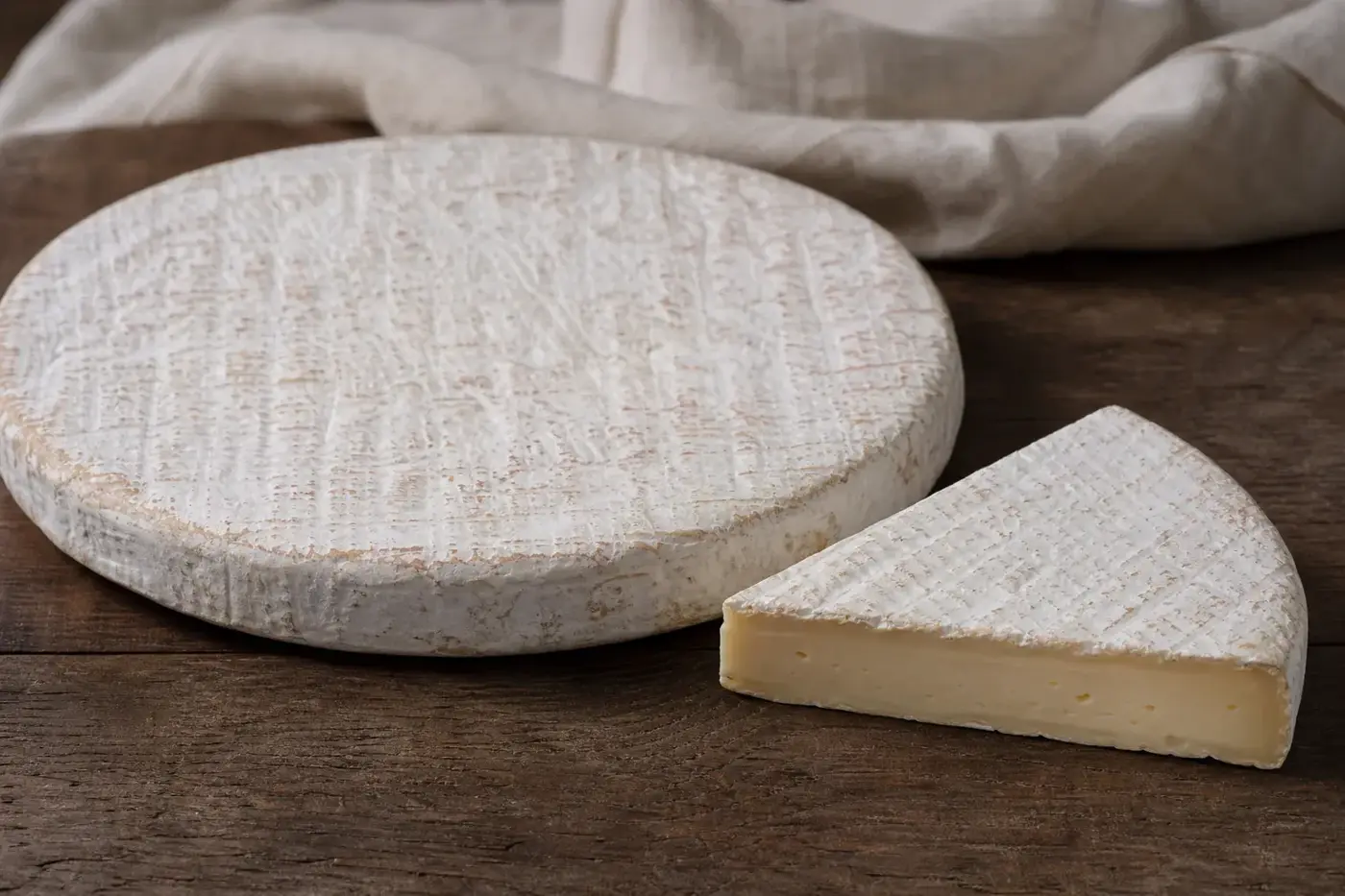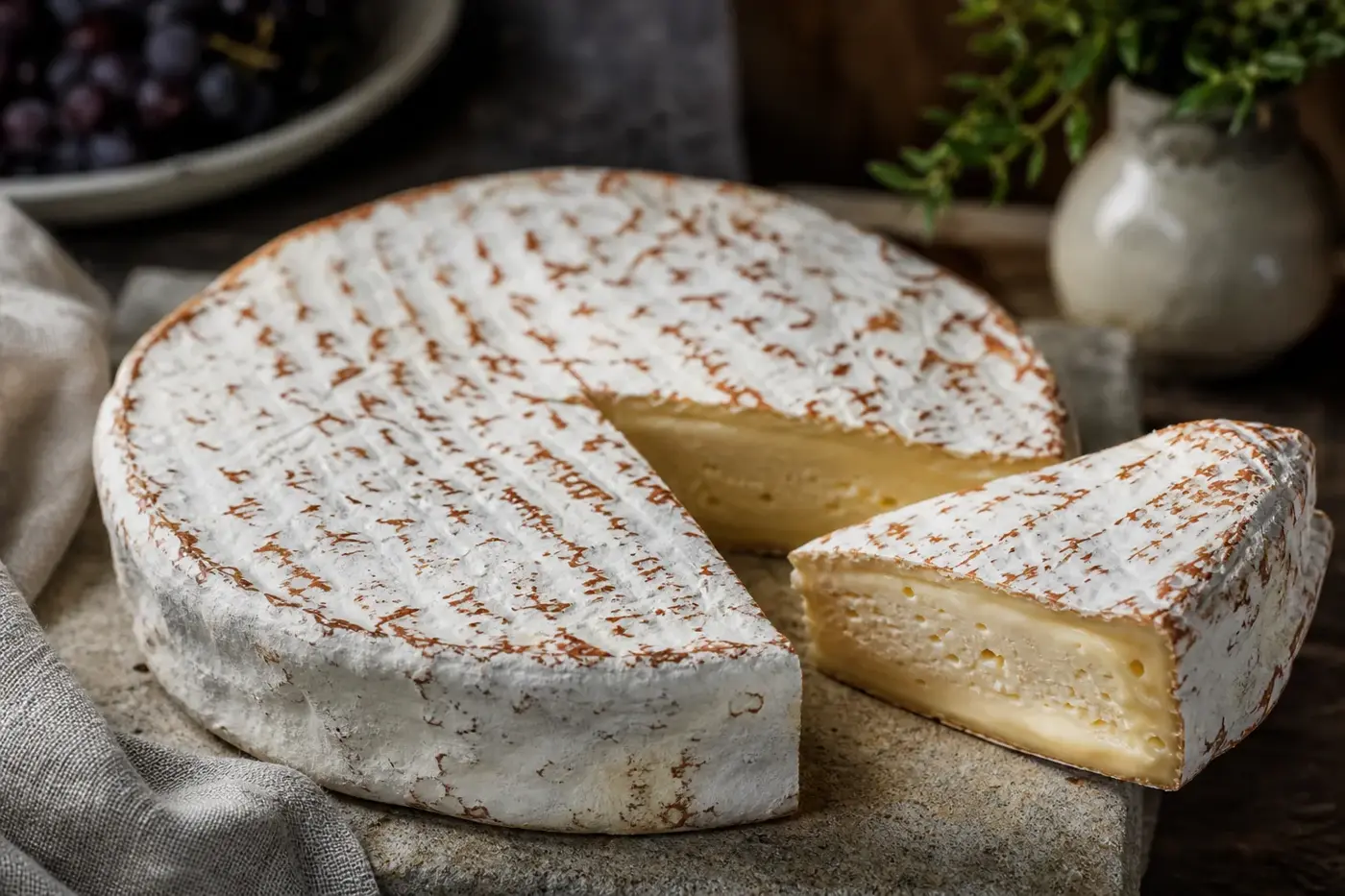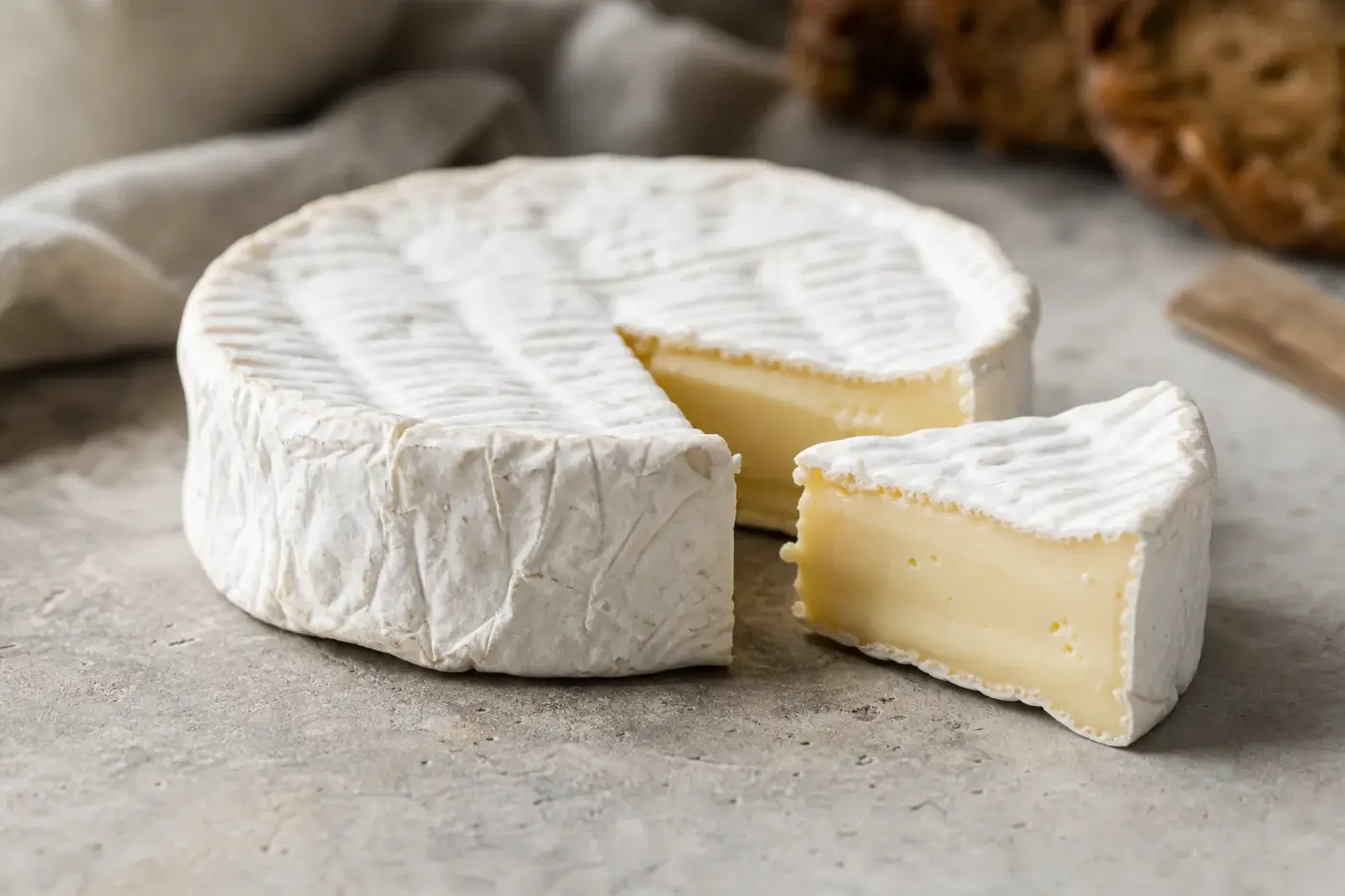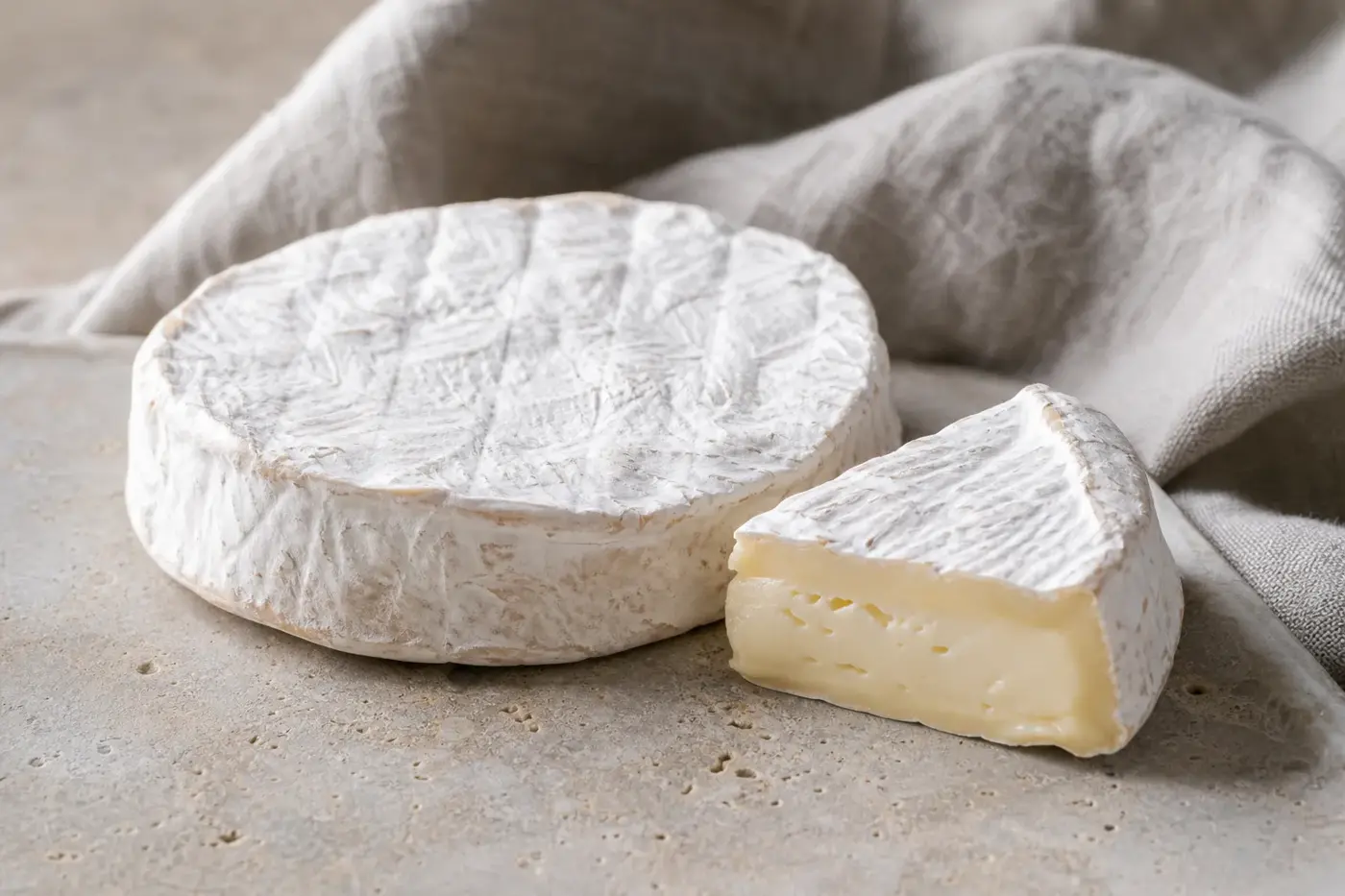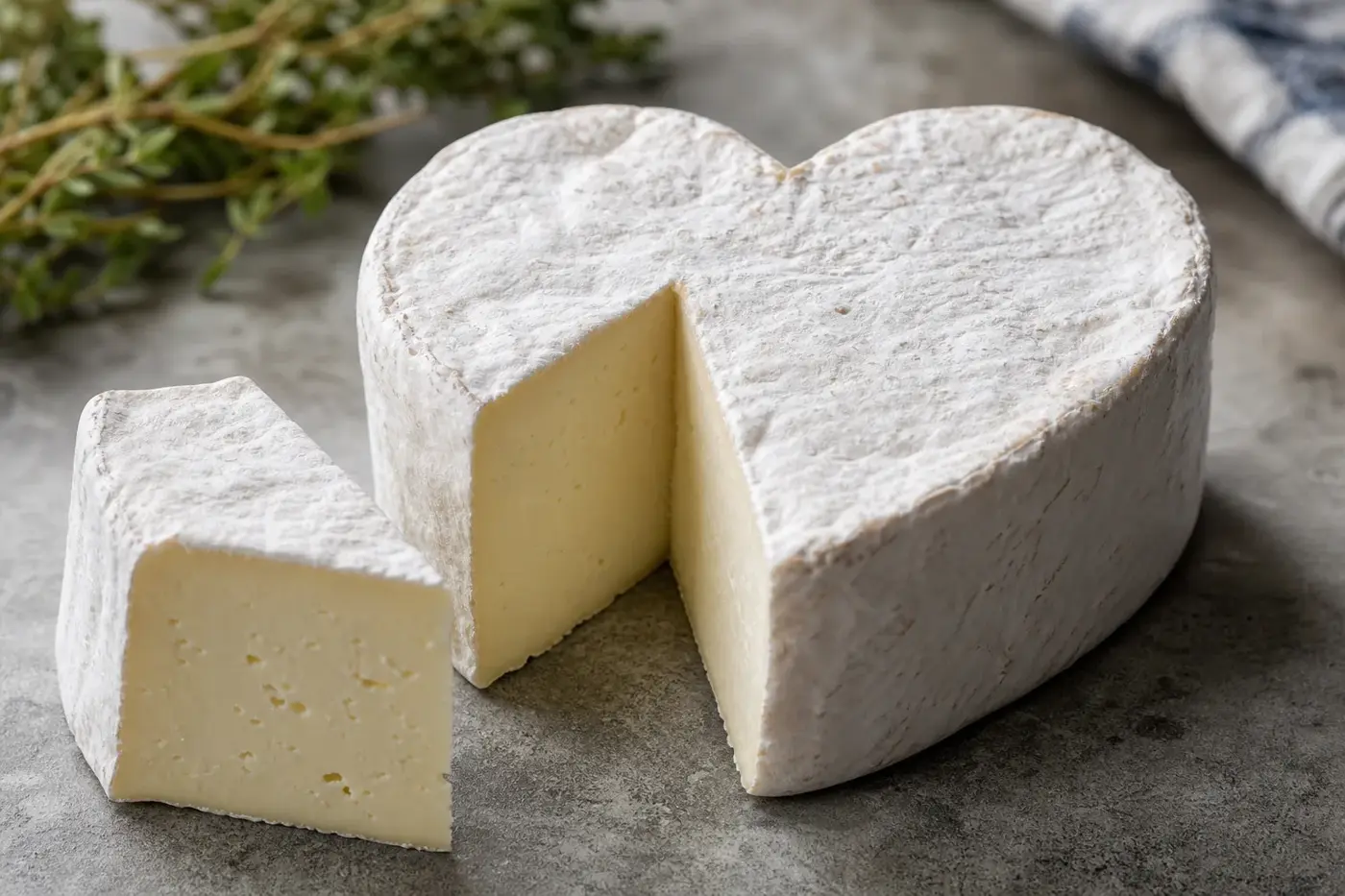
First comes the white bloom of mould. Then you notice the heart beneath it, a small piece of cheeseboard theatre from the damp, grassy Pays de Bray in northern Normandy. This soft cows’ milk cheese begins fresh and lactic, growing more pronounced as it ripens. The heart is one of six protected shapes, though its love story belongs to legend rather than the rulebook. [1,2,3]
| What you might want to know | The details |
|---|---|
| Familiar and registered name | Neufchâtel. [1,4] |
| Who registers the name | European Union scheme; Defra’s register for Great Britain. [1,4] |
| EU designation and current status | Appellation d’origine protégée, AOP, is French for Protected Designation of Origin, PDO. Current status and reference date: Not established. [1] |
| Great Britain status | Registered PDO; registration dated 31 December 2020 at 23:00. Reference date: November 2026. [4] |
| Where it must be made | Listed communes in Seine-Maritime and Oise, centred on the Pays de Bray. [2] |
| Milk | Cows’ milk. Farmhouse production uses unheated raw milk; dairy production may use thermised or pasteurised milk. [2] |
| Rind | White, bloomy rind. [1,2] |
| Minimum ripening required by law | Ten days from moulding. [2] |
| Pregnancy guidance | UK NHS guidance on white-rinded, mould-ripened soft cheese. Reference date: November 2026. [7] |
Follow the grass into the Pays de Bray
Damp clay soil, pasture and hedged fields bring you into Neufchâtel country. INAO, France’s national institute responsible for geographical indications, links that wet ground and climate with good grass growing and a long-established tradition of farmhouse cheesemaking. Here, the landscape does more than look picturesque. It helps explain the cheese. [1]
“Normandy” alone, though, will not tell you enough. The legally listed communes reach into Oise as well as Seine-Maritime, and milk production, cheesemaking and ripening must all happen within that boundary. Look for the registered name and designation, rather than relying on a Norman address. [2]
The farm’s working day left its mark, too. Pasture supports the milk supply, while slow setting and relatively short ripening developed around agricultural work. INAO describes individual cheesemaking operations that could fit between other jobs on the holding. Cheese had to find its place in a busy day. [1]
Find your shape, then ask about ripeness
You need not set your heart on a heart. Neufchâtel has six authorised forms: cœur, grand cœur, bonde cylindrique, double bonde, carré and briquette. In English, that is heart, large heart, cylinder, double cylinder, square and little brick. The specification sets their dimensions and minimum finished weights. [2]
A heart gives you an instantly recognisable centrepiece. A square or briquette makes regular portions easier to cut. Choose the shape that suits your meal, then ask about ripeness separately.
The outline helps you decide how to cut and share your cheese. It cannot tell you everything waiting inside. For that, ask about the maker, the milk treatment and how far ripening has gone.
English soldiers and a little romance
During the Hundred Years’ War, so the story goes, local young women gave heart-shaped Neufchâtel to English soldiers as tokens of affection. CNAOL, the French dairy designation industry body, explicitly records this familiar tale as a legend. You can enjoy the romance without asking it to serve as a medieval production record. [3]
The story’s lasting place in accounts of Neufchâtel is itself part of the cheese’s history. It gives that familiar heart another layer of meaning, even if it cannot supply documentary evidence.
For firmer ground, turn to the French decree of 20 October 1936. The specification’s historical account records that decree defining Neufchâtel and including the heart among its shapes. Here, you have a documented place for the outline in the written history. [2]
You can still see that inheritance on the cheeseboard. The heart is an emblem of Neufchâtel, but it belongs to a larger family. It has never been the only shape worth looking for.
Beneath the bloom, milk, cream and butter
Cut through the fine covering of short, dense white mould and you reach a supple but firm paste. CNAOL describes fresh lactic aromas of milk, cream and butter, with a lightly salted taste. Keep those flavours in mind as you take your first bite. [3]
Ripening changes the balance. INAO describes young Neufchâtel as fresh, acidic and salty, with the smell of fresh milk and cream. As it ages, that freshness retreats and more pronounced, animal aromas emerge. [1]
Tell your cheesemonger which part of that journey appeals to you. Ask for a younger cheese if you enjoy a clear lactic tang. If you prefer a stronger aromatic finish, ask which more developed examples are available and how far they have ripened.
Texture deserves a question of its own. Ask the seller to describe the paste of the particular cheese in front of you, alongside its ripeness. INAO’s progression from fresh lactic character to stronger animal aromas is a useful guide, not a promise that every Neufchâtel will taste and feel alike. [1]
This page summarises published guidance from the official sources it cites. It is not medical advice. Guidance differs between countries and changes over time, so check the current source for where you live, and ask your doctor, midwife, pharmacist or dietitian about your own circumstances.
The patient work before the mould
Neufchâtel’s distinctive step comes before it takes its shape. The curd is drained and lightly pressed, then worked and shaped, a sequence INAO singles out as a particular feature among soft cheeses. If you are new to the terms, curd means the coagulated milk solids. Whey is the liquid drained away. [1]
Setting takes time: 18 to 36 hours. The specification combines lactic coagulation with rennet, a milk-coagulating enzyme preparation. The drained paste is moulded and dry-salted, either by mixing salt into the paste or applying it to the surface. [2]
Penicillium candidum may be introduced into the milk, the paste or the cheese surface. Ripening, also called affinage, then develops the rind and character. It must last at least ten days from moulding, at 10 to 14 °C and 90 to 100% relative humidity. [2]
Those are production conditions, not settings to copy in your domestic fridge. To follow the wider journey from milk to finished cheese, see how cheese is made.
Read the name, understand the promise
Protection for the name arrived in stages. According to the specification’s historical account, French appellation recognition came in 1969. That national recognition is distinct from the later EU and Great Britain registrations. [2]
AOP is the French wording of the EU PDO designation. Defra records the original EU registration date as 21 June 1996, alongside a separate registration under the scheme protecting names in Great Britain. Each marks a different stage in protecting Neufchâtel’s name. [4]
“Farmhouse” has a precise meaning here. French Decree No 2007-628, Article 9-1, reserves fromage fermier for cheese made by an agricultural producer using traditional techniques. Only milk from that producer’s own holding may be used. It must also be processed on the holding itself. [5]
For Neufchâtel, farmhouse production uses unheated raw milk. Dairy production permits thermisation or pasteurisation before renneting. Both routes must meet the designation’s requirements. [2]
When you see fermier, read it as information about production and the milk’s origin. It does not answer every question about flavour. Ask for the taste and texture you enjoy, and explore the treatments in raw, thermised and pasteurised cheese.
Meet the American namesake before you cook
A shared name can lead your recipe in quite different directions. American Neufchatel is legally a different cheese: the United States standard, 21 CFR 133.162, defines a soft, uncured product made with pasteurised dairy ingredients. It requires milkfat of at least 20% but less than 33% of the finished food, and moisture no higher than 65% of the finished food. [6]
Before substituting, find out which cheese your recipe means. Does it call for French ripened Neufchâtel with its mould rind, or the American uncured product? The name alone cannot answer that question.
Watch what any percentage measures, too. Those American figures refer to the whole finished food. Fat in dry matter measures fat after water has been excluded, so you cannot compare that figure directly with the American percentages.
When choosing internationally, read the description alongside the country of production. Look at origin, rind, ingredients and intended use together. They will tell you more than the name can manage on its own.
Take three questions to the cheese counter
Start with these: where was it made, how was the milk treated, and how ripe is it? For a French protected example, look for Neufchâtel with AOP or PDO identification. Then give the producer information a read. [1,4]
French cheese labelling rules distinguish milk treatments, including raw, thermised and pasteurised milk. A treatment statement and fermier do different jobs. One describes milk processing; the other describes the conditions of farmhouse production. [5]
Tell the seller when you plan to serve your cheese and what you enjoy. Asking for INAO’s fresh, acidic character, or for a more developed aroma, gives them something useful to work with. “The best Neufchâtel” is a brief with rather a lot of room for interpretation. [1]
Once you open the cheese, keep the label. Its storage instructions and date still matter in your kitchen. For help with the remaining vocabulary, turn to how to read a cheese label.
Begin with bread, then choose your glass
Give the cheese your attention first, with plain bread. Then try something sweeter: CNAOL suggests traditional baguette, bread containing dried fruit and brioche-style bread. It also recommends cutting from the centre outwards, so everyone receives both rind and paste. [3]
For your glass, CNAOL’s published suggestions include Norman pear cider, cider and several red wines. It particularly recommends red wine with well-ripened examples. Let the cheese’s ripeness help you choose. [3]
Still or sparkling water gives you a clear comparison between bites. An unsweetened apple or pear drink is another option.
Alcoholic pairings are for adults of legal drinking age. People who are pregnant, driving, taking medicines that interact with alcohol, or recovering from alcohol dependence should not drink. Consult current NHS advice or the equivalent guidance for your country.
Follow the pack’s instructions and bring out only the portion you need. FSA household guidance for England, Wales and Northern Ireland says chilled food should spend the shortest possible time outside refrigeration. During preparation, the maximum is four hours. [8]
Make room in the fridge and keep it safe
Start with the pack’s storage instructions and use-by date. For England, Wales and Northern Ireland, the FSA advises a home fridge temperature between 0 and 5 °C (32 and 41 °F), with dairy products kept refrigerated. Protect cut cheese from contact with other foods and keep the packaging information. [8]
Wrapping and fridge organisation matter as well. You can find more practical help in storing cheese at home.
During pregnancy in the UK, NHS guidance is to thoroughly cook white-rinded, mould-ripened soft cheeses, whether their milk is pasteurised or unpasteurised. The permitted exception is cheese cooked until steaming hot. French Neufchâtel belongs to this mould-ripened category, so consult current NHS guidance rather than relying on milk treatment alone. [7]
The NHS also advises infants and young children, people over 65, and people with a long-term medical condition or weakened immune system to avoid certain cheeses, including mould-ripened soft cheeses, unless thoroughly cooked until steaming hot. Consult the current UK guidance. Ask a healthcare professional about your individual circumstances. [9]
Questions people ask
What does Neufchâtel taste like?
Young Neufchâtel is fresh, acidic and salty, with aromas of fresh milk and cream. As it ripens, its freshness recedes and more pronounced animal aromas develop.
Is Neufchâtel made with raw milk?
Farmhouse Neufchâtel uses unheated raw cows’ milk. Dairy production may use thermised or pasteurised milk.
Is French Neufchâtel the same as American Neufchatel?
They are different cheeses in law. French Neufchâtel is ripened and has a mould rind, while the American standard defines a soft, uncured cheese made with pasteurised dairy ingredients.
Can I eat Neufchâtel during pregnancy?
The NHS advises thoroughly cooking white rinded, mould ripened soft cheeses until steaming hot during pregnancy, whether they are made with pasteurised or unpasteurised milk. French Neufchâtel belongs to this category, so check current NHS guidance and ask a healthcare professional about your circumstances.
How should I store Neufchâtel?
Follow the pack’s storage instructions and date. The FSA advises people in England, Wales and Northern Ireland to keep dairy products refrigerated and their home fridge between 0 and 5 °C.
Sources
- INAO, Neufchâtel, undated product record, retrieved November 2026. Product identity, territory, farmhouse method and sensory development. Official product record.
- French Ministry of Agriculture, Cahier des charges de l’appellation d’origine « Neufchâtel » associé à l’avis AGRT1413737V, Bulletin officiel No 27, 2014, linked as the specification by INAO. Official specification.
- CNAOL, Neufchâtel, undated industry product and tasting guidance, retrieved November 2026. Industry account.
- Defra, Neufchâtel, protected food name register entry, published 4 January 2021, retrieved November 2026. Great Britain register entry.
- French Republic, Décret n°2007-628 du 27 avril 2007 relatif aux fromages et spécialités fromagères, consolidated text displayed as in force on 7 November 2026, particularly Articles 9-1 and 14. Consolidated legislation.
- US Government Publishing Office, Code of Federal Regulations, Title 21, §133.162, Neufchatel cheese, 1 April 2025 edition. Official annual CFR edition.
- NHS, Foods to avoid in pregnancy, live guidance retrieved November 2026, section “Cheese, milk and other dairy”. Official pregnancy guidance.
- Food Standards Agency, How to chill, freeze and defrost food safely, published 18 December 2017, live guidance retrieved November 2026; applies to England, Northern Ireland and Wales. Official chilling guidance.
- NHS, Dairy and alternatives in your diet, live guidance retrieved November 2026, sections on cheese and children. Official dairy guidance.
This piece was researched through official product records, the published specification, legislation and national safety guidance, with industry descriptions attributed separately.
Last checked: November 2026
Last checked November 2026.
The editors suggest you read next