The smell reaches you before the first bite. Then comes the golden-yellow surface, with a semi-soft to soft paste beneath it. Olomoucké Tvarůžky is a Czech surface-ripened cheese made from acidified skimmed-milk curd, and it is not inclined to enter a room quietly. [1][2]
Follow its story and you arrive in two places. Olomouc’s markets helped establish the name; Loštice is where A.W. says it makes the cheese today. One gave it a reputation, the other supplies what reaches your plate. [1][2]
| What you might want to know | The essentials |
|---|---|
| Familiar name | Olomoucké Tvarůžky. [1] |
| Exact registered name | Olomoucké tvarůžky. [3] |
| Country | Czechia. [3] |
| Style | Surface-ripened acid-curd cheese. [1][4] |
| Great Britain protection | Registered PGI on the GOV.UK register; UK scheme registration dated 31 December 2020. Reference date: November 2026. [3] |
| EU registration | GOV.UK records original EU registration on 5 August 2010. Current EU register status: not provided here. [3] |
| EU registration authority and register identifier | Not provided here |
| Legally defined production area | Not provided here |
| A.W. product milk | Curd from pasteurised cow’s milk, according to the producer. [1] |
| A.W. product coagulant | No added rennet, according to the producer. [1] |
| Surface | Golden-yellow smear. [1] |
| Declared fat | 0.5 g per 100 g of A.W.’s traditional products. [5] |
| Specification fat limit and minimum ageing | Not provided here |
Lean curd, a decidedly full personality
You might expect a cheese with this much presence to start with something rich. Instead, A.W. describes fat-free sour curd, whose characteristic flavour and smell develop as proteins break down during ripening. Its starting point is quite different from that of a cream-enriched cheese. [1]
“Acid-curd” tells you how the milk solids become curd: acidification is central to the process. Published research places Olomoucké tvarůžky among smear-ripened acid cheeses, alongside the Harzer type. Organisms associated with both the curd and its surface help shape the result. [4]
For your first taste, consider maturity as well as strength. The producer describes a journey from curd-like to more pronounced and piquant. Ask yourself a useful buying question: do you want a firmer centre, or a piece that has ripened more thoroughly? [1]
From Olomouc’s markets to Loštice’s cheesemakers
Olomouc’s markets brought a countryside cheese to a wider audience. A.W.’s history describes an earlier household product from the surrounding Moravian countryside called selské tvarůžky, meaning farmhouse or peasant tvarůžky. Trade carried its reputation further, and the producer credits those markets with its geographical name. [2]
The story then takes you to Loštice. A.W. dates the beginning of its cheesemaking there to 1876. Its present account says its tvarůžky are made in Loštice from beginning to end. [1][2]
Keep both places in mind when you turn over the packet. Olomouc belongs to the cheese’s trading reputation; Loštice belongs to the documented history of the producer and its manufacturing site. A place celebrated in a cheese’s name need not be the address where it is made. [1][2]
When cheese was part of the pay packet
Imagine receiving cheese as part of your payment for work. A.W.’s history points to just such a record from Hradečná near Uničov in 1601. It also places an early appearance of the word tvarůžky in an Olomouc estate inventory from 1583. [2]
Those early documentary claims come through the producer’s historical account, rather than a direct presentation of the underlying records or earliest evidence. Photographs bring you closer to the working trade. A.W. dates a production image from Prostějov to shortly before 1886 and its earliest Loštice production photographs to before 1900. [2]
You see people shaping and handling the cheese, then preparing it for dispatch. The producer’s museum in Loštice follows the move from hand production to machinery; its account dates the opening of the current exhibition building to 2014. Equipment changed, and a regional curd cheese became a manufactured product, still keeping its recognisable form. [2][6]
Get to know the name on the packet
Look closely at the spelling: Olomoucké tvarůžky is the exact registered name. Great Britain’s official register lists it as a protected geographical indication, or PGI, and provides a product-specification document. It records UK scheme registration on 31 December 2020 and original EU registration on 5 August 2010. [3]
Keep the scope of that information in mind. This page does not set out the current EU registration status or detailed requirements of the protected specification. A.W.’s ingredient and milk-treatment statements describe its own cheese, not everything the specification permits. [1][5]
When you buy, match the packet’s spelling to the registered name, then read the food description and ingredients. For the wider distinction between geographical schemes, see protected cheese names. For help making sense of the packet, turn to cheese labels.
Rounds, rings and the pale heart within
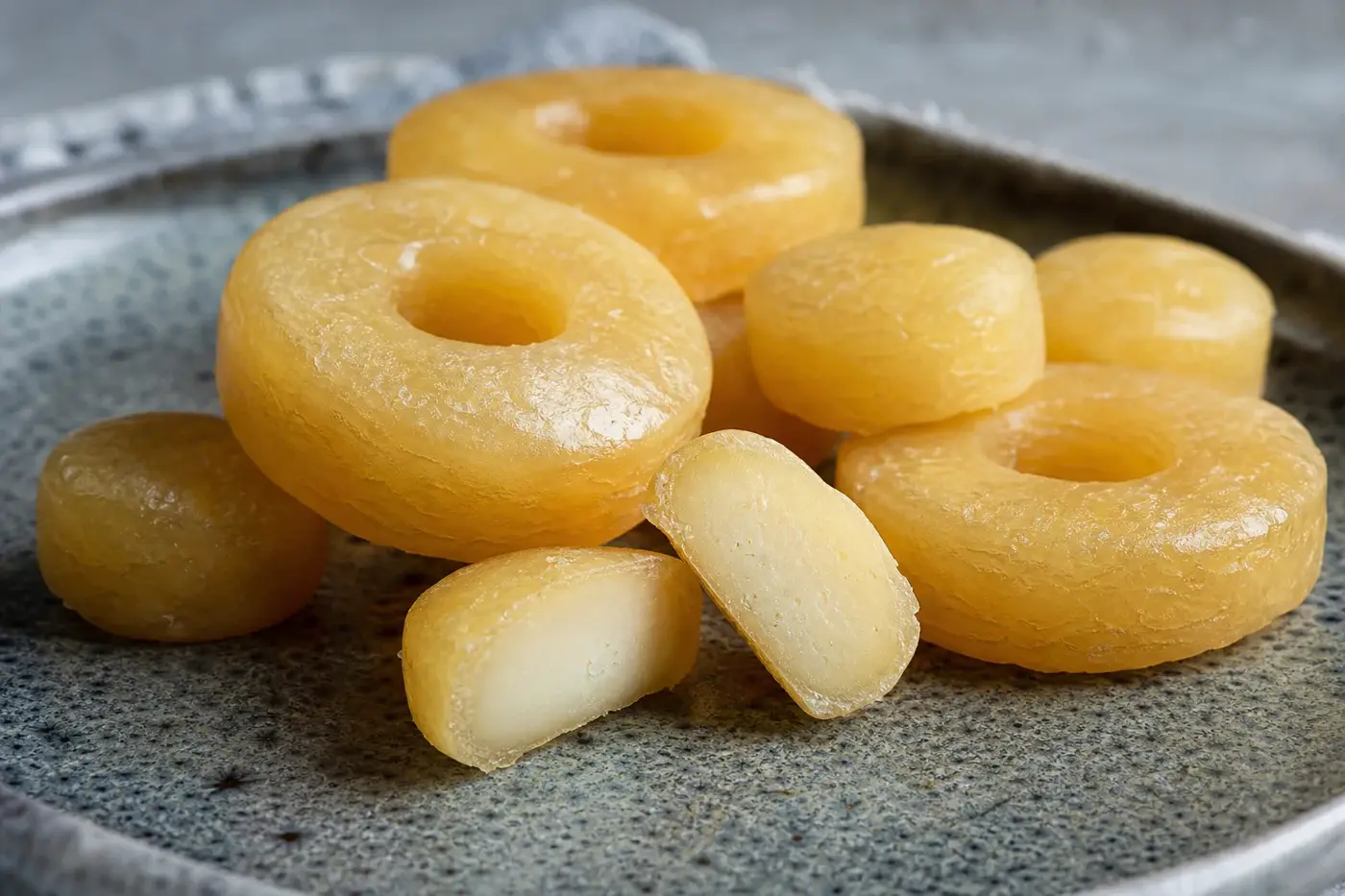
Shape is more than decoration here. A.W.’s traditional range includes small and large rounds, rings called věnečky, and smaller coin-like forms called dukáty. The producer says the rings’ central opening helps them ripen quickly: even the missing bit earns its keep. [5]
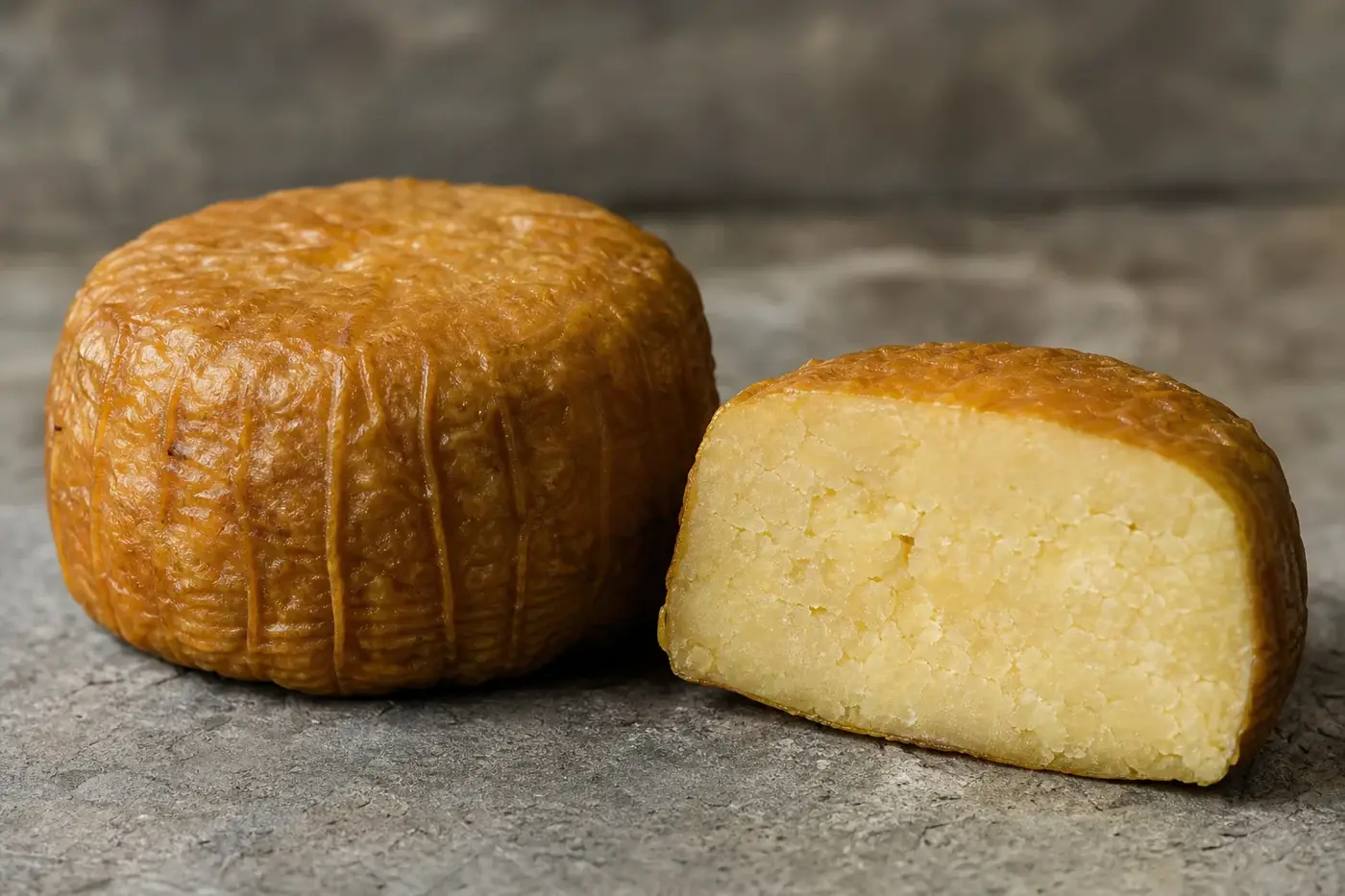
That golden-yellow surface is a smear, a ripening layer rather than wax. In A.W.’s maturity chart, the colour moves towards orange-yellow, then brownish orange as ripening advances. Cut into a younger piece and you may find a conspicuous white curd centre inside the yellower, ripened outer layer. [1]
As ripening continues, the centre becomes less distinct and the paste more yielding. A.W. describes the texture moving from firm towards elastic and softer. You need not expect every piece to be yellow all the way through: a pale centre belongs to the expected maturity pattern too. [1]
Follow a piece from curd to packet
The starting point is sour, low-fat curd. For its plain traditional products, A.W. lists curd, salt, dairy cultures and two acidity regulators: sodium hydrogen carbonate, E500, and calcium carbonate, E170. The producer also says it adds no rennet, colourings, flavourings or stabilisers. [1][5]
The curd takes shape as rounds, rings or pieces. Surface ripening changes the cheese’s texture and character, working from the outside towards the centre. [4] Detailed requirements for shaping, surface treatment and packing are beyond the information presented here.
The packet does not bring that development to a halt. The producer’s maturity chart describes changes during the period before the packet’s best-before date, while its storage advice tells you to keep the cheese refrigerated. Shape, pack size and maturity at purchase all help determine what you take home. [1]
Meet the community behind the aroma
There is chemistry behind that first impression. Research connects protein breakdown, called proteolysis, with the formation and transformation of volatile compounds. These substances can enter the air and contribute to smell, so changing compounds mean a changing aroma during ripening. [4]
A 2013 study followed manufacture and a subsequent 42-day ripening period. Researchers measured free amino acids using ion-exchange chromatography. They examined volatile compounds using headspace extraction coupled with gas chromatography and mass spectrometry, identifying 46 across several chemical groups. [4]
Among the sulphur compounds were methanethiol and dimethyl disulphide. Their concentrations did not simply climb as the cheese matured. Some compounds increased while others decreased, so what reaches your nose is a shifting mixture, not one substance steadily growing stronger. [4]
The paper discusses lactic acid bacteria from the curd alongside aerobic surface cultures. It also explains the role of Brevibacterium linens in sulphur metabolism in smear-ripened cheese. Picture a ripening community contributing to the pungency, rather than a single organism doing the whole job. [4]
Read beyond that small fat figure
A.W.’s traditional-product information declares 0.5 g of fat per 100 g of cheese. That means fat in the whole food as sold. Fat in dry matter answers a different question, because water is excluded when calculating the proportion. [5]
The same information gives 28 g of protein and 4.5 g of salt per 100 g. Read those three figures together, rather than letting the small fat number tell the whole nutritional story. These declarations concern the named products; if formulations or declarations change, your current packet takes priority. [5]
When you compare cheeses, keep the measurements consistent. Grams per 100 g on a nutrition panel and a specification’s percentage of fat in dry matter need separate columns. They are not figures to compare directly.
Choose your maturity, then keep it chilled
Choose the cheese you want to eat, not simply the shape you like. A.W.’s descriptions suggest small rounds and rings for convenient portions, while larger rounds can be sliced for bread or cooking. The producer attributes quicker ripening to the dimensions of smaller rounds and the opening in rings. [5]
In Czechia, the State Institute of Public Health, SZÚ, advises you to follow manufacturers’ storage instructions and national food-handling guidance. Read this cheese’s packet for its temperature, date and any instructions after opening. Keep the packaging so those details remain to hand. [7]
For England, Wales and Northern Ireland, the Food Standards Agency advises a home fridge temperature between 0 and 5 °C. Chilled food should spend the shortest possible time out of the fridge during preparation. Serve the portion you need and keep the rest chilled. [8]
You can find the broader principles in home cheese storage guidance. However familiar you become with the cheese’s expected aroma, smell does not replace packet instructions or official recall advice.
This page summarises published guidance from the official sources it cites. It is not medical advice. Guidance differs between countries and changes over time, so check the current source for where you live, and ask your doctor, midwife, pharmacist or dietitian about your own circumstances.
Pregnancy: turn to your local guidance
Czechia: Consult the State Institute of Public Health’s current listeriosis guidance. It covers advice for pregnant women and people with weakened immunity. Guidance reference: November 2026. [7]
Britain: NHS guidance distinguishes between cheese categories. It advises thorough cooking of soft mould-ripened cheeses with a white coating and soft blue cheeses. Cheese cooked until steaming hot is among its listed pregnancy-suitable options; the page gives the full categories and exceptions. Guidance reference: November 2026. [9]
For advice about your own circumstances, take the product label to your midwife, doctor or dietitian. The Listeria and cheese guide explains the wider food-safety issue.
Set the table the Czech way
Start with bread and let the cheese take its place alongside it. A.W. recommends serving its cheese this way and describes the small rounds as an accompaniment to beer. [1][5] Water offers an alcohol free alternative.
People who are pregnant, driving, taking medicines that interact with alcohol, or recovering from alcohol dependence should not drink. Keep that advice in mind when choosing what goes alongside your cheese.
If you fancy something spreadable, the producer publishes a version of rozhuda with tvaroh, butter, tvarůžky, onion and seasoning. The ripened cheese joins a fresh-curd mixture rather than arriving as a whole round on your plate. It is the producer’s preparation, offered as a serving idea. [10]
Its cooked recipes offer two more directions for your table. There are mushrooms filled with tvarůžky and fried onion, and savoury pastry spirals with onion and sauerkraut. One gives the cheese a vegetable carrier; the other folds it into baked pastry. Follow the source recipes for the complete methods. [10]
Questions people ask
What does Olomoucké Tvarůžky taste and smell like?
The cheese has a formidable smell and develops a more pronounced, piquant flavour as it ripens. A.W. describes younger cheese as having a more curdlike character.
Why is the cheese named after Olomouc if it is made in Loštice?
According to A.W., markets in Olomouc spread the reputation of the countryside cheese and gave it its geographical name. The producer dates the start of its cheesemaking in Loštice to 1876 and says it makes the cheese there from beginning to end today.
Is Olomoucké Tvarůžky made with rennet?
A.W. says it adds no rennet to its cheese. It makes the curd from pasteurised cow’s milk.
How much fat does the cheese contain?
A.W. declares 0.5 g of fat per 100 g for its traditional products. It also declares 28 g of protein and 4.5 g of salt per 100 g.
Why does my cheese have a white centre?
A younger piece may have a white curd centre surrounded by a yellower, ripened layer. As ripening continues, the centre becomes less distinct and the cheese becomes softer.
Sources
[1] A.W., O tvarůžkách, undated producer information and maturity chart, retrieved November 2026. Producer information.
[2] A.W., Střípky z historie, undated producer historical account and photographic collection, retrieved November 2026. Historical account.
[3] Department for Environment, Food & Rural Affairs, Olomoucké tvarůžky, Great Britain protected food-name register, published 4 January 2021, retrieved November 2026. Official register entry and specification link.
[4] The development of free amino acids and volatile compounds in cheese ‘Oloumoucké tvarůžky’ (PGI) during ripening, International Journal of Food Science and Technology, volume 48, issue 9, pages 1868 to 1876, 2013; publisher text and Tomas Bata University repository abstract, retrieved November 2026. University research record.
[5] A.W., Tradiční druhy, undated product descriptions, ingredients and nutrition declarations, retrieved November 2026. Traditional products.
[6] A.W., Muzeum Olomouckých tvarůžků, undated museum account, retrieved November 2026. Museum information.
[7] Czech State Institute of Public Health, SZÚ, Listerióza: základní informace o onemocnění, undated webpage, retrieved November 2026. Official Czech guidance.
[8] Food Standards Agency, How to chill, freeze and defrost food safely, published 18 December 2017, retrieved November 2026. Applies to England, Northern Ireland and Wales. Official storage guidance.
[9] NHS, Foods to avoid in pregnancy, current webpage retrieved November 2026. Official pregnancy guidance.
[10] A.W., Recepty, undated producer recipe collection, retrieved November 2026. This is a commercial producer’s collection; the preparations have not been independently tested by fromage.co.uk. Recipe collection.
This desk-researched draft brings together official register information, published experimental research, attributed producer records and national food-safety guidance.
Last checked: November 2026
Last checked November 2026.
The editors suggest you read next
Jarlsberg
Cut into Jarlsberg and those great, rounded holes catch your eye before you take a bite.