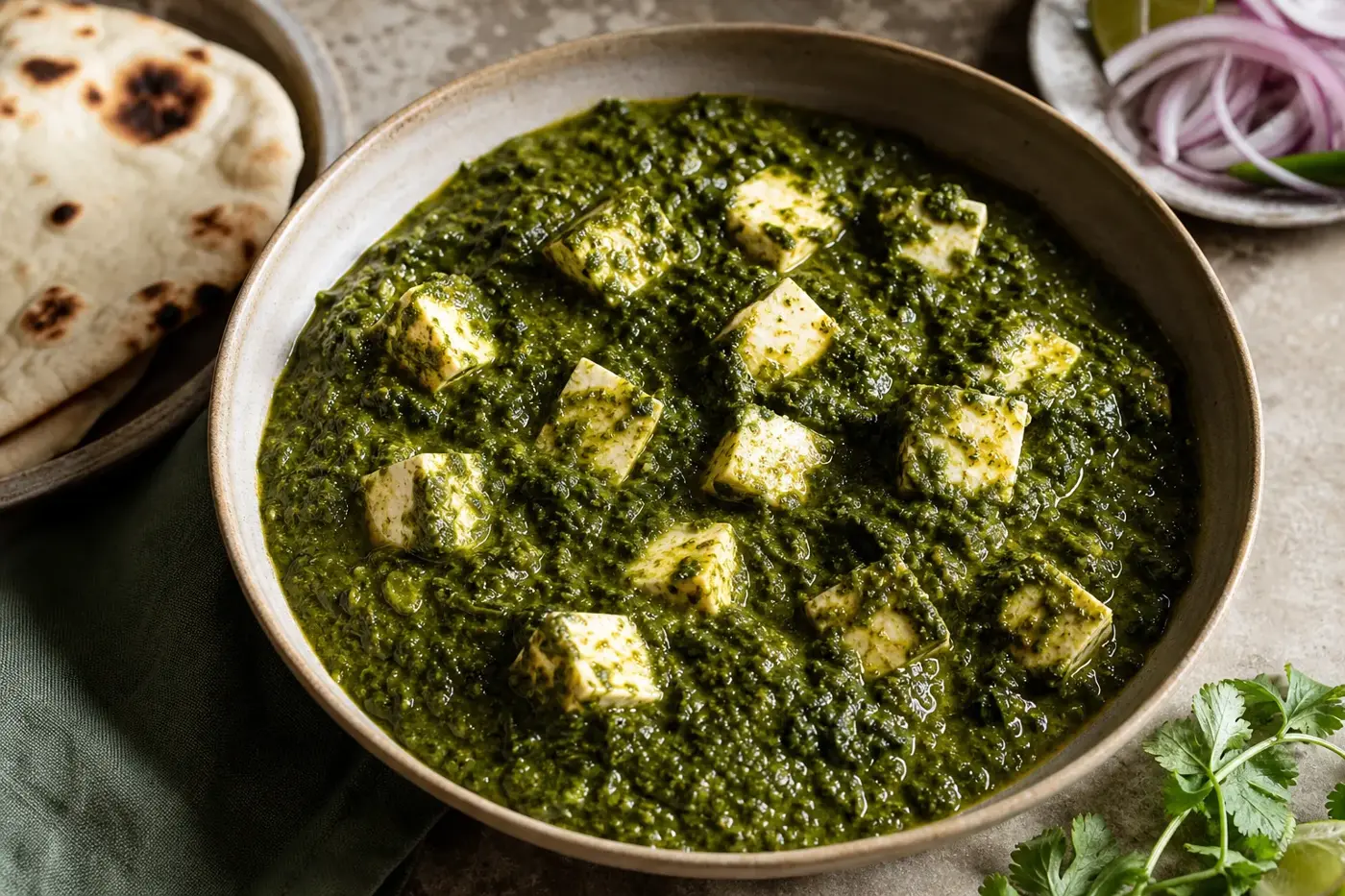
Ginger, garlic and spices scent the pan. In goes the green spinach sauce, then soft cubes of paneer, holding their shape as you fold them through. The cheese needs a gentle finish, not a long simmer: it is a late arrival, not a permanent resident. Your best work happens earlier, draining the spinach and giving the onion base time of its own. [1, 2]
Get to know the greens and the cheese
Palak means spinach in Hindi, so the name tells you which green is heading for your sauce. Saag casts a wider net. The Hindwi dictionary describes edible plant leaves, including spinach, and also records the word for cooked vegetables. A dish called saag can therefore contain other leaves. [3, 4]
Paneer begins with milk, heat and acid. The milk proteins gather into curds, the liquid whey drains away, and pressing turns those curds into a block of fresh cheese. Dairy research describes this process and explores how pressing conditions influence the texture. [6]
That brings you to paneer’s great kitchen talent: its cubes stay distinct in the sauce. The recipe below follows published palak paneer methods that add the cheese late in cooking. If you fancy following the curds a little further, explore how cheese is made. [1, 2]
Your palak paneer supper for four
Recipe status: adapted from the published recipes at Chef Kunal Kapur and Dassana’s Veg Recipes; no independent testing by fromage.co.uk. The metric quantities and combined method below are editorial adaptations. [1, 2]
Serves: four with bread or rice
Preparation: approximately 20 minutes
Cooking: approximately 25 minutes
Total: approximately 45 minutes, excluding any additional time required by frozen spinach packaging instructions
Equipment: large saucepan, colander, bowl, blender, wide sauté pan and spatula
Heat: hob only; no oven required
Gather everything beside the hob
- 500 g fresh spinach, weighed after removing tough stalks, or 500 g plain frozen spinach
- 250 g paneer, cut into approximately 2 cm cubes
- 30 ml neutral cooking oil
- 2 g cumin seeds
- 100 g onion, finely chopped
- 12 g fresh ginger, peeled and finely chopped
- 12 g garlic, finely chopped
- 5 g green chilli, finely chopped, or less to taste
- 100 g ripe tomato, finely chopped, optional
- 1 g ground cumin
- 0.5 g ground turmeric
- 0.5 g chilli powder, optional
- 1 g garam masala
- 2 g fine salt initially, then adjust to taste
- 50 to 150 ml water for the sauce
- 30 ml double cream, optional
- 15 ml additional oil, only if frying the paneer
Using fresh spinach? Have a pan of boiling water and a bowl of cold water ready. Keep your measured sauce water separate so you can add it gradually and stay in charge of the consistency.
Turn those leaves into supper
-
Prepare your spinach. Wash fresh leaves thoroughly and remove stringy stalks. Blanch in boiling water for about one minute, until wilted, then transfer immediately to cold water. Drain and squeeze out excess water. For frozen spinach, follow the packaging’s cooking instructions, then drain thoroughly. [1, 2, 7]
-
Blend the greens. Let hot spinach cool sufficiently for your blender, following its instructions for warm ingredients. Blend the drained leaves, adding a little of the measured sauce water only if needed. Stop sooner if you like a lightly textured sauce.
-
Give the onion time. Heat the 30 ml oil in your sauté pan over medium heat. Add the cumin seeds, then the onion. Cook, stirring, until the onion softens and begins to turn golden. Add the ginger, garlic and green chilli.
-
Bring in tomato and spices. If you are using tomato, cook it until softened and incorporated into the onion mixture. Lower the heat and stir in the ground cumin, turmeric and optional chilli powder. Add the spinach promptly.
-
Find your sauce consistency. Add the initial salt and enough water to make a thick but stirrable sauce. Simmer gently, stirring, until hot throughout. Aim for a consistency that suits your bread or rice.
-
Fold in the paneer. Add the cheese and garam masala. Heat gently until the cubes are hot through, avoiding a prolonged boil. Remove from the heat and stir in the optional cream. Taste before adding more salt, then serve promptly. [1, 2]
Ingredient note: this version contains milk through paneer and optional cream. Check the labels of the cheese, spice mixtures and accompaniments you use.
Start with spinach that is ready for the sauce
With fresh spinach, remove thick, fibrous stems before blending, but keep the tender ones. Dassana’s Veg Recipes identifies the tougher stems as a cause of stringy sauce. Both recipe sources give the leaves a brief blanch followed by cold water. [1, 2]
Drain first, then decide how much sauce water you need. That measured allowance is a working supply, not a challenge to empty the jug. Add it in stages: water loosens a thick sauce immediately, while a watery sauce needs more cooking to put things right.
Frozen spinach needs cooking according to its packet instructions, not just thawing. The Food Standards Agency advises cooking most frozen vegetables before eating and following the packet instructions. Once yours is cooked and drained, try blending without extra water. Add a little only if the blades need help. [7]
Give the onion and spices their own moment
Let the onion base have its time in the pan, away from the spinach. Soften the onion and develop its colour first, then add ginger, garlic and chilli. You build the base without making the greens sit through every stage.
The published recipes take different routes to the finished dish. One uses a small amount of onion with cumin, ginger and garlic; the other includes tomato and finishes with garam masala. This recipe brings those approaches together. The optional tomato lets you choose between the two versions. [1, 2]
If you choose tomato, cook it into the onion mixture before the spinach joins it. Have your ground spices ready beside the hob. Once they go in, follow promptly with the purée rather than leaving the powdered spices in the heat.
Find your favourite spinach texture
Blend your spinach before adding the paneer. That keeps the cheese intact and gives you room to choose the sauce’s texture.
For a smooth finish, process the drained leaves until no obvious pieces remain. Prefer a little texture? Pulse briefly and check between pulses. You are working with the same prepared spinach; only the amount of blending changes.
You can also blend most of the spinach, finely chop the rest, then bring the two together. This is an editorial variation on the puréed sauces in the source recipes. Choose your texture before adding more water, then judge the consistency again once the greens meet the onion base. [1, 2]
Keep your paneer soft, or add a little colour
Cut your paneer into similar-sized cubes so it is easier to judge whether they have heated evenly. Use a broad spatula to fold the sauce around them. There is no need for vigorous stirring.
Both source recipes add paneer late, but their finishing times differ. One cooks it in the sauce for three to four minutes; the other gives it a much shorter finish and warns that overcooking makes the cheese chewy and dense. Follow any cooking instructions on your paneer packaging. You want hot cubes, not an extended simmer. [1, 2]
If you fancy browned surfaces, fry the paneer first. Pat the cubes dry, then use the additional oil to fry them lightly before folding them into the finished sauce. Leave them unfried if you want soft cubes throughout. Dassana’s Veg Recipes includes light frying as an option in its recipe notes. [2]
Make the final spoonful taste like yours
Both source recipes add cream at the end. You can do the same, or let the spinach sauce stand alone. Start with the stated amount rather than pouring straight from the container. [1, 2]
Want less chilli heat? Reduce or omit both the green chilli and chilli powder. Keep the ginger, garlic and cumin: turning down the chilli need not turn down all the seasoning.
Adjust the salt after adding paneer and cream. To loosen the sauce, add small amounts of water and stir thoroughly before deciding whether you need more. If it is too loose, reduce it before adding the cheese. Keep these sauce adjustments separate from the gentle paneer finish.
Cheese substitutions: none recommended for this recipe. Paneer preserves the intended combination of distinct cheese cubes and spinach sauce.
Bring bread or rice to the table
Roti, naan and steamed rice all appear as accompaniments in the recipe sources. Choose a thicker sauce if you want to scoop it up with bread. Loosen it slightly if you would rather have it spread through rice. [2]
For a refreshing drink, try chilled sparkling water with a wedge of lime. Serve the lime separately so everyone can choose how much citrus to add, or keep things straightforward with plain chilled water. These are editorial pairing suggestions, rather than traditional accompaniments.
Keep your meal uncomplicated with one bread or rice accompaniment. Serve everything together once the paneer is hot. If you are cooking rice, give its cooling a separate place in your plans.
Look after tomorrow’s leftovers
The following advice comes from the Food Standards Agency for England, Northern Ireland and Wales, with November 2026 as the guidance reference date. Its guidance says to keep your home fridge between 0 and 5 °C. [7, 8]
Divide leftover palak paneer into smaller containers so it cools quickly, then refrigerate within one to two hours. Eat refrigerated leftovers within 48 hours or freeze them. Defrost frozen portions in the fridge and use within 24 hours of fully defrosting. [7, 8]
Reheat only once, until steaming hot throughout, including the cheese cubes. Stir during heating, and follow your microwave’s instructions for stirring and standing times if you use one. Leftovers need thorough reheating, even though your freshly made dish calls for a gentle finish. [7]
Give leftover rice its own timetable
Cool leftover rice as quickly as possible, ideally within one hour, advises the FSA. Divide it into smaller portions rather than leaving it in the cooking pan or rice cooker. Refrigerate and consume within 24 hours. [9]
Reheat rice only once, until steaming hot throughout. The FSA explains that uncooked rice can carry bacterial spores that survive cooking, which makes storage after cooking particularly important. Keep your curry and rice in separate containers so their different storage limits stay clear. [9]
For broader guidance, explore storing cheese at home and cheese food safety.
General information only, not medical advice: follow the official guidance where you live.
Questions people ask
Can I use frozen spinach for palak paneer?
Yes. The Food Standards Agency advises cooking most frozen vegetables before eating and following the packet instructions. Drain the cooked spinach thoroughly before blending, and see the Food Standards Agency’s guidance for more information.
How can I stop the spinach sauce becoming watery?
Drain the spinach before blending and add sauce water gradually. If the sauce is too loose, reduce it before adding the paneer.
Should I fry paneer before adding it to palak paneer?
You can fry it lightly for browned surfaces, or leave it unfried for soft cubes throughout. Either way, fold it into the sauce near the end and heat it gently until hot through.
How long can I keep leftover palak paneer?
The Food Standards Agency advises refrigerating leftovers within one to two hours, then eating them within 48 hours or freezing them. It advises reheating leftovers only once, until steaming hot throughout. See the Food Standards Agency’s guidance for details.
How should I store leftover rice served with palak paneer?
The Food Standards Agency advises cooling rice as quickly as possible, ideally within one hour, then refrigerating and consuming it within 24 hours. It advises reheating rice only once, until steaming hot throughout. See the Food Standards Agency’s rice guidance for details.
Sources
- Chef Kunal Kapur website. Palak Paneer Restaurant Style, published recipe, undated page. Four-serving recipe, spinach preparation, ingredients and late addition of paneer and cream.
- Dassana’s Veg Recipes. Palak Paneer Recipe (Homestyle & Restaurant Style), updated 15 July 2026. Recipe card, preparation instructions, paneer handling, optional frying and serving suggestions.
- Shabdkosh. Spinach: meaning in Hindi, online dictionary, undated. Records पालक as a Hindi translation of spinach.
- Hindwi Dictionary. साग का हिंदी अर्थ, online dictionary, undated. Defines edible leaves and records the wider cooked-vegetable usage.
- Food Safety and Standards Authority of India. Food Safety and Standards (Food Products Standards and Food Additives) Regulations, 2011, compendium Version XIV, 25 March 2021, section 2.1.16, “Standard for Chhana and Paneer”.
- ICAR National Dairy Research Institute and collaborating researchers. Control of matting temperature during pressing of Paneer and its effect on Paneer quality. Journal of Food Science and Technology, volume 56, 2019, pages 1715 to 1722.
- Food Standards Agency. Cooking your food, published 2017, live guidance checked November 2026. Sections on frozen vegetables, leftovers and reheating.
- Food Standards Agency. How to chill, freeze and defrost food safely, published 18 December 2017, live guidance checked November 2026. Sections on refrigeration, cooling and defrosting.
- Food Standards Agency. Home food fact checker, live guidance checked November 2026. Rice storage, cooling and reheating advice.
Researched by comparing published culinary methods with dictionary entries, the retrieved Indian paneer standard, primary dairy research and Food Standards Agency guidance.
Last checked: November 2026
Last checked November 2026.
The editors suggest you read next