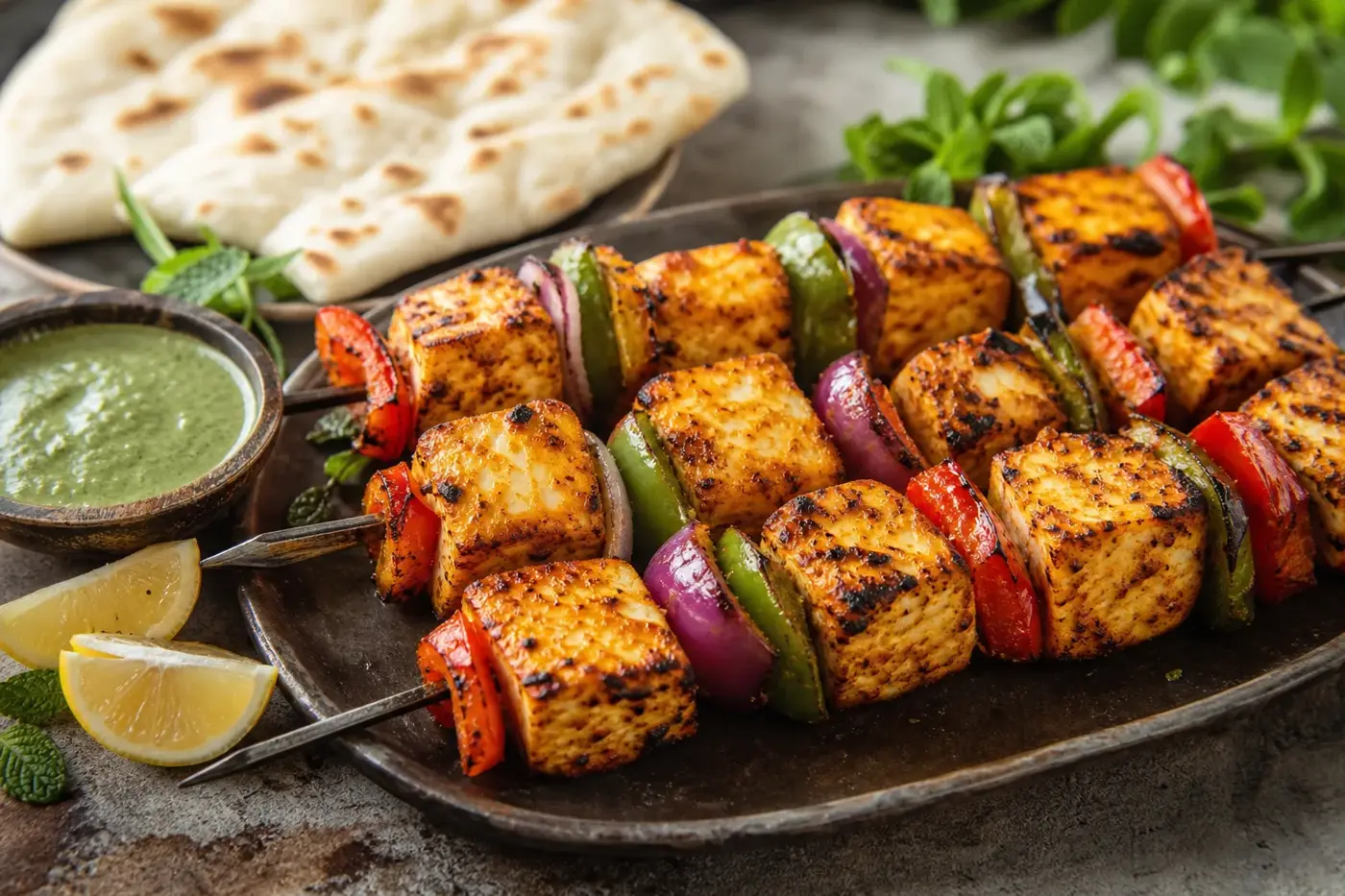
The yoghurt browns. The edges darken. Cut into your paneer tikka and there it is: a tender centre, still holding its shape after fierce heat. That contrast is the pleasure, a little char outside and a soft landing within.[1,4]
In northern Indian cooking, where paneer tikka belongs, a tandoor traditionally does the work. Firm, acid-set paneer holds its spiced yoghurt coat without melting away. At home, a hot oven and a brief spell under the grill bring those dark edges within reach.[1,4]
Meet the cheese that holds its ground
Paneer’s staying power begins before you open the packet. Milk is heated, then acid is added to coagulate it. The proteins gather into curds, ready to be drained and pressed into a block. The Canadian Dairy Commission explains that heating brings whey proteins into the curd alongside casein, the main milk protein.[2]
This heat-and-acid structure behaves differently from the protein network in many rennet-set cheeses. A dairy-processing reference published by the Technical Centre for Agricultural and Rural Cooperation identifies those incorporated whey proteins as a reason cooking cheeses resist melting. Your paneer keeps its outline on the skewer, though prolonged cooking can still dry it out.[3,4]
Curious about what happens before the block reaches your kitchen? Follow how cheese is made. For this recipe, your starting point is a finished block and a sharp knife.
Your paneer tikka plan for four
Recipe status: adapted from published Indian cooking recipes, with an oven and grill sequence based on Cook With Manali. Independent fromage.co.uk recipe testing: none.[4,5]
- Serves: four as a starter, or with flatbread and salad.
- Preparation: about 25 minutes.
- Marinating: 2 hours in the fridge.
- Cooking: about 15 minutes in the oven and grill; allow longer for batches in a frying pan.
- Total elapsed time: about 2 hours 40 minutes.[4,5]
Get your equipment ready: large bowl, whisk, flexible spatula, chopping board, sharp knife, measuring spoons, metal skewers, shallow metal roasting tray, tongs, pastry brush and oven gloves. Choosing the pan route? You need a well-seasoned frying pan or tawa, a flat griddle.[5,6,8]
Gather the cheese, vegetables and spice
- 400 g (14.1 oz) paneer, in a firm block.
- 200 g (7.1 oz) plain thick Greek yoghurt.
- 200 g (7.1 oz) mixed red and green peppers, trimmed weight.
- 150 g (5.3 oz) red onion, peeled weight.
- 20 g (0.7 oz) finely grated ginger.
- 10 g (0.35 oz) finely grated garlic.
- 15 ml (0.51 US fl oz) lemon juice.
- 30 ml (1.01 US fl oz) neutral cooking oil, divided.
- 2 teaspoons ground coriander.
- 1 teaspoon ground cumin.
- 1 teaspoon Kashmiri chilli powder.
- ½ teaspoon garam masala.
- ¼ teaspoon ground turmeric.
- ½ teaspoon fine salt.
- 1 teaspoon crushed dried fenugreek leaves, optional.
- 1 teaspoon sweet paprika, optional for the milder version.[5,8]
For the table: 80 g (2.8 oz) mint chutney, 1 lemon cut into wedges, 150 g (5.3 oz) cucumber salad and 4 flatbreads.[5,7]
Allergen note: paneer and yoghurt contain milk. Check the ingredient and allergen information for every packaged ingredient, including spice blends, chutney and flatbreads, and for any substitutions. A missing ingredient list does not establish that an allergen is absent.
Make a marinade that stays put
Your yoghurt should sit thickly on a spoon, not pour from it. Whisk until smooth, then mix in the ginger, garlic, lemon juice, 20 ml of the oil, spices, salt and optional fenugreek. Take thick yoghurt straight from the pot, leaving separated whey behind. That extra liquid thins the coating you want to keep on your cheese.[7]
Prefer a gentler version? Replace the Kashmiri chilli powder with the sweet paprika. For more heat, add a small pinch of hotter chilli powder, mix and taste before the cheese goes in. Keep the ginger, garlic and other spices unchanged: fragrance matters as much as fire.[1]
Think coat, not swimming costume. You want every surface covered, without the pieces disappearing into a pool of marinade. If your yoghurt pours freely instead of sitting on the spoon, drain it in a lined sieve in the fridge before weighing the required amount.[7]
Handle gently, then give it time
Cut the paneer into roughly 2.5 cm cubes with a sharp knife. Support the block with your other hand rather than pressing down hard. Cut the peppers into squares of similar width, then separate the onion into layers and cut matching pieces. Keep thick wedges for another dish.[5,6]
Fold the vegetables into the marinade first, then add the paneer. Slide a spatula underneath and lift gently, turning just enough to coat each piece. This is folding, not a test of enthusiasm: vigorous stirring chips those corners.[6]
Cover and refrigerate for 2 hours. The FSA’s domestic advice for England, Wales and Northern Ireland is a fridge between 0 and 5 °C (32 to 41 °F).[6,9]
Published recipes also allow overnight marinating, but two hours is your schedule here. While the bowl chills, make the chutney and prepare the accompaniments. Heat the oven before you thread the skewers.[1]
Let the oven cook and the grill colour
Heat the oven to 230 °C conventional or 210 °C fan (450 °F). Line the metal tray with foil. Thread paneer, pepper and onion alternately onto metal skewers, leaving a little space between pieces. Support each cube with your fingertips as you push the skewer through its centre.[4,5,6]
Lay the skewers across the tray with room between them and brush with the remaining oil. Bake for 10 minutes, turning halfway with tongs and oven gloves. Lift the skewer, not the cheese. If a cube sticks to the tray, ease it free with a thin spatula before turning.[4,8]
Now switch to a high overhead grill, called a broiler in the US. Follow your appliance instructions for shelf position and door setting. Grill for about 2 to 3 minutes, turning once as the exposed edges colour. Stay and watch continuously.[4]
Look for browned marinade with scattered dark edges, lightly blistered peppers and onion that has softened but still has bite. The paneer should yield gently under your tongs. Check that a central piece is hot throughout: a browned surface cannot tell you how warm the middle is.[6,8,10]
Metal skewers save you the job of soaking wooden sticks. If you have no metal skewers, leave the pieces loose and use the pan method below.[5,8]
Want to use only the grill? Preheat the overhead grill to 230 to 240 °C (450 to 465 °F), if it has a temperature control. Cook for 7 to 10 minutes, turn, then continue for 3 to 5 minutes, using the same doneness cues. Move the tray farther from the heat if the coating colours before the vegetables soften.[1]
No skewers? Bring out the frying pan
A frying pan or tawa puts every piece within easy reach. Heat a little of the allocated oil over medium heat. Add the coated paneer in a single layer, with space around it, and cook until golden underneath. Turn gently to brown the remaining sides, adjusting the heat if the spice coating catches.[8]
Give the peppers and onion their own turn in the pan. They can cook longer without drying out your paneer. Work in batches, moving cooked pieces to a serving plate. This loose-piece method is particularly useful for a crumbly block, with no skewering to negotiate.[1,8]
Bring everyone to the table
Serve your tikka straight after cooking with mint chutney, lemon wedges and sliced onion. Put the chutney alongside, rather than pouring it over the skewers, so that browned coating keeps its texture. Cucumber salad adds a crisp accompaniment. Warm roti or naan turns your starter into a meal.[5,7]
For an alcohol-free drink, try sparkling water with a squeeze of lime. It is a simple partner for a marinade already carrying cumin, coriander, ginger and chilli. Leave lemon on the table so everyone can choose their final touch of sharpness.
A little help for your next batch
| What happened? | What may be behind it | What to try next |
|---|---|---|
| Dry paneer | A quality issue: prolonged cooking or too little oil. | Shorten cooking; finish briefly under the grill rather than extending the bake.[4] |
| Watery marinade | A quality issue: thin yoghurt or added whey. | Drain yoghurt before measuring; dry washed vegetables thoroughly.[7] |
| Uneven vegetables | A quality issue: thick onion wedges or crowded skewers. | Separate onion layers; cut uniform pieces or cook vegetables separately.[8] |
| Broken cubes | A quality issue: forceful mixing or a fragile block. | Fold gently; cook loose pieces in a pan.[6] |
Let your block choose the route
No suitable substitutions are listed for this recipe. Paneer blocks vary in firmness, so take your cue from the one in front of you. If it crumbles easily, the pan may be a kinder route to dinner than skewers.[2,6]
Give leftovers the care they need
Cool leftovers as quickly as possible, ideally within 1 to 2 hours, then put them in the fridge. This household handling advice comes from the FSA for England, Wales and Northern Ireland; the guidance date for this page is November 2026. Keep your fridge at 5 °C (41 °F) or below. Eat leftovers within 48 hours or freeze them.[9]
Reheat only the portion you intend to eat. The FSA says to reheat food only once, until steaming hot throughout. Use the hob, oven or microwave, turning the pieces and following the appliance’s standing instructions to avoid cold spots. Check the centre of the largest piece rather than trusting its browned surface.[10]
Keep chutney and salad in separate containers so you can serve each appropriately. For broader handling advice, follow how to store cheese at home and cheese food safety, then check the official guidance for your country.[9,10]
General information only, not medical advice: follow the official guidance where you live.
Questions people ask
Why does paneer not melt when cooked?
Paneer is made by heating milk and adding acid, then draining and pressing the curds. A dairy processing reference identifies incorporated whey proteins as a reason these cooking cheeses resist melting.
How long should paneer tikka be marinated?
This recipe calls for two hours in the fridge. The page says published recipes also allow overnight marinating.
Can I make paneer tikka without skewers or a grill?
Yes. Cook the coated paneer loose in a frying pan or tawa, turning it gently to brown the sides. Cook the peppers and onion separately because they can stay in the pan longer without drying the paneer.
How can I stop the marinade becoming watery?
Use thick yoghurt and leave any separated whey behind. If the yoghurt pours freely, drain it in a lined sieve in the fridge before weighing it.
How long can I keep and reheat leftover paneer tikka?
The FSA advises cooling leftovers as quickly as possible, ideally within one to two hours, then refrigerating them at 5 °C or below and eating them within 48 hours or freezing them. It says to reheat food only once, until steaming hot throughout. Check the current FSA guidance for England, Wales and Northern Ireland, or the official guidance for your country.
Sources
- Dassana's Veg Recipes, Paneer Tikka Recipe (Oven & Tawa), updated 19 December 2025. Primary cooking account, including North Indian classification, marination, grill timings and separate pan cooking.
- Canadian Dairy Commission, [Paneer](../paneer/), undated live technical account. Milk treatment, incorporated whey proteins and paneer texture.
- Technical Centre for Agricultural and Rural Cooperation, Setting up and running a small-scale dairy processing business, 2008, section on heat/acid-precipitated cheese.
- Cook With Manali, [Paneer Tikka](../paneer-tikka/), updated 3 April 2026. Primary recipe describing baking followed by broiling, oil in the marinade and avoiding prolonged cooking.
- Sanjeev Kapoor, [Paneer Tikka](../paneer-tikka/), 15 July 2021. Primary recipe using 400 g paneer for four, peppers, separated onion layers and yoghurt marinade.
- Dassana's Veg Recipes, Paneer Malai Tikka, updated 8 July 2026. Primary recipe supporting gentle handling, turning skewers and judging light charring.
- Dassana's Veg Recipes, Hariyali Paneer Tikka (Stovetop & Oven), updated 27 May 2023. Primary cooking account explaining why added water and yoghurt whey thin a marinade.
- Dassana's Veg Recipes, Paneer Tikka Masala Recipe, updated 9 March 2026. Only its preliminary tikka preparation, marinade and cooking methods inform this recipe.
- Food Standards Agency, How to chill, freeze and defrost food safely, published 18 December 2017, current live guidance retrieved November 2026. Applies to England, Wales and Northern Ireland.
- Food Standards Agency, Cooking your food, published 18 December 2017, current live guidance retrieved November 2026. Applies to England, Wales and Northern Ireland.
This piece combines published Indian cooking methods with official dairy explanations and FSA household guidance; its adapted recipe has not undergone a fromage.co.uk kitchen trial.
Last checked: November 2026
Last checked November 2026.
The editors suggest you read next