Paški Sir
Cold bora wind sweeps seawater droplets across Pag’s exposed eastern side.
Cold bora wind sweeps seawater droplets across Pag’s exposed eastern side. Below it, native Pag sheep graze among sparse rocks and aromatic plants. Their milk becomes Paški Sir: firm, dense and increasingly sharp as it ages. This is not a landscape that does things by halves.[1][2]
That island character comes with rules. Registered as Paški sir, the protected name ties the cheese to a local breed, a defined production area and at least 60 days of ripening. When you cut a wedge, you meet a cheese with very particular roots.[1][2]
Get to know your island cheese
| What you want to know | The detail |
|---|---|
| Familiar name | Paški Sir |
| Registered name | Paški sir [1] |
| Authority and identifier | European Commission; application identifier PDO-HR-02397. Register identifier: Not established [1] |
| EU registration act | Commission Implementing Regulation (EU) 2019/1940 [3] |
| Protection | EU: registered PDO under Regulation (EU) 2019/1940; Great Britain: registered PDO from 31 December 2020, 23:00, according to the British register. Northern Ireland and current EU status: Not established [3][4] |
| Where it is made | Pag, Maun and Škrda, Croatia [1] |
| Milk | Whole milk from native Pag sheep; raw or heat-treated [1] |
| What sets the milk | Animal rennet or microbial coagulating enzymes [1] |
| Minimum time to ripen | 60 days [1] |
| What is in the cheese | At least 45% fat in dry matter; at least 55% dry matter [1] |
| Allergens and additives | Milk; lysozyme permitted. Egg-derived lysozyme is an egg allergen; egg must be declared under EU labelling rules. Check the product label [2][8] |
Follow the flock through the seasons
On Pag, in Croatia’s Adriatic, sheep find grazing where cultivation is difficult. Much of it lies on stony karst, terrain formed in soluble rock. The native Pag sheep, paška ovca, is adapted to this tough ground, spending the year on enclosed pastures with shelter available in severe weather.[1][2]
The milk arrives on the flock’s timetable, not the cheesemaker’s whim. The specification describes lambing from November to March, followed by about 40 days of suckling and roughly 130 days of milking. Cheesemaking follows that seasonal supply, while the wheels keep developing in the ripening room after milking ends.[1][2]
Pasture is central, but the feeding rules allow supplementation. During milking, herbage and hay must supply at least 83% of the ration’s dry matter, with concentrated feed providing up to 17%. The island’s limited forage also means specified quantities of feed from outside the area are allowed.[1]
Meet the wind behind the landscape
Sage, thyme, fennel and mint appear among the aromatic plants recorded in the specification. They grow in a landscape shaped by the bora, locally bura, a strong, cold wind carrying seawater droplets inland. Salt settles on the sparse, rocky grazing, particularly along Pag’s exposed eastern side.[2]
Follow that trail from weather to vegetation, feed and milk, and you begin to understand the cheese’s sense of place. The PDO account links Paški Sir’s identity to this environment and local cheesemaking knowledge. Its salty taste has a more direct explanation, too: the wheels bathe in brine made with Pag sea salt.[1][2]
Those herbs belong to the farming story. When you taste, start with the aromas and flavours you can identify, then compare them with the maker’s description. You need not conduct a botanical survey of every mouthful.
Read the island story in the name
For Paški Sir, the whole production chain stays on Pag and the neighbouring islets of Maun and Škrda. Milk production, coagulation, moulding, pressing, salting and ripening must all happen within this defined area. PDO means protected designation of origin; here, that connection runs from milk to mature wheel.[1]
The registration regulation was adopted on 15 November 2019 and published on 25 November 2019. That publication date is the registration date recorded by the British register. A separate provision brought it into force on the twentieth day after publication, 15 December 2019; Great Britain’s register records protection from 31 December 2020 at 23:00.[3][4]
Give both names on the label your attention. The protected name tells you which specified cheese you have; the producer’s name tells you who made it. For the wider picture, see protected names explained.
Watch the milk become a wheel
Paški Sir can begin with raw, thermised or pasteurised milk. The specification permits starter cultures, calcium chloride and lysozyme, alongside animal rennet or microbial coagulating enzymes. Rennet sets the milk into curd, the solid mass separated from liquid whey.[2]
The curd is cut into grains about the size of wheat, then warmed while stirring. Next come moulds, draining and pressing, followed by brining and a move to the ripening rooms. That fragile milk gel becomes a close-textured cheese you can cut and, with greater age, grate.[1][2]
The maker’s choices matter throughout. A study in Mljekarstvo’s 2025 volume compared 18 experimental cheeses made on a Kolan farm, using different rennet and culture preparations and 120 days of ripening. Gas chromatography with mass spectrometry identified differences in their volatile compounds.[5]
When you compare cheeses, consider the maker, milk treatment and age together. Explore raw and heat-treated milk for the treatment differences. For the ingredients that set the curd, see rennet explained.
Look beneath the golden rind
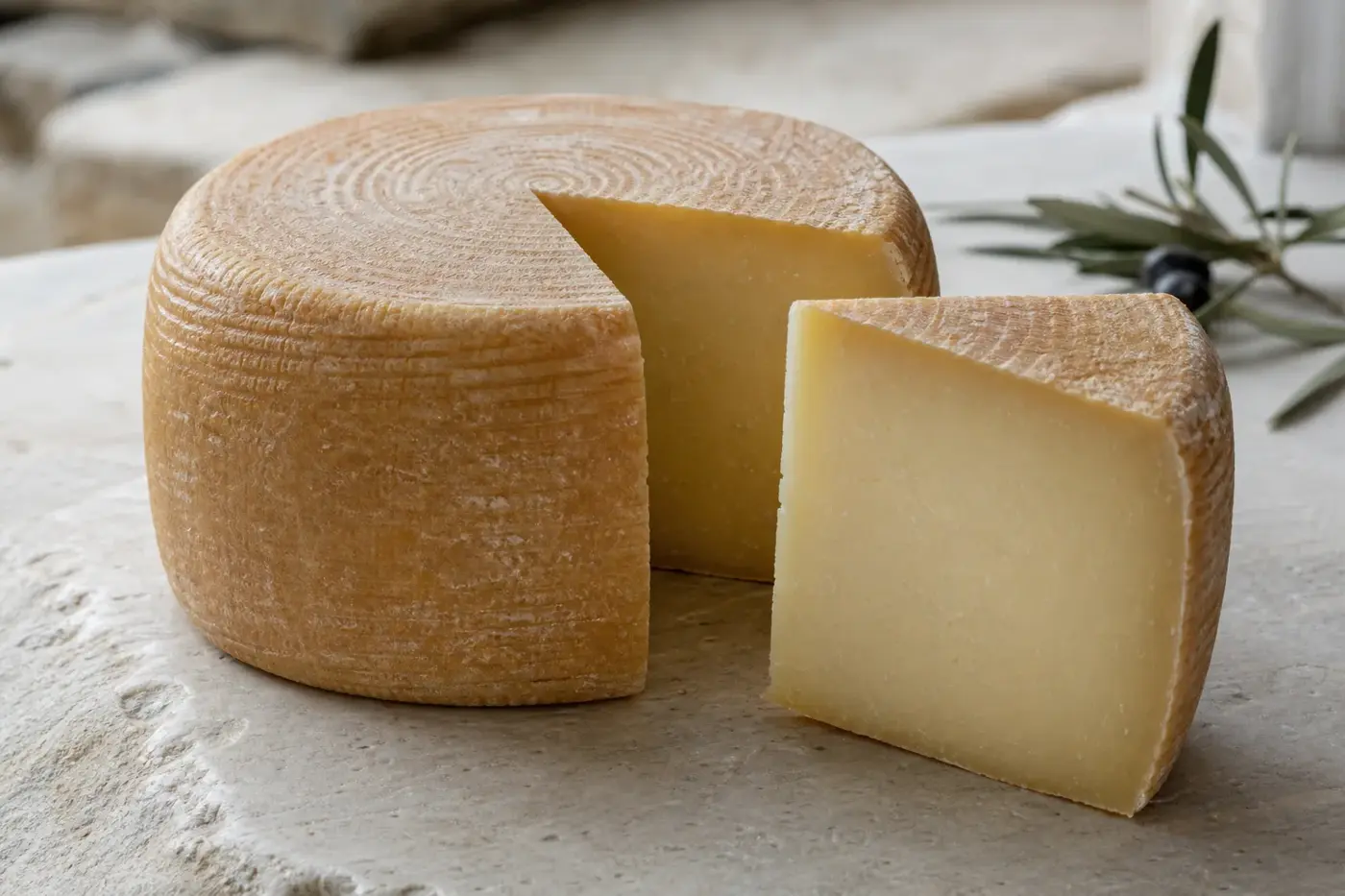
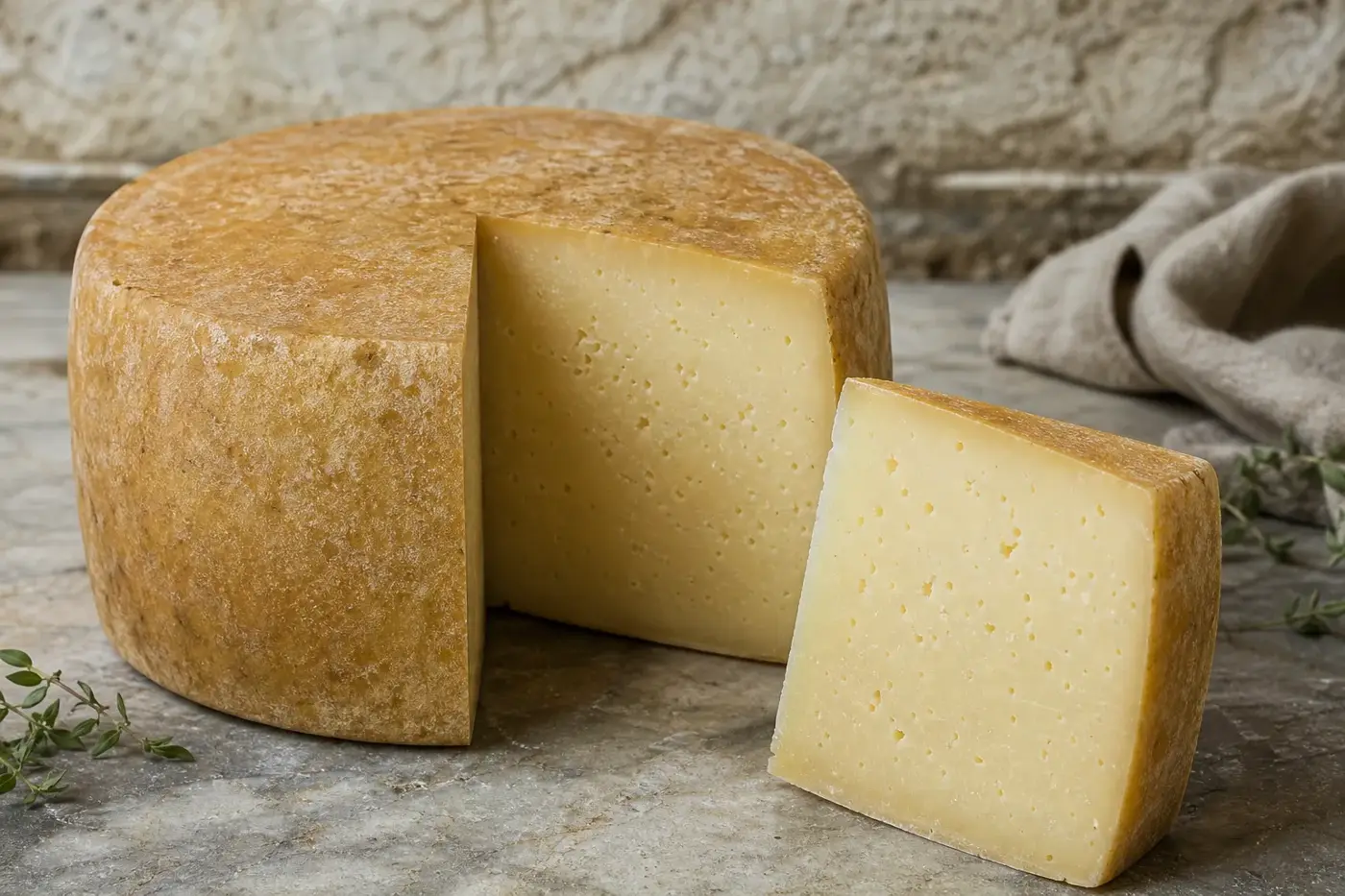
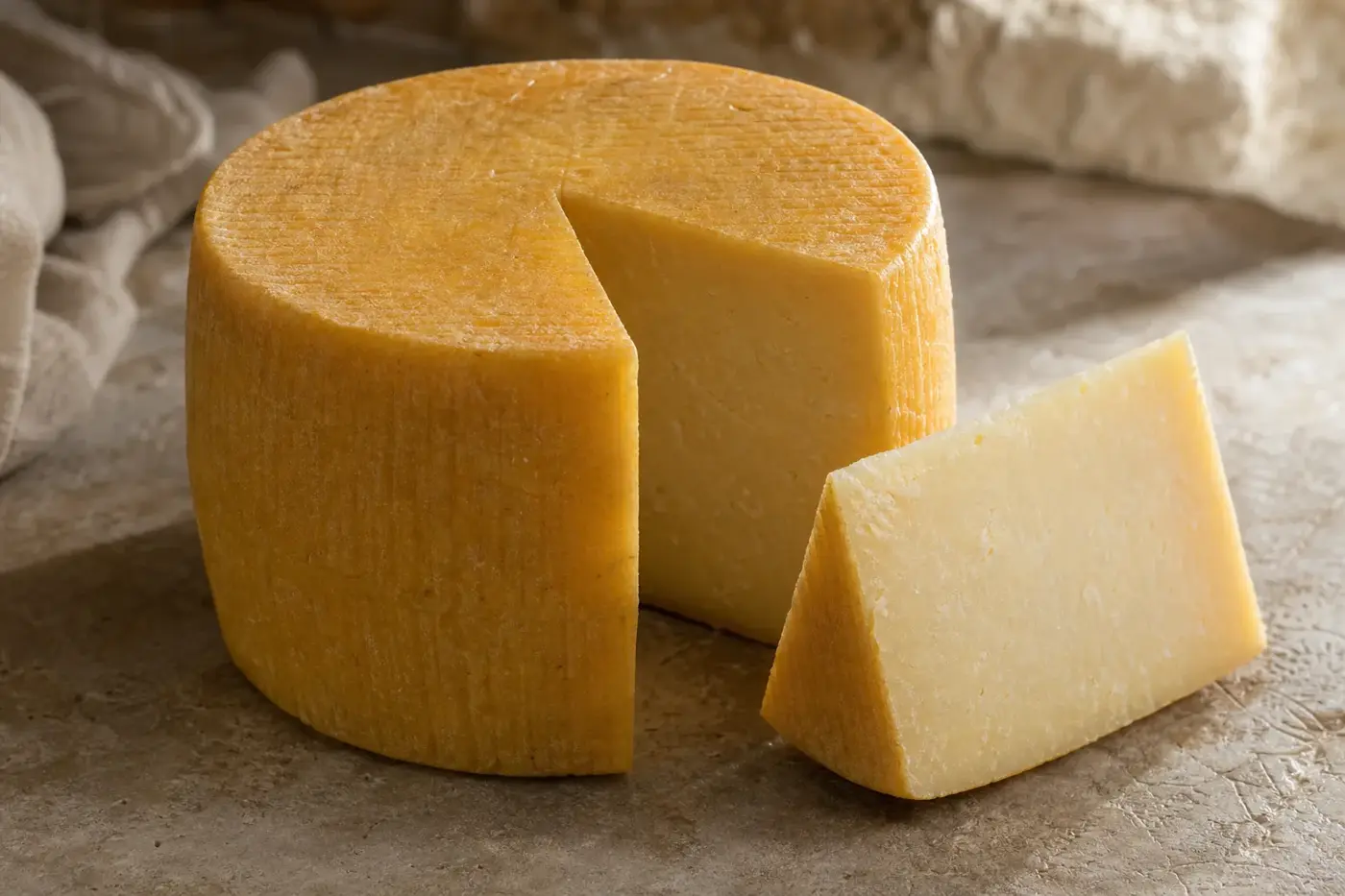
A standard cylindrical wheel measures 18 to 24 cm across and 7 to 13 cm high, weighing 1.8 to 3.5 kg. Smaller wheels of 0.6 to 1.2 kg are also permitted. Whichever size catches your eye, it must ripen for at least 60 days.[1]
The official description gives the cheese a smooth, hard rind, ranging from golden yellow to pale reddish-brown. Cut inside and you find dense, pale yellow paste with a few small, irregular holes, or none at all. As it ripens, the paste darkens and loses elasticity, while the flavour grows sharper.[1]
Give the first bite a little time
Slight sweetness, gentle sharpness and sheep’s-cheese aroma with hints of aromatic herbs form the PDO’s sensory description. Begin with the balance between sweetness and sharpness. You are looking for how they sit together, rather than one flavour drowning out everything else.[1]
Try a small piece alone before reaching for bread or fruit. Notice saltiness, savoury depth and any nutty impression separately, then compare your observations with the producer’s description. You will build a useful vocabulary for recording what you find.
The specification describes the cheese’s shared sensory identity. The production study shows how culture and rennet choices can change its aroma chemistry. Keep a maker’s tasting notes beside the named product and its stated age, so the words stay connected to the cheese in front of you.[1][5]
Find a wedge for your plans
Start with the exact name Paški sir, the producer and a stated maturation period. The rules require a prominent name and the common Paški sir symbol. Buying a cut piece? Ask to see the original wheel’s label or the supplier’s product information.[1]
Think about how you want to eat it. For neat slices, ask your cheesemonger for a wheel that still cuts cleanly; for a more pronounced finish, compare a longer-ripened example. The legal minimum gives you a starting point, but the actual age tells you more about that particular cheese.
Read the ingredients and milk treatment on the pack. Both animal and microbial coagulants are permitted, so confirm vegetarian suitability for the individual product, and check permitted additives too. You will find more pointers in reading a cheese label.[2]
From fridge to table, with care
Keep the cheese refrigerated while you prepare the portion you want to eat. For home storage in England, Wales and Northern Ireland, the Food Standards Agency advises a fridge between 0 and 5 °C (32 to 41 °F). Follow the pack’s storage instructions and dates, including any directions for after opening.[6]
For serving, take out a small portion and let it briefly lose its chill while you set the table. The same agency advises keeping chilled food out for the shortest possible time, with a maximum of four hours. Treat that as the outer limit, not a recommended serving time.[6]
Ask whether the maker intends that particular rind to be eaten, and whether it has a coating. Wax, plastic coatings and cloth are not food. If the rind’s treatment is unclear, trim it away and taste the paste.
For pregnancy, UK NHS guidance lists pasteurised and unpasteurised hard cheeses among foods that can be eaten. Consult its current foods to avoid in pregnancy guidance (November 2026), and ask your midwife or doctor about your own circumstances.[7]
Give your wedge good company
Begin simply, with plain bread and still water, so you can give the cheese your full attention. Then try fresh pear for a juicy contrast, or a little fig preserve if you enjoy sweetness beside a sharper cheese. These are starting points, not seating arrangements you must obey.
Put accompaniments beside the cheese rather than over it. Taste a piece alone, then with your chosen partner; walnuts offer another comparison, setting the cheese’s texture against something crisp. Let your own preference settle the matter.
In the kitchen, try small shavings over warm vegetables, pasta or a bean salad. Taste before adding more salt. Older cheese has a documented role beyond the cheeseboard: the PDO rules expressly allow grated Paški sir after more than 12 months of maturation.[1]
Let curiosity lead you around Croatia
Paški sir is defined by native Pag sheep’s milk and its island production area. Other Croatian sheep’s milk cheeses need not follow that specification. Look at their own documented milk, production areas and maturation requirements to discover what sets them apart.[1]
Bring the same concrete questions to each cheese. Which animal supplied the milk, where was it produced, how was it coagulated and how long did it mature? Those answers tell you more than the country name alone, and give you a useful basis for comparison.
General information only, not medical advice: follow the official guidance where you live.
Questions people ask
Where is Paški Sir made?
Paški Sir is made on Pag and the neighbouring islets of Maun and Škrda in Croatia. Every stage, from milk production to ripening, must take place in this area.
What does Paški Sir taste like?
The PDO description notes slight sweetness, gentle sharpness and a sheep’s cheese aroma with hints of aromatic herbs. The flavour becomes sharper as the cheese ripens, and it must ripen for at least 60 days.
Is Paški Sir vegetarian?
The specification permits either animal rennet or microbial coagulating enzymes. Check the ingredients for the individual product to confirm whether it is suitable.
Can I eat Paški Sir during pregnancy?
The UK NHS lists pasteurised and unpasteurised hard cheeses among foods that can be eaten during pregnancy. Check its current guidance at https://www.nhs.uk/pregnancy/keeping-well/foods-to-avoid/ and ask your midwife or doctor about your circumstances.
How should I store Paški Sir?
For home storage in England, Wales and Northern Ireland, the Food Standards Agency advises a fridge temperature between 0 and 5 °C. Follow the pack’s storage instructions and dates, including any instructions for after opening.
Sources
- European Commission. Single document: Paški sir, application PDO-HR-02397, dated 10 April 2018; published as 2019/C 225/05 in the Official Journal, 5 July 2019, pages C 225/33 to C 225/37. Sections 3 to 5 cover composition, formats, sensory characteristics, feed, production area, labelling and the geographical link. Official document.
- Croatian Ministry of Agriculture, published specification submitted by the producers' association. Specifikacija proizvoda: Paški sir, October 2018 version. Sections 2, 3, 5 and 6 cover ingredients, milk treatment, production, the sheep and island environment. Product specification; ministry status and specification page.
- European Commission. Commission Implementing Regulation (EU) 2019/1940 of 15 November 2019 entering a name in the register of protected designations of origin and protected geographical indications Paški sir (PDO), 2019. Article 1 registers the name; Article 2 specifies entry into force. Official regulation.
- Department for Environment, Food & Rural Affairs. Paški sir, protected food name register entry, published 4 January 2021, current page accessed November 2026. Records registered PDO status, the original EU registration date and the British scheme registration timestamp. Register entry.
- Mljekarstvo, Croatian Dairy Union. Učinci inovativne tehnologije proizvodnje na aromatski profil paškog sira, volume 75, issue 1, 2025, pages 3 to 14; published online 29 December 2024. Experimental comparison of 18 cheeses, analysed using gas chromatography with mass spectrometry. Full text.
- Food Standards Agency. How to chill, freeze and defrost food safely, published 18 December 2017, current text accessed November 2026. Consumer guidance for England, Northern Ireland and Wales on refrigeration, packaging instructions and time outside refrigeration. Official guidance.
- NHS. Foods to avoid in pregnancy, current web edition accessed November 2026. The dairy section distinguishes hard cheeses from other product categories. Official guidance.
- European Parliament and Council. Regulation (EU) No 1169/2011 on the provision of food information to consumers, 2011, Articles 9 and 21 and Annex II.
This piece was researched from official registration documents, the published Croatian specification, experimental dairy research and official UK consumer guidance, with serving suggestions identified as editorial recommendations.
Last checked: November 2026
Last checked November 2026.
The editors suggest you read next