Heat the cheese. Keep stirring. Then seal it in protective containers. On 6 June 1916, a United States patent set out that solution to a stubborn kitchen problem: cheese that separated when heated. The ambition was to keep its flavour and stop further ripening at a chosen stage.[3]
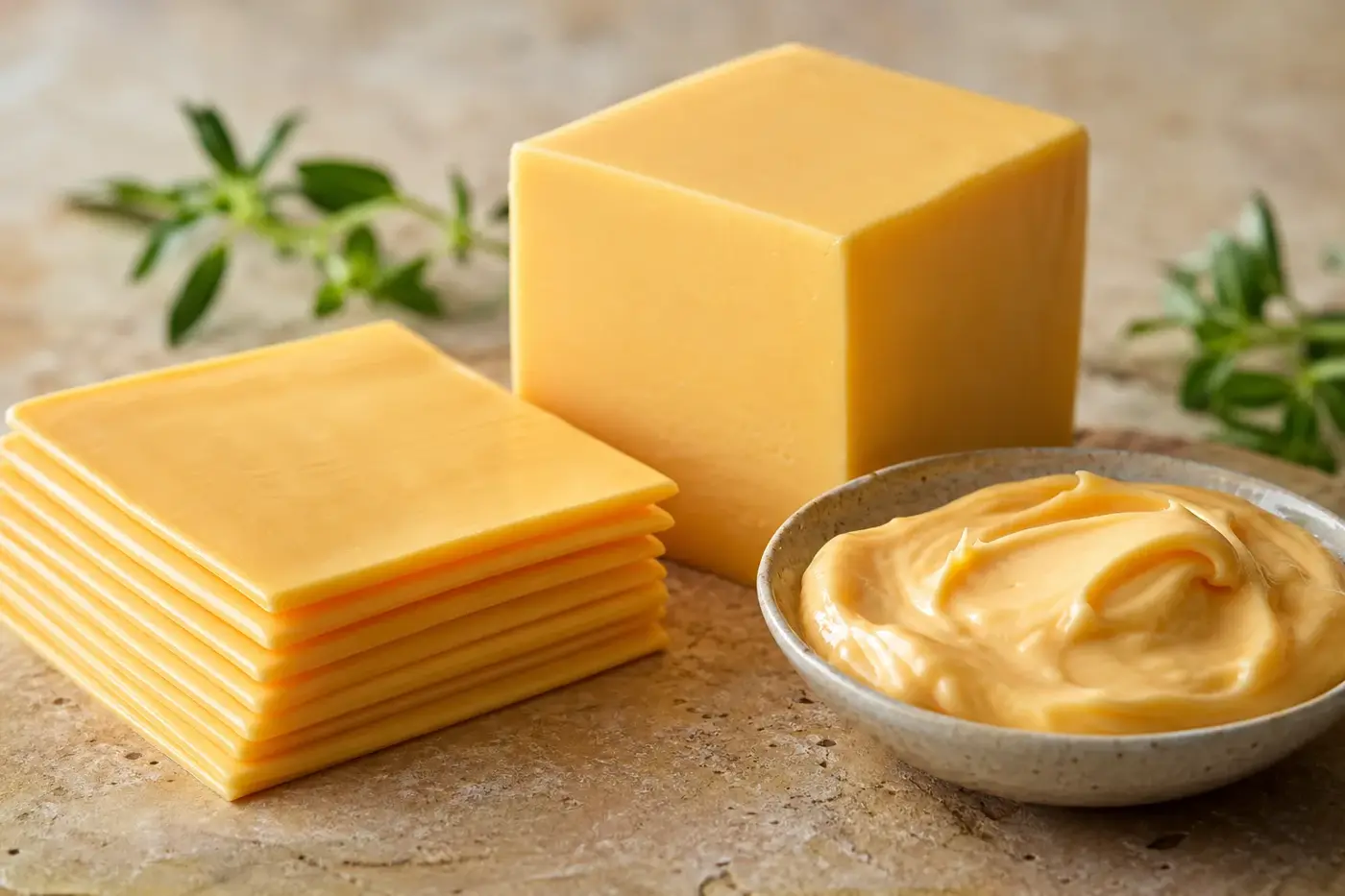
You can see where that ambition led, from firm slices to spoonable spreads. Their smooth melt comes from reorganising milk proteins so they help hold water and fat together. Usually, that means heating and blending cheese with emulsifying salts and other ingredients. There is rather more going on than the modest wrapper suggests.[1,2]
Unwrap it, then read the recipe
Cheese comes first, but it need not arrive alone. The recipe may include water, milk powder, whey ingredients, milk fat, salt and ingredients that adjust acidity or texture. Two individually wrapped slices can have quite different recipes. You learn more from the balance of ingredients than from the wrapping.[2,8,9]
Unlike cheese made directly from milk, processed cheese starts with cheese that already exists. The dairy research cited here calls that starting material “natural cheese”. To follow its earlier journey, head to how cheese is made.[1]
Plant based alternatives belong to a separate category. When you choose, distinguish between a product containing cheese and milk ingredients and one formulated from plant ingredients.[8,9,12]
From a keeping problem to the sandwich
Better keeping qualities were the early technical goal. The obstacle was heating cheese without it separating. The 1916 patent captures the ambition: a homogeneous product with controllable character, retained flavour and ripening stopped at a chosen point. Those keeping claims belong to the historical document, not your fridge: follow current product storage instructions today.[3,14]
Convenience later arrived in several shapes. Dairylea’s published history records a foil-wrapped block in the early 1960s, slices in 1965 and a spread in the 1980s. Each gave the same broad manufacturing approach a different everyday job, from portioning to filling sandwiches or spreading.[16]
The work behind a good melt
The starting cheese brings flavour and protein. Manufacturers select it for its composition, maturity and behaviour during processing, then blend to shape the finished product. Added dairy ingredients and water adjust the mixture. Acidity, calcium and the chosen salts also influence its consistency.[1,2]
Heat makes that blend workable; mixing distributes its components. Simply reaching a melting temperature is not enough, because the finished texture depends on the whole recipe and process. The processed mixture is then packed and cooled into its intended form.[1,3]
Meet the salts keeping everything together
Emulsifying salts help cheese proteins hold the mixture together. Casein, the main cheese protein, forms a network whose structure involves calcium. These salts, commonly citrates and phosphates, alter the calcium interactions. That helps casein disperse and take up water.[1,2]
With heating and mixing, those dispersed proteins can stabilise small fat droplets throughout the mixture. The salts help proteins do the emulsifying work, rather than simply making melted cheese thicker. A thickener has a different job, even when you find both in the same ingredients list.[1,9]
The choice of salt matters, too. In a controlled study using a Mozzarella base, researchers compared five salts, measuring texture, protein dispersion, fat particle size and water behaviour. Both salt type and concentration changed the results, including hardness and fat particle size. The smooth melt you get is formulated, and processed products deliver it differently.[1]
Slices, spreads and the question of sauce
Slices give you even coverage over bread or a burger. Read the food name, though: slicing ordinary cheese does not turn it into processed cheese. Dairylea’s published slice recipe includes milk ingredients, cheese, modified starch and several emulsifying salts.[9]
Blocks give you a larger piece to cut or portion, while spreads are made for spreading rather than neat slicing. Shape can fool you here. A triangle may be a spreadable portion, and Dairylea describes its triangles as suitable for spreading on bread. Geometry is not much help with lunch.[8,16]
Sauces deserve a closer look. A cheese sauce might be thickened with starch, made with processed cheese or prepared by another method. “Sauce” tells you its use, not its recipe. For what is inside, turn to the food name and ingredients.[4,5]
Give the food name your attention
Start with the food name, even when the brand catches your eye first. In Great Britain, Article 17 of assimilated Regulation (EU) No 1169/2011 requires the legal name or, where none exists, a customary or descriptive name. Legal product descriptions differ between jurisdictions, so compare the descriptions on packs sold in your market.[4]
Next, read the ingredients list. In Great Britain, ingredients are generally listed in descending order of weight at manufacture, subject to applicable exceptions. Look for cheese, milk ingredients, added fat, water, emulsifying salts and any starches or other texture ingredients. Their order tells you more about the recipe than colour or shape; find the wider details in reading a cheese label.[5]
The FSA’s additive list identifies sodium citrates as E331, sodium phosphates as E339, triphosphates as E451 and polyphosphates as E452. An E number identifies an additive, but permission to use it depends on the food category and applicable conditions. In Great Britain, the governing framework is assimilated Regulation (EC) No 1333/2008.[6,7]
Follow the flavour, then watch the melt
For flavour clues, look first at the cheeses named in the recipe and the published product description. Processing can bring several starting materials into one consistent profile. Texture follows the same idea: you get a uniform mass, rather than the preserved structure of the original cheese.[1,2]
At the cooker, the useful contrast is a cohesive melt versus the possibility of fat separating from heated cheese. That separation was at the heart of the problem described in the 1916 patent. Choose a processed slice when you want even coverage. Choose an ordinary cheese when its particular flavour and texture are the point of your dish.[3]
Compare what is in your portion
Start with equal weights, then think about your portion. The current manufacturer pages below show differences even within one range. Values are grams per 100 g of the whole product. The 30 g figures are calculated from those declarations and rounded to two decimal places.[8,9,10]
| UK product, November 2026 | Amount | Saturated fat (g) | Protein (g) | Salt (g) |
|---|---|---|---|---|
| Dairylea Triangles[8] | 100 g | 9.8 | 12 | 1.50 |
| Dairylea Triangles[8] | 30 g | 2.94 | 3.60 | 0.45 |
| Dairylea Slices[9] | 100 g | 9.0 | 15 | 1.50 |
| Dairylea Slices[9] | 30 g | 2.70 | 4.50 | 0.45 |
| Dairylea Cheese Spread[10] | 100 g | 9.2 | 12 | 1.52 |
| Dairylea Cheese Spread[10] | 30 g | 2.76 | 3.60 | 0.46 |
In these recipes, the slices have more protein and less saturated fat than the triangles, with the same declared salt. That describes these products, not the whole category. When choosing, read the current pack and consider the portion you actually use.[8,9]
For a broader view, the UK’s official Composition of Foods Integrated Dataset brings together food composition information. Its 2021 edition contains data from different years, so a category entry offers a different perspective from a current branded label. For the recipe in your hand, use that named product’s declaration.[15]
This page summarises published guidance from the official sources it cites. It is not medical advice. Guidance differs between countries and changes over time, so check the current source for where you live, and ask your doctor, midwife, pharmacist or dietitian about your own circumstances.
Milk allergy and lactose: know the difference
Lactose intolerance concerns the milk sugar lactose; food allergy can be life threatening. The UK NHS distinguishes the two and advises seeking medical guidance for recurring symptoms. Speak to a GP or dietitian before cutting foods out of your or your child’s diet.[11]
For prepacked products in Great Britain, Article 21 of the food information regulation requires milk allergens to be identified and emphasised. The FSA’s technical guidance specifically covers milk-derived ingredients such as whey and casein. Read every relevant ingredient, along with any precautionary allergen statement.[12,13]
Lactose content depends on the finished formulation. If a recipe combines cheese with milk powder or whey, the starting cheese alone cannot give you the answer. Ask the manufacturer for product-specific lactose information where needed. You can also explore lactose in cheese and allergy versus intolerance for more detail.[8,9,11,12]
Choose the cheese for your next bite
Think about what you want it to do. For a sandwich, consider the slice’s thickness and coverage. For toast or a cold filling, a spreadable product saves you softening and working a firm cheese. For a dip, start with a product whose manufacturer describes that use.[8,9,10]
Comparing two candidates? Put their food names side by side before looking at ingredients and nutrition declarations. Decide whether you want a slice that holds together, a spread that works straight from its container or a product intended for melting. Shape is only part of the answer.[4,8,9,10]
Keep the pack handy for storage
Follow the manufacturer’s instructions before and after opening, including any stated opening limit. For England, Wales and Northern Ireland, the FSA’s advice as at November 2026 is to keep a domestic fridge between 0 and 5 °C. It also advises following the storage instructions and dates on packaging.[14]
Keep the pack so you still have those instructions, especially when individual portions leave their outer box. Write the opening date on a tub if that helps you follow the stated limit. Follow the instructions for that opened product, rather than assuming everything called processed cheese keeps for the same period.[14]
Your pack gives you the instructions for that product. For broader handling guidance, turn to storing cheese at home.
Questions people ask
What is processed cheese made from?
Processed cheese begins with an existing cheese. Its recipe may also contain water, milk powder, whey ingredients, milk fat, salt and ingredients that adjust acidity or texture.
Why does processed cheese melt smoothly?
Emulsifying salts help cheese proteins disperse and take up water. With heating and mixing, the proteins can stabilise small fat droplets throughout the mixture.
Is every cheese slice processed cheese?
No. Cutting ordinary cheese into slices does not make it processed cheese. Check the food name and ingredients to see what the product contains.
Does processed cheese contain lactose?
The finished formulation determines its lactose content, so the starting cheese alone cannot tell you the answer. The NHS distinguishes lactose intolerance from food allergy and advises seeking medical guidance for recurring symptoms. See the NHS guidance on lactose intolerance.
How should processed cheese be stored?
The FSA advises keeping a domestic fridge between 0 and 5 °C and following the storage instructions and dates on packaging. See the FSA’s storage guidance for England, Wales and Northern Ireland.
Sources
- Journal of Dairy Science, “Effect of emulsifying salts on the physicochemical properties of processed cheese made from Mozzarella”, volume 95, issue 9, 2012, pages 4823 to 4830. Original experimental research comparing five emulsifying salts.
- Foods, “Soluble Salts in Processed Cheese Prepared with Citrate- and Phosphate-Based Calcium Sequestering Salts”, 2024. Original experimental research on protein and mineral distribution in processed cheese.
- United States Patent Office, patent US1186524A, “Process of sterilizing cheese and an improved product produced by such process”, published 6 June 1916. Contemporary patent text, retrieved through Google Patents.
- UK legislation publisher, assimilated Regulation (EU) No 1169/2011, Article 17, “Name of the food”, current displayed text accessed November 2026.
- Department for Environment, Food & Rural Affairs, Food labelling: giving food information to consumers, current online guidance accessed November 2026, particularly the ingredients and storage sections.
- Food Standards Agency, Approved additives and E numbers, published 25 June 2026, current online edition accessed November 2026.
- UK legislation publisher, assimilated Regulation (EC) No 1333/2008 on food additives, current displayed full-text document accessed November 2026.
- Dairylea UK, Triangles, undated manufacturer product page, ingredients and nutrition declarations accessed November 2026. Commercial primary source for its own product.
- Dairylea UK, Cheese Slices, undated manufacturer product page, ingredients and nutrition declarations accessed November 2026. Commercial primary source for its own product.
- Dairylea UK, Cheese Spread, undated manufacturer product page, ingredients and nutrition declarations accessed November 2026. Commercial primary source for its own product.
- NHS, Lactose intolerance, reviewed 8 July 2026, accessed November 2026.
- Food Standards Agency, Food allergen labelling and information requirements technical guidance, current online edition accessed November 2026, particularly the milk and prepacked food sections.
- UK legislation publisher, assimilated Regulation (EU) No 1169/2011, Article 21, “Labelling of certain substances or products causing allergies or intolerances”, current displayed text accessed November 2026.
- Food Standards Agency, How to chill, freeze and defrost food safely, published 18 December 2017, current online text accessed November 2026; stated territorial scope: England, Northern Ireland and Wales.
- Public Health England, Composition of foods integrated dataset (CoFID), 2021 edition, publication page and accompanying user guide accessed November 2026.
- Dairylea UK, Home, undated manufacturer history, accessed November 2026. Commercial primary source for the company’s account of its product formats.
This piece was researched from original dairy science studies, a contemporary patent, British legislation and official guidance, with manufacturer declarations used for the named product examples.
Last checked: November 2026
Last checked November 2026.
The editors suggest you read next
How to Tell Cheese Styles Apart: Milk, Rind, Texture and Method
Watch mozzarella curd being worked and stretched in hot water.