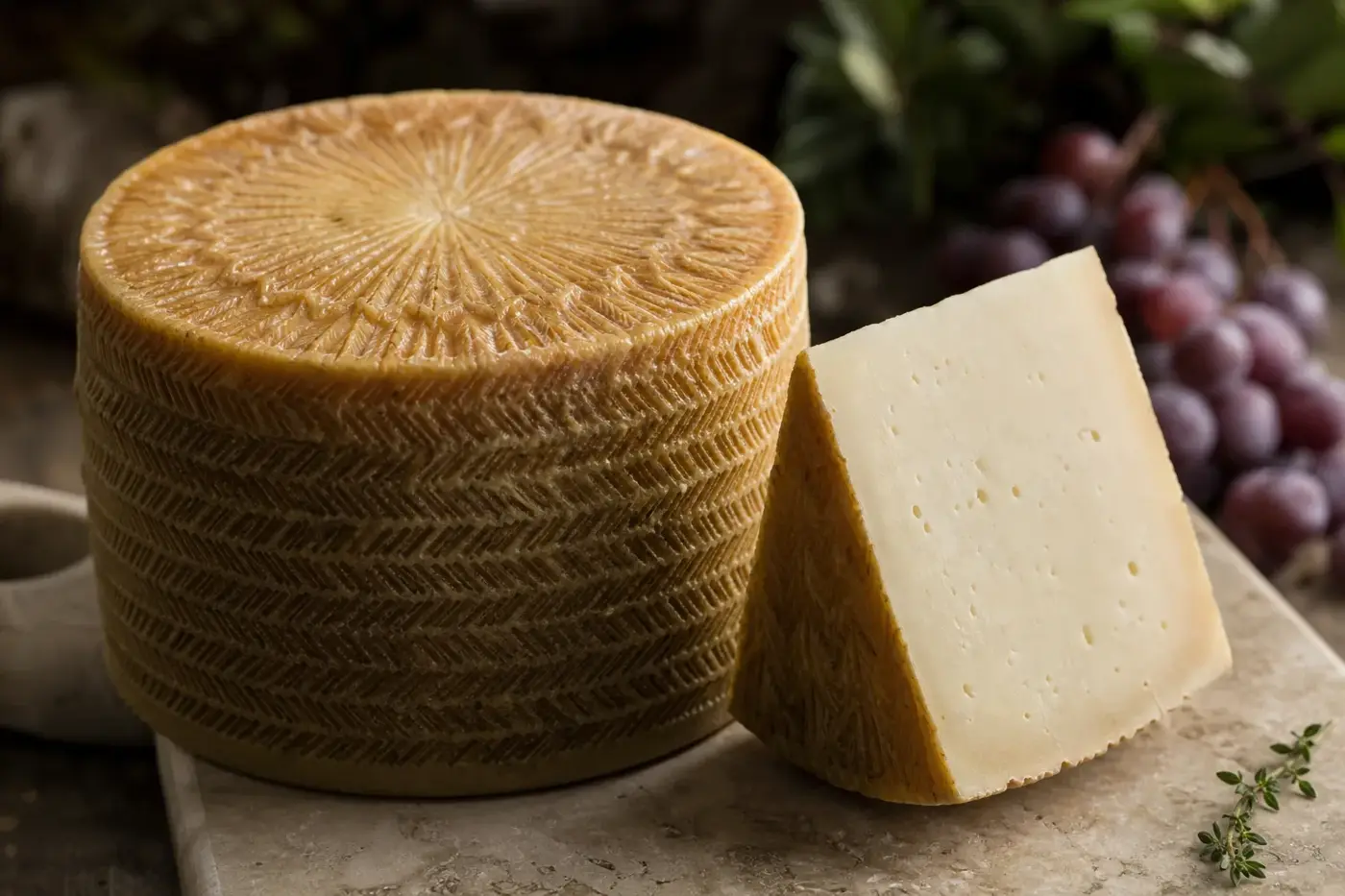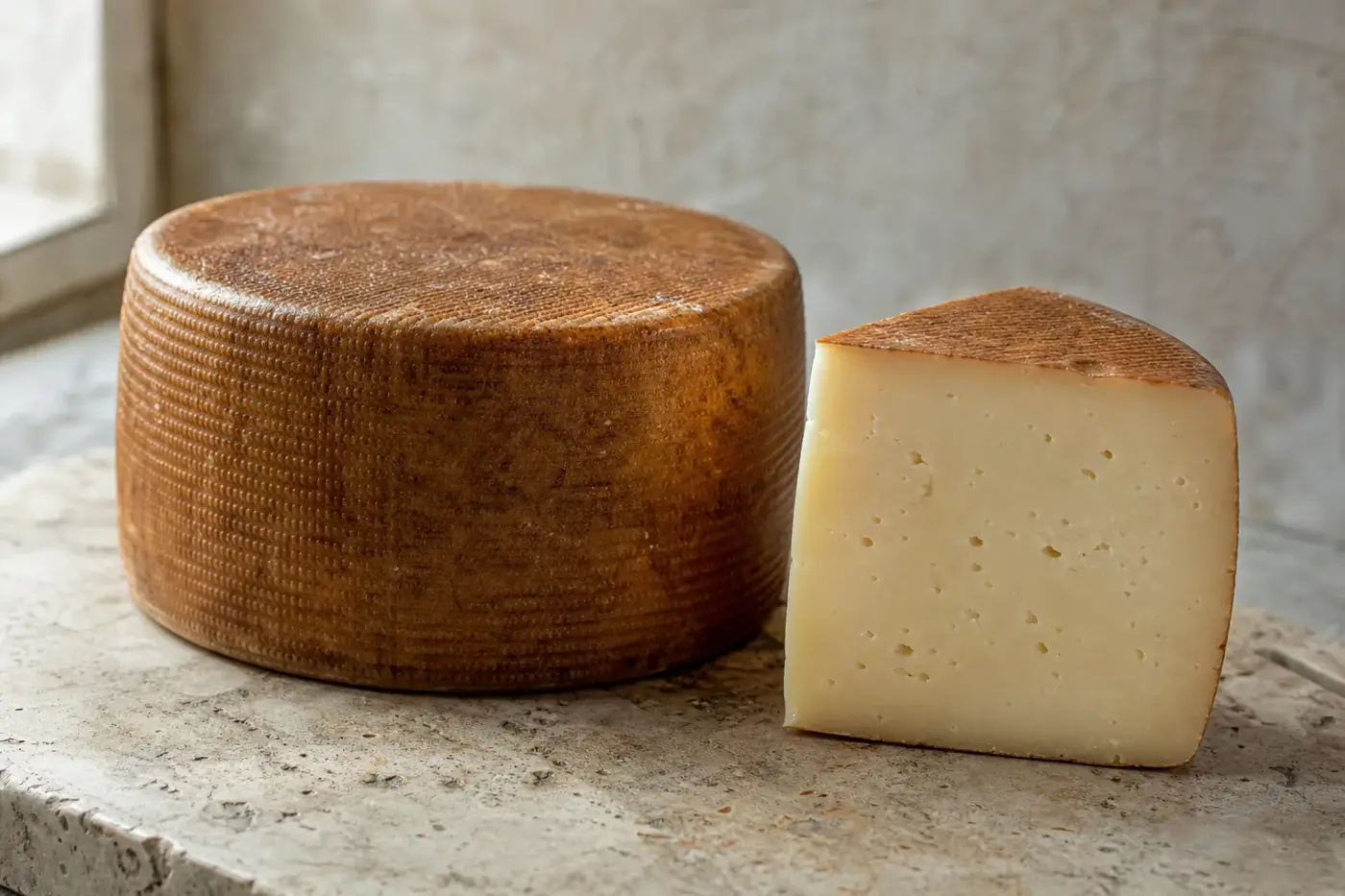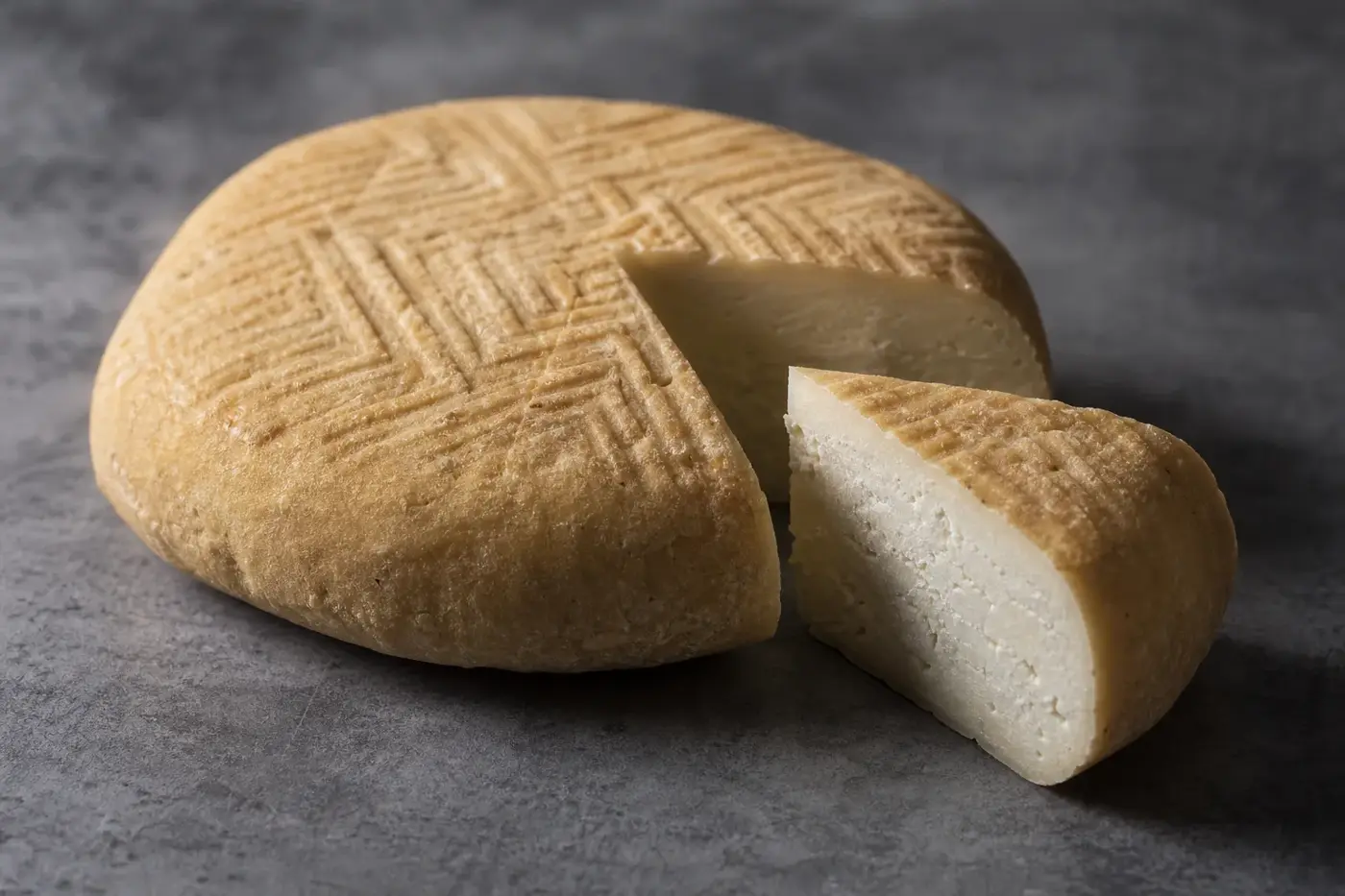
A decorative stamp meets a flattened disc of cheese. Flowers, perhaps, or geometric patterns: a final flourish after repeated kneading of the curd. You’re looking at Queso Casín, a whole, raw cow’s milk cheese from the mountains of Asturias in northern Spain. Its EU protected designation of origin ties milk, making and maturation to three municipalities. [1,2,3]
Your quick guide to Casín
| What to know | The details |
|---|---|
| Registered name | Queso Casín. [1] |
| EU registration | PDO, European Commission; file PDO-ES-0718. [4] |
| Registration instrument | Commission Implementing Regulation (EU) No 986/2011, dated 30 September 2011. [6] |
| Where it belongs | Caso, Sobrescobio and Piloña, Asturias, Spain. [1] |
| Milk and coagulant | Whole, raw cow’s milk; animal rennet or animal-origin coagulant. [1] |
| Minimum maturation | 60 days from curd manufacture. [1] |
| Permitted size | 150 to 1,000 g; up to 20 cm across and 7 cm high. [1] |
| Fat requirement | At least 45% fat in dry matter. [1] |
Follow Casín into the mountains
Caso gives the cheese its name, but its territory reaches into neighbouring Sobrescobio and Piloña. Redes Natural Park occupies Caso and Sobrescobio; the PDO extends into the surrounding country rather than following the park boundary exactly. Milk production, making, maturation and packing must all stay inside the defined area. [1,7]
The mountain climate has a hand in what happens to the curd. According to the specification, damp conditions made small portions difficult to dry, so cheesemakers brought them together and kneaded them repeatedly. Generations turned that practical problem into a drier, more compact mass, without pressing. [1,8]
Meet the mountain cattle
The local Asturiana de la Montaña, also called Casina, has a central place in this story. Small and hardy, it can use steep mountain pasture and was formerly valued for milk, meat and draught work. Its milk remains part of the tradition, but you needn’t assume every Casín comes from this breed alone. [1,3]
The designation also permits Asturiana de los Valles, Friesian cattle and crosses of the permitted breeds. Their milk must be whole and raw, from herds within the designated area. Feeding centres on local grazing, supplemented with fresh or conserved forage, cereals and legumes. [1,2]
A PDO label tells you about defined origins and production methods, then, not necessarily one particular breed. For that detail, ask the maker. You can explore milk treatments in raw, thermised and pasteurised milk.
Give the curd a little time
Making begins when rennet turns milk into a gel through enzymatic coagulation. The current specification requires an animal-origin coagulant, with cultures and optional calcium chloride. Wire tools cut the curd, which is stirred, left to settle and drained until the maker has something firm enough to work. [1,8]
Cloths called fardelas, or draining vessels, let the whey escape: that’s the liquid separated from the curd. Next come three or more days in the drying room, with daily turning as drainage continues and lactic fermentation develops. By kneading time, you have drained, fermenting curd, not a freshly set vat of milk. [2,8]
Rabilar: the work that shapes the flavour
Now comes rabilar, the decisive kneading stage. A machine works the paste between two rollers turning in opposite directions, before hands shape it into gorollos, portions resembling truncated pyramids. These rest in the drying room before further working and final shaping; the specification allows a drying interval of five days to two weeks. [1,2]
Salt goes in during one of the passes. There is no single compulsory number of passes: the maker works towards the desired texture. The specification links more passes with finer, more homogeneous paste, better curing and stronger flavour. Less worked cheese keeps the same general flavour character at lower intensity. [1,2,9]
There’s more happening here than a change of texture. The specification’s explanation of the geographical link says kneading distributes salt and ripening organisms through the mass, helping establish the character that develops during maturation. When you buy, “How much was it worked?” can be as revealing as “How old is it?” [1,8,14]
Read the story in the stamp
Hands give the finished cheese its irregular, flattened disc shape. Then a stamp presses flowers, geometric patterns, symbols or the maker’s name into the upper surface. Called a marcu in the specification, it decorates the cheese’s most visible face. Even a cheese with this much character makes an effort for company. [1,9]
Not every traditional mark was simply decoration, though. The producer association describes an ochavau that identified a partly worked gorollo, recording its maker and number of kneadings. The finishing stamp decorated and identified the completed cheese. These marks belonged to its working life as well as its final appearance. [3]
Expect power, then a buttery surprise
Casín’s minimum maturation clock starts when the curd is made. Those early days of draining and working count towards its ageing history, too. Final maturation happens in a chamber at 6 to 12 °C (43 to 54 °F) and 75 to 85% relative humidity, with turning and cleaning as required. [1,8,14]
As moisture leaves, proteins and fats break down, contributing to taste and aroma. The specification’s sensory description doesn’t whisper: powerful aroma, pungency and a long, slightly bitter finish, with a rustic note compared to well-aged butter. These published descriptors give you a clear idea of the cheese’s character before your first bite. [1,8,9]
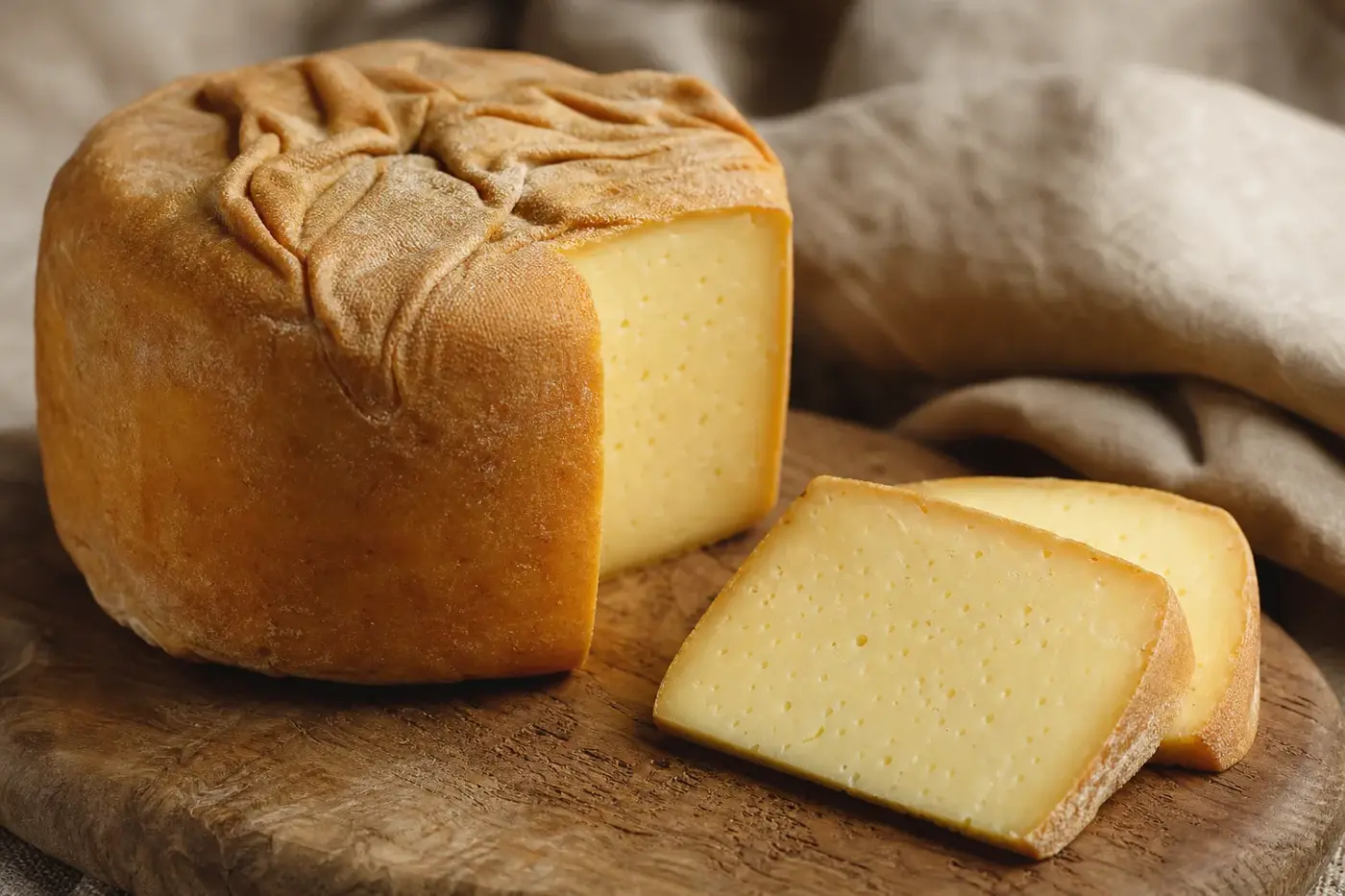
Under your knife, the yellowish, dense paste may crumble; in your mouth, it can feel yielding and buttery. There are no eyes, the round openings you find in some cheeses, though small cracks within the paste are permitted. [1,9,14]
Look closely at the surface, too. It is smooth and extremely thin, dark creamy yellow with whitish tones. That barely distinct rind, alongside firmness and friability, belongs to Casín’s documented identity. [1,9,14]
Take a few questions to the cheese counter
Look for the registered name, numbered PDO counter-label, maker’s details and storage instructions. The decorative stamp may include the maker’s name, but the numbered designation label belongs to the certification system. Buying a cut piece? Ask to see the original label, then ask about maturation and kneading rather than choosing by looks alone. [1,2]
You’ll find variation within the defined style: smaller and larger discs, drier or slightly unctuous surfaces, and different intensities of that same pungent flavour. The current specification allows pieces from 150 g, worth knowing because older descriptions give a higher lower limit. Use the current specification to judge size, and let the seller introduce you to the particular cheese. [1,9,14]
Keep it chilled, serve what you need
If you follow UK guidance, the Food Standards Agency advises a fridge temperature of 5 °C (41 °F) or below. Follow the maker’s storage and date instructions, too. [10]
Cut a portion to serve and leave the rest chilled. For how long chilled food can stay out during preparation and serving, consult current Food Standards Agency guidance. [10]
For the wider routine, see how to store cheese at home.
Taste the cheese, then bring out the apple
My suggestion: try a small piece on its own before adding plain bread and a slice of apple. Bread gives you a neutral interval between bites; apple brings contrasting crispness. Consider it a pause in the conversation, not a change of subject. These are editorial pairing suggestions based on Casín’s documented dense paste and persistent flavour. [9]
If you’re an adult of legal drinking age and choose alcohol, Asturian cider offers a locally grounded accompaniment. The producer association documents Casín and cider tastings, so try a small serving beside the cheese, with water available too. [12]
People who are pregnant, driving, taking medicines that interact with alcohol or recovering from alcohol dependence should not drink. Consult current NHS advice for the UK. [15]
For an alcohol free plate, keep the apple and bread. Serve still or sparkling water alongside.
Meet the neighbours, notice the differences
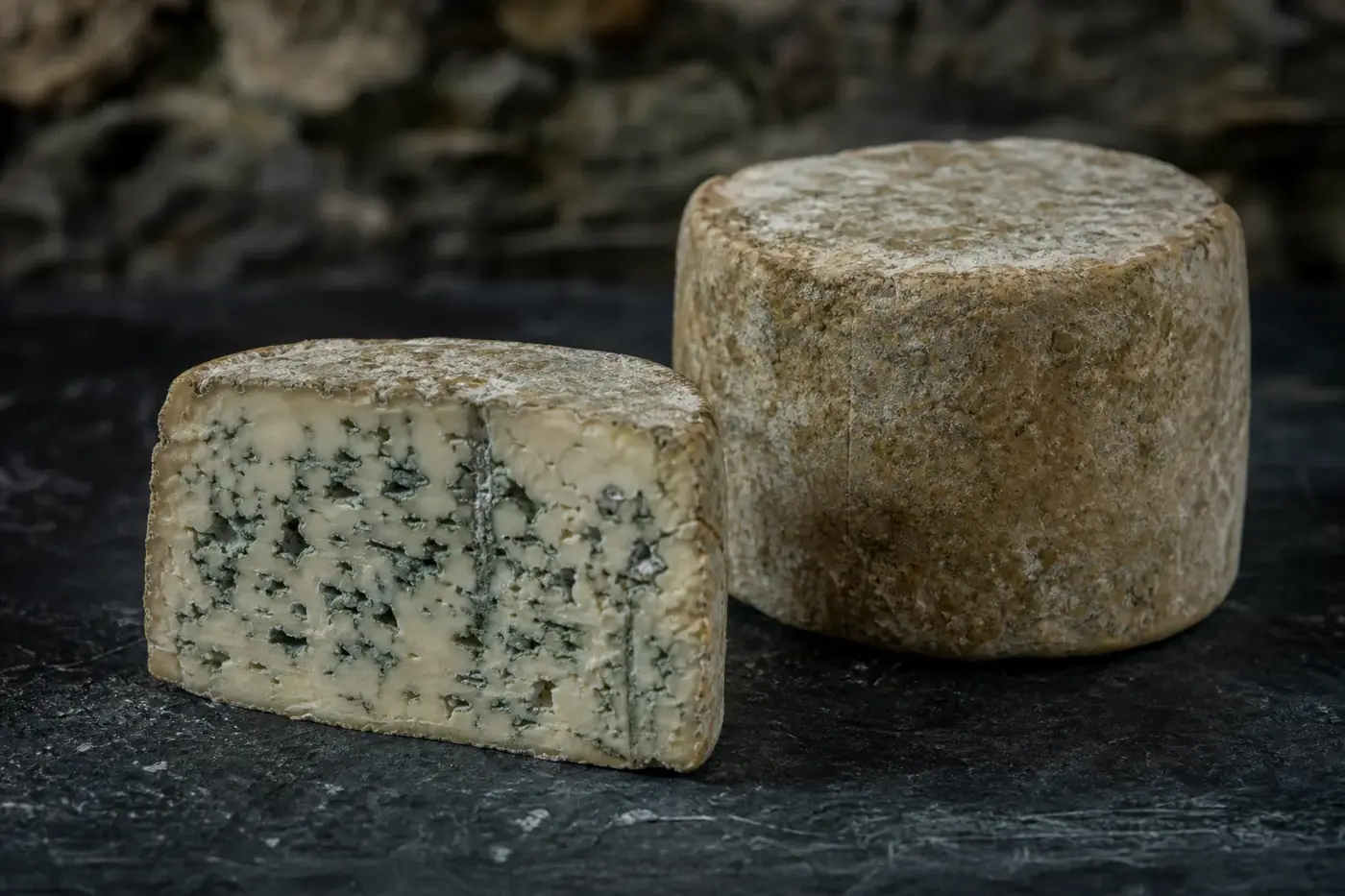
Casín’s strength might make you think of Cabrales, but their defining methods take different paths. Asturias’s tourism authority describes Cabrales as a blue cheese matured in natural caves. Casín has yellowish paste without eyes, repeatedly worked before final maturation. Strength alone tells you little about how either cheese got there. [7,9]
Afuega'l Pitu is another distinct Asturian name, though this comparison offers no technical distinctions between it and Casín. To understand what the designation on your label means, turn to protected names explained. [7]
General information only, not medical advice: follow the official guidance where you live.
Questions people ask
Where does Queso Casín come from?
It comes from the mountains of Asturias in northern Spain. Its defined area covers Caso, Sobrescobio and Piloña, and its name comes from Caso.
How is Queso Casín made?
The drained curd is repeatedly kneaded through a machine with two rollers turning in opposite directions. The cheese is then shaped into a flattened disc and stamped with a decorative design.
What does Queso Casín taste like, and how long is it matured?
The specification describes a powerful aroma, pungency and a long, slightly bitter finish, with a rustic note compared to well aged butter. It is matured for at least 60 days from the day the curd is made.
What milk and coagulant are used in Queso Casín?
It is made from whole, raw cow’s milk. The specification requires an animal origin coagulant.
How should Queso Casín be stored?
The UK Food Standards Agency advises keeping the fridge at 5 °C or below. Follow the maker’s storage and date instructions, and check the current Food Standards Agency guidance on how long chilled food may be kept out during preparation and serving.
Sources
-
Ministerio de Agricultura, Pesca y Alimentación (MAPA). Pliego de condiciones de la Denominación de Origen Protegida “Queso Casín”, version identified by MAPA as 18 January 2023. Sections B to F establish the product description, area, traceability, method and geographical link. Official specification.
-
Consejo Regulador DOP Queso Casín. Elaboración, undated, retrieved November 2026. Producer-body explanation of draining, rollers, gorollos, working and identification. Published account.
-
Consejo Regulador DOP Queso Casín. Descripción, undated, retrieved November 2026. Producer-body account of cattle, kneading and traditional stamps. Published description.
-
MAPA. Indicaciones geográficas y acuerdos internacionales, table dated 7 March 2025, page 7. Records Queso Casín and file PDO-ES-0718. Official table.
-
MAPA. Pliegos de condiciones en vigor, updated 25 November 2025, cheese table, page 3. Identifies the specification version dated 18 January 2023. Official list.
-
Consejo Regulador DOP Queso Casín. Documentos, undated, retrieved November 2026. Identifies Commission Implementing Regulation (EU) No 986/2011 of 30 September 2011. Document listing.
-
Turismo Asturias. 5 quesos que tienes que probar en Asturias, undated page, retrieved November 2026. Regional tourism account of Redes, Casín and neighbouring cheese traditions. Published article.
-
Boletín Oficial del Estado. Resolución de 16 de febrero de 2009, BOE-A-2009-4841, published 23 March 2009, with the historical specification annex. Used for the recorded geographical explanation and continuity of the method, not current format limits. Official text.
-
Consejo Regulador DOP Queso Casín. DOP, undated, retrieved November 2026. Current producer-body presentation of format, surface, paste and sensory characteristics. Published description.
-
Food Standards Agency. How to chill, freeze and defrost food safely, current household guidance retrieved November 2026. Sections on refrigeration, packaging instructions and time outside refrigeration. Official guidance.
-
Food Standards Agency. Chilling food correctly in your business, current PDF retrieved November 2026. Section on serving and displaying cold food outside refrigeration. Official guidance.
-
Consejo Regulador DOP Queso Casín. Redes, undated, retrieved November 2026. Documents the producer's Casín and cider tastings. Producer-body account.
-
Agencia Española de Seguridad Alimentaria y Nutrición (AESAN). Buscador de alertas alimentarias, live index retrieved November 2026. Used for the preliminary recall review recorded below. Official alert index.
-
Principado de Asturias. Pliego de condiciones de la Denominación de Origen Protegida “Queso Casín”, historical version, undated document retrieved November 2026. Used to distinguish earlier format limits from the current specification. Historical specification.
This desk-researched article brings together the Spanish official specification, government records, attributed producer-body descriptions and named UK handling guidance.
Last checked: November 2026
Last checked November 2026.
The editors suggest you read next