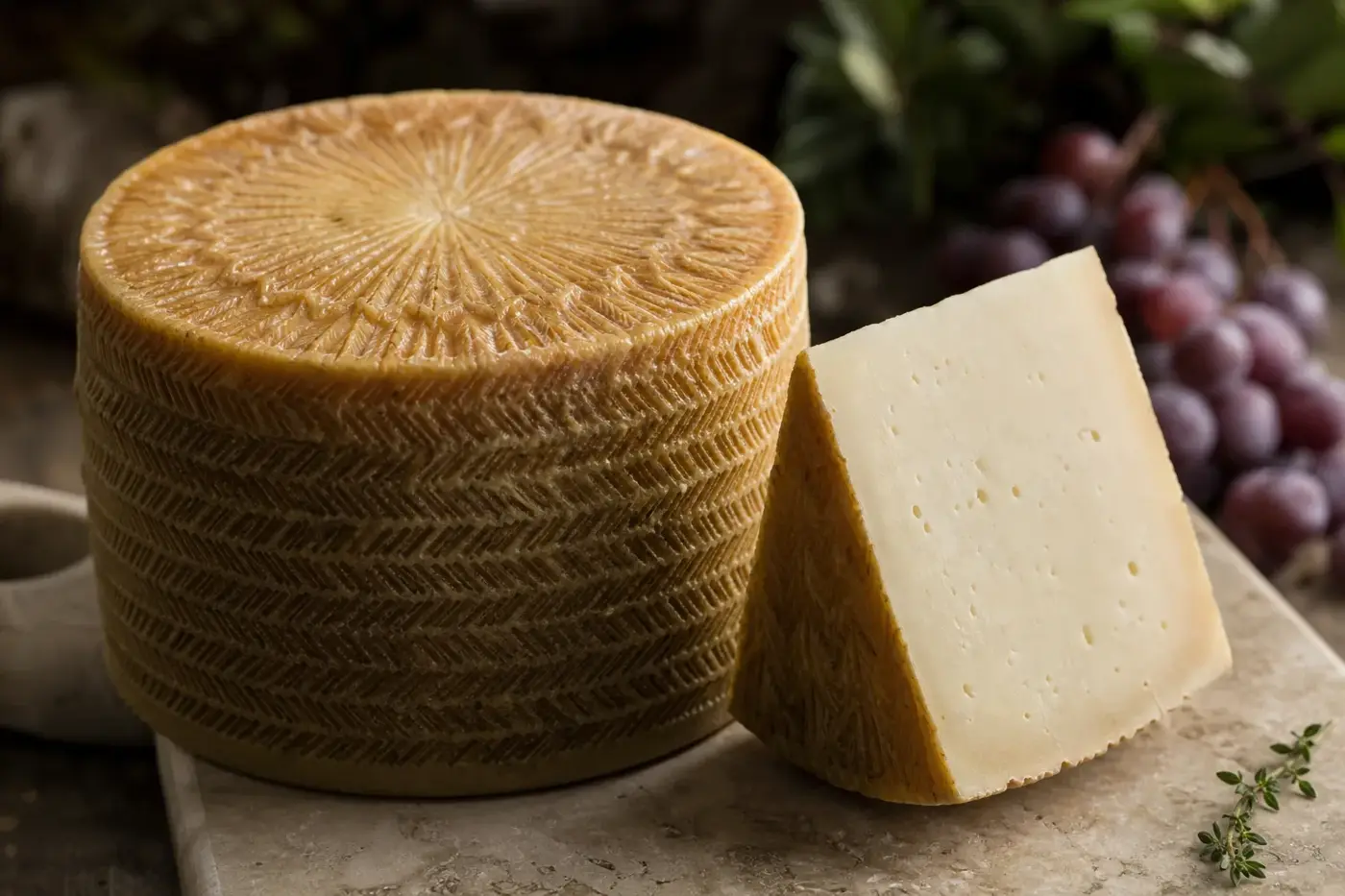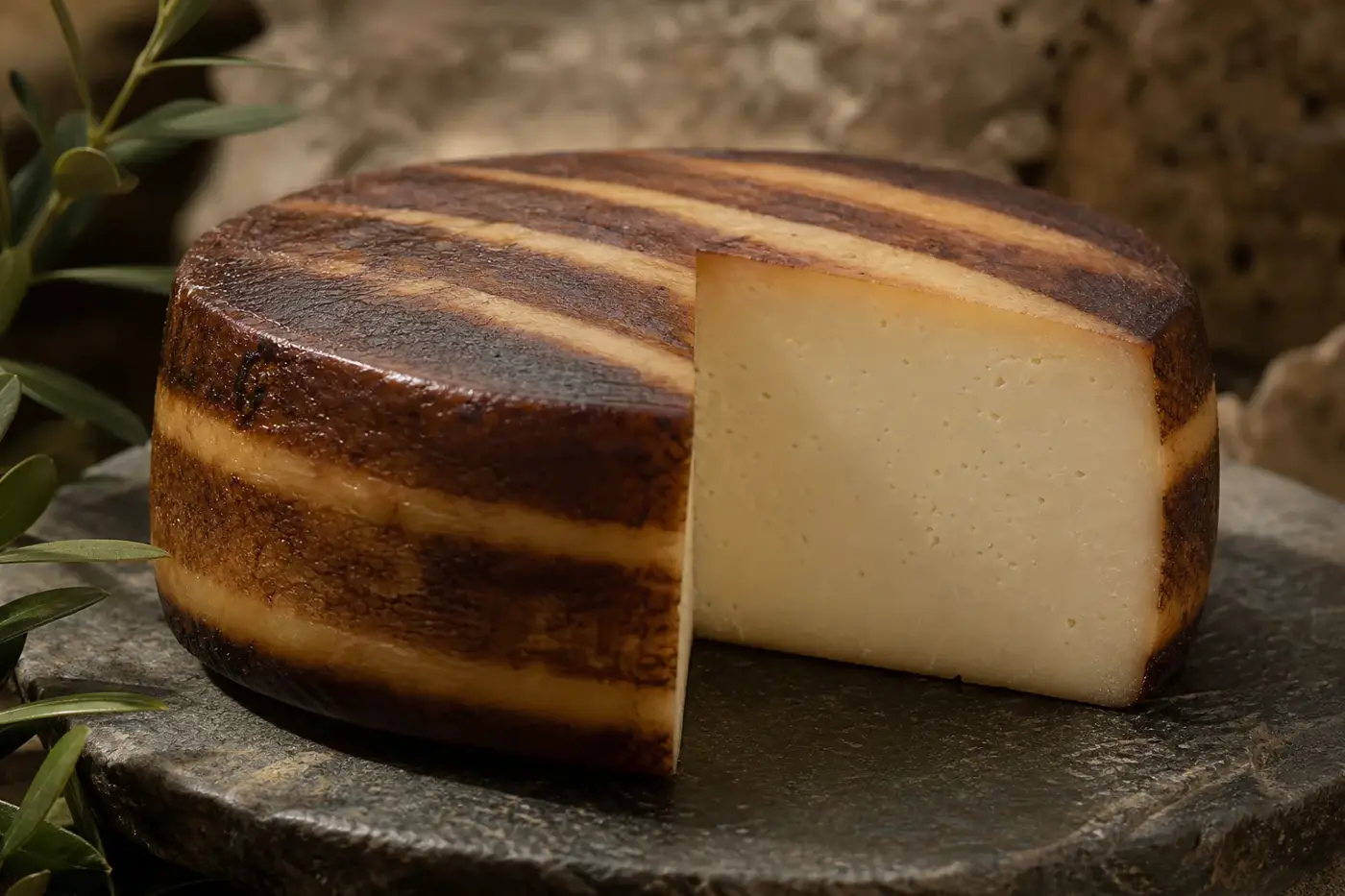
Dark and pale stripes circle the wheel. Smoke has slipped around the supports beneath a Queso Palmero, leaving a pattern on its rind.[7] Cut through it and you find an uncooked, pressed cheese made on La Palma from raw Palmera goat’s milk.[5][6] The outside has already begun telling you how it was made.
Not every wheel meets smoke, though. Time leaves its own signature: in a study of 48 cheeses, aroma, flavour and pungency grew stronger with age.[1][6] Before you settle on a wedge, get to know the island, the goats and the choices behind it.
| What to know | The details |
|---|---|
| Name you will recognise | Queso Palmero.[1] |
| Registered names | Queso Palmero / Queso de la Palma.[2][3] |
| EU authority and identifier | European Commission; PDO-ES-0172; eAmbrosia record EUGI00000013488.[2][4] |
| EU protection | PDO registration regulation published 11 July 2002; in force from 31 July 2002. Register reference: November 2026.[2][4] |
| Great Britain protection | Registered PDO; UK scheme registration dated 31 December 2020 at 23:00. Register reference: November 2026.[3] |
| Its island home | All municipalities of La Palma, Canary Islands, Spain; milk production, cheesemaking and maturation stay on the island.[1] |
| Milk | Raw Palmera goat’s milk.[5][6] |
| What sets the curd | Natural rennet from suckling kids in the cited specification.[1] |
| Maturity | Fresh, tierno, semicurado and curado; the cited PDO specification gives no numerical category minima.[1] |
| Smoke, if you like | Optional; materials include almond shells, prickly pear and Canary pine.[1][7] |
| Shape and size | Cylindrical; 6 to 15 cm high and 12 to 60 cm across, with diameter two to four times the height.[1] |
| UK pregnancy guidance | See the NHS guidance below, November 2026.[10] |
Meet La Palma’s sure-footed goats
On La Palma’s steep ground, goats, forage and cheesemaking belong to the same story. The PDO specification connects the cheese with the island’s varied microclimates and vegetation.[1] It also keeps the whole undertaking close to home: milk production, cheesemaking and maturation all happen on La Palma.[1]
The Palmera is a distinct breed, not a general name for goats living in the Canaries. The denomination’s producer body describes an animal suited to La Palma’s climate and rugged terrain, with short, well-set legs.[8] Coats vary considerably, although reddish ones are common.[8]
That breed’s milk is fundamental to the protected cheese. The producer body highlights its casein, a milk protein important in cheesemaking.[8] Before you get absorbed in smoke or maturity, remember the foundations: Palmera goats, local feeding resources and the work of individual farms.[1][8]
Now look out to sea. The denomination’s published history reports documentary evidence of sixteenth-century cheese exports to Atlantic destinations, including the Caribbean and Cape Verde.[9] Long before you might have asked for it by name, this cheese had a place in La Palma’s farming and trading economy.
Two names, one island to remember
You may find Queso Palmero or Queso de la Palma on the label. Both names belong to the same protected designation of origin, or PDO.[2] The registering instrument, Commission Regulation (EC) No 1241/2002, was adopted on 10 July 2002 and published on 11 July; Article 2 separately provides for entry into force on the twentieth day after publication.[2]
Spain’s agriculture ministry identifies the designation as PDO-ES-0172. Great Britain lists the same names in its own register, with UK scheme registration dated 31 December 2020.[3][4] These are separate jurisdictions, a distinction worth keeping in mind when you read an overseas label.
The geographical boundary is refreshingly simple. All of La Palma is included, but the designation does not extend across the Canary Islands.[1] Milk production, cheesemaking and maturation must remain within the defined island area.[1]
If you want to untangle a regional name from the rules behind it, start with protected names explained.
This page summarises published guidance from the official sources it cites. It is not medical advice. Guidance differs between countries and changes over time, so check the current source for where you live, and ask your doctor, midwife, pharmacist or dietitian about your own circumstances.
Follow the milk from farm to mould
Traditionally, work starts soon after milking. The milk is filtered, then rennet gathers its proteins into curd and separates them from the liquid whey.[1] The specification describes natural kid rennet and successive cuts that reduce the curd to small grains, helping the whey escape.[1]
Those grains go into circular moulds. Pressing and drainage give the wheel its shape, followed by salting, commonly with dry sea salt.[5] During maturation, the cheeses are turned, and their surfaces may receive olive oil, gofio or flour as protective treatments.[5]
You taste the consequences of those decisions. Cutting and draining establish the body, moulding sets the proportions, and salt and maturation develop the character.[5][6] This is an uncooked, pressed cheese, distinct from stretched-curd cheeses and soft cheeses ripened beneath a white mould coat.[5][6]
For a closer look at these processes, rather than instructions for making your own, follow how cheese is made.
Let the smoke introduce itself
Smoking is traditional, but an unsmoked wheel is every bit as much Queso Palmero as a smoked one. The official specification names almond shells, prickly pear and Canary pine among the principal plant materials used to produce the smoke.[1] The protected name alone cannot tell you which version you are buying.
Look again at those stripes. The Canary Islands government’s cheese guide describes characteristic parallel bands, formed because the supports beneath the cheese affect where smoke reaches it.[7] Some wheels have alternating darker and lighter areas.[7]
The specification calls for a roasted aromatic contribution of low intensity. You should still find the goat’s milk character, slight acidity and moderate saltiness, rather than smoke claiming the entire conversation.[1] Ask whether the particular cheese is smoked before choosing your wedge.
Read the rind, then peek inside
Queso Palmero is a broad cylinder with flat faces. Its specified proportions accommodate smaller wheels as well as substantial cheeses, so a cut wedge may tell you little about the original scale.[1] There is no single uniform size.
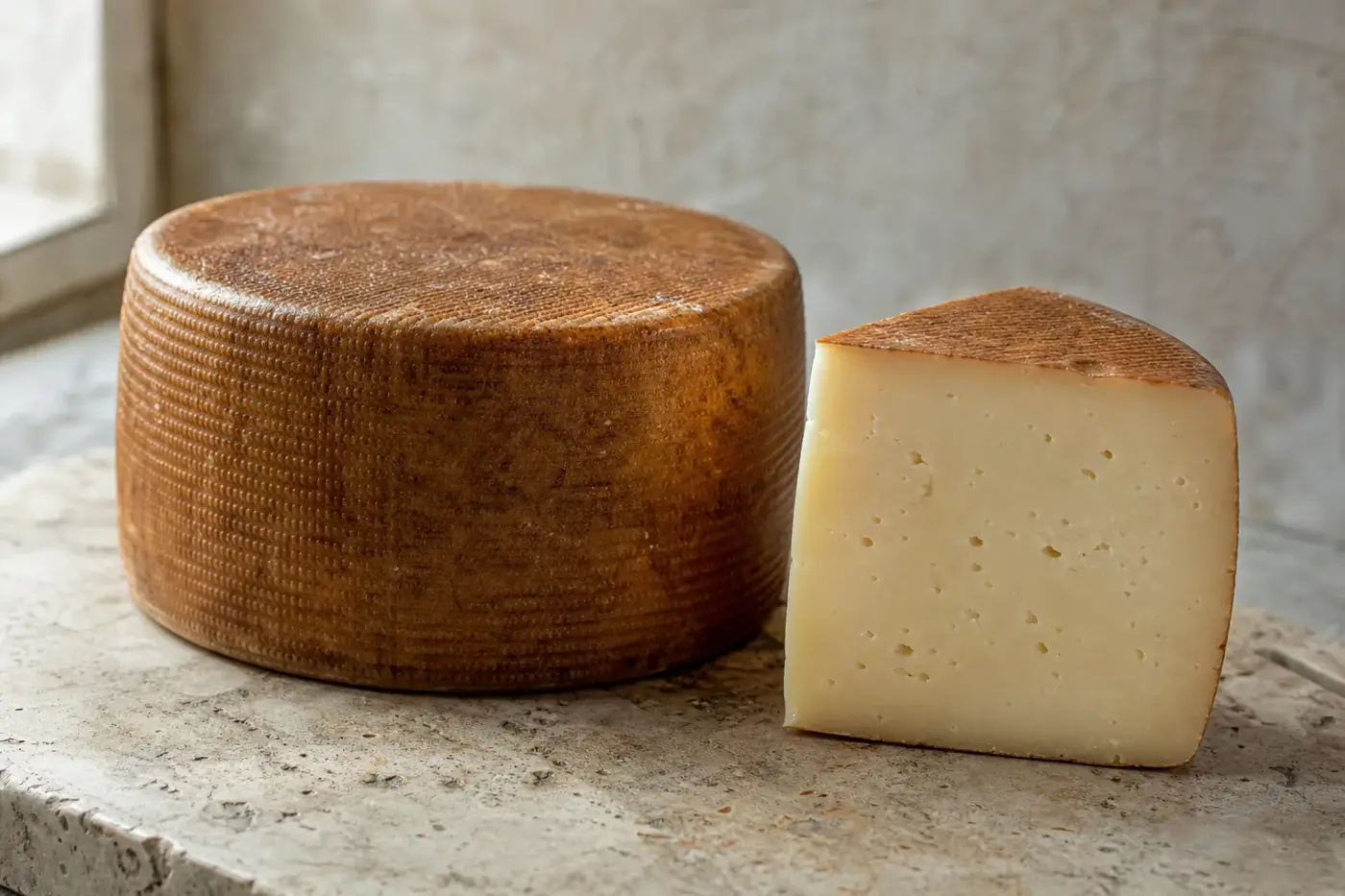
Look closely and you may find small round marks left by drainage holes in the mould. A fine square pattern on a face comes from the mesh on which the cheese drained.[5] These are traces of the work, not the denomination’s identifying label.
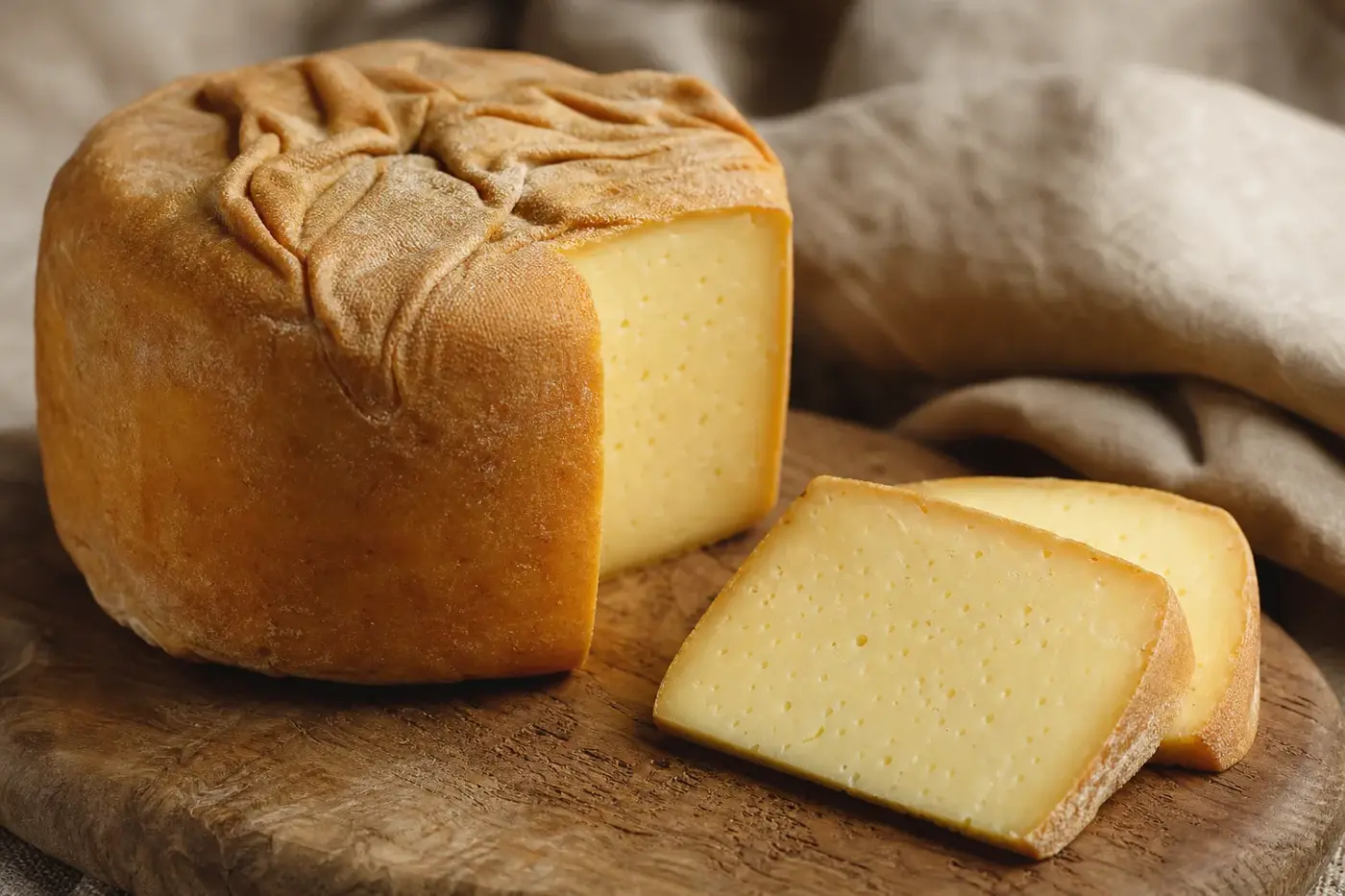
Colour offers another clue. ICEX’s official Foods and Wines from Spain profile describes unsmoked rinds as white, becoming yellowish with maturation.[5] Smoked examples can be brownish with darker stripes, while surface treatments can alter their appearance again.[5]
Inside, the paste moves from bright white towards a more matt, ivory appearance.[5] Take in the rind, then the cut face. Each gives you another part of the picture.
Taste the difference a little time makes
Age makes itself known here. ICEX describes aromas of goat’s milk and natural rennet, with possible associations of grass, hay, mushroom or nuts.[5] Use those as tasting prompts, not an exam paper. Nobody needs to find a mushroom on demand.
A study published in Animals explored that change in detail. Researchers examined 48 cheeses from four dairies at 15, 30, 60 and 90 days.[6] They combined composition measurements, instrumental texture and colour analysis, and assessments by seven trained sensory judges.[6]
As the cheeses matured, moisture fell while instrumental hardness and fracturability increased. The sensory panel found stronger aroma and flavour, greater perceived saltiness and increasing pungency.[6] Younger samples were moister and generally more elastic; older cheeses were drier, with a more developed character.[6]
The dairy made a difference too. Ask about the maker and particular batch as well as age, especially if you are choosing between a yielding table cheese and a firmer, more assertive wedge.[6] A description of the cheese being cut for you is more useful than a sweeping promise.
Tierno, semicurado and curado give you a starting point for that conversation. For a precise comparison, ask how long the cheese has matured as well as reading the category on its label.
Palmero or Majorero? Find your island first
Queso Palmero belongs to La Palma; Queso Majorero belongs to Fuerteventura. These are separately registered names with their own island traditions, not interchangeable labels for Canary Islands goat’s cheese.[4][7] Their differences begin well before either reaches your plate.
Palmero uses milk from Palmera goats on La Palma. Majorero is associated with Majorera goats and Fuerteventura.[1][7] With Palmero, smoking, age, maker and surface treatment all matter, so read the product’s label and its own specification to understand the cheese in front of you.[1][6][7]
Fancy tasting them side by side? Choose examples of comparable age and note any surface treatments, or a contrast between youth and maturity can look like a fixed difference between islands.[6] The documented variation within Palmero itself is good reason to keep your comparisons specific.[6]
Set the table with potatoes, mojo and a glass
Give your first small piece the plate to itself. Then try plain bread as a useful starting point, or potatoes to make a satisfying plate. Keep the mojo separate so you can decide how much sauce joins each bite.
With a younger cheese, keep things simple: bread, potatoes and a little green mojo. Be just as sparing with the sauce beside a mature or smoked example. Let the milk character, texture and finish come through before adding stronger seasoning.
For wine, try a dry Canary Islands white with a younger wedge. A restrained red is a starting point for a firmer, more pungent example, not a rule you must obey. Still or sparkling water offers an alcohol-free alternative that leaves the cheese easy to assess.
Wine pairings are for adults of legal drinking age, in small servings. People who are pregnant, driving, taking medicines that interact with alcohol or recovering from alcohol dependence should not drink. The NHS advises avoiding alcohol during pregnancy.[10] For a broader approach, see cheese and wine pairing.
Find your wedge and bring it home well
Look for either registered name and the denomination’s numbered counterlabel. The producer body identifies that counterlabel as the distinguishing certification feature.[1][11] If you are buying a cut piece, ask to see the original wheel’s identification or the information retained by the cheesemonger.
Three questions will take you a long way: who made it, how long has it matured, and is it smoked? Check the milk information too, because the protected cheese is made from raw goat’s milk.[5][6] For the distinctions between treatments, see raw milk, thermised and pasteurised cheese.
At home, follow the product’s storage instructions and date marking. Food Standards Agency guidance for England, Wales and Northern Ireland recommends a fridge between 0 and 5 °C and keeping dairy products refrigerated.[12] When preparing a serving, keep chilled food out for the shortest practicable time.[12]
Keep the label with the remaining cheese so its identity, instructions and dates stay together. It is a small habit that makes the next serving simpler. For wrapping and caring for a cut piece, see how to store cheese at home.
Pregnant in the UK? Start with the actual cheese
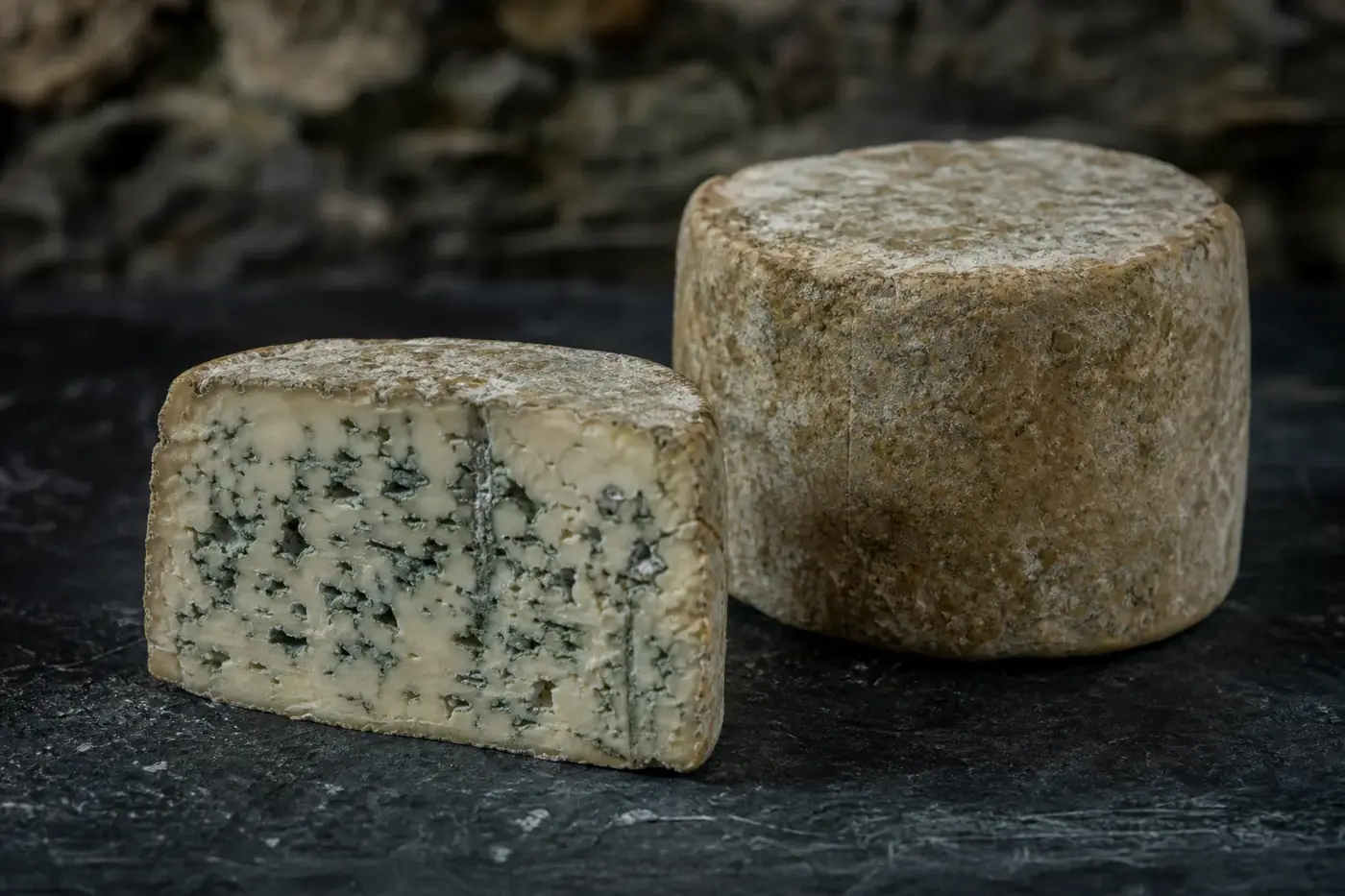
The NHS guidance for November 2026 permits hard cheeses made with pasteurised or unpasteurised milk, and semi hard cheeses made with pasteurised milk, during pregnancy.[10] It advises against specified mould ripened soft cheeses and soft blue cheeses unless cooked until steaming hot all the way through.[10]
Queso Palmero comes at different maturities, so use the actual product’s milk treatment and texture when consulting that guidance. If you need help applying it to your circumstances, ask your midwife or another appropriate healthcare professional.
Questions people ask
Where is Queso Palmero made?
It is made on La Palma in the Canary Islands, Spain, from the raw milk of Palmera goats. Milk production, cheesemaking and maturation all take place on the island.
Is Queso Palmero always smoked?
No, smoking is optional. Materials used to produce the smoke include almond shells, prickly pear and Canary pine.
What does Queso Palmero taste like?
Its aromas can suggest goat’s milk and natural rennet, with possible notes of grass, hay, mushroom or nuts. Older cheeses tend to have stronger flavour and pungency, while younger ones are moister and generally more elastic.
What is the difference between Queso Palmero and Queso Majorero?
Queso Palmero comes from La Palma and uses milk from Palmera goats. Queso Majorero is associated with Fuerteventura and Majorera goats; the two are separately registered names.
Can I eat Queso Palmero during pregnancy?
The NHS permits hard cheeses made with pasteurised or unpasteurised milk and semi hard cheeses made with pasteurised milk during pregnancy. Queso Palmero is sold at different maturities, so check the current NHS pregnancy guidance using the actual product’s milk treatment and texture. Ask your midwife or another appropriate healthcare professional if you need help applying it to your circumstances.
Sources
- Spanish Ministry of Agriculture, Fisheries and Food, Pliego de condiciones de la denominación de origen “Queso Palmero”, specification listed by the ministry as in force from 11 July 2002. Sections A to F cover names, characteristics, geographical area, identification and production. Specification.
- European Commission, Commission Regulation (EC) No 1241/2002, 10 July 2002, Official Journal L 181, 11 July 2002, Articles 1 and 2 and Annex. Official text.
- Department for Environment, Food & Rural Affairs, Queso Palmero / Queso de la Palma, GB protected food names register, published 4 January 2021, accessed November 2026. Register entry.
- Spanish Ministry of Agriculture, Fisheries and Food, Indicaciones geográficas protegidas a través de acuerdos internacionales, dated 7 March 2025, cheese entries, including PDO-ES-0172; and ministry designation page linking the EU record. Ministry designation page. EU register entry.
- ICEX, Foods and Wines from Spain, Queso Palmero PDO, undated product profile, accessed November 2026. Product profile.
- Animals, Effect of the Ripening Period and Intravarietal Comparison on Chemical, Textural and Sensorial Characteristics of Palmero (PDO) Goat Cheese, volume 11, article 58, published online 31 December 2020, January 2021 issue. Open-access study.
- Government of the Canary Islands, Instituto Canario de Calidad Agroalimentaria, cheese guide, published approximately 2009, sections on Queso Palmero and Queso Majorero. Historical guide used for descriptive context, not current producer counts. Guide.
- Consejo Regulador de la DOP Queso Palmero, La Cabra Palmera, undated, accessed November 2026. Producer-body account. Breed profile.
- Consejo Regulador de la DOP Queso Palmero, Breve Historia, undated, accessed November 2026. Producer-body historical account. History.
- NHS, Foods to avoid in pregnancy, current retrieved guidance, checked November 2026. Official guidance.
- Consejo Regulador de la DOP Queso Palmero, Guía del consumidor, undated, accessed November 2026. Consumer guide.
- Food Standards Agency, How to chill, freeze and defrost food safely, published 18 December 2017, current retrieved guidance, checked November 2026. Applies to England, Northern Ireland and Wales. Official guidance.
This piece combines desk research from the official specification, registration records, published research and attributed institutional accounts; serving suggestions are editorial preferences.
Last checked: November 2026
Last checked November 2026.
The editors suggest you read next