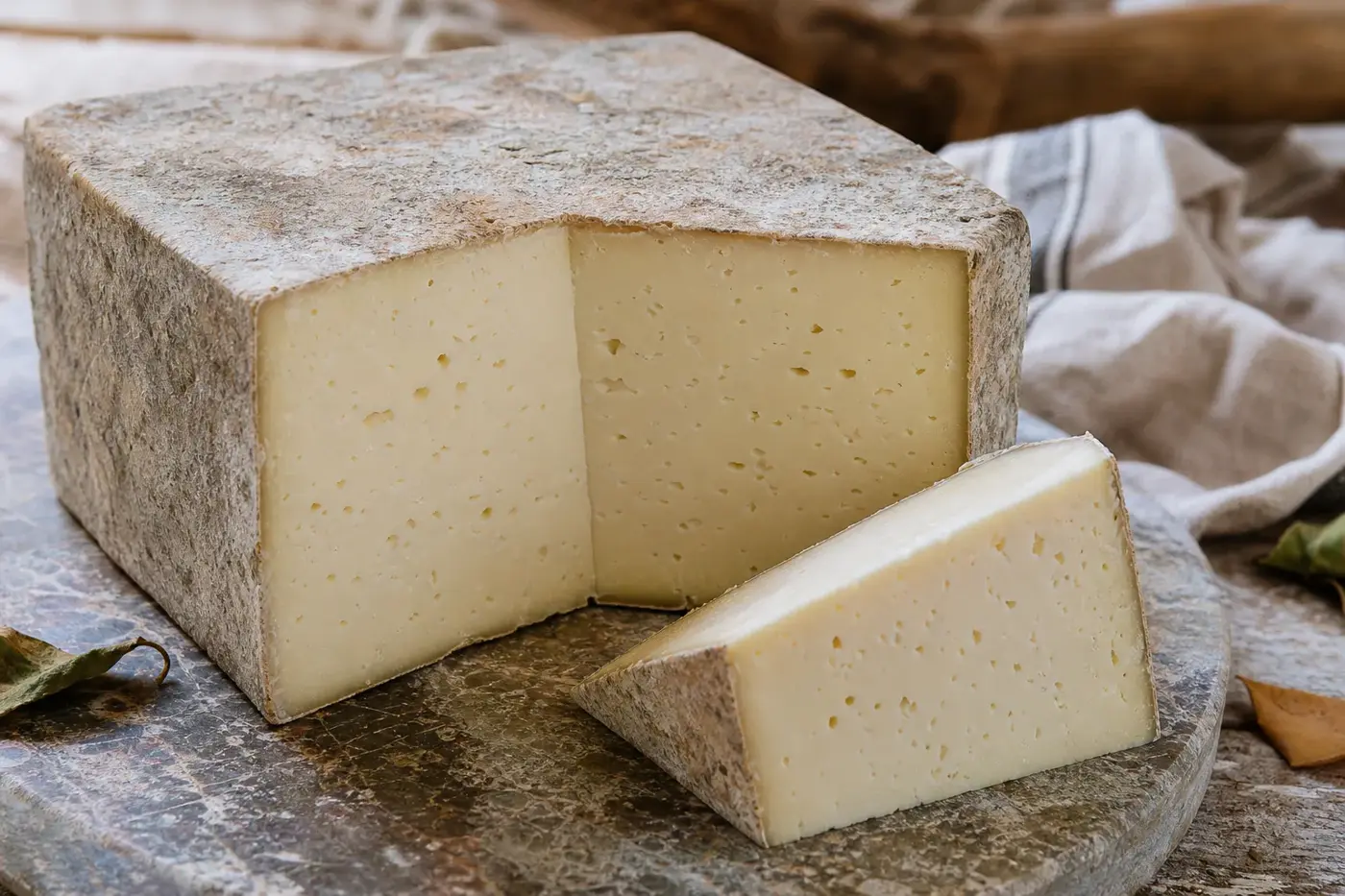
Picture a substantial square of cheese travelling on muleback. According to the producers’ consortium, Raschera’s square shape made that mountain journey easier.[7] Cut into it today and you find pale, supple paste dotted with tiny, irregular holes. Practical packing has rarely looked so appetising.
You can find Raschera as a broad round wheel, too. Both shapes belong to Cuneo’s pastoral tradition, although this protected Piedmontese cheese’s EU production area now also includes neighbouring Villafranca Piemonte, in the province of Turin.[1][2][3]
| What you might want to know | Raschera at a glance |
|---|---|
| Familiar and registered name | Raschera.[1][3] |
| EU designation | Registered PDO; European Commission identifier PDO-IT-0023. The 2022 amendment was approved by Implementing Regulation (EU) 2022/487.[1][2] |
| Great Britain designation | Registered PDO, entered in the GB scheme on 31 December 2020 at 23:00; status as of November 2026.[3] |
| EU production area | Province of Cuneo and municipality of Villafranca Piemonte, covering milk production, cheesemaking and maturation.[1] |
| Milk | Cow’s milk, optionally with small additions of sheep’s or goat’s milk; raw or hygienically treated milk permitted.[1][4] |
| What sets the milk | Animal rennet containing at least 80% chymosin, or a non-animal coagulant.[1] |
| Minimum maturation | 30 days.[5] |
| Longer maturation | ONAF records examples aged five or six months.[6] |
| Fat | Minimum 32% fat in dry matter.[1][4] |
| Rind | Thin, elastic, grey or reddish, sometimes yellowish; specified as inedible.[1][4] |
Follow the name to its mountain pasture
Alpe Raschera, near Monte Mongioie, gives this cheese its name, according to the producers’ consortium. You can trace that connection to a particular mountain pasture, rather than Piedmont’s mountains in general. The consortium’s account of squares travelling conveniently on muleback belongs to the same recorded local tradition.[7]
When cheesemakers first adopted that shape remains an open question. So does the earliest documented use of the name.
The story takes you downhill, too. The designation’s published account describes seasonal movement between mountain grazing and the adjoining plain. Follow that movement and you begin to see how a pasture cheese became established across a wider dairy-producing area.[4]
Mountain and lowland cheesemaking both belong here. Within that broad Raschera family, though, sits a more tightly defined alpine-pasture category, with requirements of its own.[1]
Get acquainted with the wheel and the square
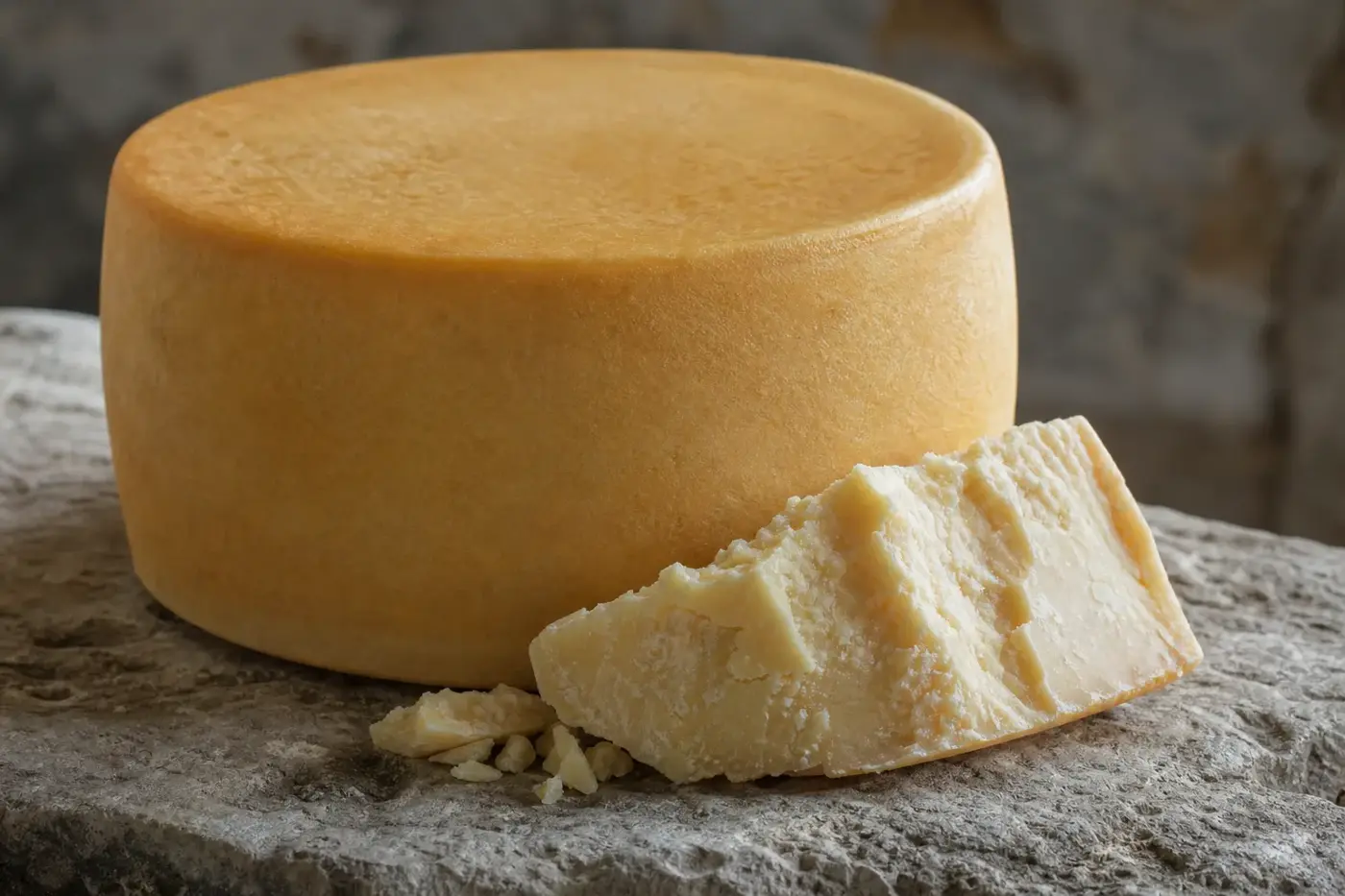
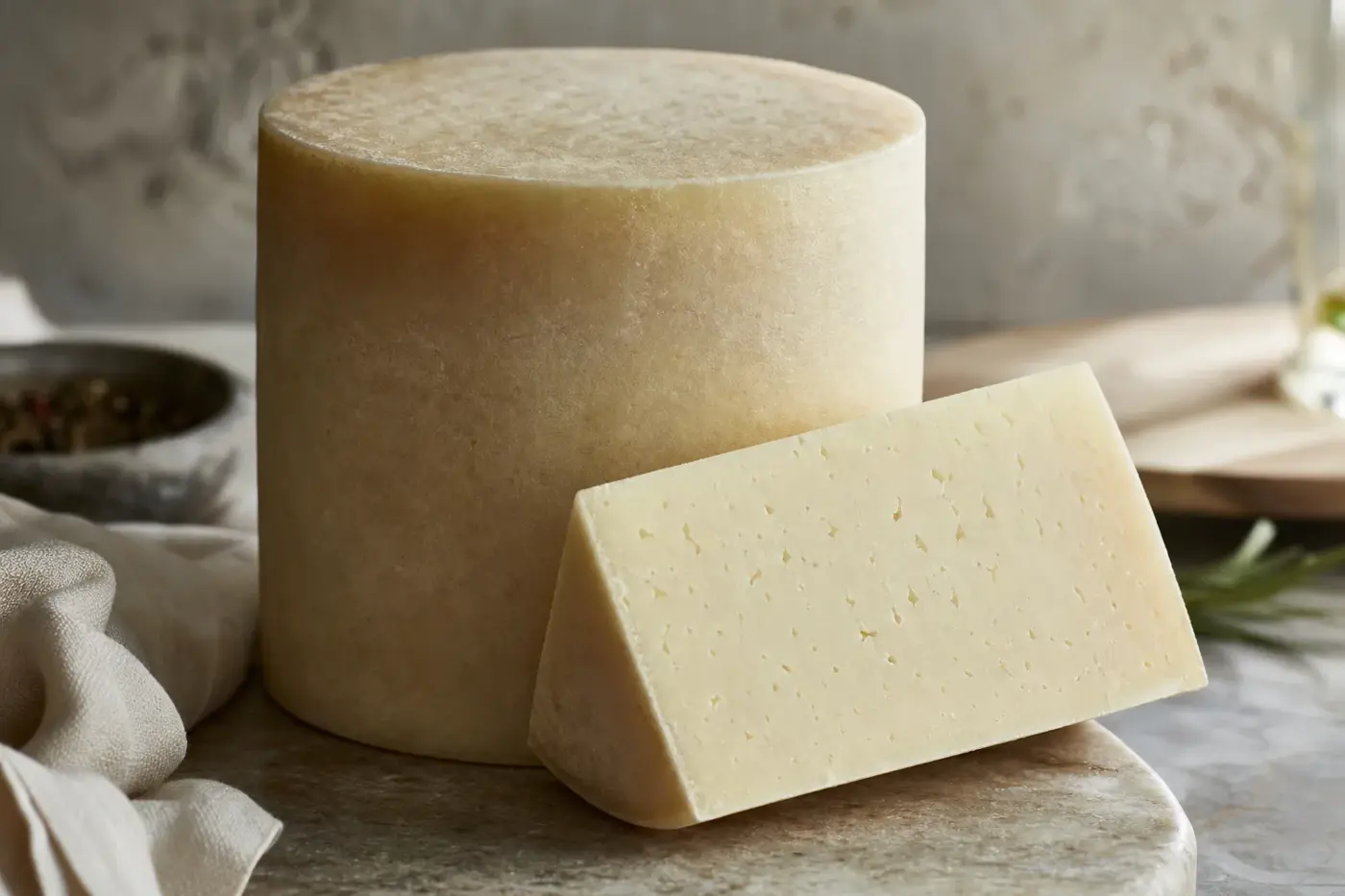
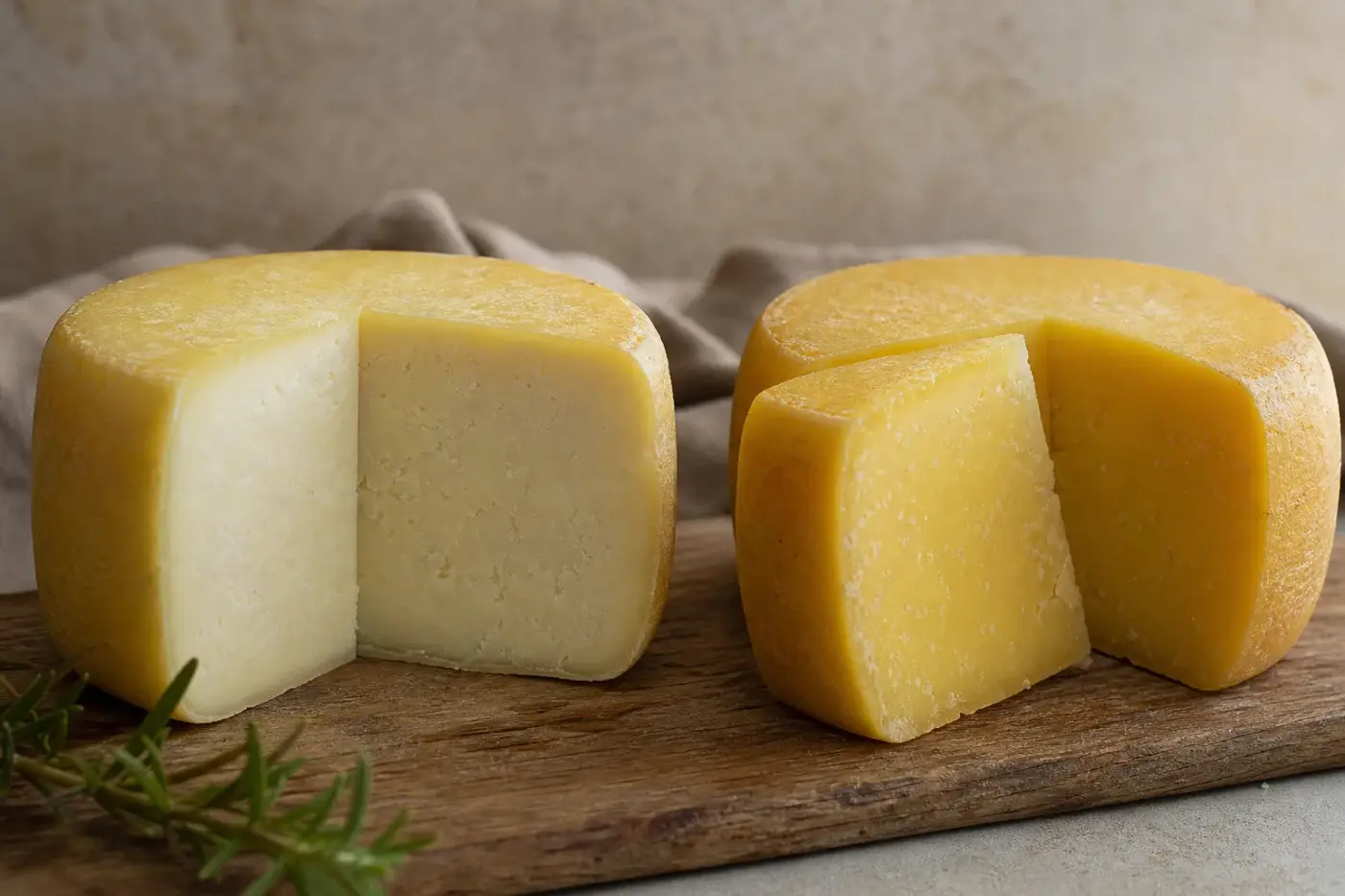
Neither authorised shape is modest about its dimensions. A round Raschera has flat faces, measures 30 to 40 cm across and has a slightly convex side 6 to 9 cm high. At minimum maturation, it weighs 5 to 9 kg.[4]
The square has faces approximately 28 to 40 cm across. Its irregular side stands approximately 7 to 15 cm high, and it weighs 6 to 10 kg.[4] This is not a cheese that slips unnoticed into your shopping bag.
Inside either shape, look for white or ivory paste, fairly firm but elastic, with very small, irregular holes. As maturation advances, stronger reddish patches can develop on the rind.[4]
At the counter, ask to see a cut face as well as the outside. The substantial rind encloses a comparatively yielding interior, a contrast worth pausing over. Then ask about age and the maker’s handling. Shape gets you acquainted; it does not tell you everything.
Find out what went into your piece
Cow’s milk is the foundation. The rules allow small additions of sheep’s milk, goat’s milk or both, but the published product description gives no numerical proportion. Partial skimming is permitted too, including by letting cream rise naturally.[1]
The Italian specification permits both raw milk and milk that has undergone hygienic treatment. “Raschera” alone therefore cannot tell you which treatment your cheese received. Read the producer’s declaration or ask your cheesemonger; raw, thermised and pasteurised cheese explains the distinctions.[1][6]
Give the coagulant the same attention. Rennet sets milk into curd, and the approved 2022 amendment permits non-animal coagulants.[1][2] If you want vegetarian cheese, get confirmation for that particular product. Permission to change does not mean every producer has changed.
From warm milk to a finished cheese
Before Raschera takes its broad round or square form, the milk must coagulate and the curd must be cut and moulded. Pressing follows, then salting and maturation. Regione Piemonte describes coagulation at 27 to 38 °C (81 to 100 °F), followed by breaking the curd and pressing it in round or square moulds.[5]
Curd is the solid part of set milk; whey is the liquid it releases. Cutting and pressing separate the two and bring the curd together into its final shape. You can follow the wider process in how cheese is made.
Regione Piemonte also records an alpine technique you can almost feel in your hands. Cloth supports an initial manual pressing, then the curd is worked and formed again. Into moulds it goes, beneath a wooden board weighted with stones. This is a traditional technique, not a description of every dairy’s equipment.[5]
Salting may be dry, in brine, or a combination of both. Raschera then matures on wooden boards or another suitable material for at least 30 days before it may enter the market under its production rules.[5] That is only the starting point, so ask the actual age of the piece you are buying.
Look beyond the mountain picture for “D’Alpeggio”
A mountain picture is not enough. “D’Alpeggio” identifies a defined alpine-pasture production category within the EU specification. Location, altitude, grazing, season and feed all have a part to play.[1][2]
The listed municipalities are Frabosa Soprana, Frabosa Sottana, Montaldo Mondovì, Ormea, Pamparato, Roburent and Roccaforte Mondovì. Add Valcasotto in Garessio and the part of Magliano Alpi adjoining Ormea. Both the milk’s origin and the cheese’s maturation must fall within these territories above 900 metres.[1]
The milk must come from grazing animals during the mountain-pasture period, from 1 June to 15 October. Supplementary feed is limited to 10% of the dry matter consumed daily. Stationary mountain herds can qualify too, if they graze above 900 metres in the specified territories and meet the seasonal and feeding conditions.[1]
When you shop, distinguish Raschera from the wider designated area from cheese meeting these additional alpine-pasture requirements. Read the label’s actual wording, not just its scenery. For help with the terminology, see PDO, PGI and TSG explained.
Let age lead the tasting
Start young and the specification describes a character that is fine, delicate and aromatic. With maturation, Raschera becomes moderately piquant and savoury.[4] Your choice is between that early delicacy and a greater savoury emphasis with more age.
ONAF, the Italian cheese tasters’ association, identifies mountain-herb notes in the alpine-pasture version. It also records a tradition of maturation lasting five or six months.[6] There is another useful question to take to the counter.
If you can compare pieces, smell first. Notice how the paste yields, then follow the finish as it develops. Ask what distinguishes that particular wheel. Age, milk treatment and alpine-pasture designation tell you more than its outline ever could.
Choose well, then look after your piece
Start with four questions: who made it, how old is it, how was the milk treated, and which coagulant was used? If you are buying a cut portion, ask to see the original label. Keep those details so you can find something similar next time, or deliberately try a different expression of Raschera. Cheese notes are perfectly respectable reading material.
Regione Piemonte recommends wrapping it in its purchase paper or foil and putting it in a covered container.[5] Follow the product’s storage instructions, including any directions for after opening. For more on wrapping and cut surfaces, see storing cheese at home.
For refrigeration and time outside it, US FDA consumer guidance, November 2026 gives these limits: keep your refrigerator at 4 °C (40 °F) or below and follow label directions. Foods requiring refrigeration should spend no more than two hours at room temperature. Reduce that to one hour when the air temperature exceeds approximately 32 °C (90 °F).[8]
Bring out only what you intend to serve, leaving the rest refrigerated. Let the refrigerator chill lift shortly before eating, within that time limit, and remove the rind: Raschera’s specification identifies it as inedible.[4] Cut manageable pieces so you can notice the paste before adding accompaniments.
Start with a plain bite, then consider gnocchi
Give your first bite a simple setting. Plain bread, with water or unsweetened tea alongside, keeps your attention on the cheese. Pear slices make another straightforward accompaniment. Offer them separately so you can taste the cheese first, then discover how the fruit changes the impression.
There is a place for Raschera in the kitchen, too. ONAF records it melted into risotto and vegetable dishes.[6] Regione Piemonte offers a particularly local preparation: potato gnocchi from Val Corsaglia, served with a sauce of Raschera melted with cream and a little milk.[5]
That sauce gives you a useful starting point when choosing Raschera for melting. Try a small quantity before committing your whole piece, especially when comparing ages or producers. Let the documented preparation guide the texture you want. Then see how your particular cheese behaves.
Give Raschera and Bra room to be themselves
Nearby Bra makes an instructive comparison. The consortium distinguishes Bra Tenero, with a minimum maturation of 45 days, from Bra Duro, with a minimum of 180 days.[7] Those are named categories of another cheese, not versions of Raschera.
Raschera has its own shapes, origin and production requirements. For your cheese board or recipe, decide what you need before choosing the name. Are you after a supple cutting cheese, a longer-matured savoury piece, or something to melt into sauce?
Ask how the particular Raschera suits that job, rather than treating every wheel as interchangeable. For a broader comparison of method, rind and texture, see how to tell cheese styles apart. Shared uses help you choose. Their individual characters give you a reason to keep tasting.
General information only, not medical advice: follow the official guidance where you live.
Questions people ask
Where does Raschera come from?
Raschera is a protected Piedmontese cheese named after Alpe Raschera, a pasture near Monte Mongioie. Its EU production area covers the province of Cuneo and the municipality of Villafranca Piemonte.
Is Raschera made with raw milk, and is it vegetarian?
Raschera may be made with raw or hygienically treated milk, so check the producer’s declaration or ask the cheesemonger. Animal rennet and non animal coagulants are both permitted, so ask about the particular cheese if you are vegetarian.
What does Raschera D’Alpeggio mean?
It identifies an alpine pasture category with additional requirements for location, altitude, grazing, season and feed. The milk must come from grazing animals during the mountain pasture period from 1 June to 15 October, and the milk’s origin and the cheese’s maturation must be within specified territories above 900 metres.
What does Raschera taste like, and how long is it aged?
Raschera starts with a fine, delicate and aromatic character and becomes moderately piquant and savoury as it matures. It is aged for at least 30 days, although ONAF records examples matured for five or six months.
Can you eat Raschera rind, and how should you store the cheese?
Raschera’s specification identifies the rind as inedible. Regione Piemonte recommends wrapping the cheese in its purchase paper or foil and placing it in a covered container.
Sources
[1] European Commission, Publication of an application for approval of a non-minor amendment to a product specification: “Raschera”, 2021/C 439/09, 29 October 2021. Includes the amendment application and single document, PDO-IT-0023-AM02. Read together with its approval in source [2].
[2] European Commission, Commission Implementing Regulation (EU) 2022/487 of 21 March 2022 approving non-minor amendments to the specification for a name entered in the register of protected designations of origin and protected geographical indications (‘Raschera’ (PDO)), Official Journal L 100, 28 March 2022.
[3] Department for Environment, Food & Rural Affairs, Raschera, Great Britain protected food-name register, published 4 January 2021, live entry retrieved November 2026.
[4] Italian agriculture ministry, Disciplinare di produzione della denominazione d’origine protetta “Raschera”, ministry-hosted 2011 text. Used for unchanged physical and sensory descriptions and the published geographical-link account, with subsequent changes taken from [1] and [2].
[5] Regione Piemonte, Piemonte Agri Qualità, Raschera, undated live product record, retrieved November 2026. Includes production details, storage suggestions and Gnocchi di patate al raschera.
[6] Organizzazione Nazionale Assaggiatori di Formaggio, Raschera, product information sheet, undated edition, retrieved November 2026. Used for attributed tasting descriptions, longer maturation and culinary pairings.
[7] Consorzi per la tutela del Bra e Raschera, Il Raschera, Origini e caratteristiche and Bra production information, undated live website, retrieved November 2026. Producer-industry source, used with attribution for tradition and regional comparisons.
[8] US Food and Drug Administration, Are You Storing Food Safely?, live consumer guidance, retrieved November 2026, “Storage Basics”.
Researched through official designation documents, the GB register, regional agricultural information, published specialist descriptions and US FDA storage guidance.
Last checked: November 2026
Last checked November 2026.
The editors suggest you read next
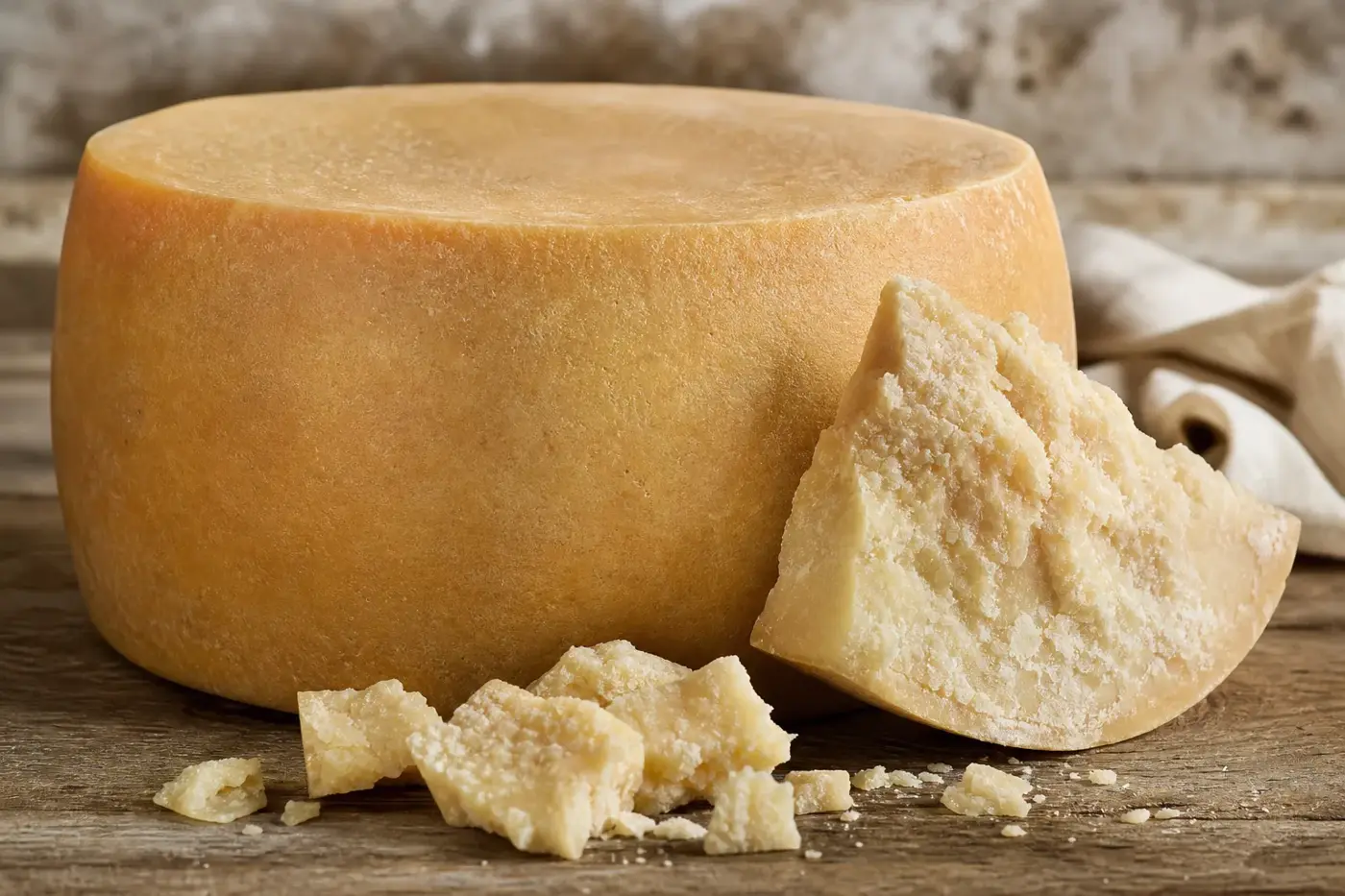
Parmigiano Reggiano
Break into a wheel of Parmigiano Reggiano and flakes fall away, revealing a finely granular cheese, pale straw to straw in colour.