Requeijão
At a Brazilian breakfast table, your spoon slips into requeijão, ready for a sweep across bread.
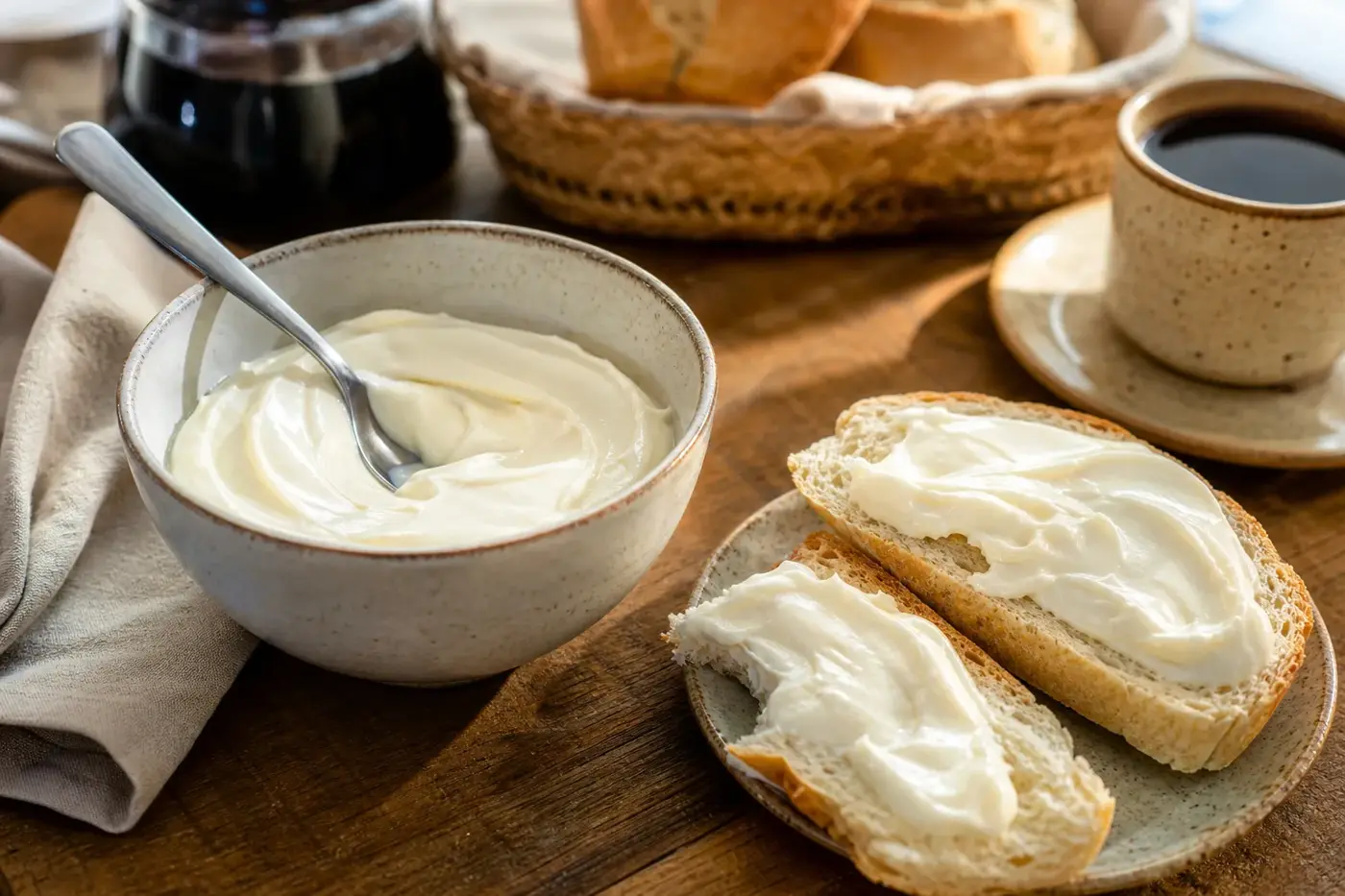
At a Brazilian breakfast table, your spoon slips into requeijão, ready for a sweep across bread. Another member of the family arrives from a mould, firm enough to demand a knife. Spoonable requeijão cremoso and sliceable requeijão de corte make rather different breakfast companions, but both begin with milk curd fused by heat. [1][2]
Meet the family, spoon and knife ready
| What to know | Your introduction |
|---|---|
| Family | Brazilian cheeses made by heating and fusing milk curd. [1] |
| Two defining forms | Spoonable cremoso and sliceable de corte. [1][2] |
| Brazilian standard | Portaria MAA nº 359 of 4 September 1997, annex. [1] |
| Where it belongs | Brazil, with documented rural traditions in the Southeast and Centre-West. [2] |
| For your kitchen | Products labelled requeijão culinário are sold for cooking. [3] |
Follow the family resemblance into the pan
To understand requeijão, look past its shape and into the pan. Brazil's standard describes the fusion of drained, washed milk curd, obtained through acid coagulation, enzyme coagulation or both. Coagulation turns liquid milk into curd: the solid material that separates from the liquid whey. [1]
That shared beginning takes you towards strikingly different textures. Your soft breakfast spread and a block you cut with a knife can both be requeijão. The process makes them relatives; the consistency tells you how to serve them. For the bigger picture, see how to tell cheese styles apart.
Cremoso: make room on your toast
Choose cremoso when you want cheese that spreads rather than stands to attention. The Brazilian standard describes a fine, smooth texture and a cream-like flavour with slight acidity, optionally salted. Expect gentle dairy flavour with a small sour edge, rather than the sharpness of a long-aged cheese. [1]
Plain bread or toast makes a good first introduction. Without stronger ingredients competing, you can notice how the cheese spreads and where its salt and acidity sit. Start with a plain version to meet the cheese itself. A flavoured product brings other ingredients into that first impression.
De corte: a cheese worth slicing
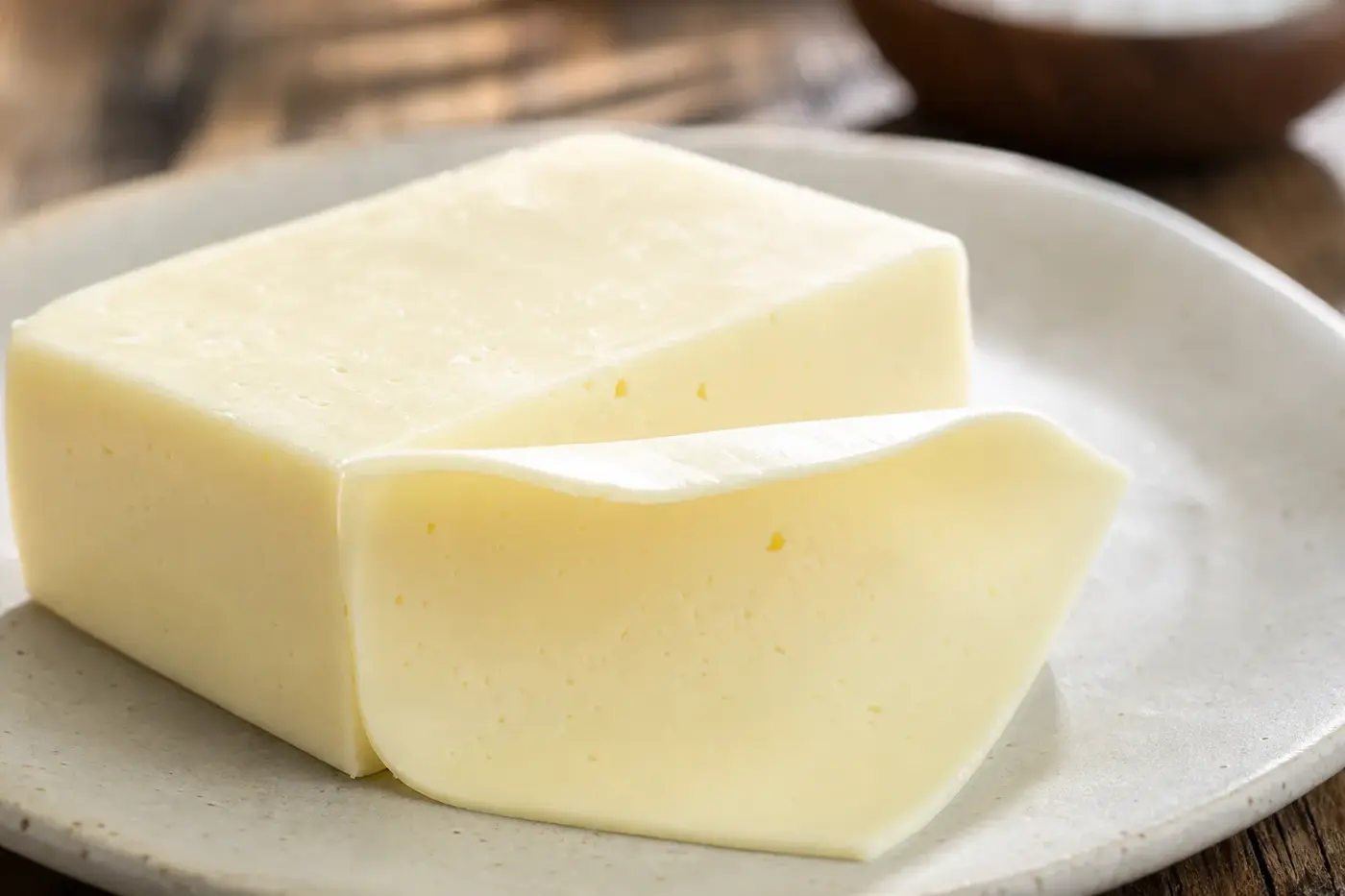
De corte means cheese intended for cutting. SENAR Paraná describes curd fused with dairy fat and salt to make a firm, sliceable cheese. A mould gives it shape, and you bring it to the table as a piece to cut rather than a spoonful to spread. [2]
Do not let the outline choose for you. The Brazilian standard allows variable shapes across the family, so neither a rectangle nor a rounded cheese settles the matter. Look for a cheese sold for slicing and ask about its consistency. Choose de corte for separate slices, and cremoso when you want an even coating. [1][2]
First the curd, then the transformation
Making requeijão takes two distinct transformations: first the curd, then the fusion. Acid or suitable coagulating enzymes cause milk to form a mass that can be drained. Heat and mixing then turn that mass into the finished cheese. You are not simply thickening milk; forming curd and fusing it are separate operations. [1][2]
Cream, butter or anhydrous milk fat can join the formulation. Anhydrous milk fat is milk fat with almost all its water removed. Brazil's standard requires added dairy fat for cremoso, while permitting it in the broader requeijão category. Requeijão de manteiga has its own definition, involving prolonged fusion and stirring with butter. [1]
For more on curd and whey, follow how cheese is made. Here, keep your eye on that second heating stage. It connects two cheeses that might otherwise seem unrelated: the spread that yields to your spoon and the firm piece that holds a slice.
Different routes to the same starting point
Citric acid, natural souring, vinegar, lemon and acidic whey all feature in SENAR Paraná's account of requeijão production. It documents direct acidification with citric acid and records the other approaches in traditional practice. Think of these as different routes to the starting curd, not one recipe that every producer follows. [2]
Industrial formulations can use ingredients listed in the Brazilian standard, including milk powder, casein and caseinates. Casein and caseinates are milk proteins. Read the ingredients to understand what a maker uses, then look at the intended texture to understand the product's job. The length of that list is not your guide to flavour. [1]
Family dairies and the stories names tell
Family production and surplus milk sit at the heart of the rural tradition described by SENAR Paraná. Its account links acid-coagulated de corte particularly with Brazil's Southeast and Centre-West. You are looking at a widespread production tradition, not a family tree that leads every requeijão back to one town. [2]
The names offer different clues. The federal standard recognises requeijão de manteiga and permits requeijão do Norte as an alternative designation, while de corte tells you about cutting consistency. Put the local name alongside the dairy's process and the question of whether it spreads or slices. Together, those answers tell you more than any single word. [1][2]
Begin with bread, then get cooking
Bread is the simplest introduction, but you need not stop at breakfast. Brazilian dairy Tirolez distinguishes everyday requeijão cremoso from requeijão culinário in its range. That maker's distinction helps you choose between a table spread and a product intended for cooking. [3]
Let the job lead your choice. Use cremoso to spread through a sandwich, a cooking-labelled product for an oven-bound filling, and de corte for a distinct slice alongside bread. For savoury cooking, choose a recipe written for your form of cheese. A spoonable cheese and a firm block give a filling different amounts of structure.
You might start with a spoonful folded into a chicken filling, a layer in a vegetable bake or a smooth cheese sauce for pasta. In each case, choose a recipe that gives quantities and handling instructions for the product you have.
Then follow the pack's cooking directions. A culinary product may be intended for a different application from the spoonable breakfast version. The familiar requeijão name does not make the two interchangeable. [3]
Same name, a different cheese on your plate
Portuguese requeijão and Brazilian requeijão start with different materials. Portugal's Directorate-General for Food and Veterinary Affairs uses whey-made requeijão as an example in its technical guidance on dairy ingredients. Whey is the liquid separated during cheesemaking; Brazil's standard instead defines cheese made from milk curd that is subsequently fused. [1][4]
Requesón needs a country attached to its description, too. A Mexican cultural ministry collection from the Altar Desert records a preparation made by heating whey and collecting the pale curds that rise. That Mexican requesón sits on the whey-based side of the comparison. When you shop in Britain, read both country and description, especially if your recipe specifically calls for Brazilian cremoso. [5]
Find your style, then your substitute
Are you spreading, slicing or cooking? Answer that first, then read the exact product name, ingredients and storage instructions. For help separating the food's name from the maker's branding, see how to read a cheese label.
For a British substitute, think about function rather than hunting for one replacement for the whole family. These are practical editorial recommendations, rather than results from comparative cooking trials.
| What you need it for | An alternative to try | What to look for |
|---|---|---|
| Spreading | Plain full-fat soft cheese | Look for smoothness; compare salt and acidity. |
| Cooking | Smooth processed cheese spread | Choose a suitable recipe and follow its heating directions. |
| Slicing | Mild, firm processed cheese | Choose a product sold for slicing, not spreading. |
These alternatives do a better job of preserving the cheese's role than its particular Brazilian flavour. If requeijão is central to your dish, the specified form is the most direct choice. If it is one part of a filling, choose a recipe that already accommodates your alternative. You then have instructions suited to the substitute, rather than relying on a straight swap.
Keep it chilled, with the instructions close
Keep your home fridge between 0 and 5 °C if following Food Standards Agency guidance in England, Wales and Northern Ireland. Its published advice is to refrigerate dairy products and follow the packaging's storage instructions. Keep requeijão chilled as directed. Processing or fusion does not automatically make a cheese suitable for cupboard storage. [6]
Once you open it, follow both the manufacturer's stated time limit and its temperature instructions. Mark the opening date on the pack if that helps, and choose a pack you can finish within the stated time. If you move the cheese to another container, keep its instructions with it. [6]
Use clean utensils and keep your food preparation surfaces clean, following the FSA's cleaning guidance. [7]
For the wider routine, see how to store cheese at home. Once the seal is broken, the pack remains your most useful guide to storing that particular requeijão. Keep those directions close at hand.
General information only, not medical advice: follow the official guidance where you live.
Questions people ask
What is requeijão?
Requeijão is a Brazilian cheese family made by heating and fusing milk curd. It includes both spoonable cremoso and firm, sliceable de corte.
What is the difference between requeijão cremoso and de corte?
Cremoso has a fine, smooth texture and spreads easily. De corte is shaped in a mould and is firm enough to slice.
Is Brazilian requeijão the same as Portuguese requeijão?
They have different starting materials. Portuguese guidance gives whey as an ingredient for making requeijão, while Brazil’s standard defines it as a cheese made from milk curd that is subsequently fused.
What can I use instead of requeijão in Britain?
For spreading, the page suggests plain full fat soft cheese. For cooking it suggests a smooth processed cheese spread, and for slicing a mild, firm processed cheese. These alternatives suit the task more readily than they reproduce the particular Brazilian flavour.
How should I store requeijão?
The Food Standards Agency advises refrigerating dairy products and following the storage instructions on the packaging. In England, Wales and Northern Ireland, its guidance is to keep the home fridge between 0 and 5 °C. Check the FSA’s guidance and the manufacturer’s instructions, including the stated time limit after opening.
Sources
- Brazilian Ministry of Agriculture, Portaria nº 359, de 4 de setembro de 1997: Regulamento Técnico para Fixação de Identidade e Qualidade de Requeijão ou Requesón, 1997, official ministry-hosted reproduction. Sections 2, 4 and 9 establish the definitions, ingredients, sensory descriptions and designations. The ministry's retrieved legislation index also lists this instrument. Official text.
- SENAR Paraná, Processamento caseiro do leite, edition hosted February 2026, section 7.2.9, “Requeijão de corte”. Agricultural training material documenting acidification, fusion, moulding and regional practice. Used descriptively, rather than as a home cheesemaking method. Technical publication.
- Tirolez, official product navigation, undated, checked November 2026. Lists requeijão cremoso under everyday products and requeijão culinário under cooking products. This is a manufacturer's commercial account of its own range. Official website.
- Direção-Geral de Alimentação e Veterinária, Portugal, Rotulagem da origem do leite: Esclarecimento Técnico nº 8/DGAV/2017, 2017, question 3. Identifies whey used to manufacture requeijão. Technical guidance.
- Dirección General de Culturas Populares, Indígenas y Urbanas, Mexico, Comida tradicional del Desierto de Altar, official digital edition hosted in 2020, “Requesón y mantequilla de requesón”, pp. 124 to 125. Cultural recipe collection.
- Food Standards Agency, How to chill, freeze and defrost food safely, published 18 December 2017, live guidance checked November 2026. Applies to England, Wales and Northern Ireland; section 1 covers domestic refrigeration, dairy products and time outside refrigeration. Official guidance.
- Food Standards Agency, Why is cleaning important, published 18 December 2017, live guidance checked November 2026. Official guidance.
Researched through Brazilian technical legislation and agricultural training material, Portuguese official guidance, a Mexican cultural collection, a manufacturer's product categories and FSA consumer guidance.
Last checked: November 2026
Last checked November 2026.
The editors suggest you read next
American Cheese: The Processed Slice Explained
Watch a slice of American cheese soften over your burger.