American Cheese: The Processed Slice Explained
Watch a slice of American cheese soften over your burger.
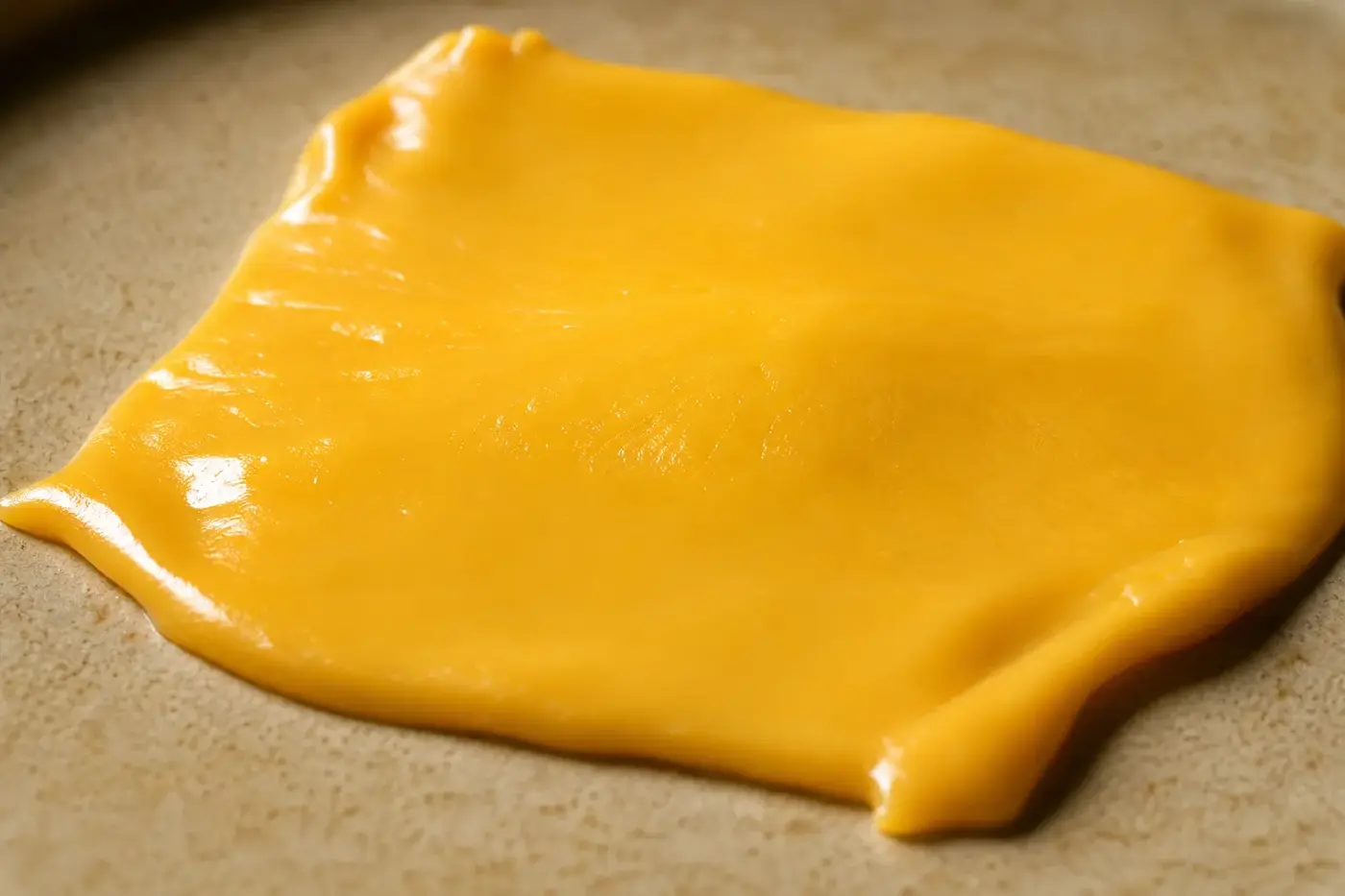
Watch a slice of American cheese soften over your burger. It settles into a smooth, cohesive layer, rather than leaving an oily pool behind. The quiet work belongs to emulsifying salts, which help milk proteins hold fat and water together when heated.[1][4]
Typically made by blending cheese with other ingredients, this slice has different ambitions from an aged Cheddar. You come to it for a consistent melt, not a crumbly texture or a long ripening history. Not every cheese needs a distinguished cellar career.[1][4]
The quiet chemistry behind that lovely melt
Melting fat is only part of the story. Cheese contains fat, water and a network of proteins, principally caseins, held together with help from calcium. Heat softens that structure, but keeping everything together takes something more.[4]
This is where emulsifying salts come in, commonly citrates or phosphates. They change how calcium and casein interact, allowing the proteins to disperse and take up water more readily. Those proteins then help stabilise fat throughout the mixture.[4]
What you get is an emulsion: fat dispersed through a phase containing water, rather than escaping into an oily layer. That effortless-looking smoothness has quite a bit of chemistry behind it.[4]
In a 2024 experimental study, researchers made processed cheeses with four calcium-sequestering salts at two concentrations and two pH levels. Using water extraction, ultracentrifugation and filtration, they demonstrated that different salts produced different distributions of calcium and protein. Your smooth melt depends on this interplay between minerals and milk proteins.[4]
The choice of salt matters, and so does the amount. A separate experimental study tested five emulsifying salts at different concentrations in model processed cheeses, measuring texture, spreadability and melting behaviour. The salts provide the mechanism; the recipe determines how the cheese behaves in your pan.[5]
How finished cheese becomes your ready slice
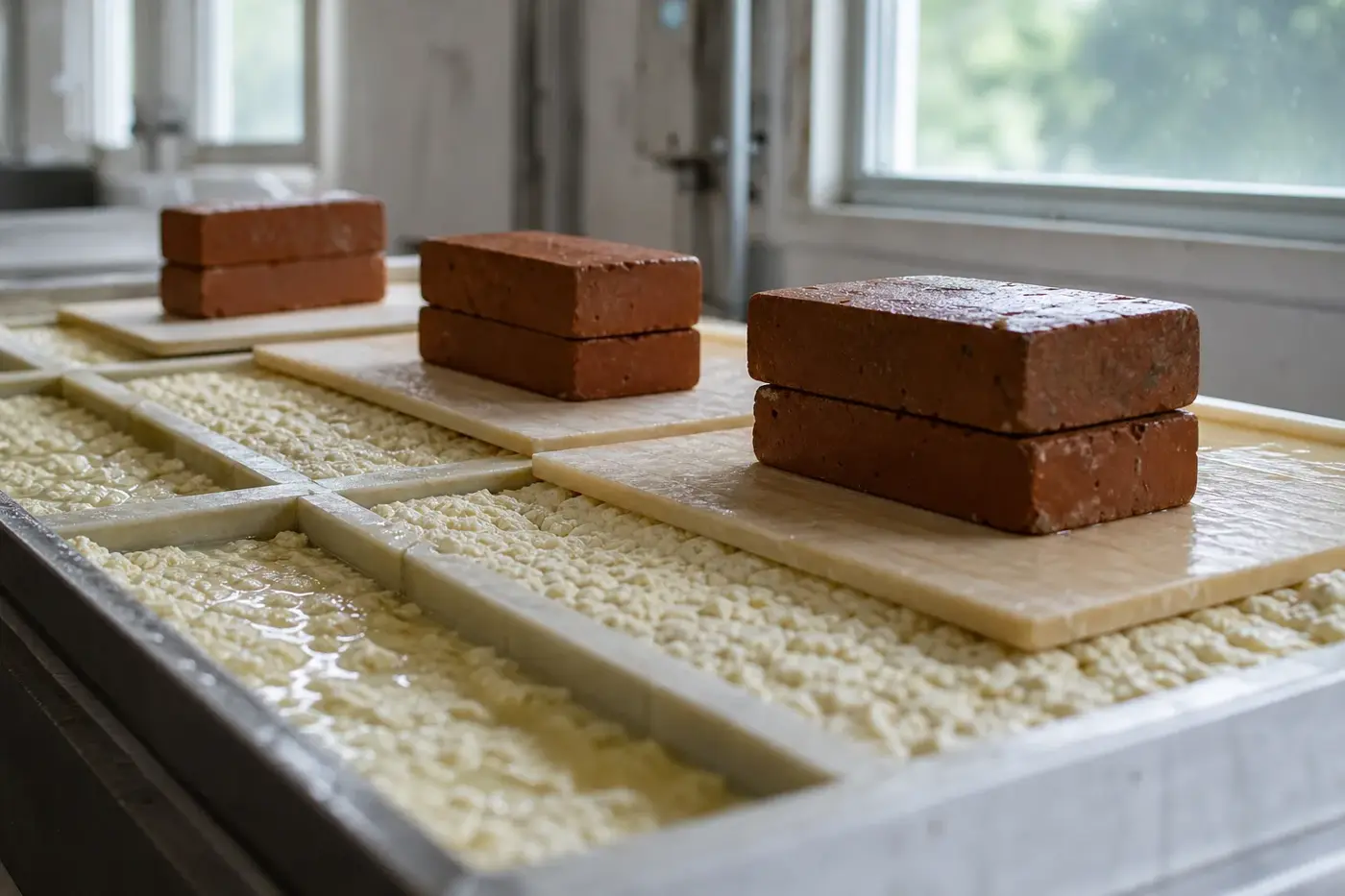
The story starts with cheese that has already been made. It is grated or reduced to small pieces, then heated and mixed with emulsifying salts and the other ingredients its product category allows. That uniform mass can then be formed and packed.[1][2][3]
Under the United States standard for pasteurised process cheese, permitted additions include water, salt, certain dairy fats, acidifying ingredients and colouring. Cheese food and cheese spread have their own ingredient provisions. Think of them as related recipes, each with its own permitted ingredients and compositional limits.[1][2][3]
Processing is a second manufacturing stage, not a way of skipping the original cheesemaking. To follow your slice back to the moment curd separates from whey, start with how cheese is made.
Before the wrapper: American Cheddar’s earlier life
“American cheese” had a life long before processed slices. The 1918 reference The Book of Cheese placed American factory Cheddar within the Cheddar group. Its trade tables recorded United States cheese exports throughout the nineteenth century, revealing an established manufacturing and export trade before processed cheese developed.[7]
Then comes a decisive primary record: the Kraft patent US 1,186,524, filed on 25 March 1916 and granted on 6 June 1916. It described heating Cheddar-type cheese while stirring continuously. The aim was to prevent separation during treatment and produce cheese suitable for sealed containers.[6]
The preservation claims belong to that historical patent. The technical challenge at its heart, keeping heated cheese homogeneous, remains central to processed cheese manufacture today. The container may be the historical detail that catches your eye, but keeping the cheese together is the thread to follow.[1][6]
By 1918, The Book of Cheese described processed cheeses being mixed, moulded and repackaged into forms different from their starting cheeses. A subsequent Kraft patent, granted on 24 August 1920, reported that the earlier process had entered extended use. You are looking at a developing technique, rather than one neat moment of invention.[6][7]
What the small print tells you about your slice
Look past the large word “American” on the packet. The full product name tells you more, because United States federal standards distinguish three relevant categories. Here is how they differ in the November 2026 eCFR text.[1][2][3]
| United States product name | What you can learn from the name | Standard, November 2026 |
|---|---|---|
| Pasteurised process cheese | Cheese blended with an emulsifying agent and permitted ingredients | 21 CFR 133.169 [1] |
| Pasteurised process cheese food | At least 51% cheese by finished weight; maximum 44% moisture and minimum 23% milkfat in the whole product | 21 CFR 133.173 [2] |
| Pasteurised process cheese spread | At least 51% cheese; more than 44% and no more than 60% moisture; at least 20% milkfat in the whole product | 21 CFR 133.179 [3] |
There is a useful practical detail in the spread standard, too. It requires spreadability at approximately 21 °C (70 °F).[3]
Section 133.169 permits the name “Pasteurized process American cheese” for products made from Cheddar, washed-curd cheese, Colby or granular cheese, individually or in mixtures. Monterey Jack is not included in that particular naming provision.[1]
Every word matters here. “Pasteurized Prepared Cheese Product”, for example, differs from all three standardised names above. Use its own ingredients and nutrition information to understand its composition, rather than assuming it matches the neighbouring packet.[1][2][3][9]
Turn the packet over: the ingredients tell a story
Start with the food’s full name, then turn to the ingredients. Look for the starting cheeses, additional milk ingredients, emulsifying salts, colouring and preservatives. Together, they give you a clearer picture of the slice and what you might cook with it.
The United States Kraft Singles American product page offers a useful example. It calls the food “Pasteurized Prepared Cheese Product” and lists Cheddar, skimmed milk, whey, milkfat, milk protein concentrate, calcium phosphate and sodium phosphate among its ingredients. It also identifies annatto and paprika-derived colouring.[9]
That recipe shows how little “processed” tells you on its own. Cheese, milk ingredients and salts can appear in different proportions, within different product categories. The familiar name on the front is only the beginning of the story.[1][2][3]
In the UK, pay attention to the date mark and storage instructions too. Government guidance distinguishes use-by dates, which concern safety, from best-before dates, which concern quality.[11] For the wider picture, turn to reading a cheese label.
White or yellow? Look beneath the colour
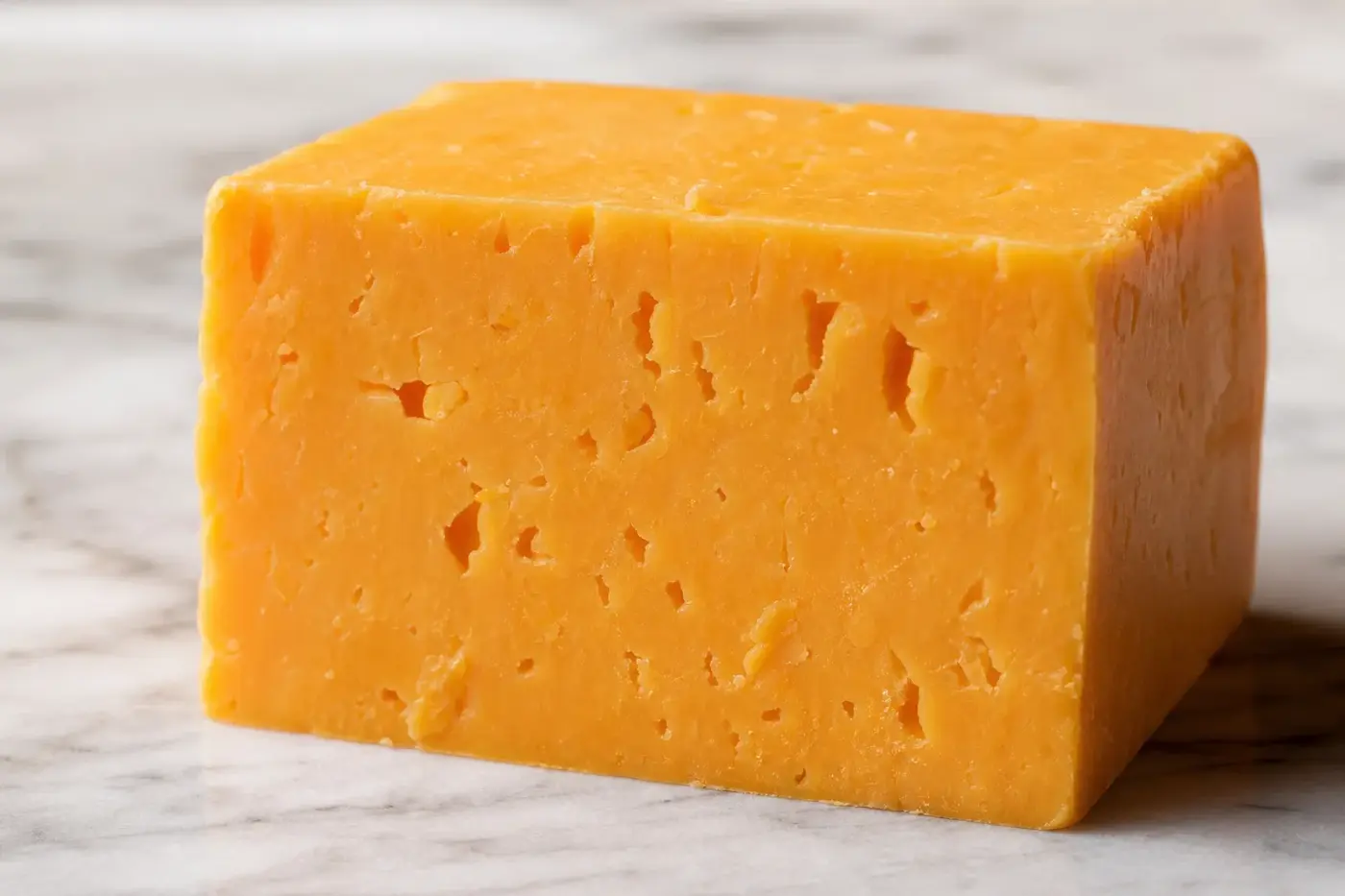
American cheese comes in white as well as yellow. Land O’Lakes documents both white and yellow deli American products. The Kraft ingredient list shows how added colouring can contribute to a yellow slice.[9][14]
For a precise picture of the intended texture, look at the USDA’s 2013 purchasing specification. It calls for flavour characteristic of process cheese made from mild to medium-cured American cheese. The body should be smooth, medium-firm and resilient, with a close texture free from graininess.[8]
Those are requirements for that purchasing programme, not a promise about every American cheese product. Keep that distinction in mind as you compare packets.[8]
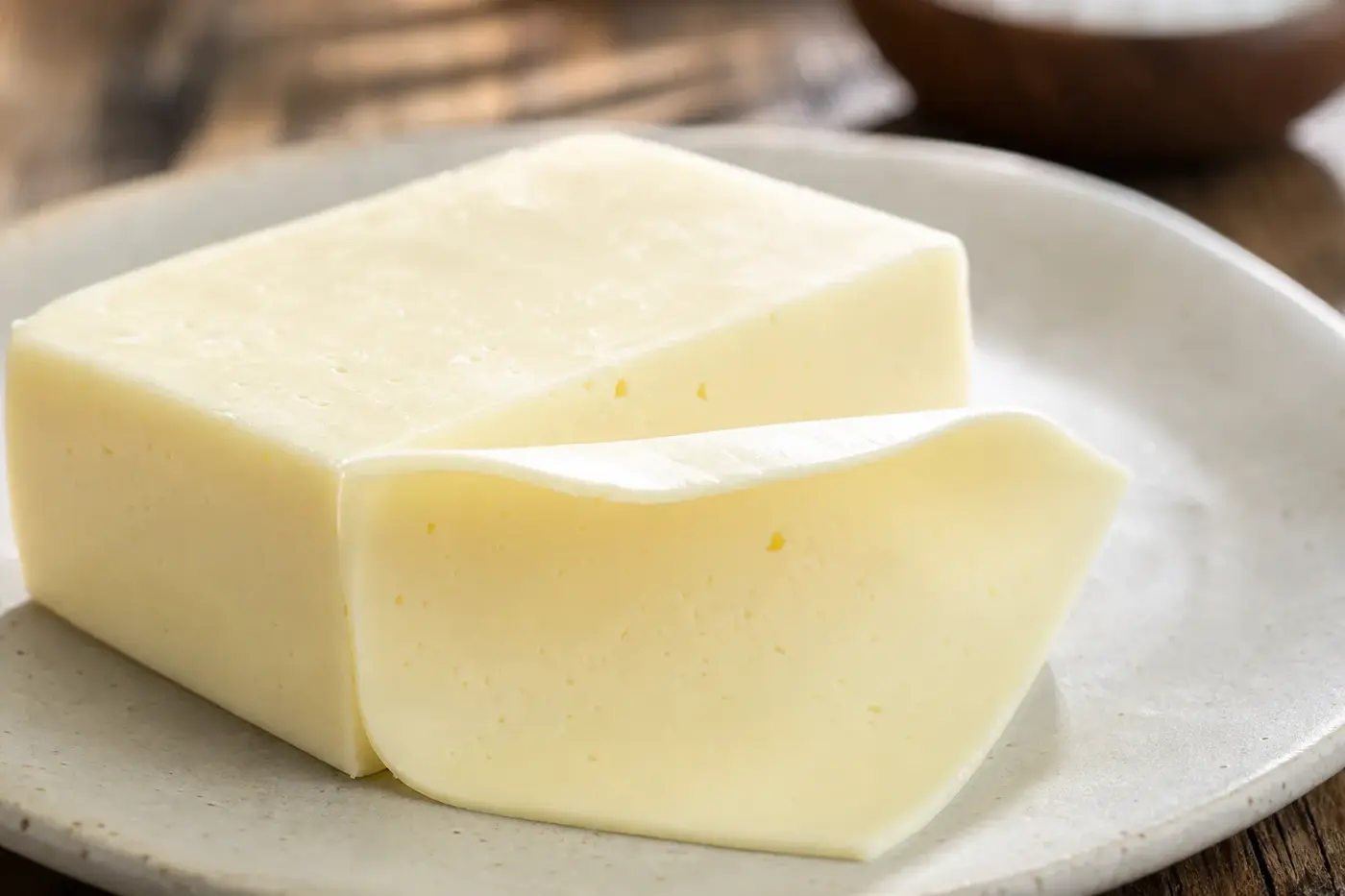
Deli blocks and individually wrapped slices differ first in format. You cut a block to the thickness you need; a wrapped slice arrives portioned. Composition is a separate question: USDA requirements cover loaves and slices, while the individually wrapped Kraft example has a different product name and ingredient list.[8][9]
Choose by the full description and what you want to cook. A wrapper is a format, not a character reference.
Give that smooth melt a job
American cheese’s practical strength is its ability to stay together. Softened cheese can coat your burger or fill a sandwich without relying on a strongly aged flavour. The ideas below are everyday applications of the documented emulsification mechanism.[4]
For burgers, a thin slice gives you an even layer that follows the patty’s surface. For grilled cheese sandwiches, its uniformity helps create a continuous filling between the bread. Kraft specifically recommends its American slices for both uses.[9]
For sauces, the attraction is that same combination of dispersed protein, water and fat. Consistency depends on the product’s composition and how much liquid you add to the dish. Sliceable products and spreads have different moisture requirements, so swapping one for the other can change the thickness.[1][3][4]
For egg dishes, small pieces make it convenient to distribute cheese through an omelette filling or breakfast sandwich. The manufacturer also documents eggs as a use for its slices.[9]
Before you reach for the packet, decide what your dish needs. A cohesive layer, a softer filling and a sauce each ask something different of the cheese. One packet may serve several purposes, but the result you want should lead the way.
American cheese or Cheddar? Let dinner decide
Cheddar, Colby and Monterey Jack are distinct cheeses with separate United States standards of identity. They are not interchangeable names for American processed cheese. It helps to keep those identities separate when you are choosing what goes into your dish.[10]
Their compositional limits differ, too. The US Cheddar standard allows a maximum of 39% moisture in the whole cheese; Colby allows 40%; Monterey Jack allows 44%. Each requires at least 50% milkfat by weight of the solids.[10]
That last figure means fat in dry matter, not fat in the whole cheese. It is a small distinction in wording, but it changes what the number tells you.[10]
These figures help explain some of what changes when you substitute one cheese for another. Melt also depends on protein structure, acidity and, for a processed product, its formulation. Moisture alone cannot tell you the whole story.[4][5]
Choose Cheddar when its particular maturity and character suit your dish. Choose American processed cheese when a cohesive melt matters most. Colby and Monterey Jack offer distinct alternatives, each with its own flavour and melting behaviour.
Compare nutrition on equal terms
Use the nutrition information for the product in your hand. Added milk ingredients, dairy fat and mineral ingredients can give two similar-looking slices different protein, calcium and fat contents.[1][2][9]
Compare equal weights, preferably per 100 g, then consider the portion you normally eat. A thin individually wrapped slice and a thicker deli slice contain different quantities. A “per slice” comparison can hide that difference.
Look at protein, calcium, total fat and saturated fat separately. On United States labels, look for sodium, or salt where the label presents it that way. The Kraft example lists both salt and sodium phosphate among its ingredients and provides product-specific sodium figures in its nutrition panel.[9]
Do not use calcium content as a stand-in for cheese content. Calcium phosphate in an ingredient list shows why a calcium figure alone cannot tell you how much cheese a product contains.[9]
Keep the packet and follow its fridge instructions
Follow the instructions on your particular pack. The Kraft example explicitly says to keep it refrigerated and not to freeze it.[9]
For home refrigeration in the United States, the FDA advises a refrigerator temperature of 4 °C (40 °F) or below. UK government guidance advises 5 °C or below where food requires refrigeration. These are the respective countries’ published consumer recommendations as of November 2026.[11][12]
Once the pack is open, follow any stated consumption period as well as the storage instructions. Keep the outer packaging until you finish the contents, so you still have the product name, date and batch information. You can find broader practical guidance in storing cheese at home.
Date wording needs local context. UK guidance treats use-by as a safety date: food should be used, cooked or frozen by that date, following the applicable instructions. US USDA guidance says use-by dates usually concern best quality rather than safety.[11][13]
Read the label using the guidance for its country. Advice from another country may give the same words a different meaning.[11][13]
Choosing vegetarian? Look beyond “Cheddar”
Check the product’s declaration, or ask the manufacturer about the enzymes used in its cheese ingredients. The US Cheddar standard permits animal, plant and microbial clotting enzymes. “Cheddar” alone therefore cannot tell you whether a product is suitable for vegetarians.[10]
The Kraft example lists only “enzymes”, leaving their origin unspecified.[9] Seek confirmation for the particular product and market you are buying.
This distinction begins before processing, when the original cheese is made. To understand that earlier choice, rennet and its alternatives explains animal, microbial and fermentation-produced coagulants.
General information only, not medical advice: follow the official guidance where you live.
Questions people ask
Why does American cheese melt so smoothly?
Emulsifying salts help milk proteins keep fat and water together when heated. Commonly used citrates or phosphates change how calcium and casein interact, helping to prevent an oily layer from separating.
Is American cheese made from real cheese?
American processed cheese starts with cheese that has already been made. It is heated and mixed with emulsifying salts and other ingredients permitted for its product category.
What is the difference between American cheese and cheese spread?
US standards distinguish pasteurised process cheese from pasteurised process cheese spread. The spread must contain at least 51% cheese, have more than 44% and no more than 60% moisture, and be spreadable at approximately 21 °C.
How should American cheese be stored?
Follow the instructions on the particular pack, including any consumption period after opening. UK government guidance advises 5 °C or below for food requiring refrigeration, while the US FDA advises 4 °C or below for home refrigerators. See the guidance for your country.
Is American cheese vegetarian?
Check the product’s declaration or ask the manufacturer about the enzymes used in its cheese ingredients. The US Cheddar standard permits animal, plant and microbial clotting enzymes, so the word Cheddar alone does not establish vegetarian suitability.
Sources
- US Food and Drug Administration, 21 CFR 133.169: Pasteurized process cheese, eCFR text current to 5 November 2026. Definition, permitted ingredients and American naming provision.
- US Food and Drug Administration, 21 CFR 133.173: Pasteurized process cheese food, eCFR text current to 5 November 2026. Composition and ingredient requirements.
- US Food and Drug Administration, 21 CFR 133.179: Pasteurized process cheese spread, eCFR text current to 5 November 2026. Composition and spreadability requirements.
- Teagasc, Wageningen University and University College Cork researchers, Soluble Salts in Processed Cheese Prepared with Citrate- and Phosphate-Based Calcium Sequestering Salts, 2024. Primary experimental research, including methods and results.
- The impact of various emulsifying salts on texture, rheology, spreadability and meltability of acid casein-whey protein model processed cheese, International Dairy Journal, 2026. Retrieved abstract describing experimental salts, concentrations and measurements.
- United States Patent Office, US 1,186,524: Process of sterilizing cheese and an improved product produced by such process, 1916; and US 1,350,870: Process of sterilizing and packaging cheese, 1920. Original patent records, reproduced by Google Patents. Historical preservation claims are attributed to the documents.
- The Book of Cheese, 1918 edition, Project Gutenberg transcription. Classification of American factory Cheddar, section 105 on processed cheeses, and section 304 with Table XXII on exports.
- US Department of Agriculture, Agricultural Marketing Service, USDA Commodity Requirements: Pasteurized Process American Cheese, DPPC3, effective 25 September 2013. Physical requirements for programme purchases, including flavour, body, texture and formats.
- Kraft Heinz, Singles American Pasteurized Prepared Cheese Product Slices, United States product page, undated, retrieved November 2026. Manufacturer’s product name, ingredients, nutrition information, suggested uses and storage instructions. Commercial primary source, not an independent quality assessment.
- US Food and Drug Administration, 21 CFR 133.113: Cheddar cheese; 133.118: Colby cheese; 133.153: Monterey cheese and monterey jack cheese, eCFR, checked November 2026. Separate standards, composition and permitted clotting enzymes.
- UK Government, Understanding food labelling: Best before and use-by dates, current online guidance, checked November 2026. Date meanings, refrigeration and instructions after opening.
- US Food and Drug Administration, Refrigerator Thermometers: Cold Facts about Food Safety, current online guidance, checked November 2026. Consumer refrigeration advice.
- US Department of Agriculture, Food Safety and Inspection Service, Is food safe after the date expires?, online guidance, retrieved search record checked November 2026. US interpretation of use-by dates.
- Land O’Lakes, Cheese, current manufacturer’s product directory, checked November 2026. Separate white and yellow deli American products.
This article was researched from federal standards, original patents, a contemporary historical reference, experimental food science, official consumer guidance and attributed manufacturer information.
Last checked: November 2026
Last checked November 2026.
The editors suggest you read next