Serbian Cheese
Tear the top from a bread roll in Užice, western Serbia, and dip into what waits inside: egg, old kajmak and pretop, the juices from roasting lamb or pork.
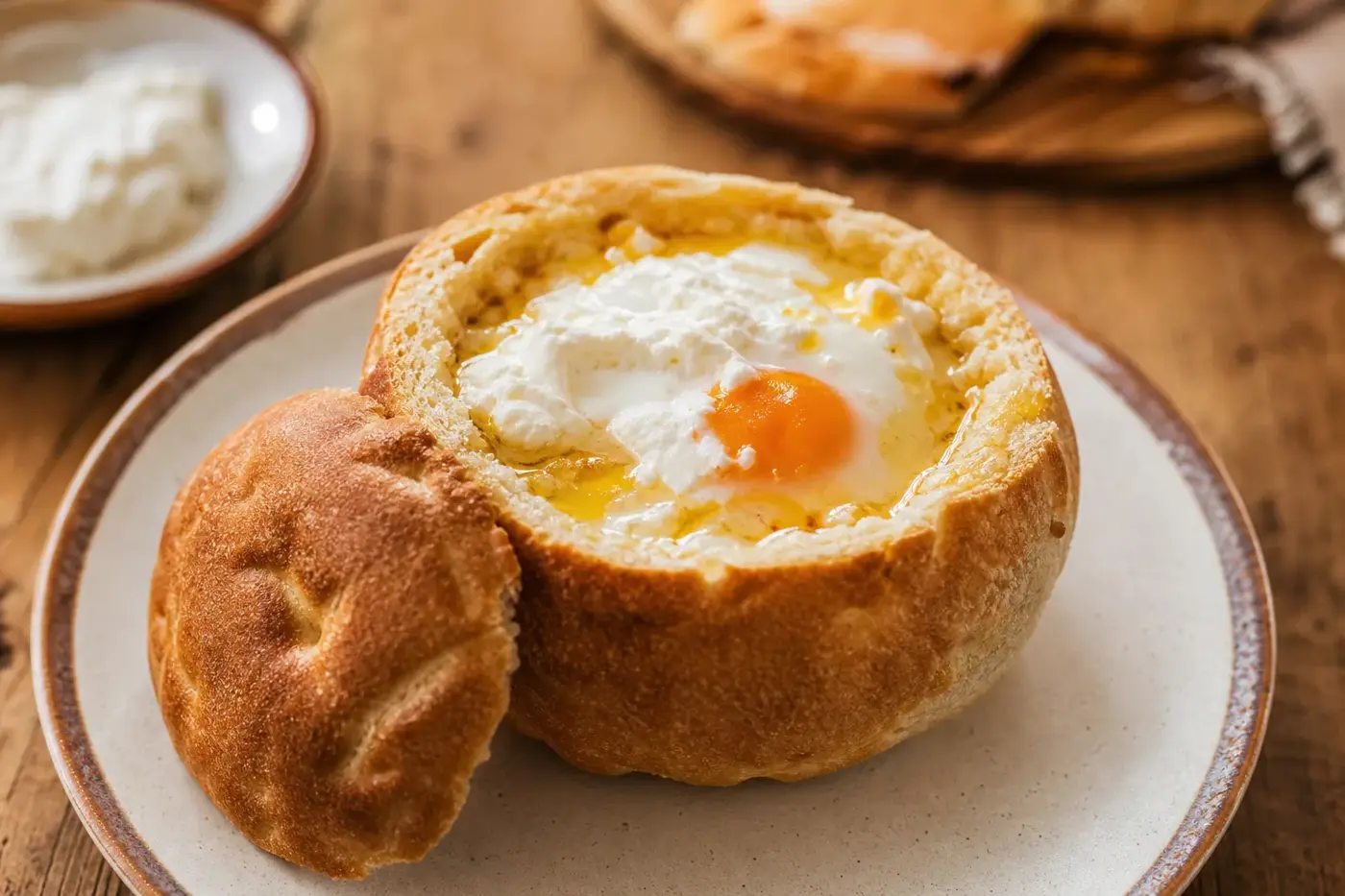
Tear the top from a bread roll in Užice, western Serbia, and dip into what waits inside: egg, old kajmak and pretop, the juices from roasting lamb or pork. This is komplet lepinja, breakfast with ripened dairy at its heart. Leaving a scrap behind would take considerable willpower.[1]
Beyond that bread roll, Serbia has white cheeses matured in brine and firmer, stretched-curd kačkavalj. Kajmak takes a different route to your table. This milk-fat speciality is collected from the surface of heated milk, rather than made by draining cheese curd, and becomes cultured as it ripens.[2]
Your first bearings, before the first bite
| A useful starting point | What to know |
|---|---|
| Country | Serbia |
| Main dairy forms | White brined cheeses, stretched-curd kačkavalj and kajmak.[2][10] |
| Serbian registration authority | Intellectual Property Office of the Republic of Serbia.[4] |
Begin with a spoonful of kajmak
Young kajmak is milder. Old kajmak is sharper and more yellow, and it is this older product that the Užice tourism organisation specifies for komplet lepinja. Ripening does more than extend keeping time: it shapes the flavour waiting inside your bread roll.[1]
Dairy research places kajmak between butter and cheese in composition and structure. The milk skin collected during production concentrates fat and protein, while ripening microorganisms develop texture and flavour. Some kajmak is sold fresh, so “cultured” describes the ripened form, not everything bearing the name.[2]
For your first tasting, give one white brined cheese, one kačkavalj and kajmak a little space of their own. White slices kept in brine and the denser paste of kačkavalj give you two clear starting points among Serbia’s cheeses.[2][10] Taste each separately before discovering what happens to it in a cooked dish.
You will find texture, salt and use easier to distinguish this way than on a plate of several unnamed white cheeses. Notice what each brings, then return to it in a dish. The guide to cheese styles helps you put words to those differences.
Follow the milk up into the mountains
On the Sjenica-Pešter plateau and around Stara Planina near Pirot, cheesemaking belongs to the working life of the mountains. A 2011 agricultural paper describes village production and summer dairying in seasonal mountain huts called katun or bačija. Picture the grazing, milking and processing together, rather than beginning and ending your interest at the maturing room.[10]
Around Zlatar, the landscape tells a related story. A 2012 field study places household cheesemaking near Nova Varoš, on the mountain’s foothills and slopes, with cattle kept higher up in summer. Seasonal grazing sets the rhythm of the feeding calendar.[9]
Ask whether your cheese comes from pasture-season milk, then ask how long it has matured. Together, those answers tell you more than the month of your visit alone. They bring the producer’s working year into the tasting.
Keep the lowlands in view, too. Look north towards Sombor and the farms of Vojvodina, where Somborski sir appears on the national list. A journey devoted entirely to mountain cheeses would leave part of Serbia’s dairying out of the picture.[4]
Milk gives you another way to read this landscape. Cow’s milk is central to registered Zlatar cheese and the cow’s-milk Pirot name; sheep’s milk defines Sjenički ovčiji sir. Homolje also has a separately registered goat’s-milk cheese.[4][5][6][7]
The 2011 study describes Pirot kačkavalj in connection with sheep’s and cow’s milk too.[10] Ask about the cheese in front of you, rather than letting the place name answer everything. A region is not a promise that every maker follows one recipe.[4][5][6][7][10]
Meet the cheeses, one slice at a time
Sjenica: a white cheese worth lingering over
Sjenica cheese belongs to the white brined family, with separate sheep’s-milk and cow’s-milk names. For the sheep’s-milk cheese, the specification requires at least 60 days of maturation in its own salted whey, the liquid separated from the curd. This is part of the registered production method, not an instruction to keep your purchase at home for 60 days.[4][5]
A 2004 study of household methods drew on a questionnaire across nine localities. It classified the cheeses examined as soft and described the acidity characteristic of this brined family.[8] Keep those clues in mind as you take your first taste.
Begin by noticing how a slice holds together. Then turn to its flavour, ask whether the milk is sheep’s or cow’s, and note its age. With those details, your next white brined cheese becomes a much more revealing comparison.
Zlatar: get to know that thin slice
The thin slice is a defining feature of Zlatarski sir, the Zlatar cheese associated with Nova Varoš and the Zlatar mountain area. Its registered specification puts draining and pressing before cutting and packing. You are looking at a soft brined cheese made from fresh whole cow’s milk, with raw milk used in the documented process and a minimum maturation of 30 days.[6]
The 2012 field study interviewed six producers near Nova Varoš and analysed their ripened cheeses.[9] At a tasting, ask the maker about the texture and flavour of the particular cheese you are being served. The regional name opens the conversation; the producer can bring it right down to the slice on your plate.
Pirotski kačkavalj: make room for a firmer bite
Pirotski kačkavalj changes the rhythm of your Serbian cheese tasting. It belongs to the firmer stretched-curd tradition, also called pasta filata. The curd, the coagulated part of the milk, is worked after heating into a cohesive mass.
The 2011 agricultural account describes a firm cheese made from steamed curd in the Stara Planina area.[10] Notice its resistance to the tooth beside the softer white cheeses. Not every Serbian cheese is going to crumble on cue.
Read the full name for an important clue about milk. The Serbian register lists Pirotski kačkavalj od kravljeg mleka, meaning Pirot kačkavalj from cow’s milk. That precise registered product belongs to a broader regional tradition whose published accounts also include sheep’s milk and blends, so ask which version the counter or restaurant is offering.[4][7][10]
Leave a little room in your notebook
In Homolje, the national list offers a useful three-way distinction. Homoljski ovčiji sir, Homoljski kozji sir and Homoljski kravlji sir are sheep’s-milk, goat’s-milk and cow’s-milk cheeses respectively. You will also find Somborski sir and Svrljiški kačkavalj recorded on the list.[4]
With small household producers, start with the maker’s identity and exact product name. A regional name becomes much more useful when it leads you to a particular dairy and batch. Now your next question has somewhere to go.
Protected names: know what you are asking for
“Sjenica cheese” sounds specific, but it does not tell you which of two milk-specific names you are being offered. Serbia’s Intellectual Property Office publishes the national list of registered geographical-origin names and their supporting specifications. The entries below appear on that list; listing alone does not establish their current legal status or operative dates.[4]
| Registered name in Serbia | Register ID | What the specification tells you |
|---|---|---|
| Сјенички овчији сир (Sjenički ovčiji sir) | 59 | Sheep’s milk; at least 60 days’ maturation in salted whey.[4][5] |
| Сјенички крављи сир (Sjenički kravlji sir) | 65 | Cow’s-milk name; detailed production requirements: Not established.[4] |
| Златарски сир (Zlatarski sir) | 64 | Whole cow’s milk; raw-milk process; at least 30 days’ maturation.[4][6] |
| Пиротски качкаваљ од крављег млека (Pirotski kačkavalj od kravljeg mleka) | 61 | Cow’s-milk name; registered specification dated 2012.[4][7] |
For the difference between national protection and an EU designation, turn to protected names explained. At a stall, ask for the registered name and producer details rather than stopping at “mountain cheese”. If you want to find that product again, write them down: exact wording is more useful than a broad description of where it comes from.
Pull up a chair for bread, porridge and pastry
Breakfast is a natural place to begin, with cheese beside bread rather than set apart as a course. Užice’s tourism organisation describes a local spread of cheese, kajmak and soured milk served with proja, maize bread. It also records kačamak, a maize porridge eaten with milk, cheese or kajmak.[1]
Each gives dairy a different part to play. You might meet a slice beside bread, a spoonful stirred into a staple, or kajmak enriching the filling of komplet lepinja. Taste it in that setting, and you begin to understand what the meal asks of the ingredient.[1]
For pastry, ask about gibanica and which cheese the kitchen uses. If possible, order that cheese plain too, so you can explore the same ingredient in two forms. With a salad, request the cheese separately if you would like a taste before it meets the dressing.
Let the kitchen tell you about its preparation. These comparisons are an invitation into the food, not instructions for how anybody ought to serve it. You are there to discover what the cook does with the cheese.
Meet the hands behind the spoonful
Women in rural households are identified as traditional kajmak makers in Serbia’s National Register of Intangible Cultural Heritage. The skill and craft of making kajmak entered the register on 26 December 2016. Its account places the practice across central and western Serbia, including the Western Morava valley, Zlatibor, Tara, Toplica and Kopaonik.[3]
Here, dairy knowledge grows from the work of the household. Milking, handling milk and recognising how the product develops all belong to that knowledge. The finished spoonful carries those domestic skills to your table.[3]
The 2012 Zlatar research also studied related brined cheesemaking in Montenegro alongside the Serbian households. Shared families of technique help explain why cheeses can resemble those across a border while keeping local names and methods. Looking at working practices makes for a richer comparison than searching for one national inventor.[9]
Ask a maker who taught them, what they have changed and which tasks they still do by hand. Those answers bring the household’s own history into view. They tell you more than an unsupported origin date.[9]
Make your tasting a journey through places and people
Build your route around Užice for kajmak and komplet lepinja, Nova Varoš for Zlatar cheese, Sjenica for the plateau’s white cheeses and Pirot for kačkavalj. Begin in each place with a market enquiry and a restaurant meal. One introduces you to the cheese on the counter; the other shows you why a kitchen chooses it.[1][5][6][10]
Let those conversations connect the regional name with the product and its use. A seller can identify what is in front of you. A cook can explain what that particular cheese brings to a dish.
At markets, ask where the cheese was made, who made it, which milk was used and whether the milk was heat-treated. Follow with its age and the storage instructions for that product. You do not need to recognise every style by sight to distinguish origin, recipe and maturity.
For packaged products, use our guide to reading cheese labels. Once you have bought your cheese, turn to how to store cheese at home for handling advice. Keep the product’s own storage instructions to hand.
Before visiting a farm, contact the host directly. Ask whether visitors are currently received, whether you need to book, what access involves and whether the visit covers livestock, cheesemaking or tasting. Selling cheese does not necessarily mean a farm offers public visits.
If access affects your plans, ask specific questions. Find out about steps, uneven ground and accessible toilets rather than relying on a general description of the farm. Clear answers make planning simpler.
Explore seasonality through the producer’s calendar. When do the animals graze outside, when is that milk made into cheese, and when are those batches ready to taste? A summer grazing trip and a visit for ripened cheese may reveal different parts of the same process.
In your tasting record, put the name, maker, milk, production place and age first. Then add what you notice about texture, acidity and salt. Those details give you something useful to return to when you taste the next cheese.
Finish by asking how the household or restaurant serves its cheese. One explained breakfast or pastry can reveal more than several unlabelled samples. Keep the producer’s details beside your notes: they are your route back from a regional name to the people still making the cheese locally.
Questions people ask
What is kajmak, and is it a cheese?
Kajmak is a milk fat speciality collected from the surface of heated milk, rather than made by draining cheese curd. Young kajmak is milder, while old kajmak is sharper and more yellow.
How is Sjenica cheese matured?
The specification for Sjenički ovčiji sir requires at least 60 days of maturation in its own salted whey. Sjenica also has a separately registered cow’s milk cheese.
What makes Zlatar cheese distinctive?
Zlatarski sir is a soft brined cheese associated with Nova Varoš and the Zlatar mountain area. Its defining feature is a thin slice, and its specification requires at least 30 days of maturation.
What is Pirotski kačkavalj made from?
The registered name Pirotski kačkavalj od kravljeg mleka refers to a cow’s milk cheese. Published accounts of the broader regional tradition also include sheep’s milk and blends.
Where can I explore Serbian cheeses?
The page suggests Užice for kajmak, Nova Varoš for Zlatar cheese, Sjenica for white cheeses and Pirot for kačkavalj. It recommends asking sellers and kitchens about the products they offer.
Sources
-
Tourist Organisation of Užice. Gastronomija, undated, current webpage retrieved November 2026. Sections “Komplet lepinja”, “Proja i kačamak” and “Užički beli mrs”.
Read at turizamuzica.org.rs -
University of Belgrade and Polimark; published by INRA and EDP Sciences. An autochthonous Serbian product, Kajmak: Characteristics and production procedures. Dairy Science & Technology, volume 88, 2008, pages 163 to 172. DOI: 10.1051/dst:2007023. Review of composition, production and ripening.
Read at dairy-journal.org -
Centre for Intangible Cultural Heritage, Ethnographic Museum in Belgrade. Skill and craft of making kajmak. National Register of Intangible Cultural Heritage of Serbia, inventory number 33, entered 26 December 2016.
Read at nkns.etnografskimuzej.rs -
Intellectual Property Office of the Republic of Serbia. Статистика и елаборати ознака географског порекла, current published list of registered geographical-origin names and linked dossiers, retrieved November 2026.
Read at zis.gov.rs -
Sjenica cheese producers’ association; dossier published by the Serbian Intellectual Property Office. Elaborat za zaštitu imena porekla Sjeničkog ovčijeg sira. Register number 59; posted edition, publication year not verified.
Read at zis.gov.rs -
Livestock breeders’ association “Uvačka reka mleka”; dossier published by the Serbian Intellectual Property Office. Elaborat za zaštitu oznake geografskog porekla “Zlatarski sir”. Register number 64; posted edition, publication year not verified.
Read at zis.gov.rs -
Municipality of Pirot, Agricultural Development Fund; dossier published by the Serbian Intellectual Property Office. Glavni elaborat o zaštiti oznake imena porekla Pirotskog kačkavalja od kravljeg mleka. Register number 61, 2012 edition.
Read at zis.gov.rs -
University of Belgrade, Faculty of Agriculture. Characteristics of autochthonous production of Sjenica cheese at Sjenica-Pester plateau region. Biotechnology in Animal Husbandry, volume 20, issues 1 to 2, 2004, pages 131 to 139. Abstract and study description retrieved through DOISerbia. DOI: 10.2298/BAH0402131J.
Read at doiserbia.nb.rs -
Institute for Meat Hygiene and Technology and collaborating university researchers. Traditional manufacturing of white cheeses in brine in Serbia and Montenegro: Similarities and differences. Acta Periodica Technologica, issue 43, 2012, pages 107 to 113. DOI: 10.2298/APT1243107V.
Read at doiserbia.nb.rs -
Institute for Animal Husbandry and University of Belgrade, Faculty of Agriculture. Traditional Production and Characteristics of Sjenica Cheese and Pirot Kachkaval. Bulgarian Journal of Agricultural Science, volume 17, 2011, pages 664 to 672. Publisher’s abstract retrieved; full PDF was inaccessible.
Read at agrojournal.org
This desk-researched article combines Serbian registration dossiers, documented dairy research and official cultural and local tourism accounts.
Last checked: November 2026
Last checked November 2026.
The editors suggest you read next

French Cheese: The Complete Guide
Picture Normandy’s pastures, then follow the milk towards the Loire’s goat dairies, the Jura’s shared cheesemaking traditions and the sheep country of the Pyrenees.


