Sperrin Blue
Below Dart Mountain, a former agricultural barn has swapped farm duties for cheesemaking.
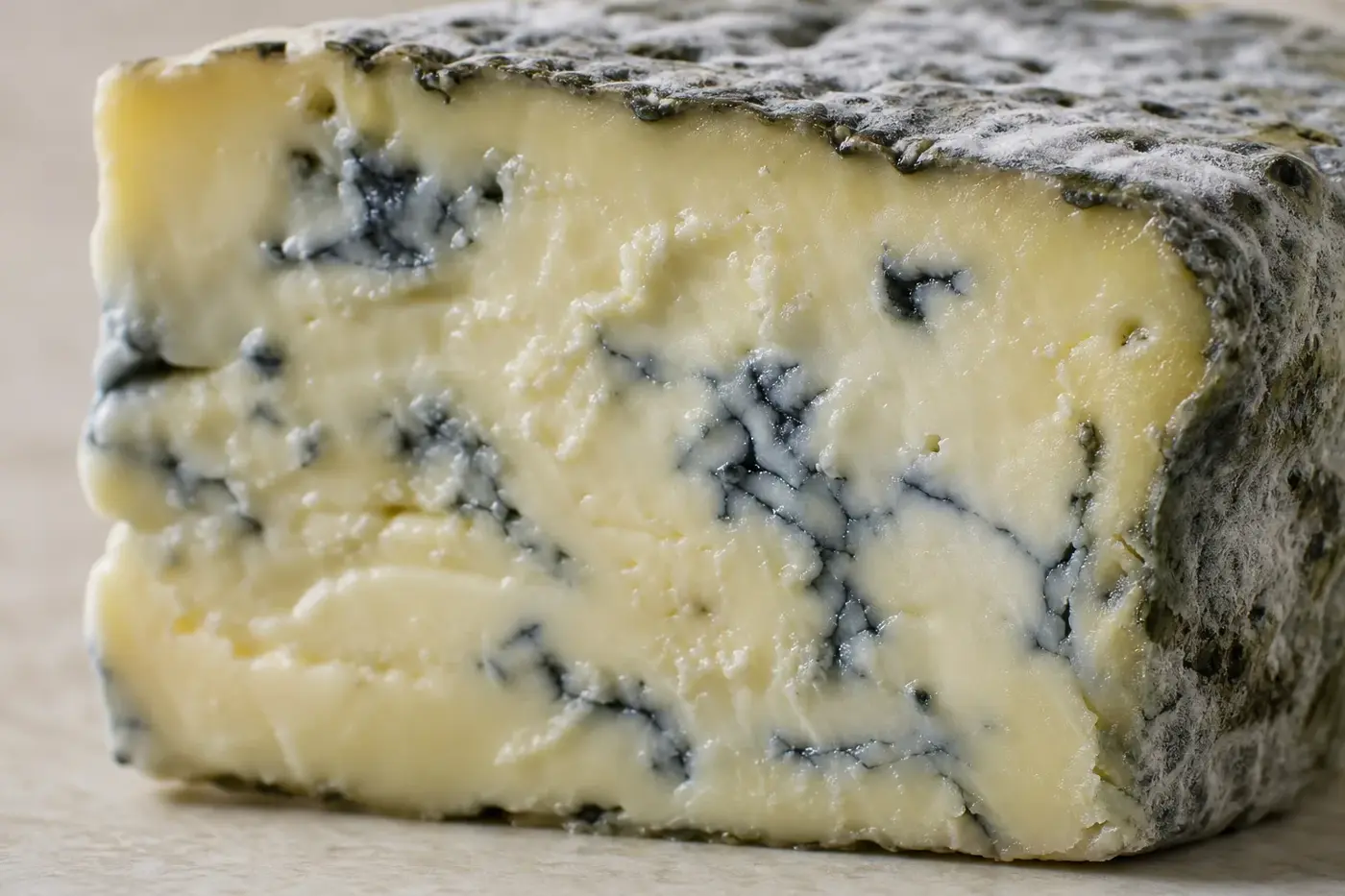
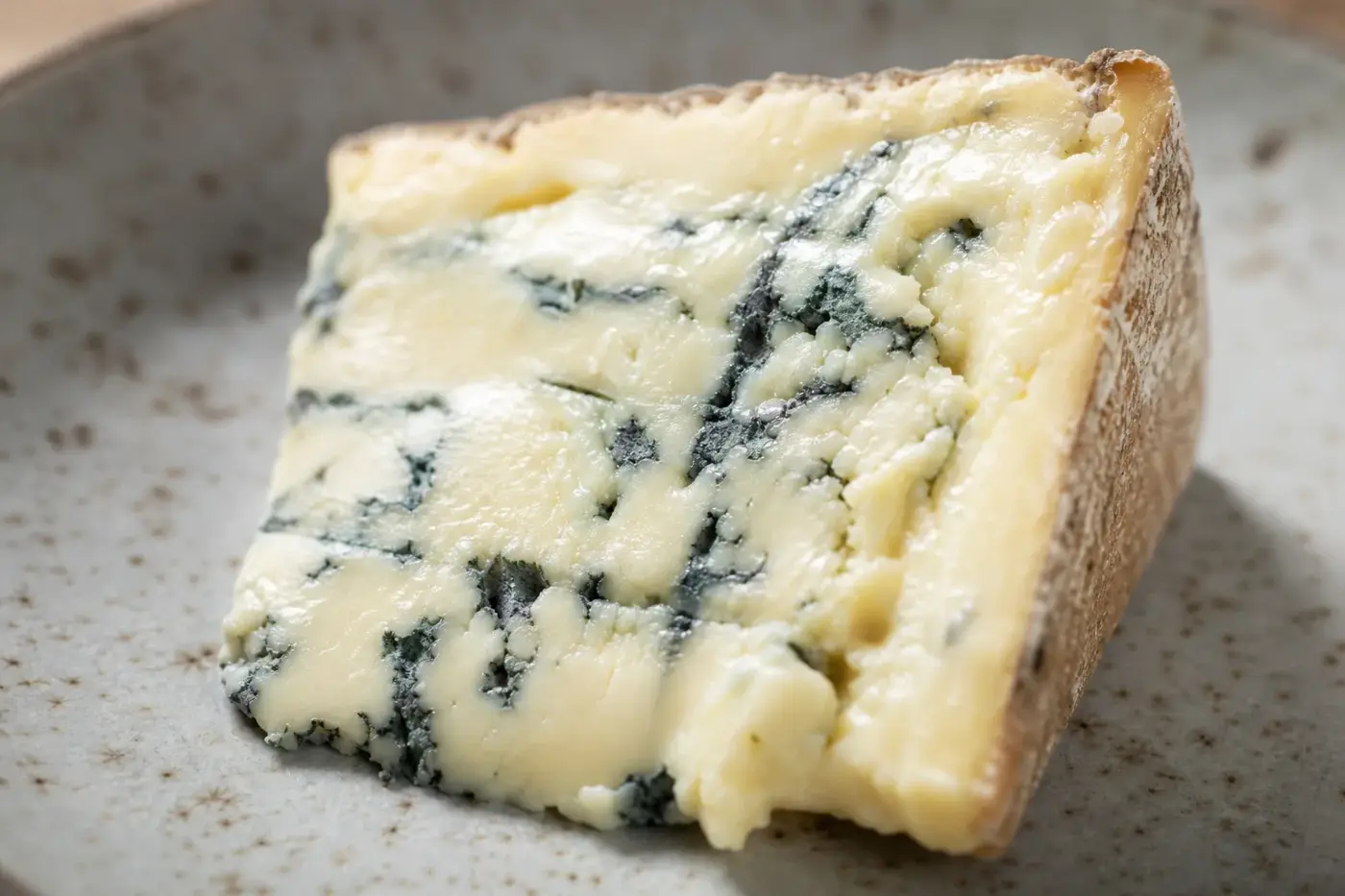
Below Dart Mountain, a former agricultural barn has swapped farm duties for cheesemaking. Here in Northern Ireland’s Sperrin Mountains, Dart Mountain Cheese made Sperrin Blue its first cheese and named it after the surrounding range. You get a creamy, blue-veined cow’s milk cheese, described by its maker as fudgy and piquant, with a dedicated maturing room in County Londonderry. Quite a change of career for a barn. [1,2,3]
Get to know Sperrin Blue
| What you might want to know | The detail |
|---|---|
| Maker | Dart Mountain Cheese [2] |
| Made in | Park, County Londonderry, Northern Ireland [2] |
| Milk | Pasteurised cow’s milk [1] |
| Where the milk comes from | Local farmers, as reported by Food NI in May 2018 [3] |
| Rennet | Described by the maker as vegetable [1] |
| Style | Creamy blue-veined cheese [1,3] |
| Rind | Mould-ripened [1] |
| Maker’s minimum maturation | Two months [1] |
| Where it matures | A dedicated maturing room [1] |
| Paste colour and detailed aroma | Detail not available |
| Cultures and piercing method | Detail not available |
| Registered name and register ID | Detail not available |
| Protection status in Northern Ireland and the EU | Detail not available |
| Protection status in Great Britain | Detail not available |
| Protection status in Switzerland | Detail not available |
| Protection status in the United States | Detail not available |
A family dairy takes root below Dart Mountain
The barn’s new chapter began in 2009, when the disused agricultural building became home to Dart Mountain Cheese. The family-run maker describes converting it, then learning about cheesemaking and ageing. Those beginnings laid the foundations for the dairy’s work with milk and maturation. [2]
You will find the dairy on Tamnagh Road, Park, in County Londonderry, also known as Derry. In the maker’s account, it sits just below Dart Mountain, which gave the business its name. Sperrin Blue takes its name from the wider mountain range, keeping both dairy and cheese firmly tied to their upland setting. [1,2]
That sense of place runs deeper than the names. In May 2018, industry body Food NI described Dart Mountain’s ambition to develop cheeses reflecting the Sperrins’ heritage and traditions. The idea was a range rooted here, with individual cheeses each getting their own treatment. [3]
Follow the milk, and get to know the rennet
Sperrin Blue starts with pasteurised cow’s milk and rennet the maker labels “vegetable”. Rennet helps milk proteins form a gel, allowing the cheesemaker to separate the curd, the solids, from the whey, the liquid. If you would like to know what different coagulants do, take a look at rennet explained. [1,4]
Food NI’s 2018 account says the milk came from local farmers, recording a connection with nearby milk production at that time. That is a different detail from the maker’s milk-treatment declaration. One tells you where the milk was reported to come from; the other tells you how it is treated. [3]
When you compare blue cheeses, begin with milk treatment and coagulant, then explore texture and maturity. Blue veins alone cannot tell you much about either ingredient choice. The guide to milk treatments explains the distinctions; for the piece you are buying, read the pack or ask the cheesemonger. [4]
Step inside the story of the blue veins
Sperrin Blue has a dedicated maturing room, where Dart Mountain gives it a minimum of two months. That time takes the cheese beyond fresh curd. Ripening shapes both its appearance and the character you find when you taste it. [1]
Across blue cheesemaking, veins develop where ripening mould grows inside the cheese. The familiar organism is Penicillium roqueforti, which needs oxygen. Spaces within the cheese allow the fungus to grow and form coloured spores, making that blue pattern a visible part of the ripening process. [4,5]
Piercing is a common way to let oxygen into blue cheeses. The scientific account in Microbiology Spectrum also describes the importance of an open curd structure, with spaces between curd particles. These principles explain internal veining, though the precise pattern depends on the cheese and how it is made. [4]
Culture choice matters, too. A 2020 study used fungal population genomics, laboratory assays and experimental cheeses to find differences between Penicillium roqueforti populations in fat breakdown and cheese-cavity colonisation. It helps explain how the culture, alongside maturing conditions, contributes to the character you eventually taste. [5]
Find the fudgy middle and the piquant edge
“Fudgy”, “piquant” and “balanced” are Dart Mountain’s words for Sperrin Blue. Fudgy describes the body, or paste; piquant points you towards the livelier edge of the flavour. The maker aims for creaminess and restrained salting, with greater intensity as the cheese ages. [1]
Give your first small piece a moment to itself, before introducing anything sweet. That mouthful gives you a reference point, helping you explore texture separately from flavour. The next might call for bread, fruit or, in the interests of thoroughness, another piece of cheese.
Ask the cheesemonger about maturity rather than automatically requesting the strongest piece. Tell them whether you prefer a gentler blue presence or a more forceful finish, and what you plan to serve with it. For a cheeseboard, consider the other cheeses; for cooking, decide how prominently you want that blue flavour to come through.
Make a little room for Sperrin Blue
Start with cheese, plain bread or an unsweetened biscuit, and one accompaniment. Taste the cheese first, then introduce a little sweetness or crunch. Keep everything separate so you can adjust each mouthful, especially if your piece has a pronounced blue flavour.
The maker suggests biscuits, a cider drizzle, leafy walnut salads and a beef burger. [1] You could also try fresh pear or apple, a few walnuts, or a modest spoonful of fruit chutney. Fruit gives you a contrasting mouthful, while nuts bring a firmer texture alongside the cheese. Choose one or two companions; the entire cupboard need not receive an invitation.
If you would like something without alcohol, try apple juice diluted with sparkling water or a cup of black tea. The first brings a fruit contrast; the second offers a drier finish. Keep plain water nearby for when you want to focus on the cheese between mouthfuls.
For serving temperature and timing, follow the Food Standards Agency guidance for England, Northern Ireland and Wales, as of November 2026. Keep dairy foods refrigerated at 0 to 5 °C (32 to 41 °F), taking out only the portion you are about to serve. Let that portion briefly lose its fridge chill while you prepare the plate. [6]
The FSA advises leaving chilled food out for the shortest possible preparation time, with a maximum of four hours. In hotter than usual weather, discard perishables left out for more than two hours. Return the main piece to the fridge rather than taking it repeatedly to the table. [6,7]
Look after your cheese, and know when to discard it
Keep the label or your cheesemonger’s written instructions with the cheese. The FSA advises refrigerating dairy products and following packaging instructions, including directions after opening. Protect your cheese from raw meat and possible drips: raw meat, poultry and fish should be contained on the bottom shelf. [6]
Look at the date on your piece. Official UK guidance distinguishes use-by dates, which concern safety, from best before dates, which concern quality. Storage conditions matter, because incorrect storage can make food deteriorate sooner. If a refrigerated piece has passed its use-by date, discard it. [8]
With blue cheese, intended ripening mould and unexpected contamination are different things. The FSA’s cheese-recovery guidance makes that distinction explicit. For soft cheeses with unwanted mould, it directs you to discard the whole cheese, because mould can penetrate beyond the growth you can see. [9]
If you cannot tell whether growth or deterioration is expected, do not eat the cheese. Discard cheese with unwanted mould rather than trimming it as though it were a hard cheese, and follow any recall notice for the affected product and batch. You can find fuller guidance in storing cheese at home and mould on cheese. [9,10]
General information only, not medical advice: follow the official guidance where you live.
Questions people ask
Where is Sperrin Blue made?
Dart Mountain Cheese makes it in Park, County Londonderry, Northern Ireland. The dairy sits just below Dart Mountain.
What milk and rennet are used in Sperrin Blue?
It is made with pasteurised cow’s milk and rennet described by the maker as vegetable. Food NI reported in May 2018 that the milk came from local farmers.
What does Sperrin Blue taste like?
The maker describes it as fudgy, piquant and balanced. It aims for creaminess with restrained salting, followed by greater intensity as the cheese ages.
What can I serve with Sperrin Blue?
The maker suggests biscuits, a cider drizzle, leafy walnut salads and a beef burger. Pear, apple, walnuts or fruit chutney are also suggested on the page.
How should I store Sperrin Blue?
The Food Standards Agency advises keeping dairy foods refrigerated at 0 to 5 °C and following packaging instructions. See the FSA’s food storage guidance for England, Northern Ireland and Wales.
Sources
- Dart Mountain Cheese, Sperrin Blue Cheese, undated product page, live version accessed November 2026. Maker’s declarations on milk, rennet, rind, maturation, sensory profile and serving suggestions. Product page.
- Dart Mountain Cheese, About us, undated, live version accessed November 2026. Maker’s account of the dairy conversion, family operation, location and business name. About us.
- Food NI, Northern Irish Dart Mountain success in Artisan Cheese Awards, 3 May 2018. Industry-body report supporting the historical local-milk sourcing statement and regional aims. Food NI report.
- American Society for Microbiology, The Basics of Cheesemaking, Microbiology Spectrum, 2013, DOI 10.1128/microbiolspec.CM-0002-2012. General cheesemaking and internal mould-ripening principles. Scientific article.
- CNRS, Université Paris-Saclay and collaborating institutions, Independent domestication events in the blue-cheese fungus Penicillium roqueforti, Molecular Ecology, 2020. Population-genomic research, laboratory phenotyping and experimental cheeses. Open-access paper.
- Food Standards Agency, How to chill, freeze and defrost food safely, published 18 December 2017, live version accessed November 2026. Applies to England, Northern Ireland and Wales. Official guidance.
- Food Standards Agency, Food safety in a heatwave, advice for consumers, 27 June 2024, live version accessed November 2026. Applies to England, Northern Ireland and Wales. Official hot-weather guidance.
- GOV.UK, Understanding food labelling: Best before and use-by dates, undated, live version accessed November 2026. Official date-marking guidance.
- Food Standards Agency, Cheese recovery guidance, undated PDF, live version accessed November 2026. Business guidance distinguishing intended ripening mould from unwanted contamination. Official guidance PDF.
- Food Standards Agency, Alerts, live database accessed November 2026. Official alerts database.
This desk-researched article combines the maker’s published account with a dated industry record, scientific explanations of blue-cheese ripening and official food-handling guidance.
Last checked: November 2026
Last checked November 2026.
The editors suggest you read next