Starter Cultures Explained
Inside a ripening Cheddar, a starter cell breaks open.
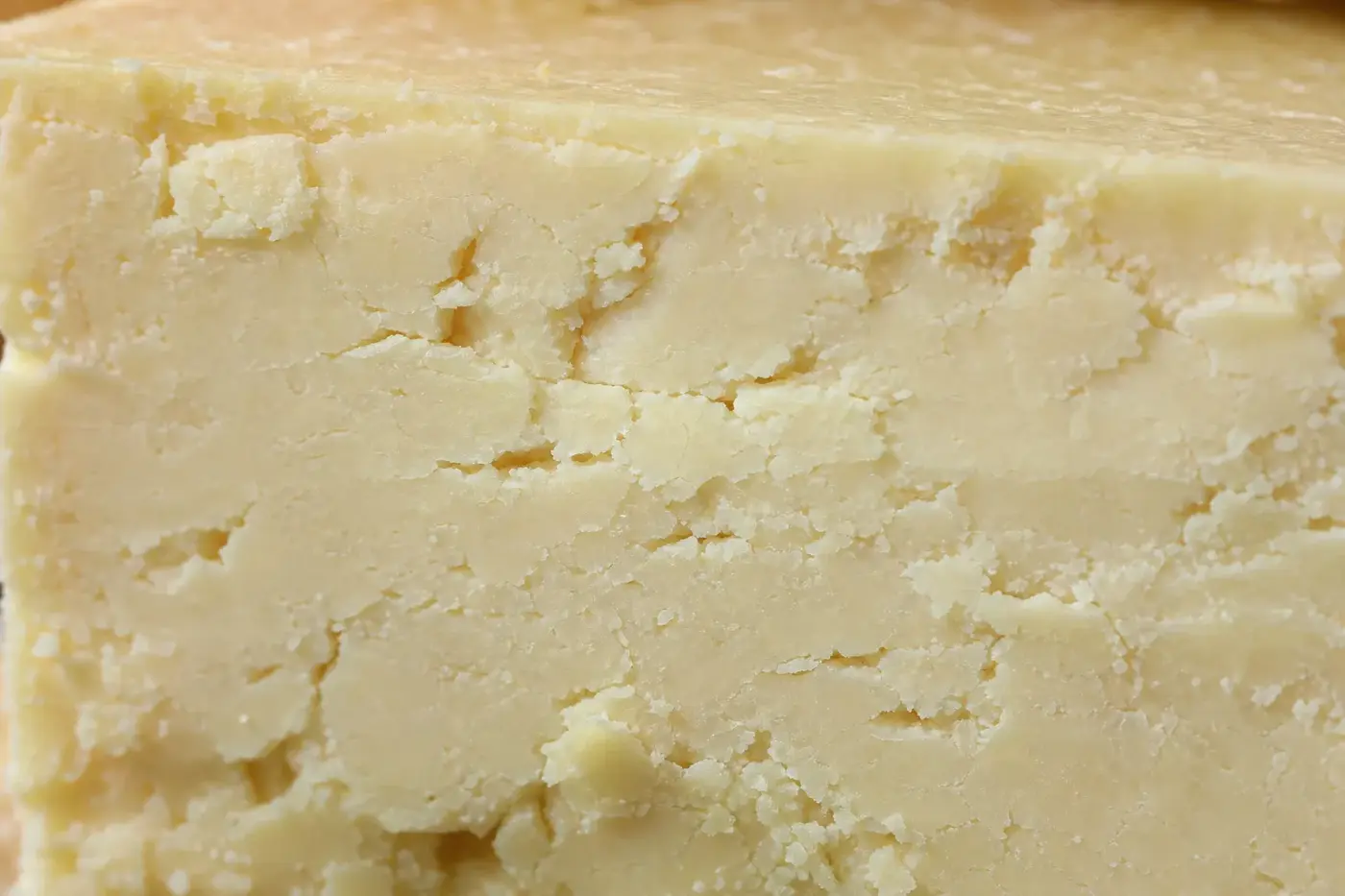
Inside a ripening Cheddar, a starter cell breaks open. Its growing days are finished, but its enzymes still have work to do. Earlier, back in the milk, selected microorganisms called starter cultures began fermentation, usually turning lactose, milk's sugar, into lactic acid. That acid helps shape how your curd forms and drains. [1, 2, 7]
Three things to take to the vat
- Your starter can go straight into the vat or first be grown in milk. [6]
- When starter cells break down, they can release enzymes that carry on working during ripening. [7]
- Bacteriophages can slow acidification or interrupt it altogether. [8]
Quiet milk, busy culture
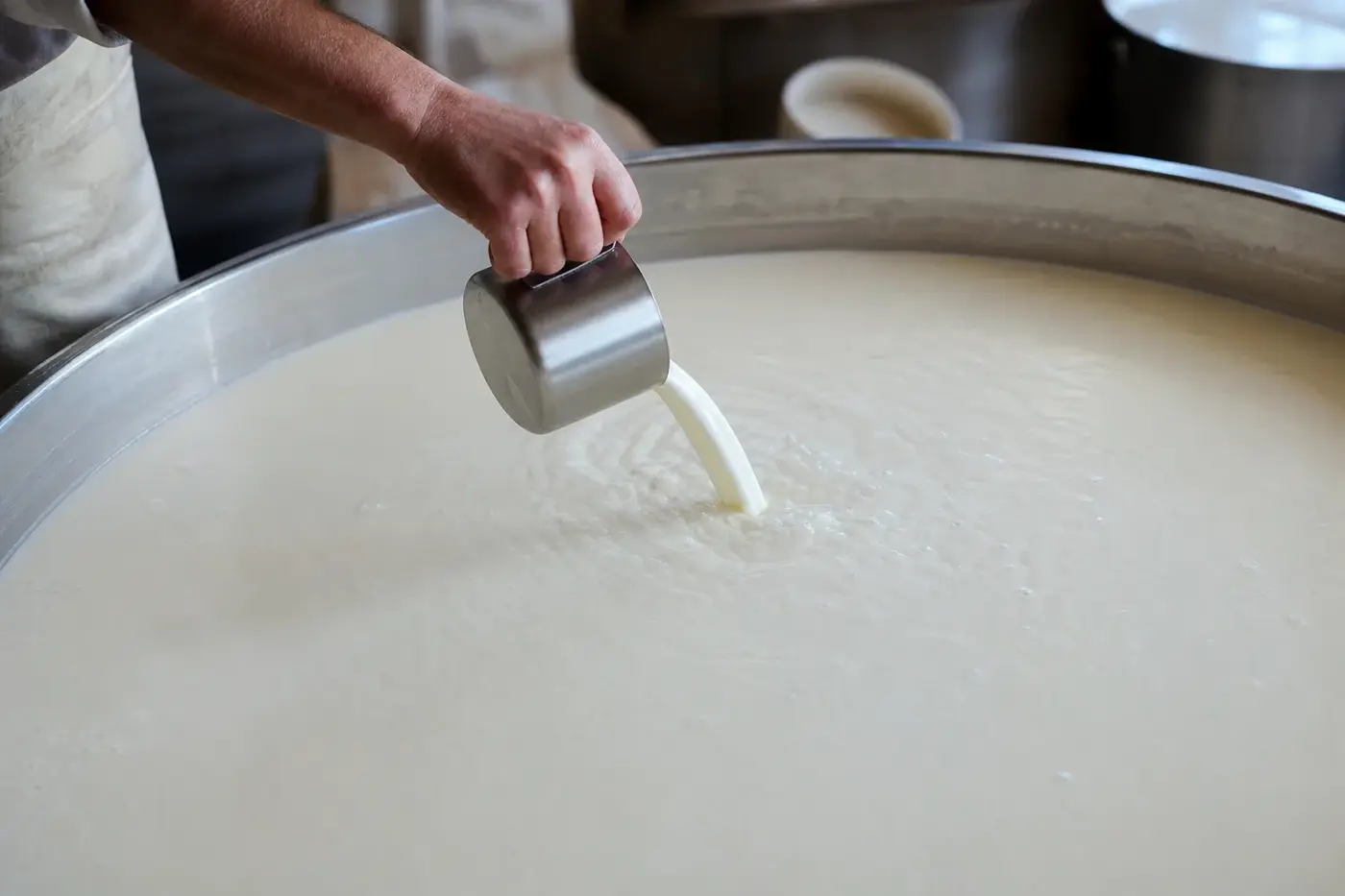
Look at the milk just after the culture goes in and you might notice nothing. Yet fermentation has begun. The cheesemaker has chosen organisms for a particular task, rather than waiting for whatever microbes happen to be there to multiply. There is rather more going on than the milk lets on. [2, 3]
The primary starter usually provides dependable acid production. Other deliberately added microorganisms may have different jobs. Codex's General Standard for Cheese makes room for both roles. [1, 2, 3]
This international reference standard permits cultures of harmless acid-producing or flavour-producing bacteria, and other harmless microorganisms. It also allows more specific provisions for individual cheese varieties. Its ingredient list reaches beyond the practical distinction between an acidifying starter and a ripening culture. [1]
Milk sugar gets a new job
Starter bacteria draw their energy from lactose. Through fermentation, they produce lactic acid, increasing acidity and lowering pH, the measure of how acidic milk or curd is. Follow that falling pH and you are watching a chemical change that matters to the next stages of cheesemaking. [2, 3]
The recipe matters, too. Research on a commercial Cheddar starter containing two strains found that changing fat and salt levels altered aspects of starter performance during ripening. Acid development depends on the particular organisms and conditions together. The cheese is the culture's working environment, not simply its address. [11]
How acid shapes your curd
Starter and rennet are partners, not substitutes. Rennet is an enzyme preparation that helps milk proteins form a gel, the first curd, while starter bacteria change the acidity. Modest acidification can help rennet coagulation. Both the amount of acid and when it develops affect the result. [2]
Acid also shifts the balance of calcium associated with casein, milk's main cheesemaking protein. As calcium phosphate dissolves, the protein network changes. Alongside cutting, stirring, heating and pressing, acid development affects curd firmness and how particles join together. Drainage timing counts because dissolved minerals can leave with the whey, the liquid separated from the curd. [2, 3]
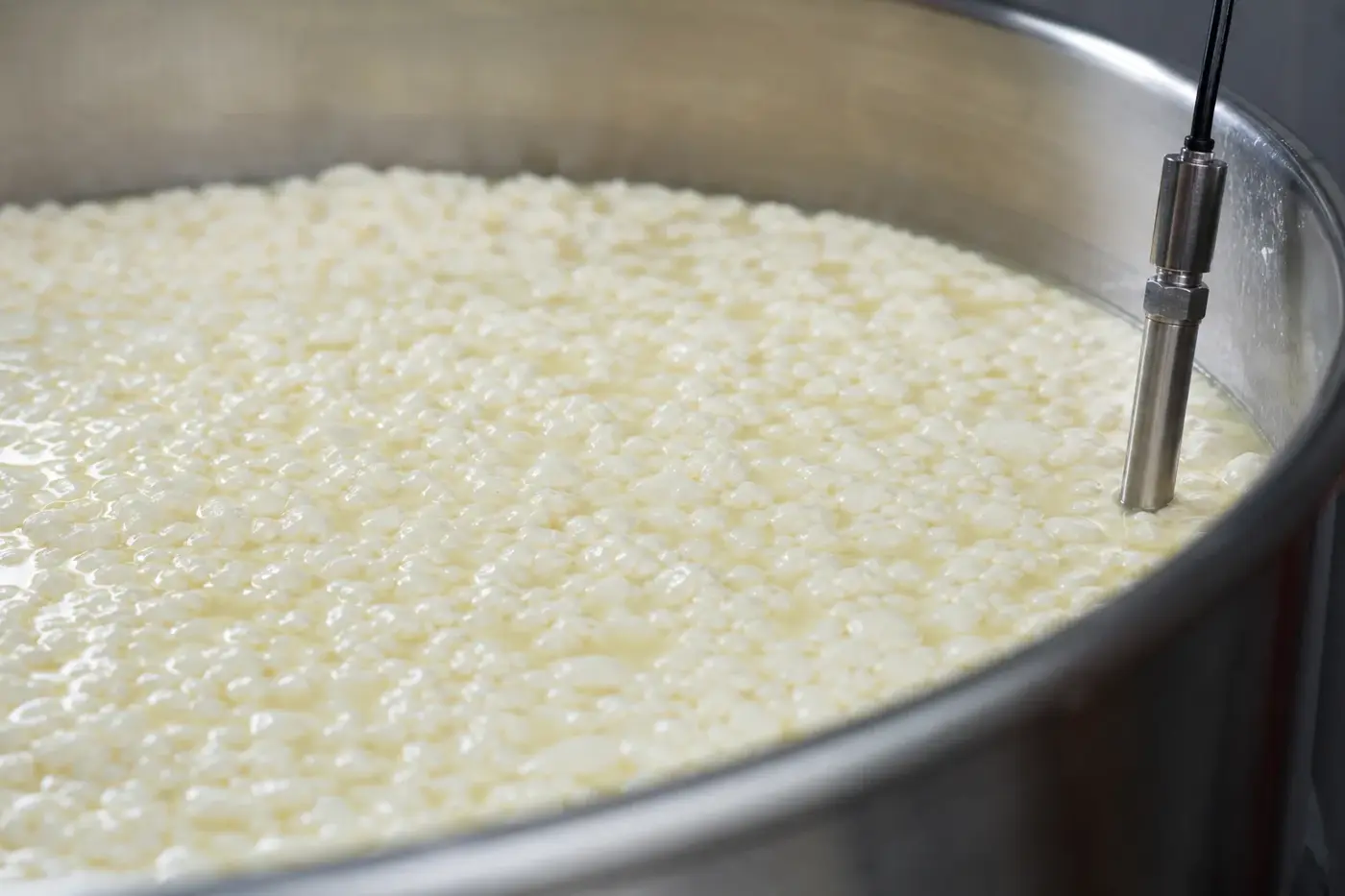
That network contracts and pushes out whey, a process called syneresis. Acidification helps govern it, but faster acid production does not necessarily give you firmer or drier cheese. Follow the whole sequence: acidity at cutting, how the curd is worked, and acidity when whey is removed. For the enzyme half of this partnership, see rennet explained. [2, 3]
Meet the bacteria and their preferred temperatures
Two names crop up on culture specifications: Lactococcus lactis and Streptococcus thermophilus. Both are recognised species names in the List of Prokaryotic names with Standing in Nomenclature. The first is associated with mesophilic starter systems, the second with thermophilic ones. Within each species, a strain is a particular lineage, and those differences matter when you make cheese. [3, 4]
Mesophilic cultures suit moderate temperatures; thermophilic cultures prefer warmer conditions. Treat those groups as useful guides, not identical temperature instructions for every member. A mixed culture can contain both, with different bacteria contributing at different points as milk and curd warm or cool. [3, 5]
One manufacturer's technical sheet brings that distinction into focus. It describes a mixed mesophilic and thermophilic culture for white cheese in brine, tested at 30 °C. That is the specified test condition for this preparation, not an optimum for every member of either group. The acidification result also depends on the stated milk medium and inoculation level. [5]
Straight to the vat, or a start in milk?
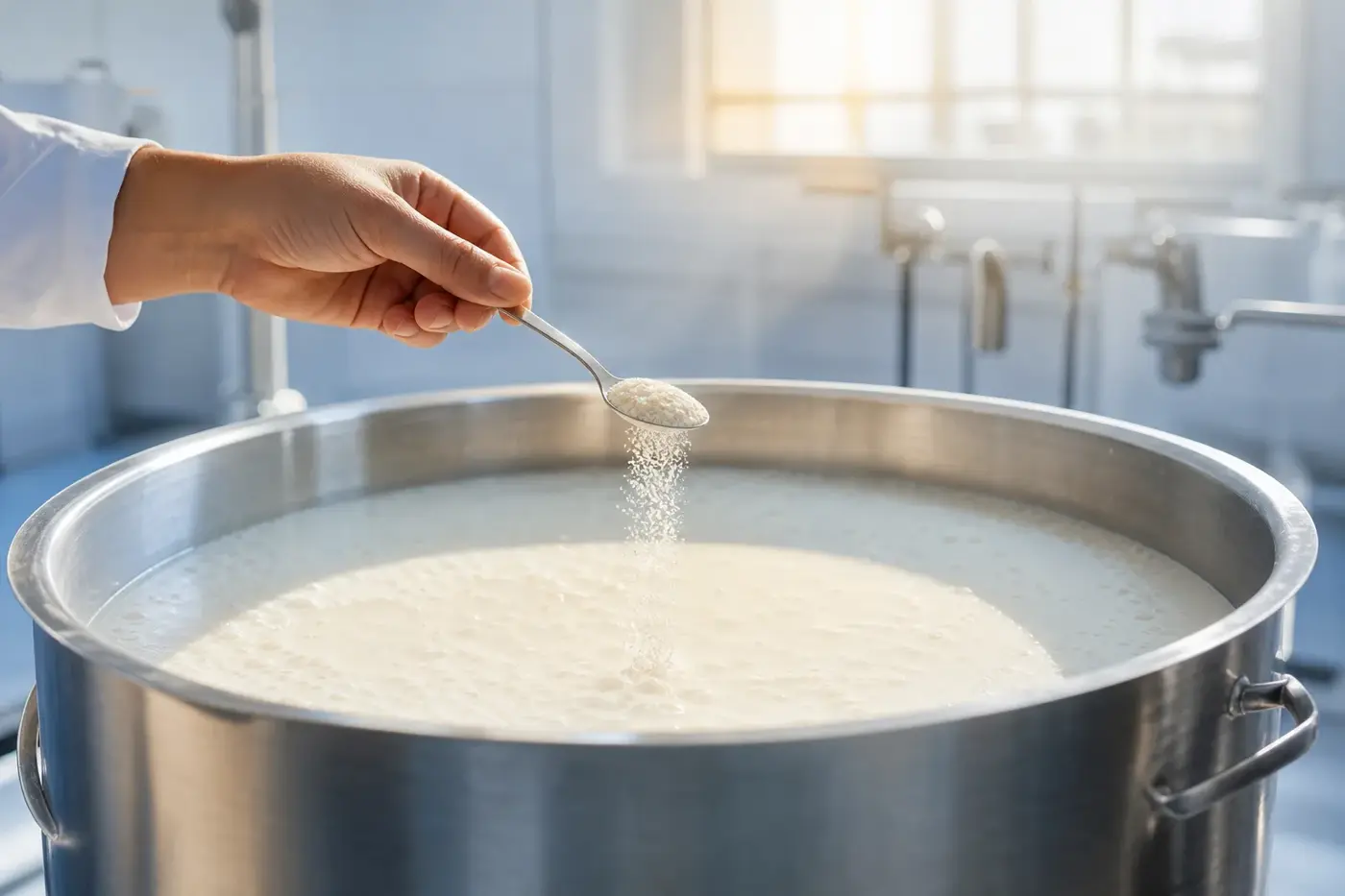
With direct vat inoculation, you add a concentrated culture to the cheese milk without first multiplying it at the dairy. Commercial preparations can be frozen or freeze-dried. A bulk starter takes another route: the cheesemaker first grows the organisms in a separate milk medium, then adds a measured quantity of that active culture to the vat. [6]
Either way, the culture must be active and uncontaminated. The European artisanal dairy hygiene guide advises following the manufacturer's storage temperature, protecting commercial cultures from humidity and light, and checking their condition and expiry date. A bulk starter gives you another fermentation to manage, with further opportunities for contamination or loss of activity. [6]
Follow the instructions for the preparation in your hands. The manufacturer of the brined-cheese culture, for example, specifies using the whole sachet to maintain consistent quality. Dividing a blended preparation by eye can conflict with those instructions, even when you are making only a small quantity of cheese. [5]
Choose for the cheese, not the stopwatch
Speed alone is no way to choose a culture. Think about the heating schedule, drainage method, salt application and ripening character you want. A suitable culture needs to deliver the right pattern of acid development and respond appropriately as the curd is heated, cooled or salted. [3, 6]
That is why cheesemakers follow temperature, elapsed time and acid development together. A pH reading needs its place in the make: the same value reached before draining or much later tells a different processing story. The FSA's commissioned cheesemaking research stresses that acid-development measurements need a time reference, while comparable pH measurements require comparable temperatures. [2]
Find the culture behind a familiar cheese
Cheddar manufacture commonly uses lactococcal mesophilic starters. Thermophilic systems suit higher-temperature makes, including many cultured mozzarella processes. Blends can bridge the groups, so you learn more from a supplier's performance data than from a sachet that simply names a cheese style. These are tendencies, not fixed recipes. [3, 5]
Even within Cheddar, starter choice can change the course of ripening. In a controlled study, cheeses made with two different starter strains showed markedly different cell breakdown and fat breakdown. Researchers made the cheeses in triplicate and followed them for 238 days. They compared the strains directly, rather than treating every member of a starter group as interchangeable. [7]
Get to know the supporting cast
An adjunct is deliberately added for a supporting purpose, commonly ripening or flavour development, rather than main acidification. Non-starter lactic acid bacteria sit outside the primary starter population and often come from the milk or dairy environment. These labels tell you about role and origin in a particular make. They do not divide organisms into useful and useless camps. [3]
The same strain can be a starter in one cheese and an adjunct in another. You need the manufacturing context to make sense of a culture list: finding an organism does not establish that it drove the early fall in pH. During ripening, microbial communities develop under the conditions created by the make, including acidity, moisture and salt. [3]
The cell stops, the enzymes carry on
Autolysis is a cell breaking open and releasing its contents into the cheese. This is how a starter can contribute enzymes after it stops growing. In the Cheddar experiment, researchers tracked an intracellular marker enzyme in extracted cheese juice. One strain showed much greater autolysis than the other, alongside differences in released fatty acids. [7]
Protein breakdown gives you another part of the story. Peptidases are enzymes that cut peptides, the smaller fragments formed when proteins break down. An experimental reduced-fat Cheddar study examined how starter proteinase specificity affected peptide accumulation and bitterness. It also identified an intracellular peptidase, released through starter autolysis, that can break down a particular bitter peptide. [10]
Meet the viruses that can stop the vat
Bacteriophages, usually called phages, are viruses that infect bacteria. A phage able to infect a starter strain can multiply inside its cells, bursting them and releasing more phages. As susceptible starter cells are lost, acidification may slow or fermentation may stall. [8]
Whey movement and aerosols are among the routes that spread phages around dairies, according to the University of Wisconsin's Center for Dairy Research. Its controls include appropriate cleaning, separation of sensitive operations and planned culture rotation. Direct addition removes the bulk-starter propagation stage, taking away one opportunity for infection. It does not stop phages reaching the cheese vat. [8]
This page summarises published guidance from the official sources it cites. It is not medical advice. Guidance differs between countries and changes over time, so check the current source for where you live, and ask your doctor, midwife, pharmacist or dietitian about your own circumstances.
Where acidity fits into cheese safety
Acidification helps you control cheesemaking, but it belongs within a wider set of safeguards. The FSA's commissioned research describes acid development as a barrier to pathogen growth and documents why organisms surviving manufacture can remain relevant later. A particular pH therefore needs to be considered alongside the milk, hygiene, temperature history and the cheese's other characteristics. [2]
For UK food businesses, the FSA's published guidance, as of November 2026, describes food safety management through hazard analysis, monitoring and records. Those principles put acidification among several controls, not on its own. For the broader context and directions to official advice, turn to the related cheese food safety guide. [9]
Follow your curiosity beyond the vat
For the full sequence around the starter, read how cheese is made. Then explore wild cultures to understand how microbial communities are maintained, and culture temperature groups for strain behaviour. Ripening bacteria take you into changes after manufacture; bacteriophages explain the causes and management of interrupted fermentation.
Questions people ask
What is a cheese starter culture?
A starter culture is a selection of microorganisms added to milk to begin fermentation. Starter bacteria usually turn lactose into lactic acid, changing how the curd forms and drains.
What is the difference between starter culture and rennet?
Starter bacteria change the acidity of the milk. Rennet is an enzyme preparation that helps milk proteins form a gel, which becomes the first curd.
What is the difference between mesophilic and thermophilic cultures?
Mesophilic cultures suit moderate temperatures, while thermophilic cultures suit warmer conditions. A mixed culture can contain both, with different bacteria contributing as the milk and curd warm or cool.
How is starter culture added to cheese milk?
A concentrated culture can be added directly to the vat without first multiplying it at the dairy. Alternatively, a cheesemaker can grow a bulk starter in a separate milk medium and add a measured quantity to the vat.
What can stop a starter culture from acidifying milk?
Bacteriophages are viruses that infect bacteria and can burst susceptible starter cells. As those cells are lost, acidification may slow or fermentation may stall.
Sources
-
FAO and WHO, Codex Alimentarius Commission. General Standard for Cheese, CXS 283-1978. Revised 1999, amended through 2024. Sections 1 and 3.2 establish the standard's scope and permitted culture ingredients. Official standard.
-
Food Standards Agency, Campden BRI and Queen's University Belfast. Persistence of Mycobacterium bovis and Verocytotoxin-producing Escherichia coli (VTEC) in UK-made raw-milk cheeses. Final report B12008, project completed 2011. Part 1, sections on cheesemaking, pH and acidity, and experimental cheese manufacture. Report.
-
American Society for Microbiology, Microbiology Spectrum. Mesophilic and Thermophilic Cultures Used in Traditional Cheesemaking. 2013. Technical review, DOI 10.1128/microbiolspec.CM-0004-2012. Sections on starter classification, direct addition, salt sensitivity and acid development. Published review.
-
Leibniz Institute DSMZ, List of Prokaryotic names with Standing in Nomenclature. Species: Lactococcus lactis and Species: Streptococcus thermophilus. Live nomenclatural records, checked November 2026. Lactococcus lactis record and Streptococcus thermophilus record.
-
IFF, Danisco. CHOOZIT FT 001 LYO 100 DCU, Product Description PD 250675-8.0EN. Valid from 15 May 2024. Manufacturer's technical data, retrieved from a distributor-hosted copy. The manufacturer has a commercial interest in the preparation described. Technical sheet.
-
Farmhouse and Artisan Cheese and Dairy Producers European Network. European Guide for Good Hygiene Practices in the Production of Artisanal Cheese and Dairy Products. Revised 20 December 2016, section III, “Cultures”, page 25. Industry-authored guidance hosted by the European Commission. Guide.
-
Teagasc Dairy Products Research Centre, Journal of Dairy Research. Evidence of a relationship between autolysis of starter bacteria and lipolysis in cheddar cheese during ripening. Volume 70, issue 1, 2003, pages 105 to 113. DOI 10.1017/S0022029902005915. Published abstract.
-
University of Wisconsin-Madison, Center for Dairy Research. Understanding and Preventing Bacteriophage. Dairy Pipeline, volume 29, number 2, 2017. Institutional technical guidance on infection, transmission and control. Publication.
-
Food Standards Agency. Managing food safety. Live guidance, checked November 2026. Sections on food safety management procedures and HACCP, meaning Hazard Analysis and Critical Control Point. Official guidance.
-
American Society for Microbiology, Applied and Environmental Microbiology. Contribution of Lactococcus lactis Cell Envelope Proteinase Specificity to Peptide Accumulation and Bitterness in Reduced-Fat Cheddar Cheese. 2002. Retrieved article extract concerning starter autolysis, intracellular peptidase PepO and peptide breakdown. Article record.
-
Journal of Dairy Science. Effect of varying the salt and fat content in Cheddar cheese on aspects of the performance of a commercial starter culture preparation during ripening. 2016. Retrieved abstract extract describing the commercial starter and effects on autolysis, permeabilisation and intracellular enzyme release. Abstract record.
This piece was researched through desk research, bringing together an international standard, taxonomic records, technical culture documentation, experimental research and official food safety material.
Last checked: November 2026
Last checked November 2026.
The editors suggest you read next
Wild Cultures vs Commercial Starters
Yesterday’s whey slips into today’s vat, carrying a dairy’s living culture with it.