String Cheese
Catch a thin strip at the end of a cheese stick and pull downwards.
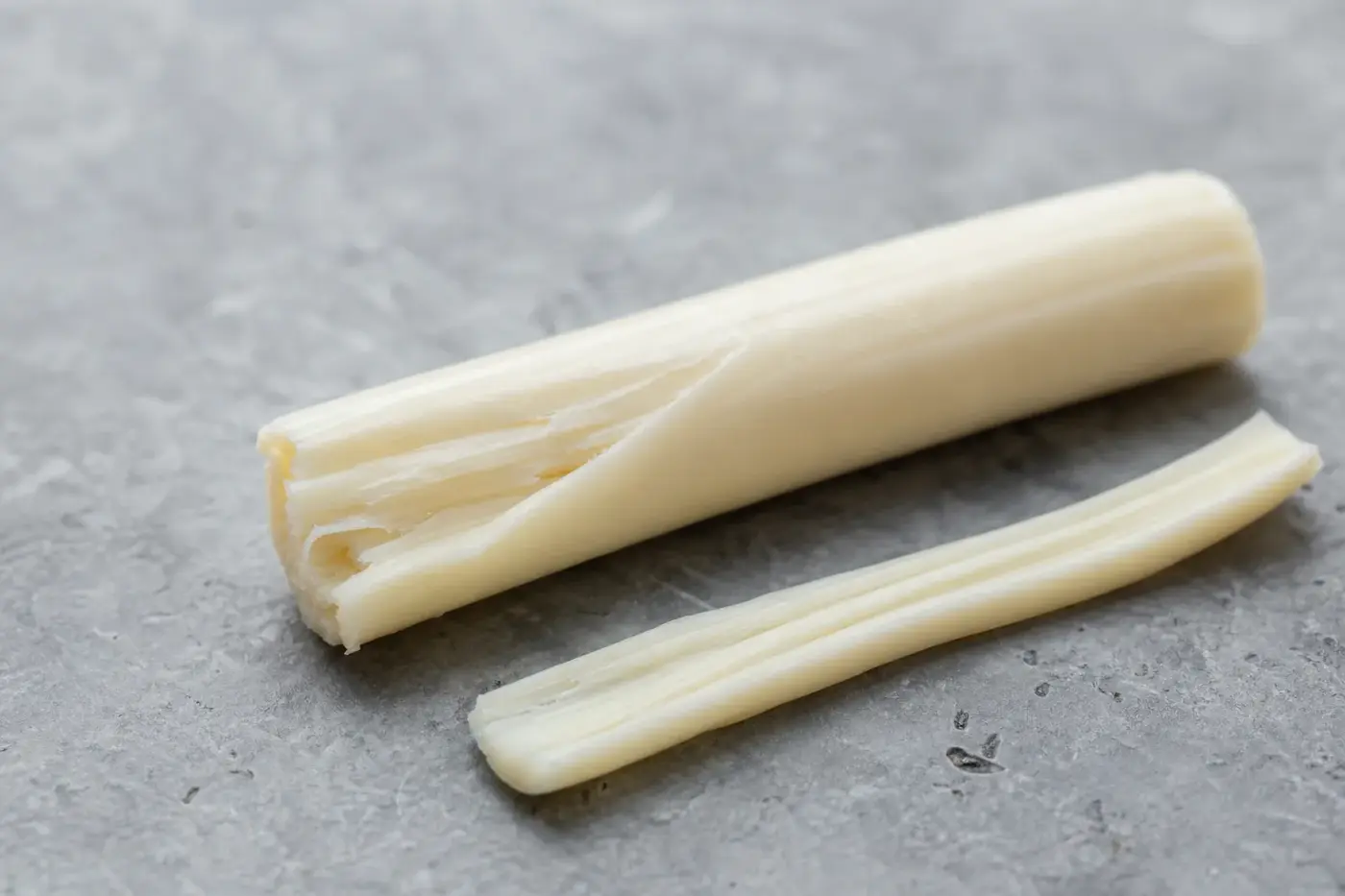
Catch a thin strip at the end of a cheese stick and pull downwards. A long strand peels away instead of crumbling, a small pleasure that can make eating feel pleasantly like unwrapping. That unravelling is string cheese’s calling card: warm curd stretched into a fibrous structure, then shaped into snack mozzarella, braids or wound ribbons.[1][2]
| What to know | The short version |
|---|---|
| Its signature trick | A fibrous structure you can separate into lengthwise strands.[1] |
| How it happens | Kneading and stretching warm curd brings its protein structure into alignment.[2] |
| Shapes to look out for | Mozzarella sticks, Armenian chechil, Slovak korbáčiky and Mexican wound quesillo.[3][6][7][9] |
| The milk behind it | It depends on the cheese: documented examples use cow’s milk, while Armenian traditions include other milks.[5][6][7] |
| Rind and finishing touches | Familiar mozzarella sticks have no rind; some regional string cheeses are smoked.[3][6] |
Follow the strand to find the family
A straight stick, a plait and a ball of wound ribbon might seem unlikely relatives. Pull them apart, though, and you can find the same narrow, connected strands running along their length. That fibrous structure brings them into the string cheese family.[1][2][6][7]
Your familiar snack version belongs to the mozzarella family. Manufacturer product listings distinguish mozzarella string cheese from other snack formats, including sticks and cubes. A stick is not necessarily string cheese: a promising silhouette is no guarantee of a good peel.[3]
If that familiar snack is what you want, look for plain, rindless mozzarella string cheese. Read the cheese’s actual name, not just the description on the front. It may explain the composition when “string cheese” leaves you guessing.[3]
Into the warmth, where curd becomes strands
Before you can pull a strand, milk has to become a gel, then curd. Under the US mozzarella standard, bacterial culture develops acidity and clotting enzymes set the milk. Cutting that set mass helps separate solid curd from liquid whey.[4]
The curd then drains and develops the properties it needs for stretching. Hot water or steam heats it, kneading smooths it, and stretching and shaping give it form. Cooling firms the cheese: that is the shared principle, although acidification, salting, shaping and finishing differ between cheeses.[2][4][6]
| Stage | What happens | What it does for your cheese |
|---|---|---|
| Setting | Acid development and clotting enzymes turn milk into a gel. | Builds the curd’s protein network.[4] |
| Cutting and draining | The gel is divided and whey separates. | Changes the moisture and structure.[2][4] |
| Heating and stretching | Warm curd is kneaded and drawn out. | Creates the aligned, fibrous structure.[2] |
| Shaping | Worked cheese becomes sticks, threads or ribbons. | Gives each cheese its recognisable form.[3][6][7] |
| Cooling | The shaped cheese firms. | Helps it hold its shape and changes the distribution of fat and whey.[2] |
You may meet the Italian term pasta filata, meaning stretched-curd cheese. It describes a manufacturing family, not one particular shape or origin. For the story before the stretching begins, explore how cheese is made.[8]
Look closer at the secret of the peel
Stretching gives cheese a grain, and your fingers can follow it. Inside, a network of milk proteins, principally casein, holds water and fat. Pulling the curd organises that network in the direction of the pull, rather than leaving it equally arranged in every direction.[1][2]
A microscopy study followed low-moisture, part-skim mozzarella through manufacture. After stretching and moulding, researchers saw aligned protein fibres, with lengthwise columns of whey and fat between them. Cooling in brine brought further changes, including solidifying the fat globules.[2]
Peel a narrow strip and you follow that lengthwise organisation. Cut across the stick and your knife crosses the aligned structure instead of separating long fibres. You have the same cheese, but two quite different experiences.[1][2]
Another experimental study tested mozzarella curds made with different acidity and stretching treatments. Researchers measured mechanical behaviour and stringiness, and microscopy linked stringiness with a uniformly lengthwise protein structure. Heat alone cannot take the credit: the arrangement of those proteins matters.[1]
Enjoy the peel, but do not confuse it with melted stretch
Peelability means fibres separate while the cheese keeps its shape. Melted stretch happens when heated cheese softens and you pull it. Both depend on the protein network, but temperature and processing change how that network behaves.[1][8]
Rubberiness is a different matter. It means resistance and springiness under compression or as you chew, so a cheese can resist your bite without parting neatly into threads. The experimental string-cheese study measured compression and flow separately from its dedicated stringiness test, making that distinction clear.[1]
You can try the distinction at the table. Does a strip separate cleanly along the cheese, or does the whole piece simply bend and spring back?
Travel beyond the familiar snack stick
Armenian chechil: follow the braid back to the villages
Pull apart a chechil braid and you see how it is built: arranged strands separating into finer fibres. Armenian ethnographic research published by Yerevan State University records considerable variation between villages in names, preparation and preservation. Skimmed cow’s milk is described as the principal milk, with sheep’s and buffalo milk also documented in the tradition.[5]
The research describes hands working the curd and cheese stored in brine, alongside other preservation practices. Those local ways of making and handling chechil belong to its identity just as much as the threads do. Look beyond the handsome braid and there is a whole tradition of craft.[5]
Slovak korbáčiky: discover the little plaited whips
Slovak korbáčiky look like little plaited whips. For Zázrivský korbáčik, the published specification describes partially ripened lump cheese heated in water and worked into a pliable mass. Makers then pull it into threads and plait it, with both smoked and unsmoked versions permitted.[6]
You can expect a milky, salty and slightly acid flavour, according to the specification. The smoked version adds a smoky aroma, while the threads should offer separable fibres and an elastic to firmer consistency. The starting cheese must come from cow’s milk, either raw or pasteurised.[6]
The full name matters legally too. As of November 2026, Zázrivský korbáčik is listed as a registered Protected Geographical Indication in Great Britain; the register records its UK scheme registration on 31 December 2020. “Korbáčiky” is the broader descriptive term used here.[9]
Mexican Oaxaca cheese and quesillo: start at the ribbon’s end
With Mexican Oaxaca cheese, you meet the family in wound-ribbon form. The official Mexican account for Quesillo de Reyes Etla describes cow’s milk curd kneaded with hot water and stretched into ribbons. Those ribbons are cooled, salted and wound by hand into a rounded piece.[7]
That account documents the Reyes Etla tradition in Oaxaca, rather than every cheese sold as Oaxaca cheese. Milk treatment and production requirements can differ. To serve yours, find the ribbon’s end, unwind it and separate smaller portions: you can follow the maker’s work as you go.[7]
Find the flavours that suit your appetite
Milk, acidity, fat, moisture and stretching conditions all help shape the finished structure. Experimental string-cheese research found that acidity strongly affected mechanical properties. The mozzarella stretching literature also identifies interactions between processing conditions, protein, water and fat.[1][8]
Then come salt and smoke. The Zázrivský korbáčik specification distinguishes smoked and unsmoked products by colour, aroma and permitted salt content, while Armenian research documents brining and local preparation differences. A pale mozzarella stick, a brined braid and a smoked whip belong to a broad textural family, but each offers you a different mouthful.[5][6]
Choose according to what you want the cheese to do. For peeling, look for “string cheese” or a description mentioning separable fibres; for cooking, consider moisture, salt and the flavour your dish needs. A braid or a stretched curd does not make every cheese behave alike.[1][6][8]
Get peeling, then set the table
Start at one end of a stick, lift a narrow strip and pull slowly along its length. Loosen a braid before teasing apart its strands, or find the end of a wound ribbon. Follow the structure already there rather than tearing across it.[1][6][7]
You do not need to crowd these cheeses with competing flavours. A cheese board need not become a committee meeting. These suggested pairings give each style room to show its character:
- Plain mozzarella strings with tomato and basil: put the accompaniments alongside the cheese.
- A salty braid with cucumber and flatbread: give the cheese a contrast of vegetables and bread, and taste before adding salt.
- Smoked korbáčiky with apple and plain bread: let one smoked ingredient lead, without competing flavours.
- Any of these with water or unsweetened iced tea: simple alcohol-free drinks leave you room to compare the cheeses.
If you are cooking, tear or cut the cheese into pieces that suit the dish. Try mozzarella strings in a toasted sandwich, or separated quesillo ribbons in a tortilla filling. These are serving ideas, so use a complete recipe for cooking and handling instructions.
Those lovely long cold strands cannot promise you a particular result in the pan. Moisture, composition and processing affect how mozzarella behaves when heated. Choose your cooking cheese for the result you want, not for peelability alone.[8]
Read the label, then make room in the fridge
Start with the food’s name, then look for milk treatment where stated, ingredients, allergen information and storage instructions. UK government guidance includes milk among the allergens that must be communicated. It also explains that some simply composed cheeses are exempt from an ingredients list, so read the whole label: no ingredients list does not mean no allergens.[10]
For US products, the displayed mozzarella standards allow specified dairy ingredients, clotting enzymes and optional ingredients including salt and vinegar. They distinguish low-moisture mozzarella from low-moisture part-skim mozzarella. The standards tell you the permitted composition; the label tells you what the manufacturer declares for that particular cheese.[4]
For household storage in England, Northern Ireland and Wales, the Food Standards Agency advises a fridge temperature between 0 and 5 °C, alongside the packaging’s storage instructions. Use a fridge thermometer to check the temperature. Once you open the cheese, follow the pack’s instructions, including any shorter consumption period.[11]
Keep the wrapper until you have finished the cheese. That keeps the date, opening instructions and batch details within reach. For more help, turn to how to read a cheese label and how to store cheese at home.
General information only, not medical advice: follow the official guidance where you live.
Questions people ask
Why does string cheese peel into strands?
Kneading and stretching warm curd aligns its protein structure in the direction of the pull. A narrow strip follows that lengthwise structure and separates into fibres.
Is all cheese sold in sticks string cheese?
No. A stick is not necessarily string cheese, because shape alone does not tell you whether it peels. Look for a product described as string cheese or as having separable fibres.
Does cheese that peels well also stretch well when melted?
Not necessarily. Peelability is the separation of fibres while cheese retains its shape, whereas melted stretch happens when heated cheese softens and is pulled. Moisture, composition and processing affect how mozzarella behaves when heated.
What milk is used to make string cheese?
It varies by cheese. Zázrivský korbáčik starts with cow’s milk, while Armenian chechil traditions also include sheep’s and buffalo milk.
How should I store string cheese at home?
For England, Northern Ireland and Wales, the Food Standards Agency advises keeping the fridge between 0 and 5 °C and following the packaging’s storage instructions. After opening, follow the pack’s instructions, including any shorter consumption period. See the Food Standards Agency’s guidance.
Sources
- Utah State University repository, Food Structure, “Structure and Rheology of String Cheese”, volume 11, issue 1, article 7, 1992. Experimental mechanical testing, image analysis and microscopy. Research record.
- Utah State University repository, Food Structure, “Microstructure of Mozzarella Cheese During Manufacture”, volume 12, issue 2, article 12, 1993. Scanning electron microscopy during manufacture. Research record.
- Sargento Foods Incorporated, “Snack Cheese”, manufacturer’s product listing, undated, retrieved November 2026. Commercial primary source used for product names and formats. Product listing.
- US Government Publishing Office and Office of the Federal Register, Electronic Code of Federal Regulations, 21 CFR §§ 133.155, 133.156 and 133.158, displayed edition current to 26 October 2026. Mozzarella, low-moisture mozzarella, low-moisture part-skim mozzarella.
- Yerevan State University Publishing House, History and Culture, “Traditional Skills in Chechil Cheese-Making and Preservation Among Armenians”, 2025. Ethnographic research record and abstract. Research record.
- European Commission, “Publication of an application”, single document for “Zázrivský korbáčik”, 2010/C 188/11, 13 July 2010, sections 3.2, 3.3 and 3.5. Historical specification publication, not used alone to establish present registration. Official document.
- Instituto Mexicano de la Propiedad Industrial, “Declaración de Protección de la Indicación Geográfica Quesillo de Reyes Etla”, 2025, production description and geographical delimitation. Official declaration.
- Food Technology and Biotechnology, “Mozzarella Cheese Stretching: A Minireview”, volume 59, issue 1, 2021, pages 82 to 91. Research synthesis used for processing relationships. Full text.
- Department for Environment, Food & Rural Affairs, “Zázrivský korbáčik”, Great Britain protected food names register, published 4 January 2021, retrieved November 2026. Register entry.
- UK government, “Food labelling: giving food information to consumers”, live guidance, retrieved November 2026, sections on allergens, ingredients and storage conditions. Official guidance.
- Food Standards Agency, “How to chill, freeze and defrost food safely”, published 18 December 2017, live guidance retrieved November 2026, sections 1 and 4. Applies to England, Northern Ireland and Wales. Official guidance.
Researched through published dairy science, Armenian ethnographic research, official regional production documents, food standards and national consumer guidance, with manufacturer records used for snack formats.
Last checked: November 2026
Last checked November 2026.
The editors suggest you read next
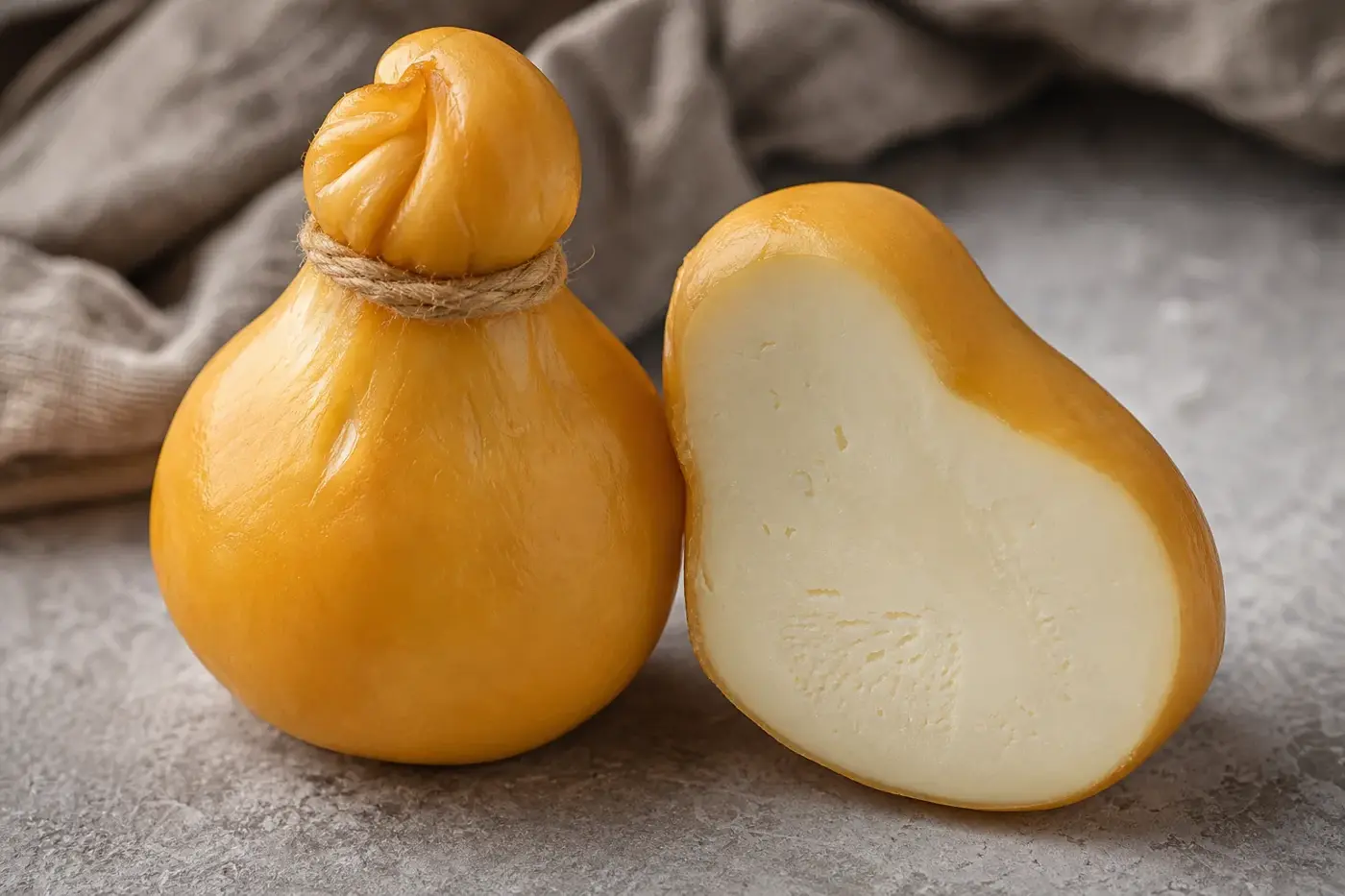
Smoked Cheese Explained
Your knife slips through the golden skin of a Puglian scamorza.