Syrian Cheese
Cut into halawet el jibn and you find cream tucked inside a thin wrapper of cheese and semolina.
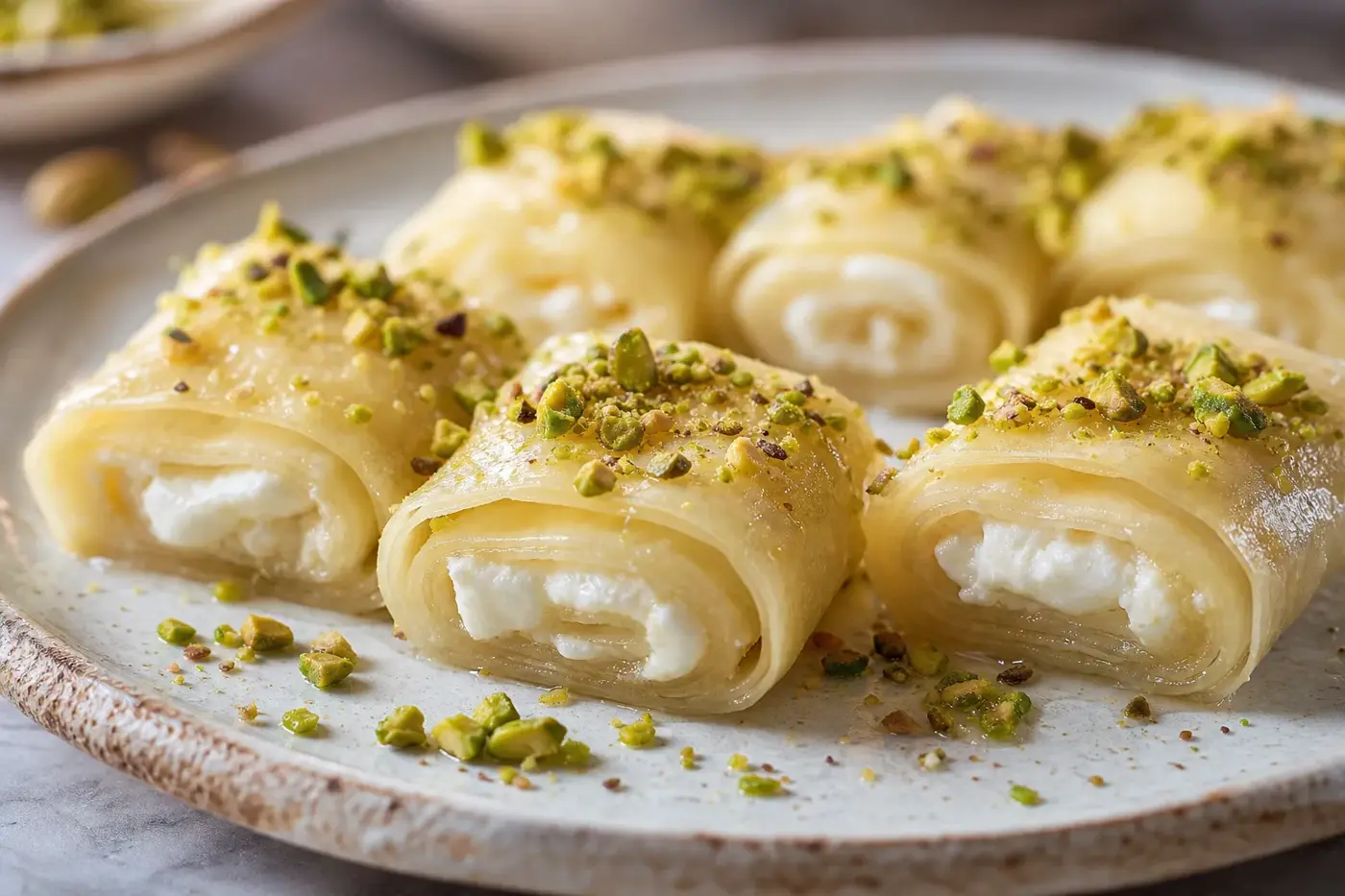
Cut into halawet el jibn and you find cream tucked inside a thin wrapper of cheese and semolina. The rolls come finished with pistachios and syrup, a sweet closely associated with Hama and Homs.[1,2] If you thought cheese belonged in the filling, it has quietly taken charge of the whole arrangement.
This sweet is one doorway into Syria’s dairy tradition. Step beyond it and you meet fresh white blocks, braided strands and dried, ripened shanklish. Sheep, goat and cow milk all have a place in this cheesemaking culture.[4,5,7]
| Your first taste | What to know |
|---|---|
| Country | Syria.[4] |
| Documented milk species | Sheep, goat and cow.[4,5] |
| Signature forms | Fresh white cheese, stretched strands, ripened shanklish.[4,6,7] |
Meet the sweet that wraps cream in cheese
In halawet el jibn, cheese holds everything together. A cook works unsalted cheese into a semolina mixture, spreads the dough thinly, fills it with cream and rolls it before cutting portions. You get cheese where you might otherwise expect a sheet of pastry.[2]
Both Hama and Homs have close ties to the sweet. Refugee Food’s published recipe records their competing claims, while a Syrian cookery account describes ma‘jouqat, a tray version with cream spread over the cheese dough rather than enclosed inside it. These accounts root the dessert in both cities, without naming an inventor or a first kitchen.[1,3]
Flower water, pistachios and syrup complete the pale dough and cream filling. Published recipes also offer a glimpse of how the dessert travels: Refugee Food uses mozzarella for the wrapper and ricotta with mascarpone for the filling. If you cook abroad, those are useful options alongside the particular cheese and cream a Syrian pastry shop uses.[1,2]
Follow the milk through Syria’s landscapes
In Syria’s dry grazing country, sheep milk cheesemaking has a documented place.[6] Field research in the Khanasser Valley, southeast of Aleppo, followed a seasonal sheep dairy economy where rainfall shaped both feed and milk supply. Surveys and follow-up visits between 2004 and 2011 traced the milk from flocks, through specialist cheesemakers, towards urban markets.[6]
Goats and cattle bring different landscapes into view. FAO’s 2003 dairy-sector assessment described sheep and mountain goats in extensive grazing systems, with cattle kept by smallholders near towns and on larger dairy farms. In villages, these different milk supplies became yoghurt, white cheese and clarified butter.[5]
A cheese’s name will not necessarily tell you which animal supplied its milk. FAO’s earlier Syrian account recorded sheep and goat milk in village cheesemaking, and cow milk in baladi cheese. When you buy cheese today, ask which milk the maker uses, whether it is mixed with another milk, and where the cheese was actually made.[4]
Get to know the cheeses, one style at a time
Start with white cheese, then ask a little more
White cheese sounds straightforward. It is a starting point, though, not a single recipe: FAO’s 1990 account identifies baladi or baida as white, square cheeses, and hamwi as a cheese associated with Hama. It also records akawieh and chelal, giving you names shaped by place, form and making method.[4]
For a gentler fresh curd, look for arisheh. The Syrian Times cookery account describes it as delicately flavoured, crumbly and white, made by heating the skimmed yoghurt liquid left after butter separation. That same curd can become the starting material for shanklish, so fresh and aged cheese begin in one dairy process before taking different paths.[7]
Tell the seller what you want your white cheese to do. You might want something mild to eat with bread, or a recommendation for a pastry filling. Ask about salt and texture separately: “white” is a colour, not much of a job description.
Unravel the strands of majdouleh and mushallaleh
With these cheeses, look closely at the strands and braids. Majdouleh and mushallaleh appear in several English transliterations, and the Khanasser field study draws a distinction: mushallaleh comes from cooked cheese pieces woven into strands. Mujadaleh is a salty white cheese with strands braided together.[6]
Notice how your cheese is put together. Do the strands separate lengthwise, and are they gathered into a loose bundle or worked into a definite plait? Ask which local name the seller uses and keep it with the maker’s details, rather than assuming every braid follows the same recipe.
Cheeses made outside Syria bring another layer of variation. A 2025 study examined 60 samples sold as Syrian cheeses in Alexandria, Egypt, including Shelal and Mudaffara, and found substantial differences in their composition. Compare the individual products in front of you: “Syrian cheese” still leaves plenty for the maker to decide.[10]
Let shanklish show you what ripening does
Shanklish gets its character from drying, ripening and seasoning. In the Syrian Times account, fresh curd is salted, shaped into balls, dried and matured, then coated with thyme. A peppered variation brings paprika and Aleppo pepper into the curd and may have a pepper coating instead.[7]
There is more to the finished ball than its covering. Research on samples collected from different parts of the Syrian coast in 2009 and 2010 describes shanklish as semi-dry, with yeasts and moulds ripening it from the outside. The study also found considerable compositional variation: ripening helps define the cheese, alongside the chosen herbs or spices.[8]
You will meet shanklish in neighbouring traditions too. A Mediterranean heritage inventory records it in Syria and northern Lebanon, describing Lebanese examples as salty, pungent balls coated with ground spice mixtures. Its account pairs the cheese with olive oil and records a mezze presentation with onion, tomato and parsley.[9]
Look beyond reputation to the protected name
A cheese’s cultural reputation tells one story; a registered geographical name tells another. Reputation concerns associations, while registration establishes a particular name and the territory where it is protected. WIPO maintains an international system for appellations of origin and geographical indications, and any protection claim rests on the specific name and registration record.[11]
For the distinction between a style name and a registered designation, turn to protected names explained. Then give the cheese’s own description equal attention: its named maker, country of manufacture, milk and ingredients. A cultural connection to Syria and a place of manufacture are separate details, and you want both.
Registration status, November 2026
| Where to look for a registration | Registration status |
|---|---|
Make room for Syrian cheese at your table
Begin with breakfast, then reach for a pastry recipe
For a first breakfast tasting, put fresh white cheese and a braided cheese beside flatbread, tomatoes, cucumber and olive oil. This suggested comparison lets you explore their textures side by side. Taste each cheese alone before adding bread or vegetables, noticing which crumbles, which slices cleanly and which pulls into threads.
For savoury pastries, start with the cheese and quantities specified in a published recipe. Ask a Syrian grocer what they recommend for that recipe, and whether the cheese is intended for a filling. Note any substitution: a different cheese can change the salt, moisture and structure, even when everything else stays the same.
With shanklish, you have a documented combination to try. The Syrian Times recipe crumbles it with chopped tomato and onion, adds olive oil and serves it with Arabic flatbread. Try that combination with a thyme-coated example and a peppered one, then see which you prefer.[7]
Save a little space for the cheese sweets
Ma‘jouqat offers another way into the cheese and semolina sweet. Sevo Kitchen describes a soft, slightly stretchy mixture spread in a tray and topped with cream, pistachios and syrup. It suggests serving the dessert after a meal, or with tea or coffee.[3]
Compare it with the rolled presentation. You meet familiar components, but in a different arrangement: here the cream sits over the dough rather than being wrapped inside it.[3] For once, comparing cheeses gives you a perfectly reasonable excuse for a second dessert.
Discover the seasons behind the cheese
Spring brought surplus milk, and cheesemaking gave it somewhere to go. FAO’s 1990 account describes milk being turned into cheese and records brining as a way to extend its keeping period. Preservation was part of that seasonal economy, with milk transformed where it was produced.[4]
Shanklish also belongs to mouneh, the preparation of provisions for winter, in the Mediterranean heritage inventory. Its account records villagers making cheese for their households and for sale, alongside production by industrial makers. In the Lebanese tradition it documents, cow milk has replaced goat milk across recent generations.[9]
The twentieth century brought organised dairy development too. FAO’s 2003 review dates the emergence of Syria’s modern dairy industry to the 1960s, including imported dairy cattle and new state farms. Yet it still describes small-scale milk production and traditional processing, giving village practice and organised manufacture a place in the country’s cheese history.[5]
Ask your way to the right cheese
Start close to home, with a Syrian grocer, cheesemonger, restaurant or pastry shop. Ask for the local name and its English spelling, and explain whether you want cheese for breakfast, a savoury filling or a sweet. Where available, try fresh white cheese, a braided cheese and shanklish on separate occasions to get to know each style.
Four questions will help you choose: who made it, in which country, from which milk, and for which use? For packaged cheese, read the maker’s description and ingredients with how to read a cheese label. In a restaurant, ask which cheese goes into the dish, since the dish’s name need not identify the dairy product.
Keep the Alexandria market study in mind: it documents cheeses sold there under Syrian style names. Give the product in front of you its own attention, including its actual country of manufacture and its connection to Syrian cooking.[10]
Before planning a visit to Syria, consult your government’s current official travel advice. In November 2026, the UK Foreign, Commonwealth & Development Office advises against all travel to Syria, citing unpredictable security conditions and the threat of terrorist attacks. Read the live country advice before making arrangements.[12]
Take your curiosity to the cheese counter
- How to Tell Cheese Styles Apart: Milk, Rind, Texture and Method: find a useful framework for comparing the cheeses you meet.
- How Cheese Is Made: From Milk to Cheese: follow the steps behind curds, whey and stretching.
Questions people ask
What is halawet el jibn made from?
It has a thin dough made with unsalted cheese and semolina, rolled around a cream filling. Pistachios, flower water and syrup complete the sweet.
What is shanklish and how is it served?
Shanklish is made by salting fresh curd, shaping it into balls, drying and maturing it, then coating it with thyme or pepper. The Syrian Times serves it crumbled with tomato, onion and olive oil, alongside Arabic flatbread.
What is the difference between mushallaleh and majdouleh?
A Khanasser field study describes mushallaleh as cooked cheese pieces woven into strands. It describes mujadaleh as a salty white cheese with braided strands.
What milk is used to make Syrian cheese?
The page documents cheese made with sheep, goat and cow milk. A cheese name alone does not identify the animal, so ask the maker which milk is used and whether it is mixed.
What is arisheh?
Arisheh is a delicately flavoured, crumbly white curd. It is made by heating the skimmed yoghurt liquid left after butter separation and can also be used to make shanklish.
Sources
- Association Refugee Food, Halawet el jibn, published 3 August 2022. Culinary recipe recording the Hama and Homs association and its own ingredient choices.
- Chef-omar.com, Halawet el-jibn | Cheese sweet, undated recipe PDF, retrieved November 2026. Primary cookery account of the cheese and semolina wrapper, cream filling and presentation. The site's translated ingredient wording and quantities require clarification before adapting it into a reproducible recipe.
- Sevo Kitchen, Majouqat Halawat Al-Jeben (Sweet Cheese Pan Dessert), undated, retrieved November 2026. Primary recipe account from a cookery website with an associated shop; its texture descriptions and serving suggestions are attributed to it.
- Food and Agriculture Organization of the United Nations, The technology of traditional milk products in developing countries, FAO Animal Production and Health Paper 85, 1990, section 7.4, “Middle East, Syria”. Historical documentation of milk sources, cheese names, forms and preservation.
- Food and Agriculture Organization of the United Nations, A Review of the Small Scale Dairy Sector, the Syrian Arab Republic, June 2003, sections 1.1 and 2.4. Historical assessment of production systems and dairy-sector development.
- Experimental Agriculture, Determinants of small scale dairy sheep producers’ decisions to use middlemen for accessing markets and getting loans in dry marginal areas in Syria, published online 2013. Primary field research using household surveys, cheesemaker interviews and follow-up observations, including definitions accompanying Table 4.
- Syrian Times, Shanklish in the Syrian way, 15 May 2023. Primary published culinary account of arisheh, shanklish preparation, coatings and a tomato and onion serving.
- Tishreen University journal, biological sciences series, دراسة خصائص جبن الشنكليش في الساحل السوري ومقارنتها بمثيلاتها من بعض الأجبان العالمية [Study of the characteristics of shanklish cheese on the Syrian coast and comparison with certain international cheeses], volume 33, issue 5. Author-supplied abstract retrieved through FAO AGRIS, whose record displays 2019; samples collected in 2009 and 2010.
- Mediterranean heritage project, ENI CBC Med, Register of the Intangible Heritage of the Mediterranean: Inventorying 50 Lebanese Intangible Cultural Heritage Elements, 2023 version, entry “Shanklish or arisheh cheese”. Heritage documentation of the northern Lebanese tradition and its Syrian connection.
- Alexandria Journal of Veterinary Sciences, Sensory, Compositional, and Microbiological Quality Assessment of Traditional Syrian Cheeses in Egyptian Markets, volume 86, pages 93 to 101, July 2025. Primary study of 60 retail samples collected in Alexandria between July and December 2024.
- World Intellectual Property Organization, Lisbon System: The International System of Appellations of Origin and Geographical Indications, current website, retrieved November 2026. System-level reference only; individual Syrian cheese registrations were not verified.
- UK Foreign, Commonwealth & Development Office, Syria travel advice, updated 27 October 2026, checked November 2026. Current warning advises against all travel.
This desk-researched article brings together Syrian culinary accounts, dated FAO documentation, primary field research and cheese studies, heritage records and current official travel advice.
Last checked: November 2026
Last checked November 2026.
The editors suggest you read next
French Cheese: The Complete Guide
Picture Normandy’s pastures, then follow the milk towards the Loire’s goat dairies, the Jura’s shared cheesemaking traditions and the sheep country of the Pyrenees.