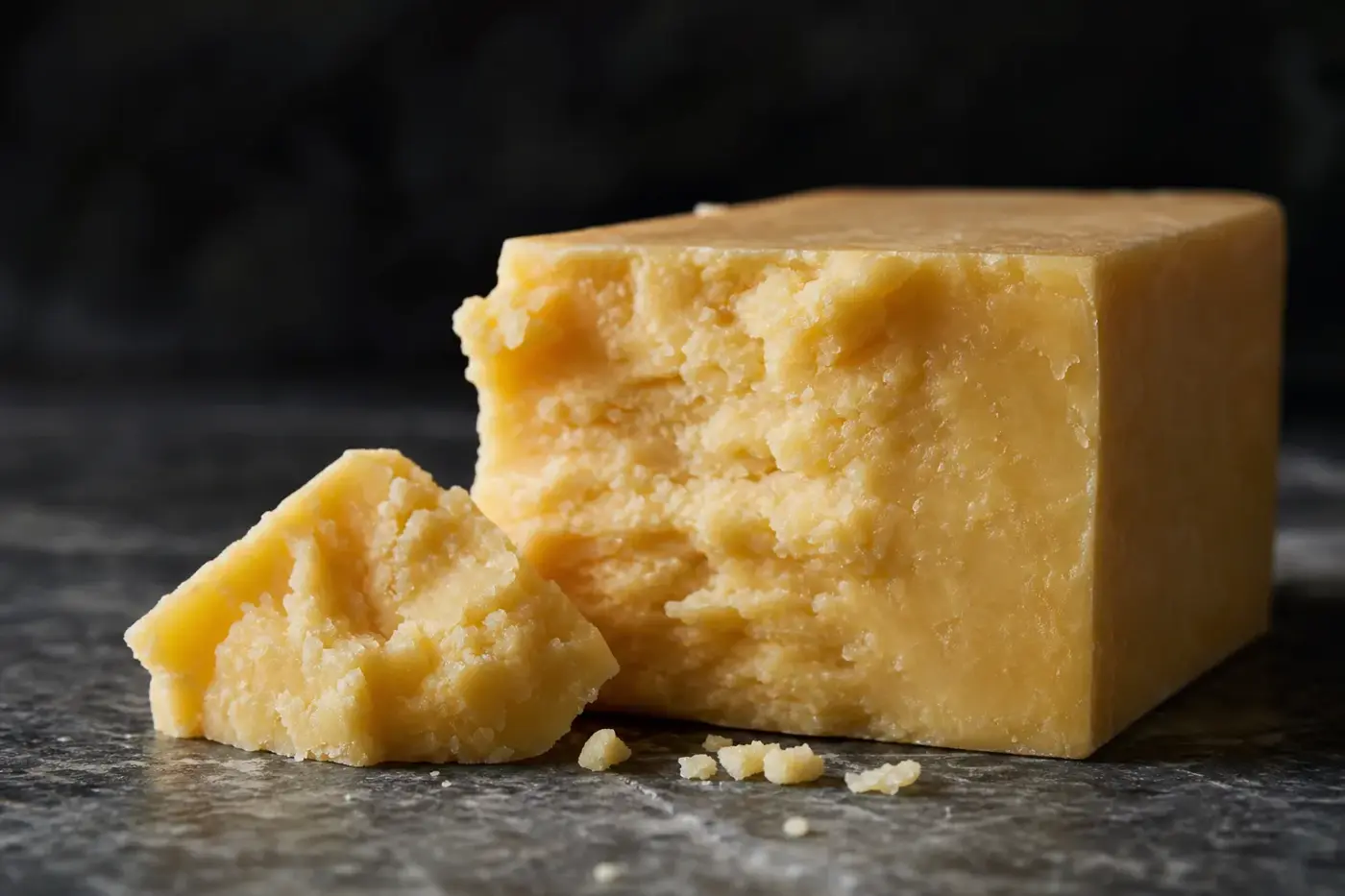
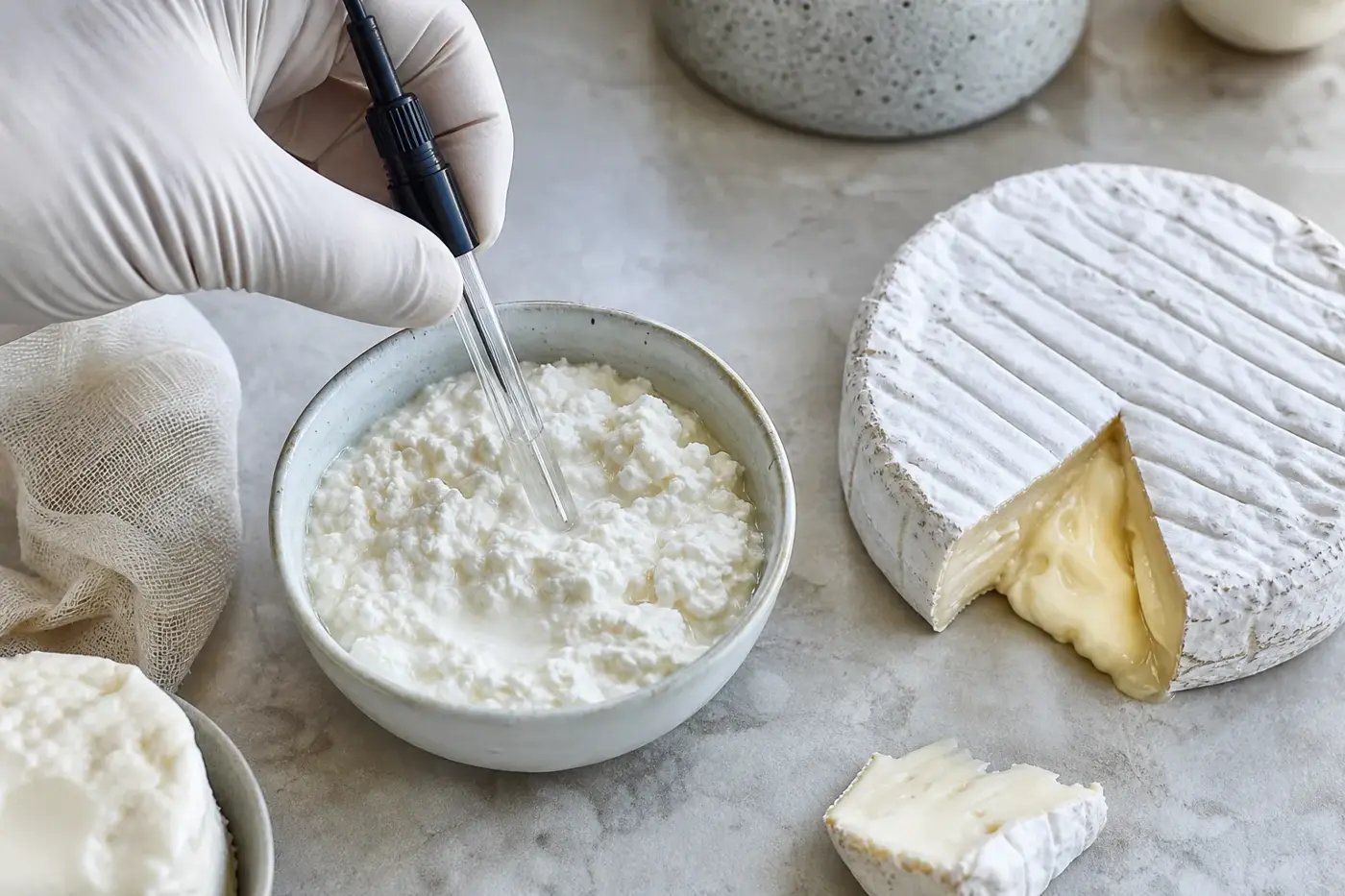
Why Some Cheese Melts and Some Does Not
Picture curds sitting in hot whey at 93 to 95 °C.
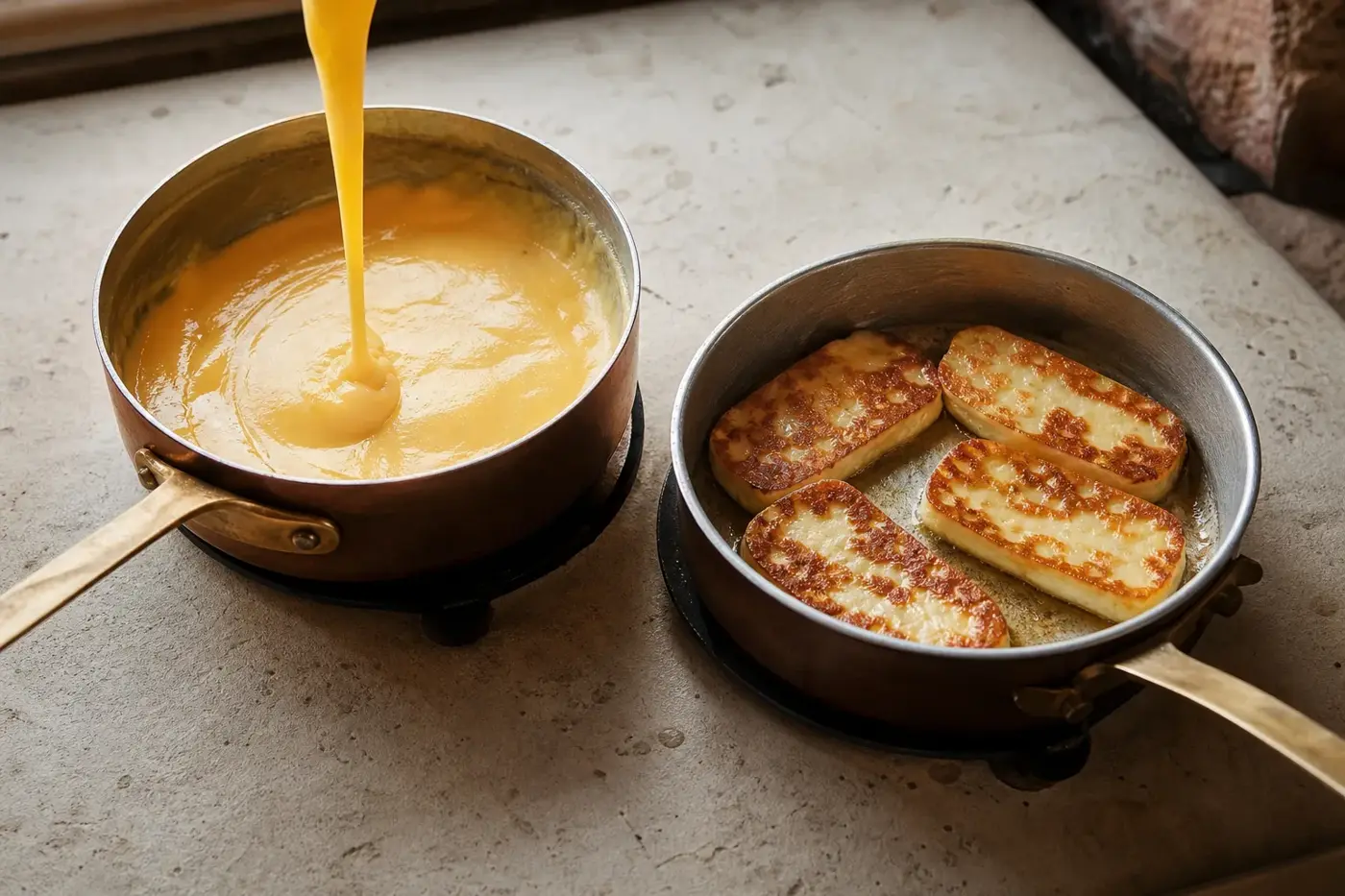
Picture curds sitting in hot whey at 93 to 95 °C. In one production study, sheep-milk curds destined for halloumi spent either 30 or 60 minutes there. That intensive cooking helps build a cheese that will hold its shape when it reaches your pan. [8]
Cheddar flows into a layer. Mozzarella pulls into threads. Paneer stays in cubes, apparently unmoved by your plans for dinner. Behind each response is a protein network shaped by calcium, acidity, water, fat and cheesemaking: heat reveals what the maker has built. [1, 2, 5]
What are you after: softness, flow or stretch?
A cheese can soften without spreading. It can spread beautifully without giving you much stretch. Researchers measure flow, elasticity and stretch separately because “melting” covers several changes, and no single measurement captures them all. [1, 2]
- Softening: your cheese becomes easier to deform, but may keep its outline.
- Flowing: heated cheese spreads under its own weight or an applied force.
- Stretching: the softened protein network pulls into connected strands.
- Browning: reactions at the heated surface produce colour, influenced by moisture, composition and heating conditions. [1, 2, 9]
A browned surface promises nothing about a flowing centre. The outside can dry and colour while the cheese underneath stays cohesive. In a moist sauce, cheese can soften and disperse without browning at all, so decide which change you want before putting heat and water to work. [9, 11]
Meet the framework inside your cheese
Much of a cheese’s structure comes from casein, the main family of milk proteins. In milk, caseins sit in particles called micelles, associated with calcium phosphate. Cheesemaking gathers those proteins into a network that holds fat and water as whey, the liquid separated from the curd, drains away. [1, 2]
For many cheeses, rennet starts that gathering. This preparation of milk-clotting enzymes changes the surface of casein particles so they can come together. The curd that forms is a three-dimensional structure, not simply solidified milk fat. You can follow the transformation in the guide to how cheese is made. [1]
Calcium helps connect and organise this framework, but its form matters as much as its total amount. Some sits with the protein matrix; some dissolves in the cheese’s watery, or aqueous, phase. Experiments following Cheddar through ripening found those proportions changing over time within the same cheese. [14]
Heat loosens things up, but only so far
Liquid fat alone cannot make your cheese flow. As cheese warms, its fat becomes more liquid and its protein network less rigid. Flow begins when interactions between proteins allow enough movement for the whole structure to rearrange. [1, 2]
The framework governs what that newly mobile fat and water can do. If it relaxes, the cheese can spread; if it stays strongly connected, the cheese can keep a recognisable shape despite the liquid fat inside. Heating experiments on rennet curds show that changing acidity shifts this balance between behaving like a solid and behaving like a liquid. [1]
There is no single melting temperature for all cheese, then. Even a laboratory result depends on what researchers measure: the start of softening, a change in mechanical behaviour, or how far a sample flows under specified conditions. Each gives you a different view of how cheese responds to heat. [1, 3]
Acidity and calcium work as a pair
Acidity changes both the proteins and the calcium around them. It alters the proteins’ electrical charge, affecting their interactions, and shifts calcium phosphate between the protein structure and the surrounding liquid. During cheesemaking, calcium dissolved by acidification can leave with the whey. [2, 14]
Under suitable conditions, reducing the calcium associated with protein helps the network take up water and rearrange. Experimental mozzarella with less calcium relative to protein showed greater flow and stretch than the control with more calcium. In a separate experiment with reduced-fat mozzarella, cheeses with less calcium also held more moisture and performed better when heated. [2, 10]
More acid does not necessarily mean more melt. As casein approaches its isoelectric condition, where its overall electrical charge is small, protein attraction and reduced hydration can favour a cohesive structure again. Acidity, calcium and manufacturing history decide the result together. [1, 2]
This helps explain a puzzle you might notice at the cooker. Acidification can prepare mozzarella for stretching, while acid coagulation can produce cooking cheeses that hold their shape. These are different ways of building the protein network, not contradictory results. [2, 5]
Five cheeses, five ways with heat
Each cheese brings its own balance of flow, stretch and cohesion to your cooking. The studies behind these tendencies used different cheeses and measurement methods. Their flow results cannot be compared directly as a league table. [2, 3, 5, 8]
Young Cheddar: a flowing layer with some backbone
Young Cheddar can soften and flow, although its relatively intact network may stay more cohesive than an older cheese’s. In experimental Cheddar, ripening time interacted with calcium, residual lactose and salt relative to moisture. Age alone did not decide how the cheese behaved. [3]
Mozzarella: made for those connected strands
Mozzarella can flow while keeping its connected strands. Hot stretching during manufacture organises the protein structure, while calcium balance, acidity, hydration and storage influence what happens when you reheat it. Treat low-moisture pizza mozzarella and wetter fresh forms as different cooking ingredients, each with its own behaviour. [2, 10]
Parmesan: give it water, not a stretching audition
Fine particles of a dry grating cheese such as Parmesan can become part of a moist sauce. Supply water and control the heat rather than expecting strands like mozzarella’s; Parmesan need not audition for every role. Research on a sauce made with pecorino, rather than Parmesan, shows how water, starch and temperature affect protein aggregation. [11]
Paneer: built to keep its shape
Heat and acid coagulation, followed by pressing, give paneer its structure. Its curd contains casein alongside whey proteins changed by heat. That combination helps explain why your pieces stay cohesive during cooking rather than spreading like a melting cheese set with rennet. [5]
Halloumi: the work continues after rennet
Halloumi starts with rennet, but its curd then gets substantial extra cooking. That manufacturing history produces a firm cooking cheese. Knowing a cheese is rennet-set tells you too little, on its own, about whether it will flow in your pan. [6, 7, 8]
Why acid-set cheeses hold their ground
Acid-set cheeses build their protein structure differently from cheeses that rely mainly on rennet coagulation. Acid reduces the stabilising charge on casein, allowing the proteins to gather together. Melting the fat does not necessarily make the resulting structure mobile. [1, 5]
Paneer brings another important step into the making: substantial heating of the milk before acid coagulation. Whey proteins become part of its curd, whereas in many rennet cheeses they largely leave with the whey. Original paneer research comparing acid coagulants describes this combined heat-and-acid process and measures how changing the coagulant affected composition and texture. [5]
At your cooker, the method tells you more than the word “fresh”. Two unripened cheeses can respond very differently to heat because their makers followed different routes to coagulation. Their shared lack of ripening tells only part of the story. [2, 5]
Halloumi prepares for your grill in the dairy
Halloumi’s resistance to flowing begins long before you cook it. The EU’s published 2023 single document for “Χαλλούμι / Halloumi / Hellim” describes a rennet-coagulated cheese whose curd is cooked before its finished shape is formed. Fresh Halloumi is identified as semi-hard and elastic, with a close texture. [6]
Experimental production studies describe blocks of curd cooking in hot whey. In one, sheep-milk curds spent either 30 or 60 minutes at 93 to 95 °C. Those are the researchers’ reported manufacturing conditions, not instructions for preparing cheese at home. [8]
That intensive treatment contributes to halloumi’s distinctive structure. Calcium retention and relatively limited initial acid development also distinguish fresh halloumi from curd prepared for stretching like mozzarella. Its resistance to flowing comes from these manufacturing factors working together, not from one unusually high “melting point”. [2, 7, 8]
Give water and fat their due
Water affects how concentrated the protein network is and how freely it can move. In reduced-fat mozzarella experiments, greater moisture and more water held within the protein structure accompanied greater flow and stretch. Where that water sits matters, not just how much your cheese contains. [10]
Fat interrupts the protein framework and becomes mobile as it warms. A fattier cheese does not automatically give you a smoother result, though: proteins still need to keep the mixture sufficiently organised. Visible pools of escaped fat signal separation, and experiments with emulsifying salts show how changing protein interactions alters that balance. [12, 13]
Cooking changes the water balance, too. Baking research measured moisture loss alongside changes in cheese colour under different heating conditions. Even a cheese that starts moist can develop a drying surface, changing its behaviour as heating continues. [9]
Older cheese changes, but does not always melt better
Ripening can increase flow by weakening the protein framework. Through proteolysis, enzymes break proteins into smaller fragments and loosen the connected structure. A useful cheese pull still needs some structure intact: you need cohesion as well as movement. [2, 3]
The minerals change their balance, too. One Cheddar experiment combined acid-base measurements with analysis of liquid expressed from the cheese to track soluble and insoluble calcium through four months of ripening. Ageing changed more than flavour or protein-chain length; it changed the calcium balance as well. [14]
Older cheese can be especially sensitive to prolonged heating. Researchers compared Cheddar and low-moisture, part-skim mozzarella at different ages, heating samples to 60 °C before measuring flow. Longer holding reduced average meltability, with older samples affected much more strongly than the youngest. Your mature cheese still calls for careful cooking. [4]
When turning up the heat makes things worse
If your cheese softens but refuses to spread, more heat is a poor remedy. Turning up the heat is not a convincing argument. Keeping cheese hot for longer can reduce its ability to flow, as the Cheddar and mozzarella holding experiment demonstrated: the structure may become less accommodating, not more fluid. [4]
In sauces, excessive heating can encourage proteins to gather in visible clumps. Research on mixtures of hard cheese, water and starch found that temperature and starch concentration strongly influenced this separation. Instead of becoming ever smoother, a dispersed sauce could develop connected protein clumps. [11]
Drying presents a different difficulty. Escaping water leaves the remaining cheese more concentrated, and an exposed surface can form a firmer layer. Baking research documents moisture loss under different heating conditions; this drying can contribute to surface firmness, while separation and protein aggregation have different causes. [9, 11]
Start with the cheese you want on your plate
Choose the result first, then choose your cheese and heat. These steps gather practical lessons from the experiments to help you make those decisions. They are not a single tested recipe. [2, 4, 9, 11]
- Choose the behaviour first. Reach for mozzarella for connected stretch, a flowing cheese for a melted layer, and paneer or halloumi for recognisable pieces. [2, 3, 5, 8]
- Grate or cut evenly. Small, similarly sized pieces shorten the distance heat must travel. This helps you avoid prolonged heating of the outside while a large centre stays firm. [4, 9]
- Stir in gently. Warm your sauce base, reduce the heat, then add cheese gradually. Aim for even dispersion without unnecessarily prolonged heating. [4, 11]
- Give each cheese a job. Mozzarella can supply stretch, while Cheddar contributes differently to flow and flavour. Treat your blend as a new ingredient: proportions and cooking conditions decide its behaviour. [2, 3]
- Let browning have its own moment. Bring the interior to the texture you want, then use a brief stage of surface heating where browning is required. [9]
How emulsifying salts keep your sauce together
Emulsifying salts work on cheese structure rather than simply thickening your sauce. Sodium citrate and certain phosphates change calcium-protein interactions. By binding calcium and helping disperse casein, they let proteins hydrate and help stabilise a mixture of water and fat. [12, 13]
These salts do not all work in the same way. A processed-cheese experiment separated soluble fractions and measured their proteins and minerals. Results for citrate supported calcium sequestration, while phosphate salts produced different calcium-containing complexes. “Emulsifying salt” describes a group of ingredients with distinct effects, not interchangeable choices. [12]
More is not necessarily the answer to a troublesome mixture. Experiments using different salts and acidified cheese bases found changes in flow, stickiness and crystal formation as formulations changed. Use a documented formulation suited to your particular salt and cheese, rather than adding more to rescue an unsuitable mixture. [13]
Follow the making to understand the melting
- How Cheese Is Made: From Milk to Cheese: follow the formation of curd and the removal of whey.
- Mozzarella: explore the cheese whose manufacture is built around stretching.
Questions people ask
Why does mozzarella stretch while paneer holds its shape?
Hot stretching during mozzarella manufacture organises its protein structure, allowing it to flow while forming connected strands. Paneer is made using heat and acid coagulation, and its curd contains casein and heat denatured whey proteins. This combination helps its pieces stay cohesive during cooking.
Why does halloumi hold its shape in the pan?
Halloumi curd undergoes substantial cooking during manufacture. This treatment, together with calcium retention and relatively limited initial acid development, contributes to its resistance to flowing.
Does older Cheddar melt better?
Ripening can increase flow by weakening the protein framework, but age alone does not decide how Cheddar behaves. Older cheese can also be especially sensitive to prolonged heating, which reduced average meltability in a study of Cheddar and mozzarella.
Why has my cheese sauce become oily or grainy?
Visible pools of fat signal separation. Excessive heating can also encourage proteins to gather into clumps, while temperature and starch concentration influence separation in hard cheese sauces. The page recommends gentle heat and stirring cheese into the warm sauce base gradually.
Can Parmesan melt into a sauce?
Fine particles of a dry grating cheese such as Parmesan can be incorporated into a moist sauce. Supply water and control the heat rather than expecting mozzarella like strands.
Sources
- University of Yamanashi research, Quantifying thermally induced flowability of rennet cheese curds, arXiv:1410.3897, 2014 preprint. Original dynamic-shear experiment; used as supplementary mechanistic evidence. Retrieved manuscript.
- Journal of Dairy Science, Effect of pH and Calcium Concentration on Some Textural and Functional Properties of Mozzarella Cheese, volume 85, 2002, pages 1655 to 1669. Original cheesemaking, microscopy and functionality experiments. Retrieved full text.
- Journal of Food Science, Effect of calcium and phosphorus, residual lactose, and salt-to-moisture ratio on the melting characteristics and hardness of cheddar cheese during ripening, volume 72, 2007. Original experiment, retrieved abstract. PubMed record.
- Journal of Dairy Science, Effect of heat treatments on the meltability of cheeses, volume 84, 2001, pages 1937 to 1943. Original experiment, retrieved abstract. PubMed record.
- Journal of Food Science and Technology, Effect of different coagulants at varying strengths on the quality of paneer made from reconstituted milk, archived article PMC3931878. Bibliographic publication date: Not verified. Original coagulant experiment, retrieved indexed text. Archived article.
- European Commission, Publication of an approved standard amendment to a product specification of a protected designation of origin or protected geographical indication in the sector of agricultural products and foodstuffs, 2023/C 165/07, published 10 May 2023. Includes the single document for “Χαλλούμι / Halloumi / Hellim”. Official publication.
- Foods, Influence of Salting Method on the Chemical and Texture Characteristics of Ovine Halloumi Cheese, 2019. Original salting and texture experiment. Full text.
- Small Ruminant Research, The effect of cooking time on curd composition and textural properties of sheep Halloumi cheese, 2015. Original cooking-time comparison, retrieved indexed text. Publisher record.
- Foods, Moisture Loss from Cheese During Baking: Influence of Cheese Type, Cheese Mass, and Temperature, volume 14, article 165, 2025. Original baking experiment, retrieved indexed text. Archived article.
- International Dairy Journal, Effect of pH and calcium level on the biochemical, textural and functional properties of reduced-fat Mozzarella cheese, 2004, pages 161 to 172. Original cheesemaking experiment, retrieved abstract. Publisher record.
- Phase behavior of Cacio and Pepe sauce, arXiv:2501.00536, version 1, deposited 31 December 2024. Original model-sauce experiments; preprint version consulted. Full text.
- Molecules, Soluble Salts in Processed Cheese Prepared with Citrate- and Phosphate-Based Calcium Sequestering Salts, volume 29, article 3631, 2024. Original fractionation and mineral-distribution experiment. Full text.
- Journal of Dairy Science, Influence of emulsifying salts on the textural properties of nonfat process cheese made from direct acid cheese bases, volume 91, 2008, pages 39 to 48. Original formulation experiment, retrieved abstract. PubMed record.
- Journal of Dairy Science, Changes in the proportions of soluble and insoluble calcium during the ripening of cheddar cheese, volume 87, 2004, pages 854 to 862. Original mineral-analysis experiment, retrieved abstract. PubMed record.
Researched through original dairy-science experiments and an official published production document, with practical recommendations identified as synthesis rather than site testing.
Last checked: November 2026
Last checked November 2026.
The editors suggest you read next
Where Cheese Flavour Comes From: The Chemistry Explained
Your knife slips through a bloomy-rind cheese.