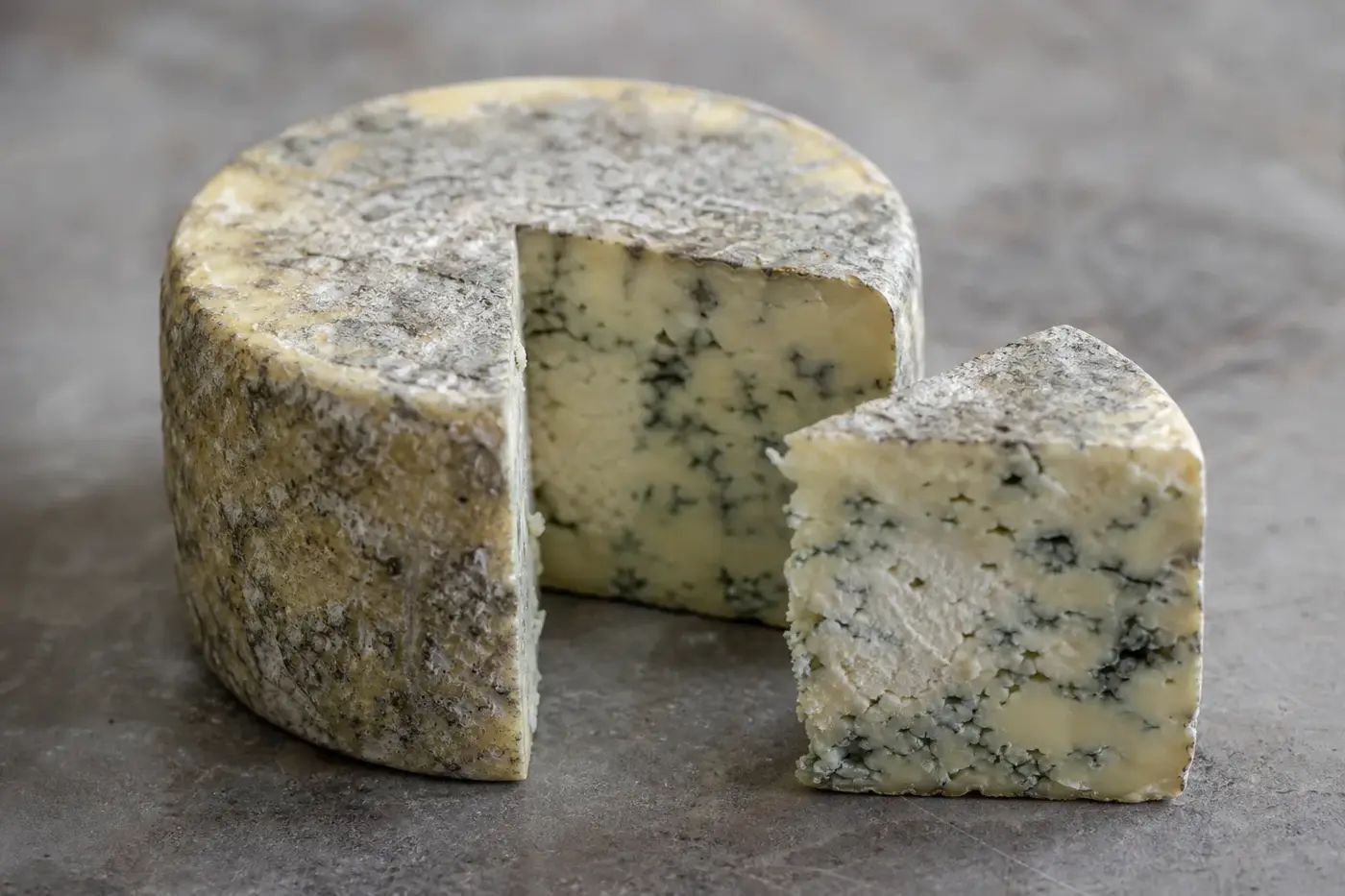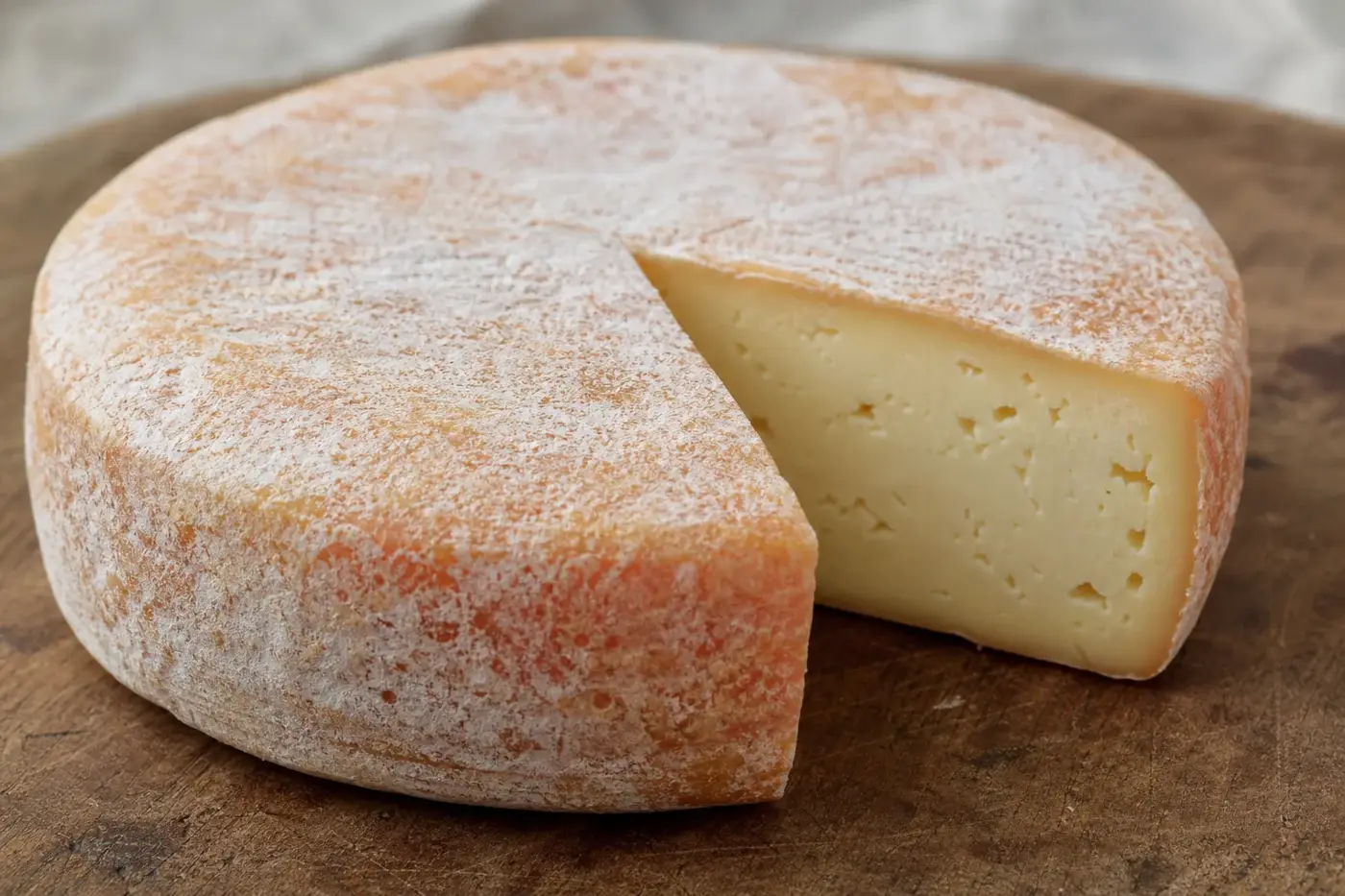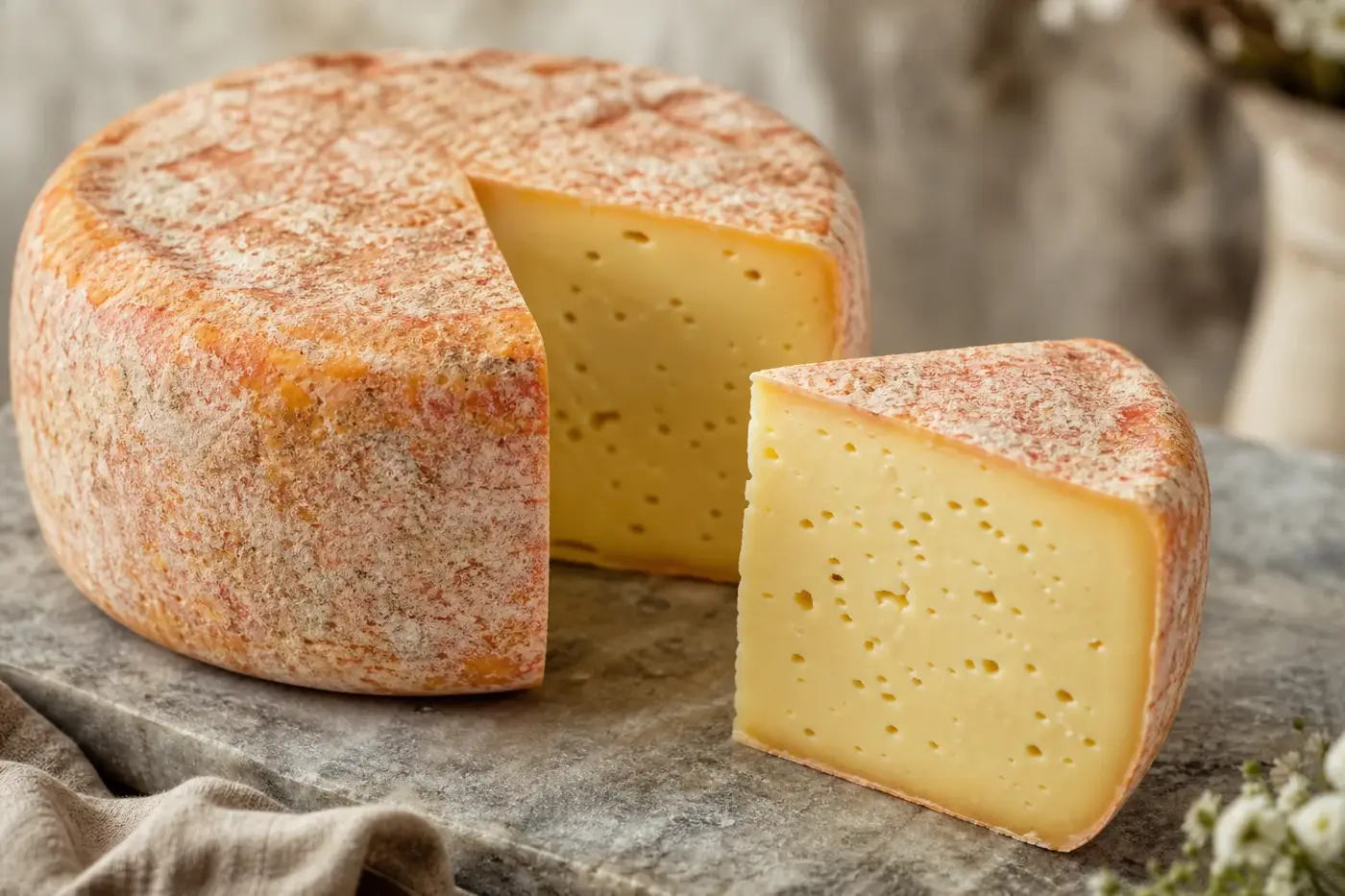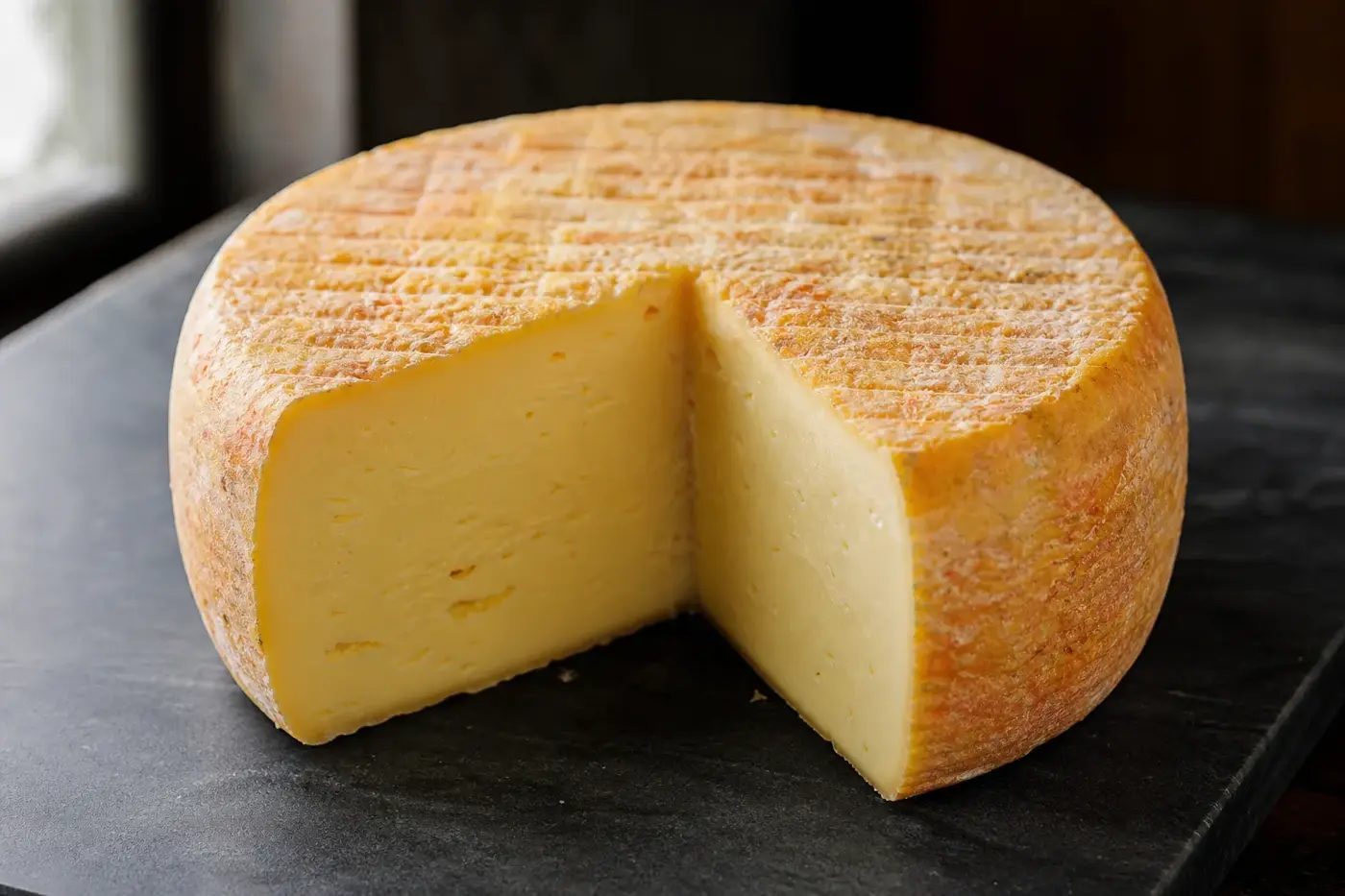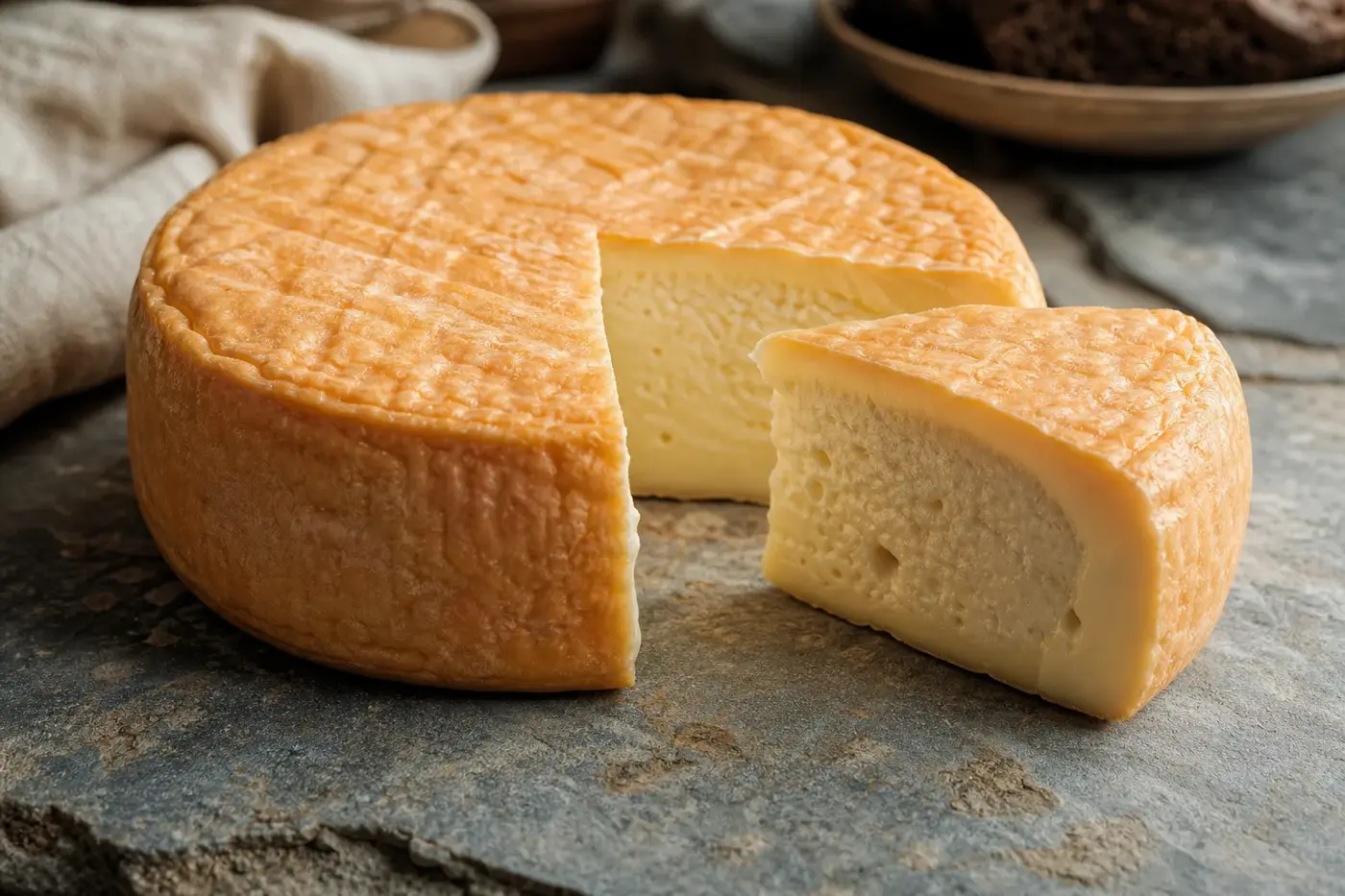
The smell reaches you first. Then you see the golden rind, the yielding cheese beneath it and, perhaps, a chalkier centre. From a farmhouse near Kanturk in County Cork comes Ardrahan, an Irish cow’s milk cheese described as rich and gently acidic. Its aroma makes the grand entrance; its flavour prefers a quieter introduction. [1][2]
Get acquainted before the first bite
| What you might want to know | The details |
|---|---|
| Name to look for | Ardrahan. [1] |
| Where the story starts | Ardrahan Farmhouse, near Kanturk, Duhallow, County Cork, Ireland. [1][2] |
| Style of cheese | Semi-soft, washed-rind farmhouse cheese. [1][2] |
| Milk in the producer profile | Pasteurised cow’s milk from the family farm. [2] |
| Rennet in the producer profile | Vegetarian rennet; ask for the current product declaration. [2] |
| Maturation in the published guide | Large wheels: 4 to 8 weeks or longer; minis: 2 weeks or longer. These are recorded periods, not legal minimums. [1] |
| Sizes in the published guide | Approximately 1.4 kg rounds and 300 g minis. Ask the seller for current dimensions. [1] |
| What is being made today | Ask the maker or seller for current production information. |
| Registered name, authority and register ID | Request current registration details from the maker or seller. |
| Pregnancy guidance | UK: NHS guidance, November 2026; see the pregnancy section below. [3] |
From a Cork farmhouse to the markets of France
Ardrahan’s story begins with trial and error on a working dairy farm. There was no ancient recipe waiting to be revived. A contemporary report in The Irish Times, published on 19 October 1999, records that the founding couple began making it in 1983. Making yoghurt had already encouraged the family’s interest in producing food themselves. [4]
France offered an early market for their cheese. The report describes deliveries to Rungis, the wholesale food market outside Paris, before Ardrahan found a wider following in Ireland and Britain. This Cork farmhouse cheese was crossing the sea while its makers were still making their name closer to home. [4]
That is the story behind the name you see at the counter. For the particular piece you are buying, bring the conversation into the present: who made it, and exactly what is on offer? An older guide makes a useful introduction; the label and your supplier’s current information should guide your choice.
Follow the milk from the family farm
The family farm supplied the milk and made the cheese. Taste Cork’s producer profile describes Ardrahan as made there with its own pasteurised cow’s milk, vegetarian rennet and starter culture. Rennet helps the milk set into curd, while the starter begins the acidification involved in cheesemaking. [1][2]
The work continues on the surface. Washing the rind and maturing the cheese help shape the finished Ardrahan, with its exterior tended during ripening rather than simply left to dry. Bord Bia’s guide places it among Ireland’s washed-rind cheeses. [1]
Curious about what happens to the milk before cheesemaking begins? Explore raw, thermised and pasteurised milk. When you buy, ask for the cheese’s current product information, so you can connect the piece in front of you with the descriptions in earlier guides.
Look a little closer at that golden rind
Moisture and salt help create a washed-rind cheese’s distinctive surface. Bord Bia’s glossary explains that these conditions encourage the surface organisms associated with this cheese family’s orange and pinkish colours and pronounced aromas. [1]
That rind is more than an attractive exterior. Published descriptions of Ardrahan link its aromatic surface with an interior that softens unevenly as the cheese matures. [1][2]
A cut piece lets you take in the whole picture. Look at the coloured surface, the softer cheese just beneath it and the centre. Ask your cheesemonger how those layers feel, particularly if you have a serving occasion in mind.
Give your palate a say
Ardrahan’s aroma does not necessarily tell you how forcefully it will taste. Taste Cork describes a golden surface, a semi-soft interior, balanced salt and background acidity. It makes a point of separating the assertive smell from the gentler impression on your palate. [2]
Begin with a small piece of the interior. Then taste another with a little rind attached, and decide which balance you prefer. Your nose has had its say; it need not chair the entire meeting.
Bord Bia’s tasting account identifies lactic acidity and salt. With greater maturity, it describes hazelnut notes alongside farmyard aromas. These are the published guide’s tasting descriptions, rather than a fromage.co.uk tasting. [1]
To remember what you enjoyed, give yourself three questions:
- What can you smell before you taste?
- How does the centre feel beside the cheese near the rind?
- What stays with you after swallowing: acidity, salt, a dairy flavour or something more savoury?
Texture is especially useful when you return for another piece. “A yielding outside with a firmer centre” tells your cheesemonger more than “strong”. Keep smell, flavour and feel separate, and you will find it easier to describe the maturity you enjoy.
Find the texture that suits your plans
A chalkier centre can sit inside a softer outer paste. Bord Bia records this contrast as Ardrahan matures. That firmer line does not automatically mean your piece needs more time. [1]
Think first about how you want to serve it. For neat pieces on a board, ask for a portion that holds its shape; for spreading over bread, ask about a more yielding outer layer. The oldest piece is not necessarily the right one for your plans.
If a sample is offered, ask whether it comes from the wheel you will buy. Taste the part that matters for your serving idea, then describe the balance you like. A clear account of texture gives the seller more to work with than age alone.
Make the most of your cheese-counter conversation
Start with the cheese’s identity and condition. Who made it, when was it cut, and how has it been stored? Ask which handling instructions come with it, too.
If vegetarian suitability matters to you, request current confirmation rather than relying on an older directory entry. For a cut portion, ask to see the cut face. Explain whether you plan to slice it, spread it or cook with it, so you can discuss the texture that suits.
Buying remotely need not mean losing that conversation. Ask for the same details in writing, including the supplier’s chilled delivery arrangements. Give a definite serving date where possible, and say what you intend to do with the cheese.
Before putting it away, read the label. Pay particular attention to the use-by date and any instructions after opening. The guide to reading a cheese label helps you distinguish practical product information from tempting descriptions.
Keep it cool and serve in small portions
Follow the cheese’s own storage instructions, including any shorter limit after opening. For England, Northern Ireland and Wales, the Food Standards Agency advises keeping a domestic fridge between 0 and 5 °C. It also advises refrigerating dairy products and following their packaging instructions. [5]
Keep that information with a cut portion. If your cheesemonger supplies it without the original packaging, ask for the relevant date and storage details before taking it home.
When serving, bring out only the portion you intend to offer. Let it lose some refrigerator chill while you prepare the board, rather than leaving the whole cheese on display throughout a gathering. For England, Northern Ireland and Wales, the FSA advises keeping refrigerated food out for the shortest possible time during preparation, with a maximum of four hours. [5]
Take extra care in hotter than usual conditions. UK government consumer guidance advises no more than two hours outside refrigeration in those conditions, and says to discard perishable food left out beyond that period. Keep your board out of sunshine and replenish it with small portions. [6]
For the broader picture, turn to storing cheese at home. Keep the cheese’s own instructions alongside that general advice.
Let bread, fruit and your glass play supporting roles
Give Ardrahan the first mouthful to itself. Keep the accompaniments simple, then discover what you enjoy alongside it. Bord Bia’s published recommendation of aromatic white wine and beer provides the starting point for the alcoholic options below. [1]
| Alongside your cheese | How you might serve it |
|---|---|
| Plain bread or unsweetened crackers | Taste the cheese alone, then bring in bread for your next mouthful. |
| Apple or pear | Offer slices separately, so everyone can choose their balance of fruit and cheese. |
| A small spoonful of fruit preserve | Put it beside the cheese rather than spreading it across the whole portion. |
| Aromatic white wine or beer | For adults of legal drinking age, offer a small serving. Compare it with the cheese before adding accompaniments. |
| Water, still or sparkling | Give it equal consideration, with a clean glass for each guest. |
For an alcohol-free board, start with water, plain bread and fruit. Add something else only if you want it. A few considered choices leave you room to explore the cheese without crowding your plate.
If you are choosing wine, the cheese and wine pairing guide explains the broader method. The NHS advises against alcohol during pregnancy. [3] People who are driving, taking medicines that interact with alcohol or recovering from alcohol dependence should not drink; consult current official guidance for your circumstances.
Give Ardrahan room on the board or in the kitchen
Leave Ardrahan some space rather than surrounding it with several other assertive cheeses. Start with a small selection of contrasting textures, plain bread and one fruit accompaniment. Put preserves and pickles in separate dishes, so your guests can taste the cheese before combining flavours.
Where practical, cut pieces that include both the centre and the outer paste. Each person can then explore the textural contrast described in the published tasting accounts. [1]
In the kitchen, you might make Ardrahan the main cheese in a simple dish. Toast, a potato topping or a vegetable tart are possibilities, not independently tested recipes. Start with a dish you already make reliably, and leave out other strongly flavoured cheeses until you know what you want Ardrahan to contribute.
If you are cooking for guests, keep the packaging to hand. The ingredient information will help you answer their questions accurately.
A few useful answers before you choose
Want to try the rind?
The 1999 report described Ardrahan’s rind as edible. [4] Before eating it, consult the current label or ask the maker for rind instructions. Remove any wrapping or packaging.
Looking for a vegetarian cheese?
Taste Cork’s undated profile records vegetarian rennet. [2] Ask the maker or seller for the current product declaration and confirmation that it suits a vegetarian diet. For more on the different coagulant sources, explore Rennet explained.
Pregnant and considering Ardrahan?
The NHS pregnancy guidance from November 2026 does not name Ardrahan. Read the linked guidance for its advice on cheese, and discuss the particular product with your midwife. [3]
Take Ardrahan’s current label and product description into that conversation, whether you speak to your midwife or another appropriate clinician. If you live outside the UK, consult your own country’s official advice.
General information only, not medical advice: follow the official guidance where you live.
Questions people ask
What does Ardrahan taste like?
Taste Cork describes its aroma as more assertive than its flavour, with balanced salt and background acidity. Bord Bia notes that hazelnut flavours can develop with greater maturity, alongside farmyard aromas.
Can you eat the rind on Ardrahan?
A 1999 report described the rind as edible. Current rind instructions are not verified, so check the label or ask the maker before eating it.
Is Ardrahan suitable for vegetarians?
Taste Cork’s undated profile records vegetarian rennet. The current product declaration is not verified, so ask the maker or seller to confirm suitability.
Can you eat Ardrahan during pregnancy?
The NHS pregnancy guidance checked in November 2026 does not name Ardrahan. Consult the NHS guidance for its advice on cheese and discuss the particular product with your midwife.
How should you store Ardrahan?
Follow the cheese’s packaging instructions, including any shorter limit after opening. For England, Northern Ireland and Wales, the Food Standards Agency advises keeping a domestic fridge between 0 and 5 °C and refrigerating dairy products.
Sources
- Bord Bia, Your Guide to Irish Farmhouse Cheeses, undated retrieved edition, pages 10 to 11 and glossary. Historical industry reference, not confirmation of present production. Retrieved PDF.
- Taste Cork, Ardrahan Dairy, undated producer profile, retrieved November 2026. Regional food promotion source. Producer profile.
- NHS, Foods to avoid in pregnancy, current retrieved webpage, checked November 2026. Official UK guidance.
- The Irish Times, Kanturk couple savour the success of their champion cheese, 19 October 1999. Contemporary reporting. Historical report.
- Food Standards Agency, How to chill, freeze and defrost food safely, published 18 December 2017, current retrieved text; applies to England, Northern Ireland and Wales. Official storage guidance.
- UK government, Food safety in a heatwave: advice for consumers, current retrieved text, checked November 2026. Official hot-weather guidance.
This desk-researched draft compares published cheese descriptions and contemporary reporting with current official UK guidance.
Last checked: November 2026
Last checked November 2026.
The editors suggest you read next