Barkham Blue
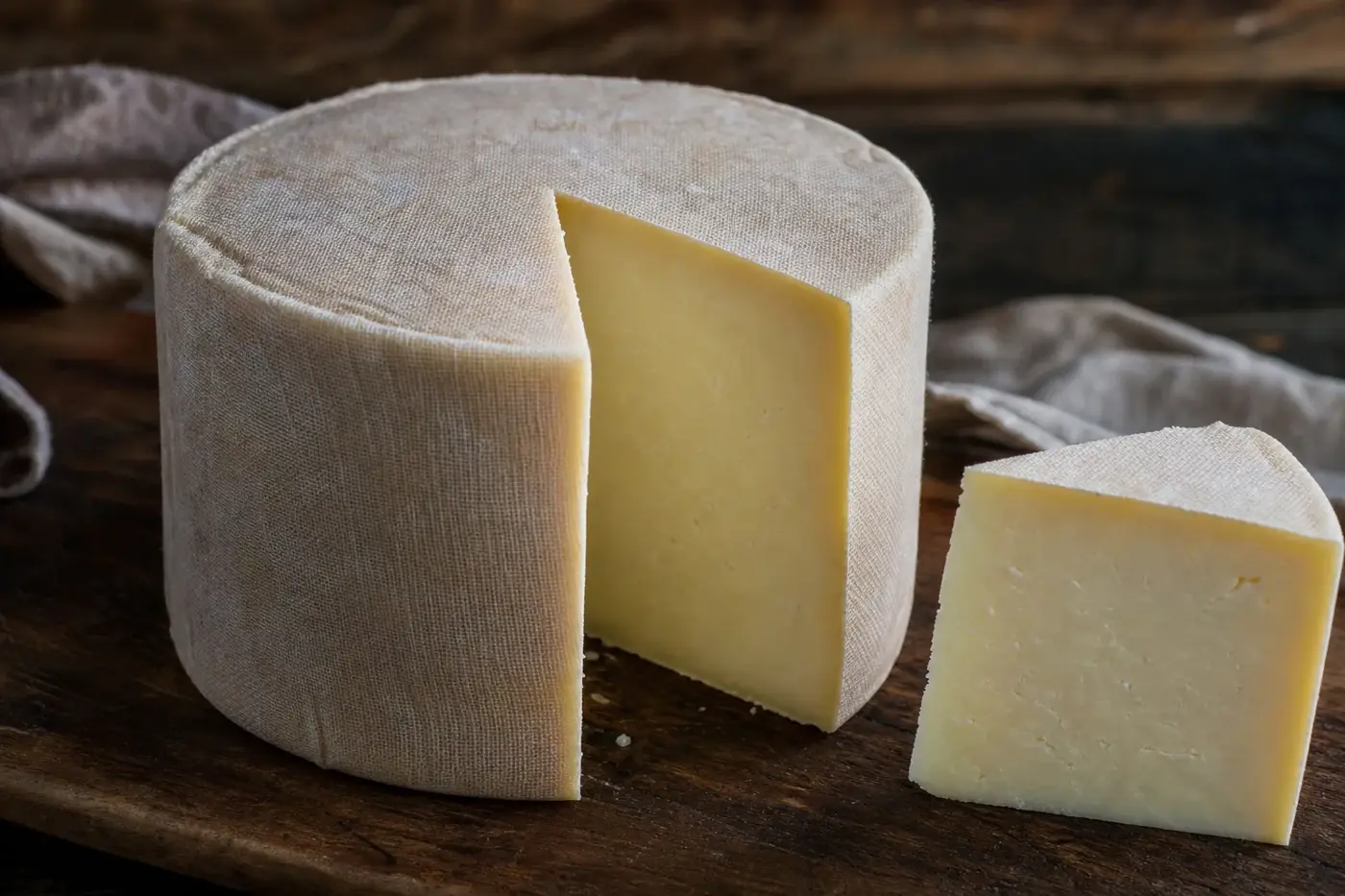
Cut into Barkham Blue and a golden, buttery interior appears beneath its coiled outline.
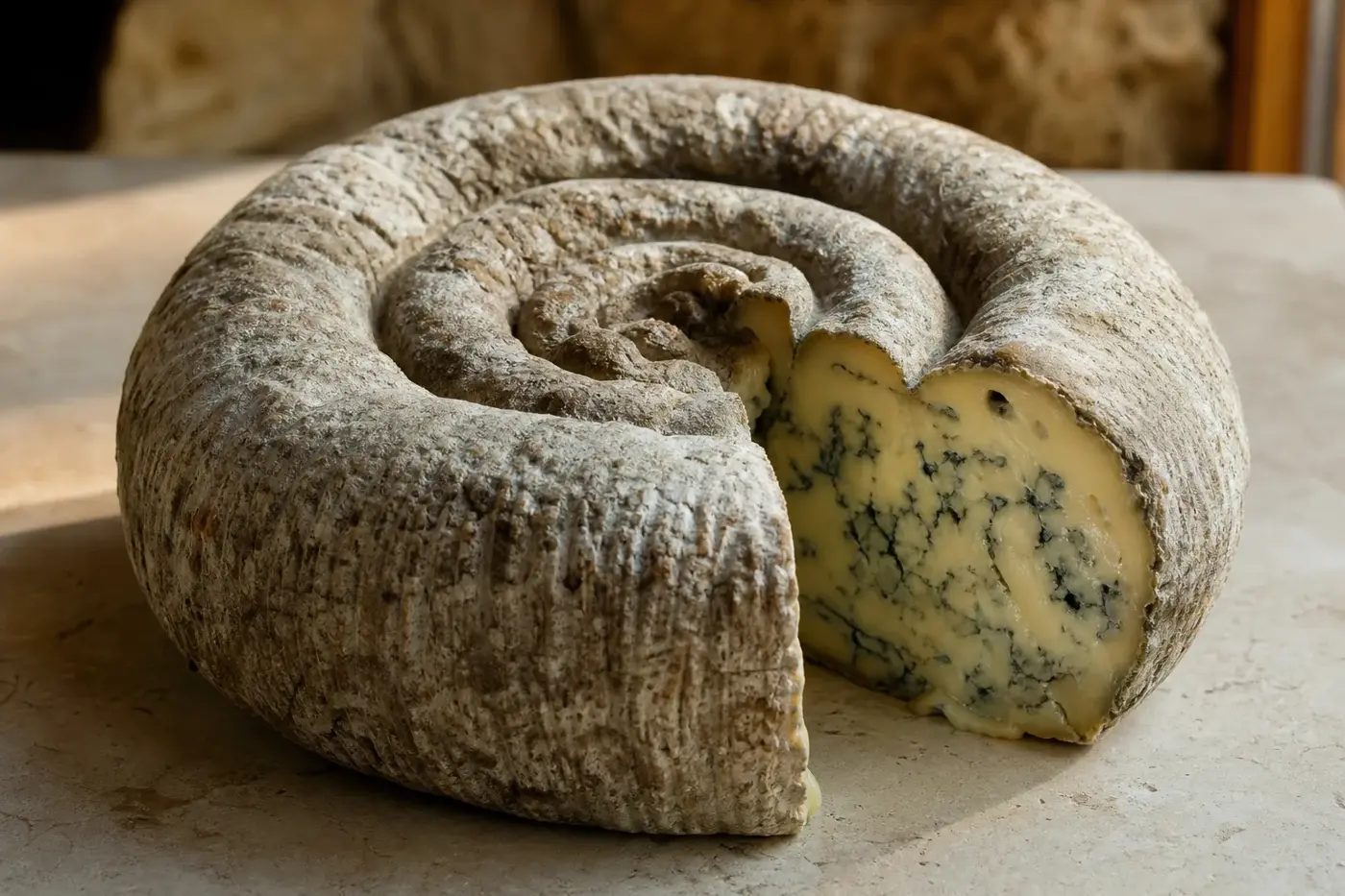
Cut into Barkham Blue and a golden, buttery interior appears beneath its coiled outline. That distinctive round takes its shape from an ammonite, a fossil shell. You might not expect palaeontology on your cheeseboard, but here it is. [1,4]
Made by Village Maid Cheese in Riseley, Berkshire, England, this soft blue-veined cows’ milk cheese uses pasteurised Guernsey milk and vegetarian rennet. The maker describes blue sharpness balanced by sweetness. Think contrast, rather than strength that takes over the conversation. [1,2,4]
Follow the curve and find the contrast
Before you reach for a cracker, look at that moulded round. The maker compares it to an ammonite, with the curve of a coiled fossil shell. Leave a curved section visible on your board rather than cutting everything into small cubes. A wedge preserves that outline and gives you the outer rind, the paste beneath it and the blue-veined centre together. [1,4]
Inside, you have three characters to get acquainted with. Village Maid describes an earthy, naturally developing rind, sweeter golden paste and sharpness from the blue veins. Taste across all three. The interest lies in their balance, not simply in how loudly the blue announces itself. [1]
A Berkshire dairy with garden beginnings
Village Maid began in a garden outbuilding at Spencers Wood near Reading in 1986. Its history traces those beginnings to research cheesemaking and microbiology at the National Institute for Research in Dairying in Shinfield. Barkham Blue therefore joined a business already practised in developing and maturing different styles. This was not a new dairy built around a single cheese. [2]
The company moved to Riseley in 1991 and now describes itself as a second-generation cheesemaker. Its published range includes sheep’s milk and cows’ milk cheeses. Berkshire is more than a flourish on the label: the working dairy is in Riseley, with its contact address on Basingstoke Road. [2,3,10]
Barkham Blue arrived through Village Maid’s acquisition of Two Hoots Cheese Ltd in February 2024. According to Village Maid, production moved to Riseley, where a purpose-built blue cheese dairy beside the existing dairy was ready for production in October 2024. The cheese had a new home, but its milk supply continued through Lacey’s Family Farm. [2]
The Guernsey milk behind that golden colour
Village Maid links Barkham Blue’s colour and buttery character to its Guernsey milk, which it identifies as pasteurised. Its production history names the same Guernsey milk supplier used before the transfer from Two Hoots. What you taste brings together that milk, the setting of the curd and the ripening method. Each has a part to play. [1,2]
The maker declares vegetarian rennet for Barkham Blue. Rennet helps milk form curd, the solid material that becomes cheese. If you are curious about how cheesemakers obtain that enzyme activity, explore rennet explained. For Barkham Blue itself, use its own product declaration. [4]
A salt-water bath and time in the blue room
After moulding, salt water and oxygen each have work to do. In a published 2024 interview, Village Maid describes putting the cheeses into brine the day after the make, drying them, then piercing them the following day. Brine is salt water; piercing opens routes for oxygen into the interior. The maker’s product description identifies that oxygen as essential to maturation. [1,4]
Next comes around five weeks in the blue maturing room, according to the same interview. The cheeses are then wrapped and chilled, with sale two weeks later. That makes approximately seven weeks after piercing. The five weeks describe the blue-room stage, not the whole reported schedule. [4]
At the counter, ask about condition as well as age. When was your piece cut, how soft has the paste become, and which date applies to the portion you are taking home? The schedule tells you about the dairy’s process. The seller can help you judge the particular piece in front of you.
Find your favourite point of softness
The paste beneath the rind softens as Barkham Blue matures, according to Village Maid. That gives you a useful starting point at the cheese counter. If you want a piece that holds a neat wedge, say so. If you would rather have a softer portion to spread, ask to see the cut face. [1]
Start with a little from the interior, then try some nearer the rind. Notice the texture before bringing in bread or fruit. Compare a blue-veined area with a piece containing more plain paste. See what draws you back: the texture, the blue character or the contrast between centre and edge.
Two Golds, with a different class each time
Barkham Blue received Gold in the Artisan Cheese Awards’ official 2024 results, entered under Village Maid Cheese Ltd in class 5, Blue. The organiser’s 2026 results record another Gold, this time in class 6, Cow. Keep the class alongside the year when you tell the story. These are two documented awards in different categories. [5,6]
Make room for Barkham Blue on your board
Start simply: a plain cracker or a slice of bread, with ripe pear alongside. Taste the cheese alone, then introduce one accompaniment at a time. You will soon discover whether you favour fruit sweetness, a crisp contrast or the cheese with no supporting cast. Not every wedge needs an entourage.
Treat these as pairing suggestions rather than a tasting verdict. For an alcohol-free drink, try still water between tastes. Or pour a small glass of apple juice and dilute it to your liking with sparkling water.
On a shared board, cut a wedge so each serving can include centre and outer edge. Leave enough space beside it to handle a knife comfortably, and put fruit in a separate small dish. Keep bread and crackers on the table rather than piled against the cut face.
If you are comparing Barkham Blue with another cheese, give each its own knife. Taste both plain before returning to the accompaniments. A simple arrangement helps you concentrate on the differences.
For a useful tasting note, write three words for texture, three for flavour and a sentence about your favourite accompaniment. Take those impressions back to the cheesemonger when you choose your next portion. You will have a practical way to explain exactly what you enjoyed.
Serve only what you expect to eat and leave the rest chilled. The FSA’s hot-weather advice says to try not to leave food out longer than two hours when temperatures are higher than usual. Keep the remaining cheese refrigerated rather than on the serving board. [7,8]
Keep your cheese cool and its label close
Keep Barkham Blue refrigerated and follow the storage instructions on its packaging. For England, Northern Ireland and Wales, FSA guidance recommends a fridge between 0 and 5 °C (32 to 41 °F), checked with a fridge thermometer. It says dairy products should be refrigerated. Return the remaining cheese promptly after serving, with its label or the cheesemonger’s instructions. [7]
Read the words beside the date, not just the date itself. UK government guidance distinguishes a use-by date, which concerns safety, from a best-before date, which concerns quality. Follow a use-by date even if the cheese looks unchanged. With a best-before date, keep and follow any separate instructions about refrigeration and use after opening. [7,9]
Before deciding whether your piece is past its best, consider its date and storage history. Take account of any instructions supplied when it was cut, too. For broader handling guidance, turn to storing cheese at home and mould on cheese. [9]
General information only, not medical advice: follow the official guidance where you live.
Questions people ask
What does Barkham Blue taste like?
Village Maid describes blue sharpness balanced by sweetness, rather than overwhelming strength. Its rind has an earthy character, while the golden paste is sweeter.
Is Barkham Blue made with pasteurised milk and vegetarian rennet?
Yes. Village Maid makes it with pasteurised Guernsey cows’ milk and declares vegetarian rennet.
Where is Barkham Blue made?
Village Maid makes Barkham Blue in Riseley, Berkshire, England. Production moved there after Village Maid acquired Two Hoots Cheese Ltd in February 2024.
How long is Barkham Blue matured?
In a 2024 interview, Village Maid described around five weeks in the blue maturing room, followed by wrapping and chilling. The cheese was then sold two weeks later.
How should I store Barkham Blue?
Keep it refrigerated and follow the instructions on its packaging. For England, Northern Ireland and Wales, the Food Standards Agency recommends a fridge temperature between 0 and 5 °C, checked with a fridge thermometer. See the agency’s current food storage guidance.
Sources
- Village Maid Cheese, Barkham Blue, undated product description, version retrieved November 2026. Product page. The maker is a commercial source; its sensory descriptions are attributed accordingly.
- Village Maid Cheese, Our Story, undated company history incorporating events through 2025, retrieved November 2026. Company history.
- Village Maid Cheese, Contact, undated, retrieved November 2026. Dairy contact details.
- Paxton & Whitfield, Meet the Maker Blog, Wigmore Cheese, 2024 interview, retrieved November 2026. Published maker interview. Production statements are the maker’s account published by a commercial cheesemonger.
- Artisan Cheese Awards, Award Winners 2024 Artisan Cheese Awards, 2024. Official results.
- Artisan Cheese Awards, The 10th (2026) Artisan Cheese Awards, 2026 results, retrieved November 2026. Official results.
- Food Standards Agency, How to chill, freeze and defrost food safely, published 18 December 2017, version retrieved November 2026; applies to England, Northern Ireland and Wales. Official guidance.
- Food Standards Agency, Food safety in a heatwave, advice for consumers, published 27 June 2024, version retrieved November 2026; applies to England, Northern Ireland and Wales. Official guidance.
- GOV.UK, Understanding food labelling: Best before and use-by dates, undated guidance, version retrieved November 2026. Official date-label guidance.
- Village Maid Cheese, Village Maid Cheese Ltd, undated homepage, version retrieved November 2026. Maker’s website.
This desk-researched article brings together the maker’s product description, production history and published interview, the awarding organisation’s records and official consumer handling guidance.
Last checked: November 2026
Last checked November 2026.
The editors suggest you read next
West Country Farmhouse Cheddar Cheese
Large pieces of curd turn and stack under the cheesemaker’s hands.