Bitto
On Lombardy’s summer mountain pastures, milking ends and the clock starts.
On Lombardy’s summer mountain pastures, milking ends and the clock starts. Within an hour, that fresh, raw milk must be worked into Bitto, a substantial wheel that starts sweet and delicate, then gains intensity with age. Give it at least a year and you can grate it, too. This is cheese with a longer diary than yours. [1, 2, 3]
Bitto holds protected designation of origin, or PDO, status in the EU. Whole cow’s milk is its foundation, with a little goat’s milk allowed but not required. Alongside it, Storico Ribelle keeps a separate production tradition alive, with differences worth knowing before you choose your piece. [1, 2, 3, 5]
| Your quick guide to Bitto | What to know |
|---|---|
| Name to look for | Bitto. [1, 4] |
| Registration authority and identifier | European Commission; EU register ID not supplied here. [1] |
| EU registration instrument | Commission Regulation (EC) No 1263/96. Current EU register status and operative dates not supplied here. [1, 4] |
| Great Britain status | Registered PDO; UK scheme registration dated 31 December 2020; November 2026 status. [4] |
| Where it comes from | Province of Sondrio and specified neighbouring mountain pastures in Bergamo and Lecco, Italy. [1] |
| Milk in your wheel | Whole raw cow’s milk; optional raw goat’s milk, up to 10%. [1] |
| What sets the curd | Calf rennet. [1] |
| Cheesemaking season | 1 June to 30 September. [1] |
| Minimum time to mature | 70 days. [1] |
| How long it can mature | Selected wheels mature for up to ten years, according to the consortium. [3] |
| Shape and size | Cylindrical; 30 to 50 cm across, 8 to 12 cm high, weighing 8 to 25 kg. [1] |
Follow the herd into Bitto country
You cannot pin Bitto to a single valley. Its territory takes in the whole province of Sondrio, neighbouring mountain pastures in eight municipalities of Bergamo’s upper Brembana valley, and specified pastures in Lecco. Milk production, cheesemaking and maturation must all stay within this defined area. [1]
Those eight Bergamo municipalities are Averara, Carona, Cusio, Foppolo, Mezzoldo, Piazzatorre, Santa Brigida and Valleve. In Lecco, the named pastures are Varrone, Artino and Lareggio, in the neighbouring territories of Introbio and Premana. An Alpine backdrop alone does not make a cheese Bitto. [1]
The calendar follows the livestock up to the mountain grazing grounds. Cheesemaking runs from 1 June to 30 September. The consortium describes production on high pastures, with maturation beginning in mountain cheese stores. [1, 3]
Summer production does not mean you must eat the cheese that summer. A wheel can be sold after its minimum maturation or kept considerably longer. When you choose a piece, its production year tells you something the purchase date cannot. [1, 3]
Meet the milk behind the wheel
Your Bitto might be made entirely from cow’s milk. Whole raw cow’s milk forms the base, while raw goat’s milk is permitted up to 10%. The specification calls for cattle breeds traditional to the area, without insisting on one named breed. [1]
Life on pasture comes with precise feeding rules. Supplementary feed is limited to 3 kg of dry matter per lactating cow each day. Exceptional weather allows emergency hay feeding. [1]
Then comes that tight deadline: milk from a single milking must be worked locally within an hour of its completion. Indigenous starter cultures associated with the local cheesemaking environment may support the spontaneous dairy microflora. When you ask about a wheel, distinguish what the rules allow from what its producer actually does. [1]
This page summarises published guidance from the official sources it cites. It is not medical advice. Guidance differs between countries and changes over time, so check the current source for where you live, and ask your doctor, midwife, pharmacist or dietitian about your own circumstances.
From rice-sized curds to mountain stores
Calf rennet sets the milk, then the curd is broken into pieces roughly the size of rice grains. It is cooked at 48 to 52 °C for about 30 minutes. These details belong to Bitto’s production requirements, rather than a recipe for your kitchen. [1]
The extracted curd goes into traditional moulding hoops called fascere, which give the wheel its characteristic concave side. The consortium’s production sequence also shows pressing before salting and maturation. Salting can be dry or in brine. [1, 3]
The first resting place is the casere d’alpe, the mountain cheese stores. Maturation then continues in facilities on the valley floor, making use of the production area’s natural climatic conditions. After at least 70 days, a wheel that passes its control check can receive the prescribed identification. [1]
Fancy following the wider journey from milk to cheese? See how cheese is made for curd formation, whey removal and ripening.
Take a closer look at that golden rind
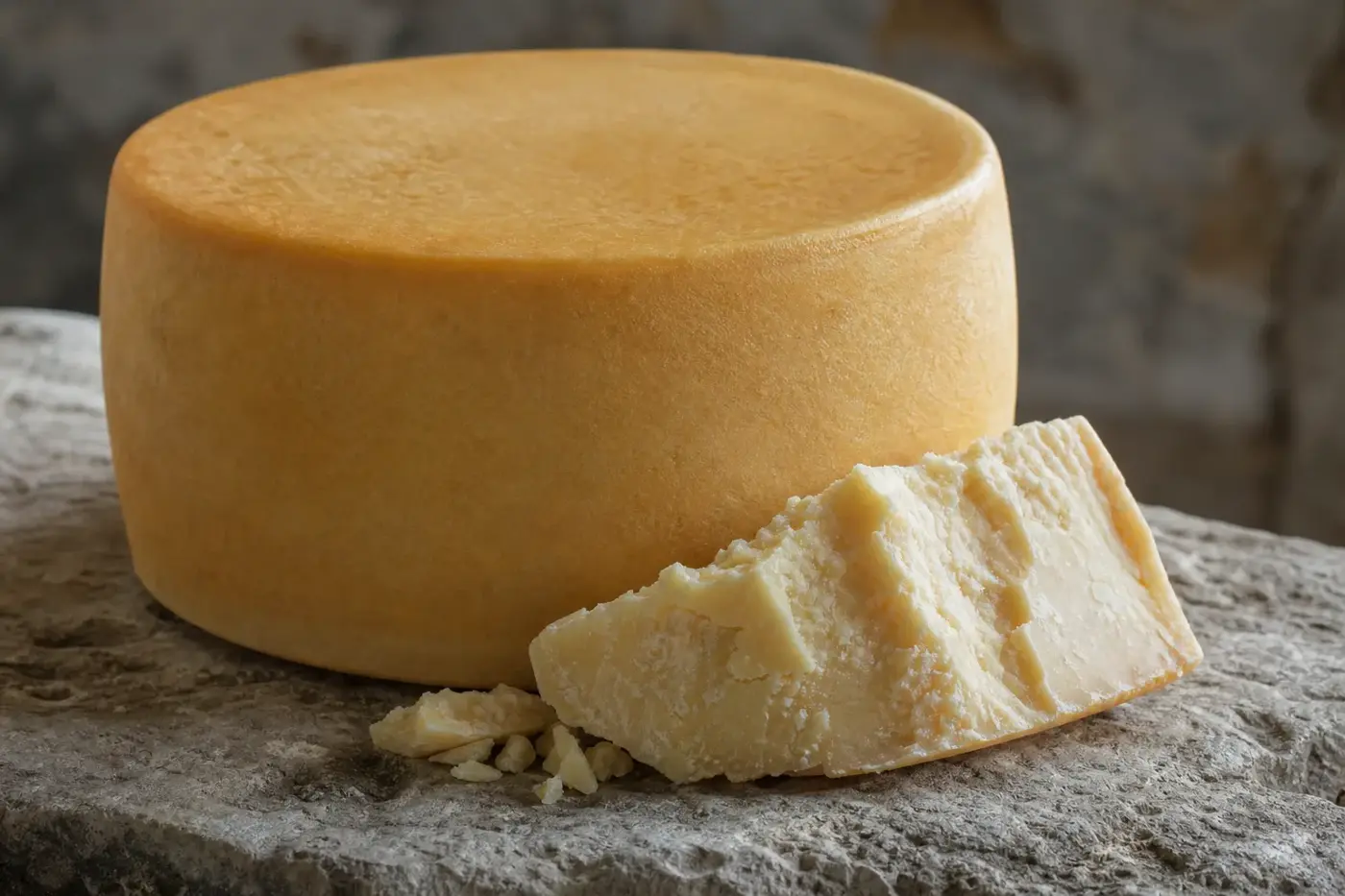
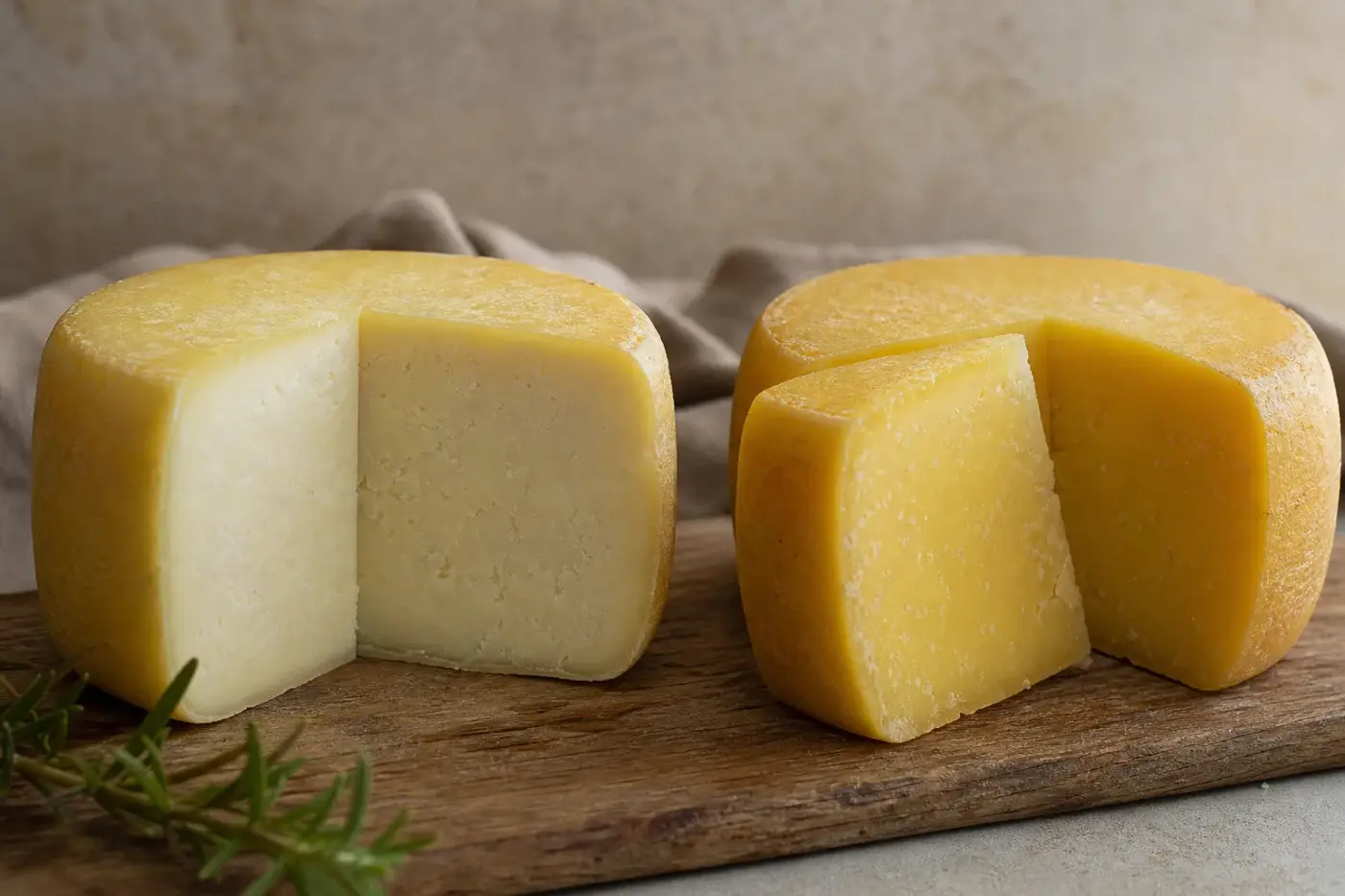
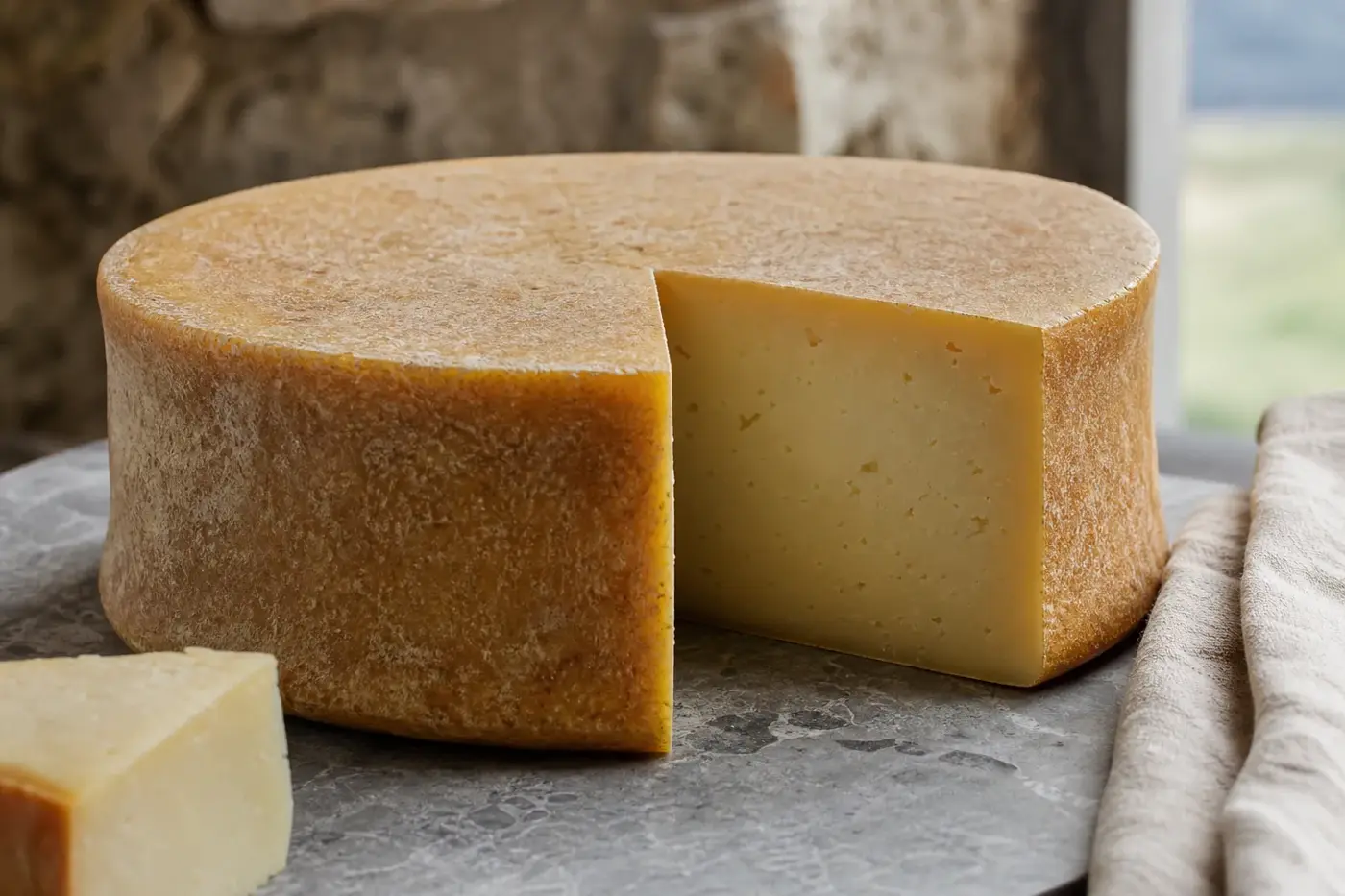
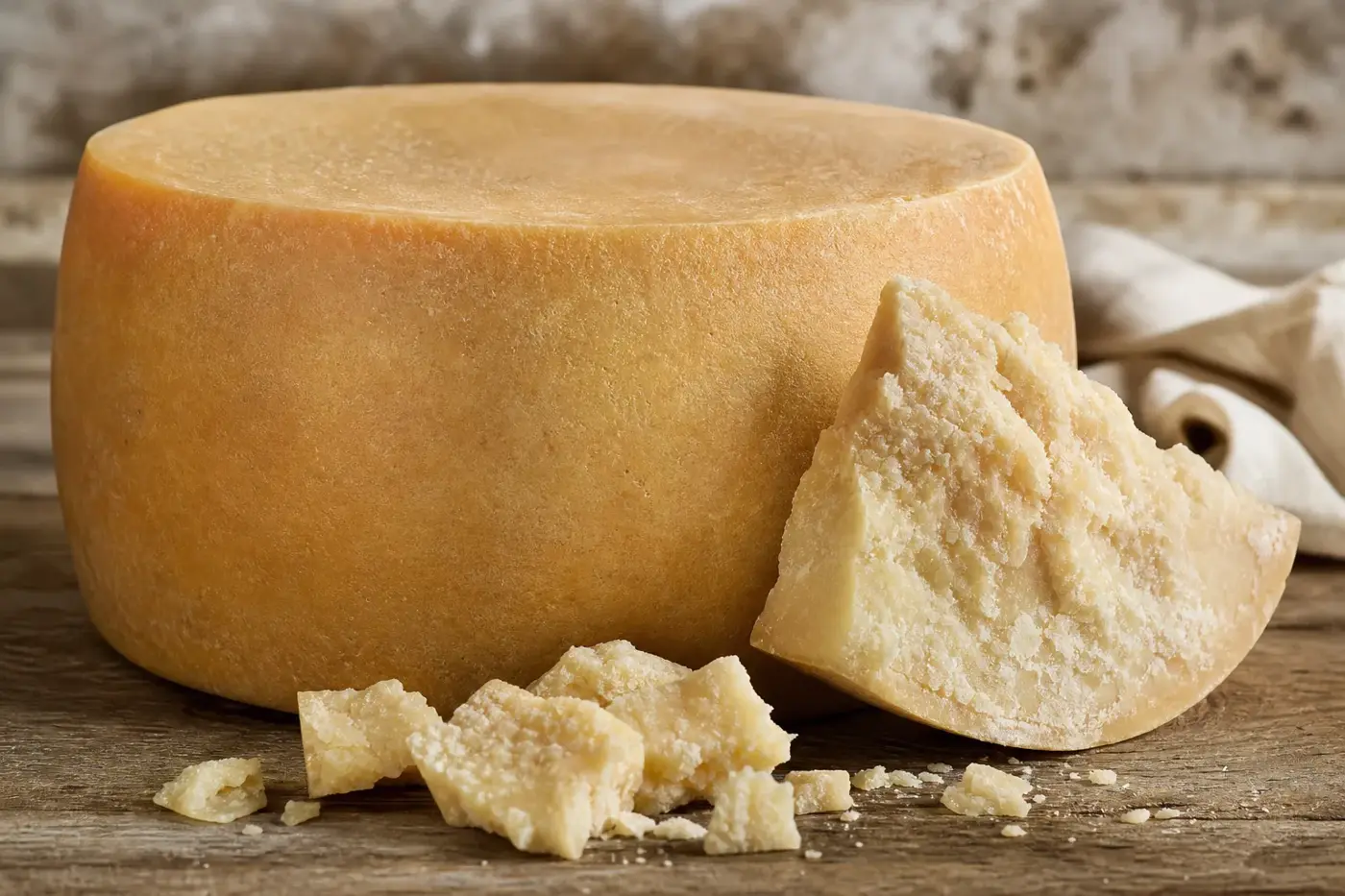
Before you taste, give the rind a moment of your attention. Compact and straw-yellow, it deepens in colour as Bitto matures; the specification puts its thickness at 2 to 4 mm. Flat faces, defined edges and a slightly hollowed side complete the wheel’s shape. [1]
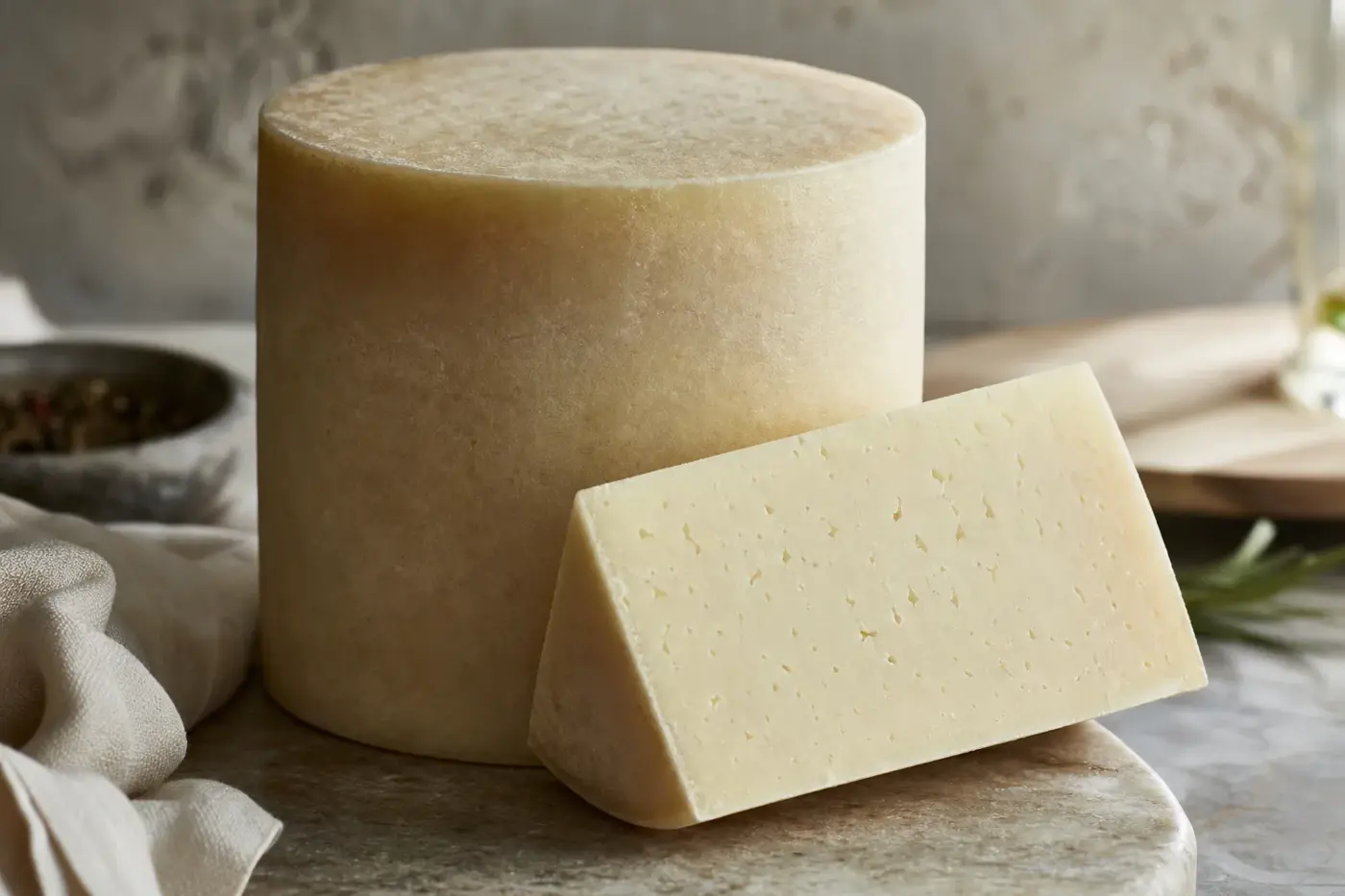
Inside, you will find compact paste, white to straw-yellow depending on age, with small, scattered openings. The Italian phrase occhiatura rada ad occhio di pernice compares those sparse eyes with a partridge’s eye. It is a wonderfully precise invitation to look closer. [1]
Look for a close paste interrupted by occasional small eyes, rather than a broadly open structure. A cut face from such a substantial wheel gives you plenty of room to examine changes in colour and structure across the cheese. [1]
Let age lead your first taste
Sweet and delicate: that is how the specification describes young Bitto. Maturation makes the flavour more intense, while goat’s milk, when used, strengthens its characteristic aroma. The consortium connects the aromas with the mountain pastures, giving you a starting point for your own tasting. [1, 3]
Age is the simplest place to begin. Younger Bitto offers the gentler character, while longer maturation brings the more pronounced flavour described in the specification. After at least a year, the official text specifically allows it to be grated as a condiment. [1]
The 70-day minimum is a qualifying threshold, not an instruction to eat every wheel at that age. At the other end, the consortium describes selected wheels matured for up to ten years. Your choice has plenty of room between those two milestones. [1, 3]
If you can, compare ages, starting with the younger piece before trying the older one. Notice the aroma, resistance to the knife and length of the finish. Note the maker and production year alongside your impressions, so you can find the wheel again. Cheese-induced optimism is no substitute for writing it down.
Get to know Storico Ribelle on its own terms
Storico Ribelle deserves its own introduction. Its producer organisation describes a raw milk mountain cheese from particular pastures in the Orobie Prealps, made between June and September. Cow’s milk is joined by 10 to 20% milk from Orobica goats. [5, 6]
Its rules prohibit added starter cultures, supplementary compound feed and silage. That is a material difference from Bitto PDO, which permits up to 10% goat’s milk, indigenous cultures and limited supplementary feeding. Keep the names separate when choosing, rather than assuming their historical relationship makes the cheeses interchangeable. [1, 5]
Even within Bitto PDO, you have more to discover. Producers meeting particular conditions can use an additional pasture-name marking. Those conditions include no added cultures, tighter milk-processing timing and a pasture-based feeding regime with specified exceptions. [1]
For a vivid glimpse of Storico Ribelle’s setting, look to the calècc. Its organisation describes this cheesemaking structure beside the pasture, where milk can be worked close to the grazing animals, along with selection and extended maturation at Gerola Alta. That account belongs to this particular tradition; Bitto’s legal production requirements come from the PDO specification. [1, 5, 6]
Bring four questions to the cheese counter
Who made it, in which production year, how long has it matured, and was goat’s milk used? Those four questions will take you a long way. The answers connect your piece with the important distinctions of season, milk composition and age. [1]
Whole qualifying wheels carry the prescribed Bitto identification on their side. Buying a cut portion? Ask to see that identification or the accompanying product information; the specification also permits producer and business references alongside the designation. [1]
Choose the age to suit what you want to do with it. Start younger to explore Bitto’s delicate character, or choose older for a more forceful condiment. If the packaging leaves you puzzling, see how to read a cheese label.
Give your piece the care it needs
Follow the storage instructions supplied with your cheese, including those for after opening. For England, Wales and Northern Ireland, the Food Standards Agency advises refrigerating dairy products and keeping a domestic fridge between 0 and 5 °C. That is the November 2026 guidance. [10]
Keep your cheese covered between uses and retain its identifying information. Buy an amount that fits your plans. A whole wheel’s ability to mature professionally for years is not a storage instruction for the cut piece in your fridge.
When you serve it, follow the FSA guidance on keeping chilled food out of refrigeration. [10] For fuller advice, turn to storing cheese at home.
Start with a taste, then bring out the pans
Begin with plain bread and water if you want to compare the cheese itself. Water also makes a straightforward alcohol free pairing. Then try apple, walnuts or a little honey separately, judging each against the age of your particular piece.
Welcome young Bitto into polenta taragna
Polenta taragna brings Bitto into the region’s everyday cooking. Porte di Valtellina’s tourism consortium publishes a version with maize and buckwheat flours, butter and young Bitto. You add the cheese towards the end of cooking. [7]
There is local variation to explore, too. Valdisotto’s tourism organisation describes versions using Bitto, Valtellina Casera or both, with differences in flour, potatoes and accompaniments. Decide which version you are making before you shop. [8]
Know your cheese before making pizzoccheri
The Accademia del Pizzocchero di Teglio’s published recipe specifies Valtellina Casera and grated grana. They join buckwheat pasta, potatoes, vegetables and garlic butter. Bitto is not the cheese named in that recorded version. [9]
If you use Bitto in a variation, name it explicitly. That makes your choice clear while respecting the academy’s recipe. As with taragna, find out which cheese and age your particular recipe calls for before buying.
Questions people ask
Where is Bitto made?
Bitto is made in the province of Sondrio and specified neighbouring mountain pastures in Bergamo and Lecco, Italy. Milk production, cheesemaking and maturation must all take place within the defined area.
What milk is used to make Bitto?
Bitto is made from whole raw cow’s milk. Raw goat’s milk is optional and may make up to 10%.
How long is Bitto aged?
Bitto must mature for at least 70 days. The consortium says selected wheels mature for up to ten years.
What is the difference between Bitto and Storico Ribelle?
Bitto permits up to 10% goat’s milk, while Storico Ribelle is made with 10 to 20% milk from Orobica goats. Storico Ribelle prohibits added starter cultures and supplementary compound feed, whereas Bitto permits indigenous cultures and limited supplementary feeding.
How is Bitto used in cooking?
The official specification allows Bitto to be grated as a condiment after at least a year of maturation. A version of polenta taragna published by Porte di Valtellina adds young Bitto towards the end of cooking.
Sources
[1] Italian Ministry of Agricultural, Food and Forestry Policies, Provvedimento 3 dicembre 2009: Modifica del disciplinare di produzione della denominazione «Bitto», published in Gazzetta Ufficiale, No 300, 28 December 2009; accompanying specification, Articles 1 to 4. Official document and specification.
[2] Consorzio per la Tutela dei Formaggi Valtellina Casera e Bitto, Il Consorzio, undated, accessed November 2026. Industry body’s account of the designation and its producers. Consortium website.
[3] Consorzio per la Tutela dei Formaggi Valtellina Casera e Bitto, Bitto DOP: Alpeggio e natura, undated, accessed November 2026. Production sequence, sensory descriptions, extended maturation and wine suggestion are the consortium’s published account. Bitto page.
[4] Department for Environment, Food & Rural Affairs, Bitto, GB protected food and drink names register, published 4 January 2021, accessed November 2026. Official register entry.
[5] Valli del Bitto Trading, Storico Ribelle, undated, accessed November 2026. Producer organisation’s account, with a commercial interest in the product. Storico Ribelle description.
[6] Valli del Bitto Trading, La Produzione, undated, accessed November 2026. Producer organisation’s account of grazing and local milk processing. Production account.
[7] Consorzio Turistico Porte di Valtellina, Polenta taragna, undated, accessed November 2026. Published local recipe.
[8] Valdisotto Tourism, La Polenta Taragna, 1 January 2021, accessed November 2026. Local variations and recipe.
[9] Accademia del Pizzocchero di Teglio, La ricetta originale dei Pizzoccheri, undated, accessed November 2026. Academy recipe.
[10] Food Standards Agency, How to chill, freeze and defrost food safely, published 18 December 2017, accessed November 2026; applies to England, Northern Ireland and Wales. Official guidance.
Researched through the published Italian specification, the GB register, producer and consortium accounts, local culinary organisations and official food-storage guidance.
Last checked: November 2026
Last checked November 2026.
The editors suggest you read next
Parmigiano Reggiano
Break into a wheel of Parmigiano Reggiano and flakes fall away, revealing a finely granular cheese, pale straw to straw in colour.