Blackmount
Beneath Blackmount’s dark coat of ash, the cheese is quietly softening.
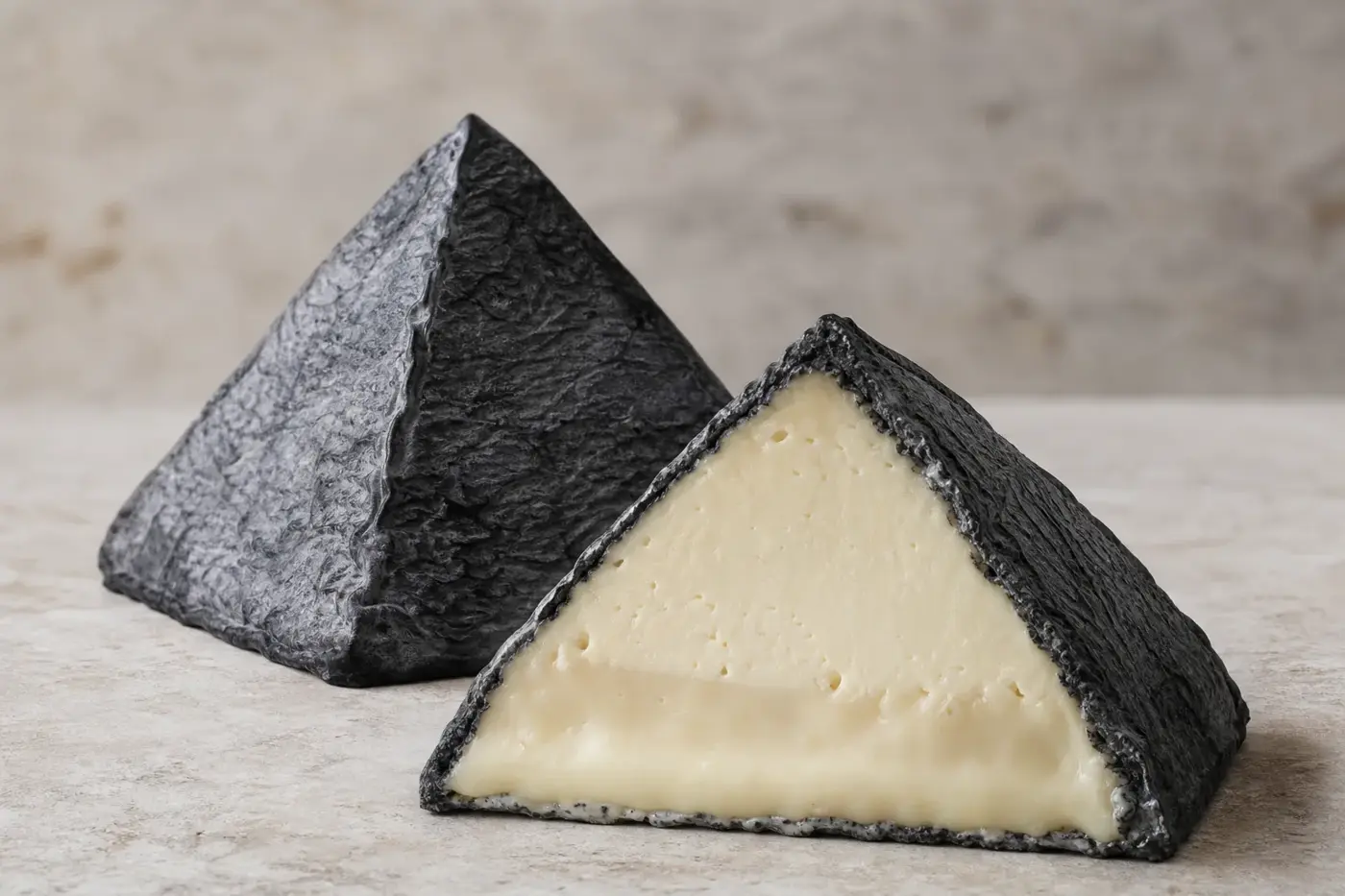
Beneath Blackmount’s dark coat of ash, the cheese is quietly softening. Its wrinkled, velvety rind gives way to a softer layer underneath. You’re looking at a soft, lactic goat’s milk cheese from Errington Cheese at Walston Braehead Farm in South Lanarkshire, Scotland. Slow acidification, delicate curd and gentle handling begin the work; a living rind carries it on. [1][2][3]
Your first look at Blackmount
| What you’d like to know | The detail |
|---|---|
| Maker | Errington Cheese. [1] |
| Home | Walston Braehead Farm, South Lanarkshire, Scotland. [2] |
| Milk | Goat’s milk from the farm’s own herd. [2] |
| Milk treatment | Unconfirmed. [1][6] |
| Style | Soft, lactic, ash-coated. [1] |
| Surface | Vegetable ash and a developing Geotrichum rind. [1][3] |
| Shape | Mounds in the maker’s description; pyramidal moulds documented by Neal’s Yard Dairy. [1][6] |
| Maturation | Average age of 3 to 6 weeks for Neal’s Yard Dairy’s selection. [6] |
| Minimum weight in maker’s listing | 220 g. [1] |
Before the goats came the sheep
Blackmount’s story starts with sheep. Errington traces cheesemaking at Walston Braehead Farm to the early 1980s, with Lanark Blue among its first cheeses. Dairy goats arrived in 2019, bringing another milk supply and allowing the farm to make cheese throughout the year. [2]
Look towards the hill between the farm and Errington’s Barn and you’ll find the source of Blackmount’s name. Errington named the cheese after that local landmark. Its name belongs firmly to South Lanarkshire, rather than a distant cheesemaking region. [1]
Each morning, the farm says, fresh milk travels from the parlour into the cheese rooms. There, a small team takes over and makes the cheeses by hand. [2]
Meet the herd behind the rind
According to Errington, every drop of milk it uses comes from its own farm. For Blackmount, you can trace that milk back to the dairy goats. Neal’s Yard Dairy describes the same close link between herd and cheese in its account of working with the maker. [2][4]
The farm attributes seasonal differences between its cheeses to changes in the milk. When you choose Blackmount, ask about the maturity and firmness of the cheese in front of you. For more on milk treatment, turn to raw, thermised and pasteurised cheese. [2]
A quiet night’s work in the dairy
Blackmount’s curd takes the night to set. Errington adds cultures to gently warmed milk, then a small quantity of rennet once the required acidity has developed. The fragile curd is ladled by hand into forms so that whey, the liquid separated from the curd, can drain away. After unmoulding, the cheeses enter a hastening room, where their surfaces begin to develop. [1]
In lactic cheesemaking, acidity does much of the setting work. Starter bacteria turn lactose, the milk sugar, into lactic acid. As acidity rises, casein proteins gather into a fragile gel. That transformation from liquid milk to set curd is coagulation. [5]
A little rennet can lend the curd extra strength. This preparation contains milk-clotting enzymes, but using it does not stop a cheese being lactic in character. What matters is the balance between acid development and enzymatic setting, rather than choosing one and excluding the other. [5]
The curd needs gentle hands because its structure is easily damaged. For acid-set cheeses, draining removes enough whey to establish the eventual consistency, rather than simply getting the cheese ready for pressing. You can follow the broader sequence in how cheese is made. [5]
Neal’s Yard Dairy’s 2026 crib sheet gives an average age of 3 to 6 weeks for the Blackmount it matures. The monger receives young cheeses, then works on rind development, salt balance and texture before releasing them. That age describes its own selection, not every Blackmount you might meet at a cheese counter. [6]
Beneath that coat of ash
Blackmount’s ash and rind are different things. After unmoulding and the first surface growth, Errington applies salt mixed with vegetable ash. The ash provides a coating; the rind is the living surface that develops as the cheese ripens. [1][3]
In its October 2026 production account, Errington explains that Geotrichum, a yeast-like fungus, joins the cheesemaking culture. Controlled temperature and humidity in the hastening room encourage it to develop. The dairy describes the result as a wrinkled, velvety skin, with softer cheese forming immediately beneath it. [3]
Research on cheese yeasts helps explain what you’re seeing. Surface organisms can consume lactate and raise the surface pH, making it less acidic. Their protein-breaking and fat-breaking activities also contribute to texture and flavour. Together, these processes help explain how a surface-ripened cheese softens on the outside while remaining firmer at its centre. [7]
The ash has a job beyond looking well dressed. Errington says it helps rind formation and contributes slight smokiness. [1]
Take the scenic route from centre to edge
Neal’s Yard Dairy’s product page describes fudgy paste, a soft layer beneath the ash and meaty flavours with a little goat character. Its 2026 crib sheet offers another view: silky texture, yoghurt-like freshness and gentle savouriness. You have several textures and flavours to get acquainted with, all within the same cheese. [4][6]
Errington’s rind account adds earthy, mushroom-like flavours, with the layer beneath the skin becoming increasingly soft during maturation. Taste for the balance between acidity and savouriness, then compare the centre with the edge. At the counter, asking for something firmer or more yielding tells the cheesemonger more than simply asking for an older cheese. [3][4]
Blackmount takes the championship
At the 2025 Scottish Dairy Championship, Blackmount was named Champion Overall Dairy. The organiser’s results identify it as Errington’s entry number 66. That same entry won Champion Cheese, Best Scottish Cheese Exhibit and both the overall and Scottish-produced speciality cheese prizes. [8]
Make room for Blackmount in the fridge
Follow the storage and opening instructions supplied with your Blackmount. Keep the wrapper or label so you retain its date and batch information. For England, Northern Ireland and Wales, the Food Standards Agency recommends a fridge temperature between 0 and 5 °C (32 to 41 °F), checked with a thermometer. [9]
Ripeness and date marks tell you different things. GOV.UK explains that a use-by date concerns safety, while a best before date concerns quality. Follow a use-by date even if the cheese looks appealing. Softening beneath Blackmount’s rind is part of ripening, but it does not override storage instructions or date marking. [3][10]
If ash-coated cheese is new to you, ask the cheesemonger what surface development to expect from the batch you’re buying. Consider its storage history as well as its appearance. For broader handling advice, see how to store cheese at home and mould on cheese. [3][10]
Give the centre and rind a fair hearing
Start with a small piece on plain bread, before anything sweet or strongly flavoured joins it. Taste the centre and the paste beside the rind separately, then together. The published descriptions suggest that texture deserves just as much attention as acidity. [3][4][6]
- Take out only what you expect to serve. Let that portion lose its refrigerator chill while you prepare bread and accompaniments, rather than repeatedly warming the whole cheese.
- In England, Northern Ireland and Wales, follow the Food Standards Agency’s current advice on keeping chilled food out of the fridge during preparation. [9]
- Cut a piece that includes centre and surface. Notice how firmly the middle holds and how readily the outer paste yields, using the maker’s and monger’s descriptions as reference points. [3][4]
- Smell before tasting, then pause after your first mouthful. Milky, yoghurt-like, earthy and savoury are useful prompts for notes. Record what you find, rather than chasing every published descriptor. [3][6]
Keep your first food pairing simple. A slice of pear offers juicy contrast, while a little honey can sit beside the cheese rather than being spread over it. Plain crackers give you a cleaner comparison than heavily seasoned ones. Serve accompaniments separately and adjust each mouthful to the cheese’s particular balance of acidity and savouriness. [3][6]
For a more substantial plate, borrow Neal’s Yard Dairy’s published pairing: pieces of Blackmount beside roasted red peppers and a little olive tapenade. Start sparingly with the tapenade so its saltiness stays in the background. If your cheese is spoonable, serve it alongside warm vegetables or bread. You can leave the complicated recipe for another evening. [6]
A simple drink lets the cheese speak
Sparkling water makes a straightforward companion. It leaves Blackmount’s acidity and changing texture clear for you to enjoy.
Where your cheese curiosity leads next
- How to Tell Cheese Styles Apart: Milk, Rind, Texture and Method: discover where lactic setting, ash and surface ripening fit into the wider world of cheese styles.
- Cheese and Wine Pairing: The Complete Guide: explore the principles of matching acidity, texture and savouriness.
General information only, not medical advice: follow the official guidance where you live.
Questions people ask
What milk is Blackmount made from, and is it pasteurised?
Blackmount is made from milk from Errington’s own dairy goats. The page does not verify how the milk is treated.
Why is Blackmount coated in ash?
Errington applies salt mixed with vegetable ash as the cheese develops its surface. The maker says the ash aids rind formation and contributes slight smokiness.
What does Blackmount taste like?
Neal’s Yard Dairy describes meaty flavours with a little goat character, as well as yoghurt freshness and gentle savouriness. Errington also describes earthy, mushroom flavours.
Is Blackmount suitable for vegetarians?
Errington says it adds a small quantity of rennet during cheesemaking. The type of coagulant has not been verified, so the page does not establish whether Blackmount is suitable for vegetarians.
How should I store Blackmount?
Follow the storage and opening instructions supplied with the cheese, and retain its wrapper or label. For England, Northern Ireland and Wales, the Food Standards Agency advises a fridge temperature between 0 and 5 °C, checked with a thermometer; see its current guidance.
Sources
- Errington Cheese, Blackmount, current product and making account, undated, accessed November 2026. Maker’s product page.
- Errington Cheese, Our Cheesemaking Story, current website account, undated, accessed November 2026. Maker’s history and milk-source account.
- Errington Cheese, Is Mould on Goat’s Cheese Normal? How to Tell If Soft Cheese Is Still Safe to Eat, 13 October 2026. Used for the maker’s production and sensory descriptions, not its safety assurances. Maker’s rind-development account.
- Neal’s Yard Dairy, Blackmount, current product page, undated, accessed November 2026. Commercial seller’s own selection, tasting and producer account. Product account.
- American Society for Microbiology, The Basics of Cheesemaking, Microbiology Spectrum, published 31 October 2013, DOI 10.1128/microbiolspec.CM-0002-2012. Published scientific account.
- Neal’s Yard Dairy, Blackmount, crib sheet, 2026 edition, file identified as 2026-06_24. Commercial affineur’s account of its own selection and maturation. Retrieved crib sheet.
- Agroscope, Cheese yeasts, Yeast, volume 36, issue 3, pages 129 to 141, 2019, DOI 10.1002/yea.3368. Published review; abstract consulted for surface deacidification and ripening functions. Publication record and abstract.
- Royal Highland Show, Scottish Dairy Championship: Special Prize Winners 2025, official results, 2025. Competition results.
- Food Standards Agency, How to chill, freeze and defrost food safely, published 18 December 2017, current retrieved version, November 2026; applies to England, Northern Ireland and Wales. Official handling guidance.
- GOV.UK, Understanding food labelling: Best before and use-by dates, current retrieved version, November 2026. Official date-marking guidance.
- Food Standards Agency, Alerts, live alert index, accessed November 2026. Official alert index.
- Food Standards Scotland, For safe food and healthy eating, current homepage and latest-alert listings, accessed November 2026. Official Scottish source.
Researched from the maker’s published accounts, the affineur’s product records, scientific publications, official competition results and official food-handling guidance.
Last checked: November 2026
Last checked November 2026.
The editors suggest you read next
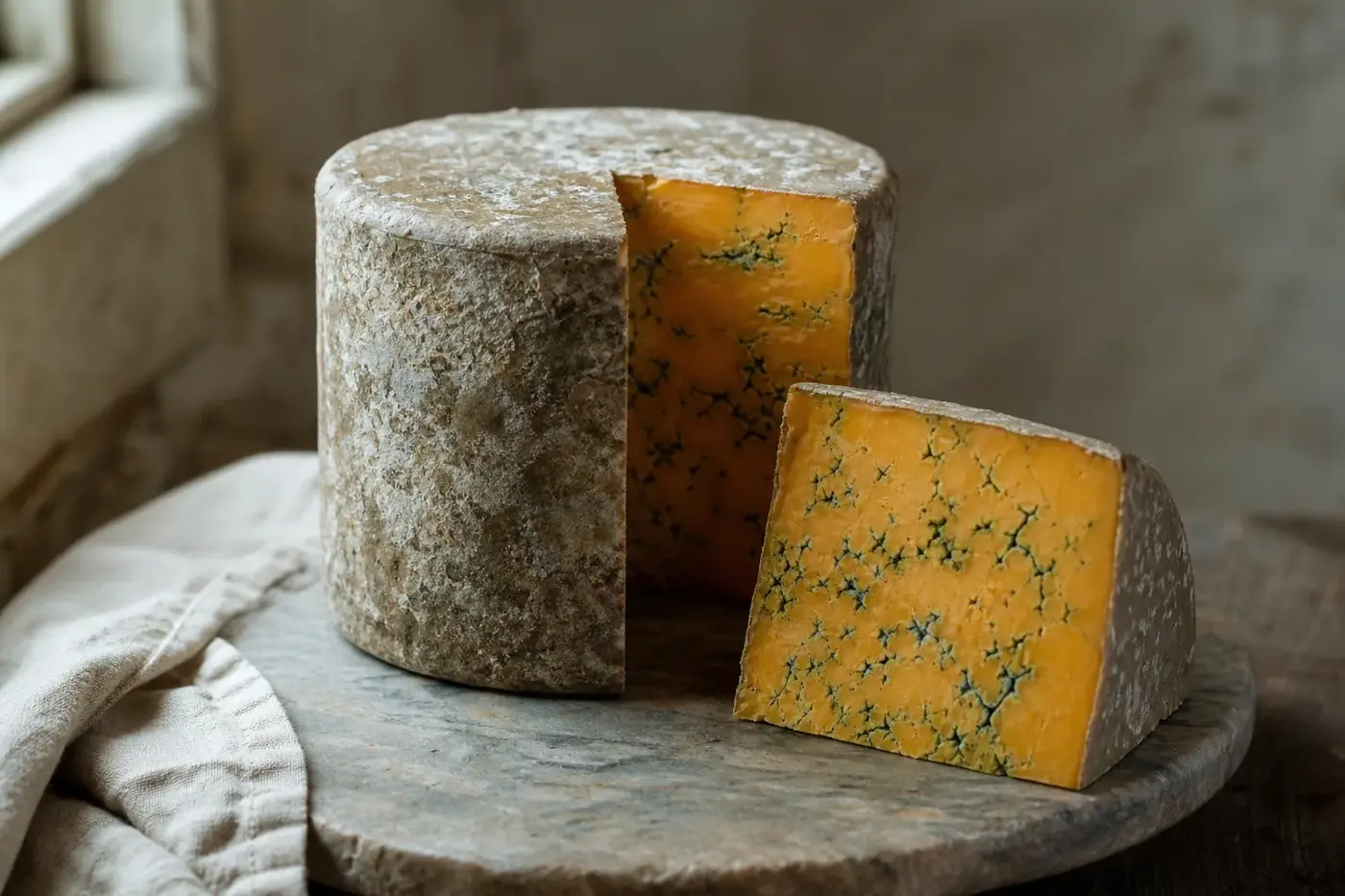
Shropshire Blue
Cut into Shropshire Blue and you get quite a colour scheme: orange crossed by blue-green veins.