Shropshire Blue
Cut into Shropshire Blue and you get quite a colour scheme: orange crossed by blue-green veins.
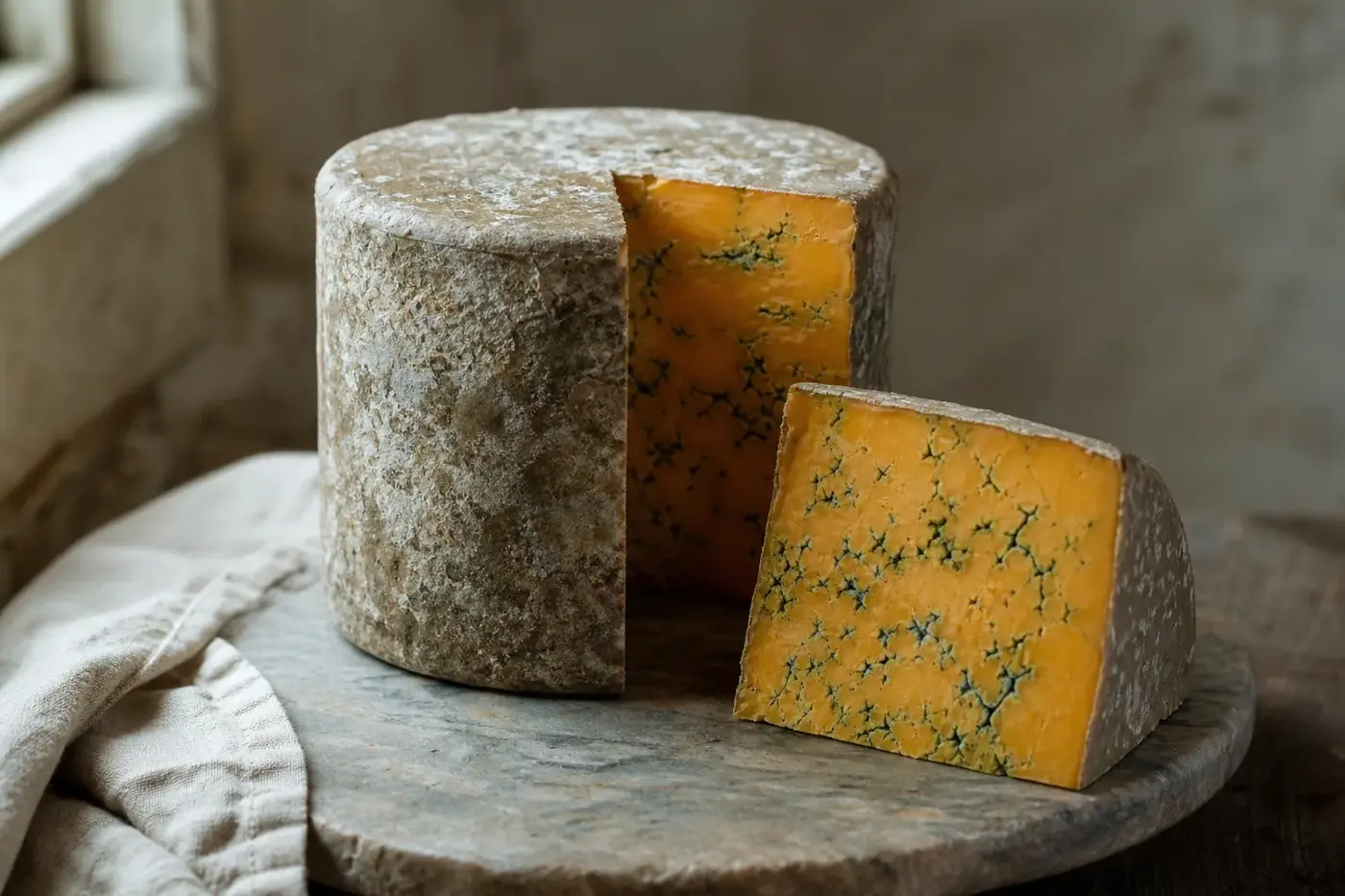
Cut into Shropshire Blue and you get quite a colour scheme: orange crossed by blue-green veins. Annatto supplies the orange; mould creates the blue. The name suggests an English county, but one published account takes you to Castle Stuart Dairy near Inverness in the 1970s. Today, established makers include Nottinghamshire dairies: this cheese has travelled further than its name lets on. [1,3,4,5]
| At a glance | What to know |
|---|---|
| Name | Shropshire Blue; also Blue Shropshire. [3] |
| Milk | Cow’s milk. [3] |
| Appearance | Cylindrical, with a natural rind, orange paste and blue-green veins. [2] |
| Cultures | Dairy cultures and Penicillium roqueforti. [3] |
| Colouring | Annatto. [3] |
| Cropwell Bishop’s milk and rennet | Pasteurised cow’s milk; vegetarian rennet. [3] |
| Typical maturation | Academy of Cheese: 10 to 13 weeks. [2] |
| Legal minimum maturation | Not specified here |
| GI registration, Great Britain | Not specified here |
| GI registration, EU | Not specified here |
| GI registration, Northern Ireland | Not specified here |
Follow the name back to Scotland
Castle Stuart Dairy, near Inverness, is where Teddington Cheese’s account of Shropshire Blue begins in the 1970s. It credits Andy Williamson, a cheesemaker trained in Stilton-making in Nottinghamshire, and records two early names: Inverness-shire Blue and Blue Stuart. In this telling, Shropshire Blue was chosen to appeal beyond Scotland, rather than identify the cheese’s birthplace. [1]
The Academy of Cheese’s teaching material includes the Castle Stuart story, alongside an alternative attribution to cheese grader Dennis Biggins. The earlier history remains disputed, so Williamson’s role belongs to an attributed account, not a settled claim that one person invented the cheese on a particular date. The Scottish story nevertheless helps you make sense of that distance between name and reported birthplace. [2]
A new home among English blue makers
The Scottish creamery closed in 1980, according to Teddington’s account. Production followed in Cheshire, before established English blue cheesemakers adopted the cheese. [1]
For the cheese you buy today, the makers’ own records provide a clearer map. In November 2026, Cropwell Bishop’s records describe Blue Shropshire made by hand at its dairy in Cropwell Bishop, Nottinghamshire. Colston Bassett Dairy lists Shropshire Blue among its cheeses made in the Vale of Belvoir, while Clawson Farms includes it in its current range. [4,5,6]
What the orange and blue tell you
Cut through the natural rind and the contrast is immediate: orange paste, the body of the cheese, threaded with blue-green veins. The tall cylindrical shape will be familiar if you know British blue cheeses. The Academy of Cheese describes a fine, web-like spread of blue through the interior. [2]
Those two colours have different jobs. Cropwell Bishop lists annatto as the colouring and Penicillium roqueforti as the mould culture: annatto brings the orange, while the mould produces the blue veining. Read the ingredients alongside the cut face, rather than judging by colour alone. A deeper orange does not mean a stronger blue flavour. [3]
Milk, curds and a little patience
The process starts with cow’s milk. Starter cultures are bacteria that develop acidity; rennet coagulates the milk into a gel, which separates into curd and liquid whey. Cropwell Bishop lists milk, dairy cultures, vegetarian rennet, salt, annatto and Penicillium roqueforti. Those ingredients describe its own Blue Shropshire, not every cheese bearing the Shropshire Blue name. [3,8]
Stilton gives you a useful comparison for curd handling. Its official specification describes pasteurised milk, the addition of starter and coagulant, and cutting the curd to release whey. The curd is subsequently cut, milled, salted and placed in cylindrical moulds. These are Stilton’s specified stages; for a particular Shropshire Blue, turn to its maker’s information. [8]
For the role of piercing in Shropshire Blue, ask the maker for its documented process. During maturation, the blue develops alongside changes in texture and flavour, with the Academy of Cheese giving a typical age profile of 10 to 13 weeks. Ask your seller how old the particular cheese is, rather than relying on that range alone. [2,8]
You can explore the general stages in how cheese is made. For the choices of coagulant, turn to rennet explained.
Meet the creamy, crumbly, peppery side
Colston Bassett describes its Shropshire Blue as creamy, milder and sweeter than its Stilton, with a mellow, peppery blue tang. Clawson Farms describes a fudgy texture and a gently tangy, mellow flavour. These are the makers’ descriptions of their own cheeses, not a fromage.co.uk tasting. [5,6]
The Academy of Cheese adds a texture that can be yielding yet slightly crumbly, with sweet dairy notes and gentle spice. That gives you a useful starting point at the cheeseboard: try a small piece alone and notice whether it breaks cleanly or yields under the knife. Follow the dairy sweetness into the tang of the blue veins. Your cheesemonger can do more with that than “stronger”, the cheese counter’s most overworked word. [2]
Give Shropshire Blue and Stilton their own moment
Shropshire Blue and Stilton share a cheesemaking tradition, and several dairies make both. Each still deserves your attention. Colston Bassett describes its Shropshire Blue as sweeter and more delicate than its Stilton, a distinction that reaches beyond the orange colour. [4,5]
Stilton also has a protected specification. As of November 2026, Stilton Blue Cheese is registered as a protected designation of origin in Great Britain. The specification requires production in Derbyshire, Leicestershire or Nottinghamshire, using pasteurised cow’s milk. It permits both animal and non-animal rennet. [7,8]
For Shropshire Blue, look to the named maker for milk treatment, rennet and maturation. Cropwell Bishop declares pasteurised milk and vegetarian rennet for its Blue Shropshire. Check other products individually, since one maker’s declaration does not describe another’s cheese. The guide to reading a cheese label shows you where to find the information. [3]
Let the cheese lead the board
Keep your board straightforward: a wedge of Shropshire Blue, plain bread or crackers, sliced pear and a few walnuts. Set the accompaniments separately so everyone can choose each mouthful. Cropwell Bishop pairs Blue Shropshire with pears in its published pairing guide, and combines the cheese, pears and walnuts in a salad recipe. On your board, those ingredients offer simple accompaniments without becoming a prepared dish. [10,11]
The maker also suggests quince jam or celery. Start with pear, then add a little quince if you fancy a sweeter mouthful. Keeping everything separate lets you return to the cheese on its own between combinations, a perfectly respectable reason to have another piece. [11]
Offer water alongside the board as an alcohol-free choice.
Bring it home and keep it well
Ask who made your cheese, when it was cut and which storage instructions come with it. Buy a quantity you expect to finish within those instructions, and keep the label or the cheesemonger’s written advice. Cropwell Bishop’s product sheet specifies refrigeration below 5 °C and consumption within three days of opening, without exceeding the use-by date. Follow the instructions supplied with your actual piece. [3]
At home, check your fridge with a thermometer. The Food Standards Agency’s guidance for England, Wales and Northern Ireland recommends a temperature between 0 and 5 °C. Wrap the cut cheese and place it in a clean lidded container, following the seller’s instructions. For Stilton, the cheesemakers’ association recommends foil or cling film inside an airtight box; ask your Shropshire Blue supplier whether that approach suits your piece. [9,12]
Before serving, consult the current Food Standards Agency guidance for England, Wales and Northern Ireland on how long chilled food can remain out of the fridge. Use that guidance when planning your serving time. [9]
For more on containers and fridge organisation, see how to store cheese at home.
General information only, not medical advice: follow the official guidance where you live.
Questions people ask
What does Shropshire Blue taste like?
Colston Bassett describes its Shropshire Blue as creamy, milder and sweeter than its Stilton, with a mellow, peppery blue tang. Clawson Farms describes its version as fudgy, gently tangy and mellow.
Is Shropshire Blue suitable for vegetarians?
Cropwell Bishop lists vegetarian rennet in its Blue Shropshire. Check other products individually, as one maker’s ingredients do not describe every Shropshire Blue.
How long is Shropshire Blue matured?
The Academy of Cheese gives a typical maturation of 10 to 13 weeks. Ask the seller how old the particular cheese is rather than relying on that range alone.
What goes well with Shropshire Blue?
Cropwell Bishop pairs Blue Shropshire with pears and also suggests quince jam or celery. Its salad recipe combines the cheese with pears and walnuts.
How should I store Shropshire Blue?
Follow the instructions supplied with your cheese. The Food Standards Agency recommends a fridge temperature between 0 and 5 °C in England, Wales and Northern Ireland; check its current guidance for more information.
Sources
- Teddington Cheese, Shropshire Blue, undated published trade account, retrieved November 2026. Source.
- Academy of Cheese, Level Two cheese brochure, February 2022 version, Shropshire Blue entry. Source.
- Cropwell Bishop Creamery, Product Information: Blue Shropshire Cheese, undated sheet linked from the maker’s current product page, retrieved November 2026. Source.
- Cropwell Bishop Creamery, Range, undated current maker statement, retrieved November 2026. Source.
- Colston Bassett Dairy, website, including Colston Bassett Shropshire Blue, undated current maker statement, retrieved November 2026. Source.
- Clawson Farms, Our cheese, undated current maker statement, retrieved November 2026. Source.
- Department for Environment, Food & Rural Affairs, Stilton Blue Cheese, Great Britain protected food name register, published 2021, checked November 2026. Register entry.
- Department for Environment, Food & Rural Affairs, Stilton Cheese: product specification, version linked from the current register entry, retrieved November 2026. Specification.
- Food Standards Agency, How to chill, freeze and defrost food safely, published 18 December 2017, current page checked November 2026; applies to England, Northern Ireland and Wales. Guidance.
- Cropwell Bishop Creamery, Pear & Blue Shropshire Salad, undated maker recipe, retrieved November 2026. Commercial producer source. Source.
- Cropwell Bishop Creamery, Pairing Guide, undated maker recommendations, retrieved November 2026. Commercial producer source. Source.
- Stilton Cheese Makers’ Association, Good Labelling Practice for Stilton Cheese, December 2023 revision. Industry guidance, not a food safety authority. Source.
- Food Standards Agency, Alerts, live official notices, accessed November 2026. Alerts index.
This desk-researched article compares current maker information, attributed historical accounts, the official Stilton specification and published FSA household guidance.
Last checked: November 2026
Last checked November 2026.
The editors suggest you read next
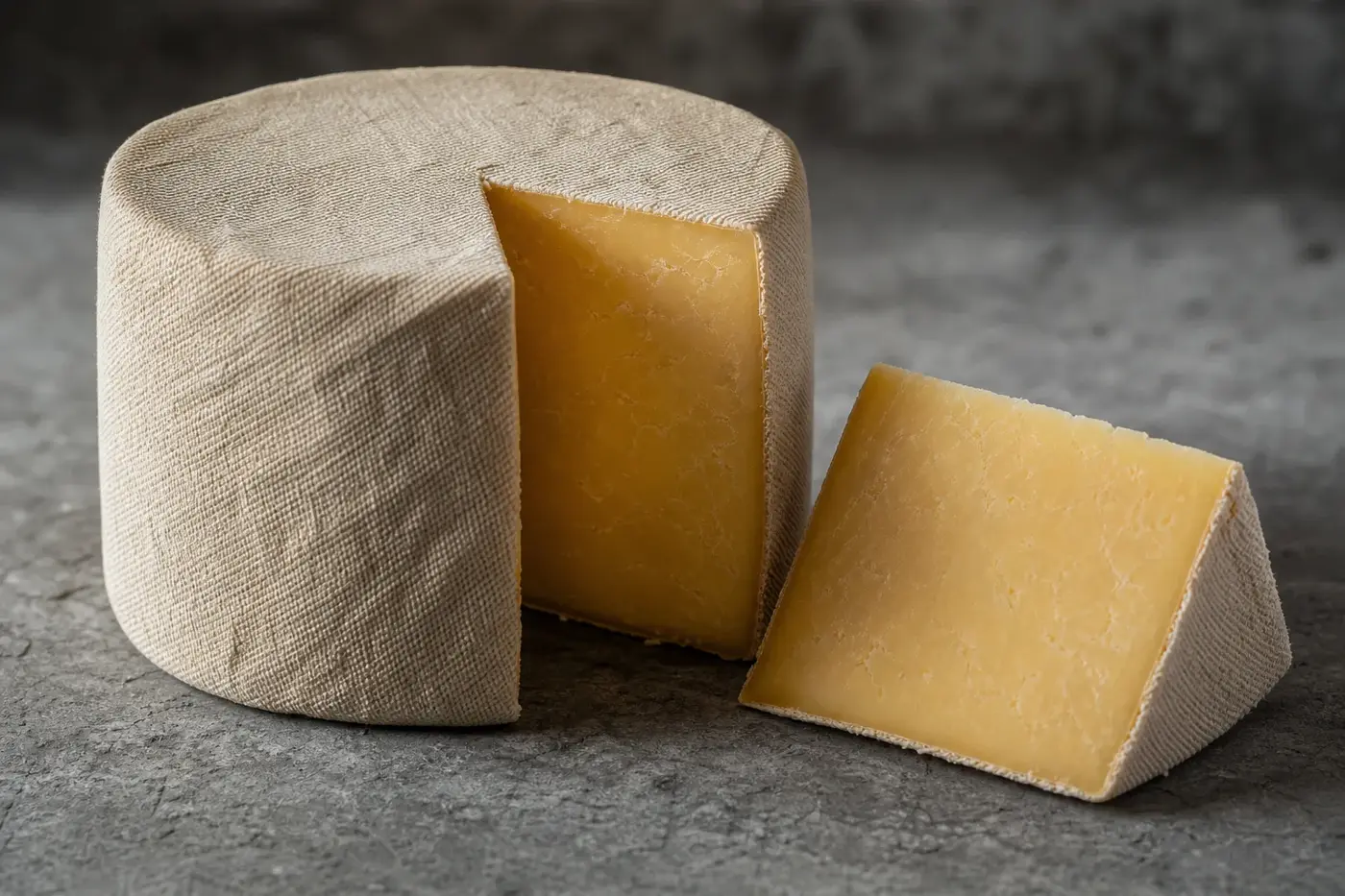
Isle of Mull Cheddar
At the winter feeding trough at Sgriob-ruadh Farm, Tobermory Distillery has a part to play.