Take a bite and the tang arrives first. Salt, earthiness and a little sweetness follow, carried in a smooth, blue-veined mouthful. Errington Cheese calls its Scottish ewe’s milk blue “fresh in summer and ripe in winter”, giving you another reason to pay attention to the season. [2]
Behind that mouthful is Walston Braehead Farm in South Lanarkshire. The Errington family’s flock and dairy keep Lanark Blue firmly rooted in the place where it is made. This is a cheese with a very particular home address. [3][4]
| What you might like to know | The detail |
|---|---|
| Name at the counter | Lanark Blue. [1] |
| Maker and home | Errington Cheese, Walston Braehead Farm, South Lanarkshire, Scotland. [3][4] |
| Milk | Ewe’s milk from the maker’s own Lacaune flock; ask the producer for current milk treatment details. [2] |
| What sets the milk | Vegetarian rennet, according to the maker. [2] |
| Where the blue comes from | Blue mould culture; pierced during maturation. [2] |
| Time to mature | Several weeks, according to the maker. [2] |
| Sheep milk season | January to September in the farm’s published account. [3] |
| Registered name, authority and register ID | Details unavailable |
| Protection status | Great Britain: status unavailable; EU: status unavailable; Northern Ireland: status unavailable. |
| Legal minimum ageing | Details unavailable |
| Direct inspiration and first production date | Details unavailable |
| UK pregnancy guidance | NHS guidance on soft blue-veined cheeses; November 2026. [10] |
Before the blue, meet the flock
Lanark Blue starts with sheep milked on the farm, rather than a specification for milk bought elsewhere. Errington describes making the cheese by hand nearby, with farming and cheesemaking belonging to the same operation. That closeness to the main ingredient is central to the dairy’s work. [5]
The maker places Lanark Blue in the semi-soft blue family. Ewe’s milk, blue mould growing inside the cheese and seasonal maturation all shape your mouthful. At the counter, “fresh or ripe?” may tell you more than “is it strong?” [2]
Strength is only one part of the pleasure, not the cheese’s entire personality. For the broader differences between milk, texture and rind, explore how to tell cheese styles apart.
A family story, with sheep at its heart
Errington dates its cheese business to 1985, with Lanark Blue as its pioneering ewe’s milk cheese. The founder’s daughter and the wider family continue that connection through farming, cheesemaking and the associated food business. [4]
Dairy Lacaune sheep have been part of the farm for more than 40 years, according to its account. Their milk goes into both Lanark Blue and the hard cheese Corra Linn. One flock, two rather different outcomes. [3]
If you are planning a visit, distinguish the farm from the Barn before setting off. Walston Braehead is the farm address in the producer’s cheesemaking accounts; Errington’s Barn is at South Melbourne Farm, Elsrickle. Look up the producer’s current visiting arrangements before you travel. [4][5]
Follow the flock’s seasonal rhythm
Winter lambing starts the story. The farm’s published sheep milk season runs from January to September, and the animals move to pasture when grass growth allows, usually after Easter. Grass, conserved hay and silage all help feed them through the year. [3]
That farming calendar reaches into the cheeseroom. It governs when fresh sheep milk arrives, while grazing, weather and the time of year bring changes for the cheesemaker to judge and accommodate. [3][6]
A production season is not a buying season, though. Your piece has already spent time maturing before reaching the counter. Ask when it was made and how it has matured: a winter purchase does not mean winter milk.
You may also see Errington describe making cheese throughout the year. That refers to the wider operation, which uses goat’s milk too. The farm distinguishes its year-round goat’s milk supply from its seasonal sheep milk supply. [3][6]
Into the cheeseroom, then on with the blue
A batch starts with one day’s milk, usually an evening and a morning milking. Errington describes moving it from the parlour to nearby cheeserooms, where warming and starter cultures begin the make. Those cultures are microorganisms that start acidification, developing the acidity cheesemaking needs. [6]
For Lanark Blue, blue mould culture and vegetarian rennet go into the milk. Rennet sets it into curd, the solid portion. Cutting and stirring release whey, the liquid portion, before the curd goes into moulds, is salted and matures for several weeks. [2]
Piercing follows during ageing, allowing the internal blue mould to develop. Each stage has a distinct purpose: setting creates the curd, handling controls its structure, and piercing supports the blue within. [2]
To follow those transformations more closely, read how cheese is made. The steps take you from milk to something you can slice, spread or crumble.
The dairy also describes grading Lanark Blue at around three weeks. That is a production assessment, not the age of the piece you buy. Changes made in the cheeseroom take time to reveal their effects; this is not work for the impatient. [6]
Find the ripeness that suits you
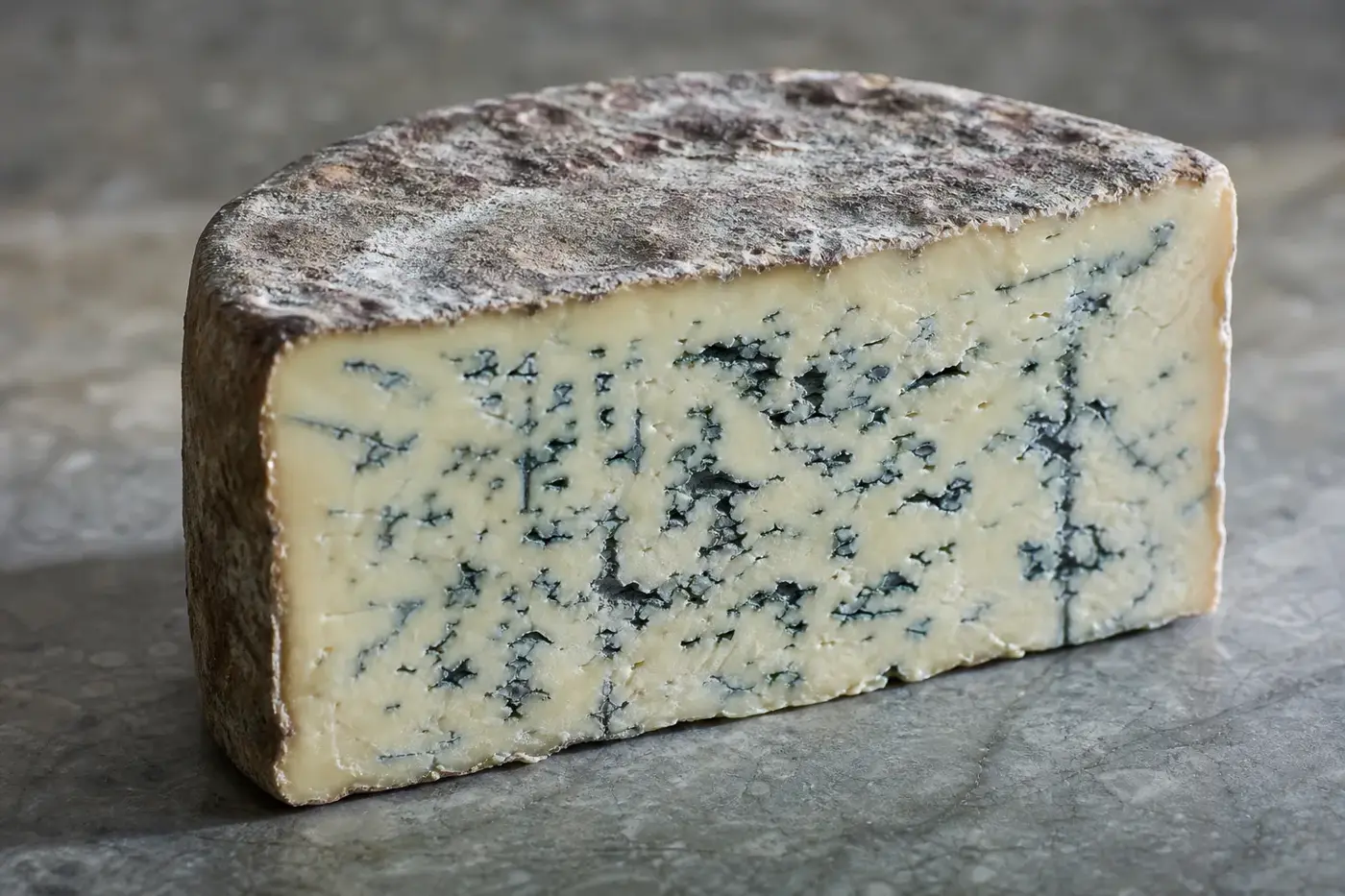
Earthy, tangy and salty, with sweetness alongside the sharper blue character: these are the maker’s tasting notes. The paste, meaning the body of the cheese, is smooth and semi-soft, with blue veins running through it. [2]
“Fresh in summer and ripe in winter” gives you a useful way into a conversation with your cheesemonger. Ask whether the piece in front of you favours gentler, milk-led flavours or a more developed blue intensity. Then ask whether its texture suits slicing, spreading or crumbling. [2]
Consider the paste, the distribution of blue and the outer surface separately. If Lanark Blue is new to you, ask about that batch’s rind and aroma. Knowing what to expect as it ripens is more useful than measuring every unfamiliar mark against another blue cheese.
For your first purchase, tell the seller what you enjoy. “A clean tang”, “a softer texture” or “a pronounced blue finish” offers more direction than “not too strong”. You need preferences, not a tasting vocabulary impressive enough to require its own notebook.
Make room for Roquefort and Beenleigh Blue
Set Lanark Blue, Roquefort and Beenleigh Blue alongside one another and you have a revealing comparison. All bring ewe’s milk and blue veining to the table, but each name belongs to a distinct cheese. Lanark Blue comes from the Errington flock and dairy in Scotland; Ticklemore Cheese Dairy makes Beenleigh Blue with milk from a separate sheep farm. [2][7]
Roquefort brings its own history and setting. Its producers’ organisation describes raw ewe’s milk cheese matured in natural caves. The milk and blue character invite comparison with Lanark Blue, but that cave maturation belongs to Roquefort’s production tradition. [8]
The makers’ tasting notes offer a place to start. Ticklemore describes Beenleigh Blue as smooth, gently sharp and slightly sweet in the finish, sometimes with sherry-like notes. Errington puts earthiness, salt and tang at the centre of Lanark Blue. [2][7]
Treat those descriptions as starting points, not a league table of strength. At home, taste each cheese first with plain bread and leave accompaniments separate. Notice texture, salt impression, blue character and finish, letting the condition of your actual pieces matter more than an assumed national style.
Have a good conversation at the counter
When was it made? How ripe is it now? How should you store this particular cut? Tell the seller when you want to eat it, whether tonight or later, so condition and dating can guide your choice.
Buy an amount you expect to use within the seller’s instructions. Keep the identifying label or receipt, particularly when you take home a cut portion rather than a wrapped whole cheese.
Follow storage instructions and any use-by date. The Food Standards Agency advises refrigerating dairy products and following their packaging instructions. Its date guidance distinguishes safety information from judgements about quality. [9]
Blue veins are an intended part of this cheese. Unexpected mould should not be dismissed as more of the same. Consult current official food safety guidance and mould on cheese. [2]
Bread first, sweetness on the side
Begin with bread and let the cheese have your attention. Errington suggests fresh bread, honey, fig jam and gingerbread, giving you the choice of a plain base or a sweet companion. [12]
Keep the sweetness beside the cheese rather than covering your whole portion. Try a bite alone, then another with a little fig jam or honey. You can decide where the balance feels right.
Water or an alcohol free apple drink are straightforward choices. Serve either separately to refresh between bites.
Wrap it well and serve what you need
Keep the seller’s protective wrapping if it is clean and intact. Follow any specific rewrapping instructions, then place the wrapped portion in a clean food container and refrigerate it. Keep its date information with it.
For England, Wales and Northern Ireland, the FSA advises a fridge temperature between 0 and 5 °C, measured with a fridge thermometer. It also advises keeping chilled food out for the shortest possible time, with a maximum of four hours during preparation. [9]
Shortly before your meal, take out only what you intend to eat. Leave the remainder refrigerated and follow any shorter limit on the label. That FSA maximum is an outer limit, not a target for warming your cheese. [9]
For more help with wrapping and cut portions, see how to store cheese at home. Keep the instructions for your particular piece close at hand.
This page summarises published guidance from the official sources it cites. It is not medical advice. Guidance differs between countries and changes over time, so check the current source for where you live, and ask your doctor, midwife, pharmacist or dietitian about your own circumstances.
Serving safely: the UK guidance
During pregnancy, the NHS advises that soft blue-veined cheeses must be thoroughly cooked, whether their milk is pasteurised or unpasteurised. Cheese cooked until steaming hot appears among its permitted choices. Errington describes Lanark Blue as semi-soft and blue-veined, so consult that guidance when deciding how to serve it; the guidance date here is November 2026. [2][10]
The NHS also identifies newborn babies, people with weakened immunity and older people as groups at greater risk of serious listeriosis. Blue-veined cheeses and dairy products made from unpasteurised milk are among the foods it associates with infection. If you or someone you are serving belongs to these groups, consult current NHS guidance and your healthcare professional about suitable choices. [11]
Questions people ask
What milk is Lanark Blue made from?
It is made from ewe’s milk from Errington’s own Lacaune flock in South Lanarkshire. The current milk treatment requires confirmation.
Is Lanark Blue vegetarian?
The maker says it uses vegetarian rennet. It also adds a blue mould culture.
What does Lanark Blue taste like?
The maker describes it as earthy, tangy and salty, with some sweetness. It has a smooth, semi soft paste threaded with blue veins.
What can I serve with Lanark Blue?
Errington suggests fresh bread, honey, fig jam and gingerbread. You can taste the cheese alone first, then try it with a little honey or fig jam.
Can I eat Lanark Blue during pregnancy?
The NHS advises that soft blue veined cheeses must be thoroughly cooked during pregnancy, whether made with pasteurised or unpasteurised milk. Errington describes Lanark Blue as semi soft and blue veined, so consult the current NHS guidance when deciding how to serve it.
Sources
[1] Cheese.com. Lanark Blue. Undated reference entry, retrieved November 2026. Supports the identification as unpasteurised ewe’s milk cheese.
Read at cheese.com
[2] Errington’s Barn. Lanark Blue. Undated producer product description, current page retrieved November 2026.
Read at erringtoncheese.co.uk
[3] Errington Cheese. Great Farmhouse Cheese Starts with Great Milk. 24 June 2025.
Read at erringtoncheese.co.uk
[4] Errington’s Barn. Discover Seasonal Flavours Rooted in the Land at Errington’s Barn, “About us” and address sections. Undated, retrieved November 2026.
Read at erringtoncheese.co.uk
[5] Errington Cheese. What Farmhouse Cheese Really Means. 20 May 2026.
Read at erringtoncheese.co.uk
[6] Errington Cheese. Turning Our Lanarkshire Milk into Farmhouse Cheese. 21 August 2025.
Read at erringtoncheese.co.uk
[7] Ticklemore Cheese Dairy. Beenleigh Blue. Undated producer account, current page retrieved November 2026.
Read at ticklemorecheese.co.uk
[8] Confédération Générale de Roquefort. Accueil, sections identifying raw ewe’s milk and natural maturation. Undated, retrieved November 2026. Industry organisation source.
Read at roquefort.fr
[9] Food Standards Agency. How to chill, freeze and defrost food safely. Published 18 December 2017, current text retrieved November 2026. Applies to England, Northern Ireland and Wales.
Read at gov.uk
[10] NHS. Foods to avoid in pregnancy. Current online guidance retrieved November 2026.
Read at nhs.uk
[11] NHS. Listeriosis. Current online guidance retrieved November 2026.
Read at nhs.uk
[12] Errington’s Barn. Homepage, Lanark Blue, “Pairings + Accompaniments”. Undated, retrieved November 2026.
Read at erringtoncheese.co.uk
This piece was researched through the producer’s published farming and cheesemaking accounts, another maker’s comparative description, and official UK food safety guidance.
Last checked: November 2026
Last checked November 2026.
The editors suggest you read next
Shropshire Blue
Cut into Shropshire Blue and you get quite a colour scheme: orange crossed by blue-green veins.