Caboc
Your knife meets coarse oatmeal, then slips into pale yellow cream cheese.
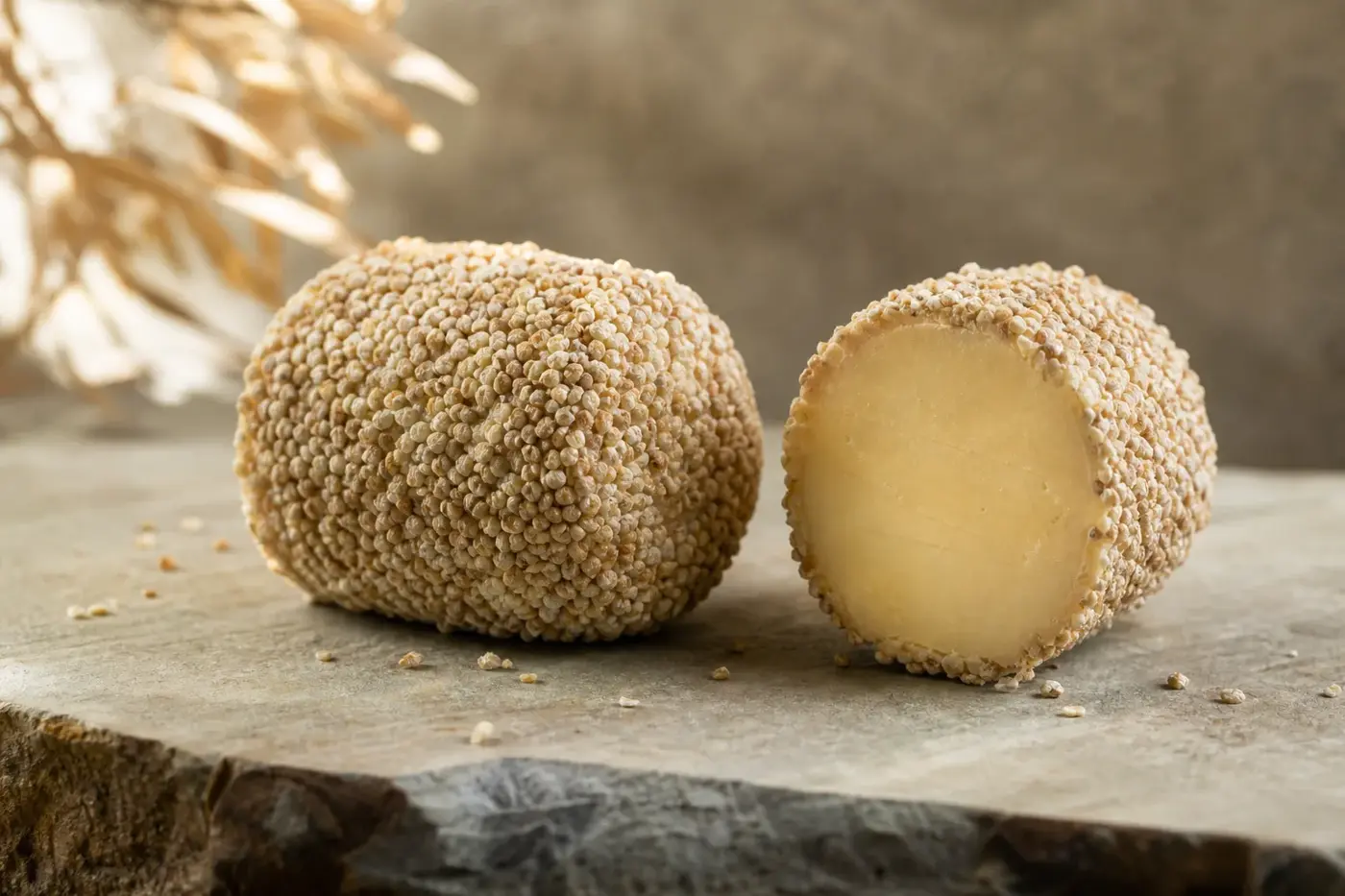
Your knife meets coarse oatmeal, then slips into pale yellow cream cheese. Cut a small log of Caboc and you get the whole Highland story in miniature: cultured cream against grain, softness against roughness. This Scottish double cream cheese is closely associated with the family behind Highland Fine Cheeses in Tain. [1][2][4]
Get to know this little Highland log
| What you want to know | The details |
|---|---|
| Familiar name | Caboc. [1] |
| Highland home | Made at Blarliath Farm, Tain, in north-east Scotland. [2] |
| Milk and treatment | Cow’s milk; the producer uses pasteurised milk throughout its cheese range. [5] |
| Shape and size | A small, hand-shaped log; listed by the producer at 110 g. [1] |
| What is on the outside | An applied pinhead oatmeal coating. [1] |
| Published allergen information | Milk; possible gluten traces in the oatmeal, according to the producer. [1] |
| Pregnancy guidance | UK NHS guidance on pasteurised cream cheese, November 2026. [6] |
Taste the cream, then give the oats their turn
Those oats belong on your plate, not abandoned on the knife. The producer’s brochure shows a short cylinder with a pale yellow interior enclosed by oatmeal. Slice across it and you find a close, smooth-looking paste, rather than crumbly, open curd or a flowing centre. [3]
Highland Fine Cheeses describes Caboc as softly textured, slightly tangy and savoury, with a nutty bite. You get buttery richness, gentle acidity and the grain of the covering in one mouthful. The cream supplies the body; the oats give all that softness something to lean against. [1]
For your first taste, try a little centre, then a piece with its full covering. You will notice the contrast more easily before bread, fruit or a drink brings another flavour along. There is no tasting exam afterwards, so you can put down the imaginary clipboard and enjoy how cream and oats work together.
From cultured cream to an oatmeal coat
There is no rennet in Caboc’s making. The maker describes a cultured double-cream cheese: cultures, the microorganisms that begin acidification, sour the dairy mixture until it sets. Salt goes in, moisture is pressed out, and the cheese is shaped into small logs before being rolled in pinhead oatmeal. [1]
Rennet, the coagulant that sets many other cheeses, has no part to play here. That makes “cream cheese” more revealing than simply “soft cheese”. Caboc’s starting ingredient and the way it acidifies matter as much as its final softness; you can follow the distinction between acid-set and rennet-set cheeses in how cheese is made.
The family’s account of Highland dairying puts that cream in context. Cream was removed from milk for butter, while the milk left behind was soured and drained to make Crowdie. Caboc takes the other path and uses the cream itself. You have a shared dairy background, but two distinct cheeses. [2]
The oatmeal has its own place in the modern record. A 2002 report based on a visit to the cheesemaking business described Caboc’s covering as toasted pinhead oatmeal. Cream cheese and toasted grain were already partners in production at that time. [4]
What the coat tells you, and what time adds
Caboc’s covering is applied and edible, not a surface grown by ripening microorganisms. The maker rolls the shaped cheese in oatmeal. That simple step explains the grainy exterior and why it deserves a place in the same bite as the centre. [1]
There can be time beneath that coat, too. Highland Fine Cheeses calls Caboc a matured double-cream cheese and says it can be aged for up to six months. That tells you what the producer can do, rather than the age of any particular retail pack. [1]
When you compare cheese styles, keep two questions separate. What is on the outside, and what has happened inside over time? Caboc’s grain covering answers the first; maturation answers the second.
You can take that distinction further with the guide to telling cheese styles apart. Method, texture and surface each offer a different clue to the cheese in front of you.
Follow the cheese home to Tain
Blarliath Farm in Tain anchors Caboc’s modern story. In the producer’s account, a smallholding grew into a cheesemaking business, with fermentation and maturing still housed in former farm buildings. This dairy in the north-eastern Highlands is the home of today’s cheese. [2]
The family’s account begins with a practical problem: more Crowdie than the household could eat. In Farmers Weekly on 10 May 2002, the family explained that surplus Crowdie had been sold to a local grocer in the early 1960s. The reporter also described old cow byres converted into a cheesemaking dairy. [4]
Those details let you trace the business from household production to a local grocer, then into converted farm buildings. The same report places Caboc at the dairy in 2002. It does not give the date or circumstances of the cheese’s revival. [4]
Mariota de Ile and a barrel of family history
In the family tradition, Caboc begins with cream saved for cheese rather than churned into butter. Highland Fine Cheeses links it to Mariota de Ile, described on its history page as a daughter of the Macdonald of the Isles. She is said to have made thick cream into cheese matured in barrels, and the family claims descent from her. [2]
By 2002, this tradition was being told publicly. The Farmers Weekly report records a family member recounting an episode involving Mariota, a cheese barrel and an attempted abduction by the Campbells. You are reading the family’s telling at that date, not a contemporary account of medieval events. [4]
The image stays with you: cream reserved for a chieftain’s cheese. It captures Caboc’s association with concentrated dairy richness, while the documented modern history follows the family dairy and its cheese. One is an inherited account of Caboc’s beginnings; the other gives you its modern setting. [2][4]
Why buttery Caboc is still very much cheese
Caboc’s resemblance to butter starts with cream, the ingredient they share. After that, their paths separate. The producer’s brochure describes butter made by churning cream; its Caboc account describes cultured cream that is set, salted, pressed and shaped. [1][3]
So you have cheese, however buttery the association. Its oatmeal covering also sets Caboc apart from many fresh cream cheeses served without one. Add the producer’s stated maturation of up to six months, remembering that the age of your individual pack is a separate question. [1]
For a comparison close to home, look at Crowdie in the same dairy’s Scottish range. The maker’s brochure describes Skinny Crowdie as light, softly curded and faintly lemony. Black Crowdie wears oatmeal and cracked black pepper, giving it a family resemblance to Caboc but a different, peppery emphasis. [3]
You can choose the experience you fancy: cream-based cheese with oats, a soft curd, or a peppered covering. These cheeses share a geographical home, not a single personality. Their ingredients and methods explain why each brings something different to your plate.
Make a little space for Caboc at the table
Start with Caboc, plain oatcakes and sliced pear. There is little here to compete for your attention, and bread is another straightforward choice. Keep the cheese in its small log so everyone can take oatmeal along with the centre. It also makes the “just one more slice” negotiations easier.
Keep your serving sequence simple:
- Read the pack’s storage instructions before opening. Keep any portion you are not serving refrigerated.
- Let the serving portion lose its refrigerator chill towards room temperature. FSA guidance for England, Wales and Northern Ireland says chilled food should be out for the shortest possible time, with a maximum of four hours. That is an outer limit, not a serving target. [7]
- Taste a small piece alone, then try it on an oatcake or bread.
- Add fruit separately, so you can decide how much sweetness you want beside the cheese.
For a drink, consider black tea, sparkling water or a lightly flavoured alcohol-free apple drink. Tea is an appealing companion to an oat-based accompaniment; water keeps your attention on the cheese. Give the quieter flavours their turn before bringing in anything strongly flavoured.
If you fancy something warm instead, the producer suggests Caboc with potatoes, roasted vegetables or steak. Those are other ways to bring it to your table. [1]
Keep Caboc cool and its instructions close
Keep Caboc refrigerated and follow its pack instructions. The FSA’s consumer guidance for England, Wales and Northern Ireland recommends a refrigerator temperature between 0 and 5 °C, checked with a fridge thermometer. It also tells you to follow the packaging instructions for dairy foods. [7]
After opening, use the manufacturer’s stated period alongside the printed date. If the instructions leave you unsure, ask the producer or supplying cheesemonger for guidance specific to that product. Keep the packaging until you finish the cheese, so its date and storage information stay to hand. [7][8]
A use-by date is about safety; a best-before date is about quality. UK government guidance makes that distinction and explains that incorrect storage can make food unsafe before its use-by date. [8]
For broader handling advice, turn to how to store cheese at home. For help deciding which packaging details to retain, see how to read a cheese label.
This page summarises published guidance from the official sources it cites. It is not medical advice. Guidance differs between countries and changes over time, so check the current source for where you live, and ask your doctor, midwife, pharmacist or dietitian about your own circumstances.
Pregnancy and allergies: guidance for your circumstances
UK NHS guidance from November 2026 lists pasteurised cream cheese among the cheeses you can eat during pregnancy. It gives different advice for mould-ripened soft cheeses with a white coating and soft blue-veined cheeses. Those must be thoroughly cooked until steaming hot. [6]
Highland Fine Cheeses says it uses pasteurised cow’s milk throughout its cheese range. [5] Read your current Caboc pack for the product description and milk treatment, then consult NHS guidance or your country’s equivalent. If the product information leaves you uncertain, ask your midwife or doctor.
For allergies, retain the complete ingredient declaration and precautionary statements. The producer’s Caboc page identifies milk and warns of possible gluten traces in the oatmeal. [1] If you need help distinguishing an allergy from lactose intolerance, see cheese allergy versus lactose intolerance.
Questions people ask
What is Caboc and how is it made?
Caboc is a Scottish double cream cheese made from cultured cream. It is salted, pressed, shaped into small logs and rolled in pinhead oatmeal, without using rennet.
Can you eat the oatmeal coating on Caboc?
Yes, the oatmeal is an edible covering applied by the maker. The producer warns that the oatmeal may contain traces of gluten.
How is Caboc different from Crowdie?
Caboc uses cream, while the family account describes Crowdie as made from milk left after cream was removed for butter. The producer describes Skinny Crowdie as softly curded and faintly lemony, while Black Crowdie has an oatmeal and cracked black pepper coating.
Can you eat Caboc during pregnancy?
UK NHS guidance checked in November 2026 lists pasteurised cream cheese among the cheeses that can be eaten during pregnancy. Highland Fine Cheeses says it uses pasteurised cow’s milk throughout its range, but check the current Caboc pack and consult NHS guidance or your country’s equivalent.
How should Caboc be stored?
Keep Caboc refrigerated and follow the pack instructions. The FSA recommends a fridge temperature between 0 and 5 °C for England, Wales and Northern Ireland; if the instructions after opening are unclear, ask the producer or cheesemonger.
Sources
- Highland Fine Cheeses, Caboc, undated current product page, retrieved November 2026. Product format, production account, maturation statement, tasting notes and allergen information.
- Highland Fine Cheeses, About Us, undated current company account, retrieved November 2026. Tain dairy, family beginnings, Highland dairying account and Mariota tradition.
- Highland Fine Cheeses, product brochure hosted by Fine Cheesemakers of Scotland, undated edition, retrieved November 2026. Caboc presentation, related cheese descriptions and butter production description.
- Farmers Weekly, Mild cheese from croft finds a keen demand, 10 May 2002. Contemporary reporting and family interview concerning the dairy’s beginnings, Caboc and the Mariota story.
- Highland Fine Cheeses, FAQ’s, undated current page, retrieved November 2026. Producer’s statement that its cheeses use pasteurised cow’s milk.
- NHS, Foods to avoid in pregnancy, current online guidance retrieved November 2026. Cheese, milk and other dairy section.
- Food Standards Agency, How to chill, freeze and defrost food safely, published 18 December 2017, current online version retrieved November 2026. Applies to England, Northern Ireland and Wales.
- UK Government, Understanding food labelling: Best before and use-by dates, current online guidance retrieved November 2026. Date meanings, storage and instructions after opening.
This desk-researched account compares the producer’s published information with a contemporary family interview and official UK consumer guidance.
Last checked: November 2026
Last checked November 2026.
The editors suggest you read next
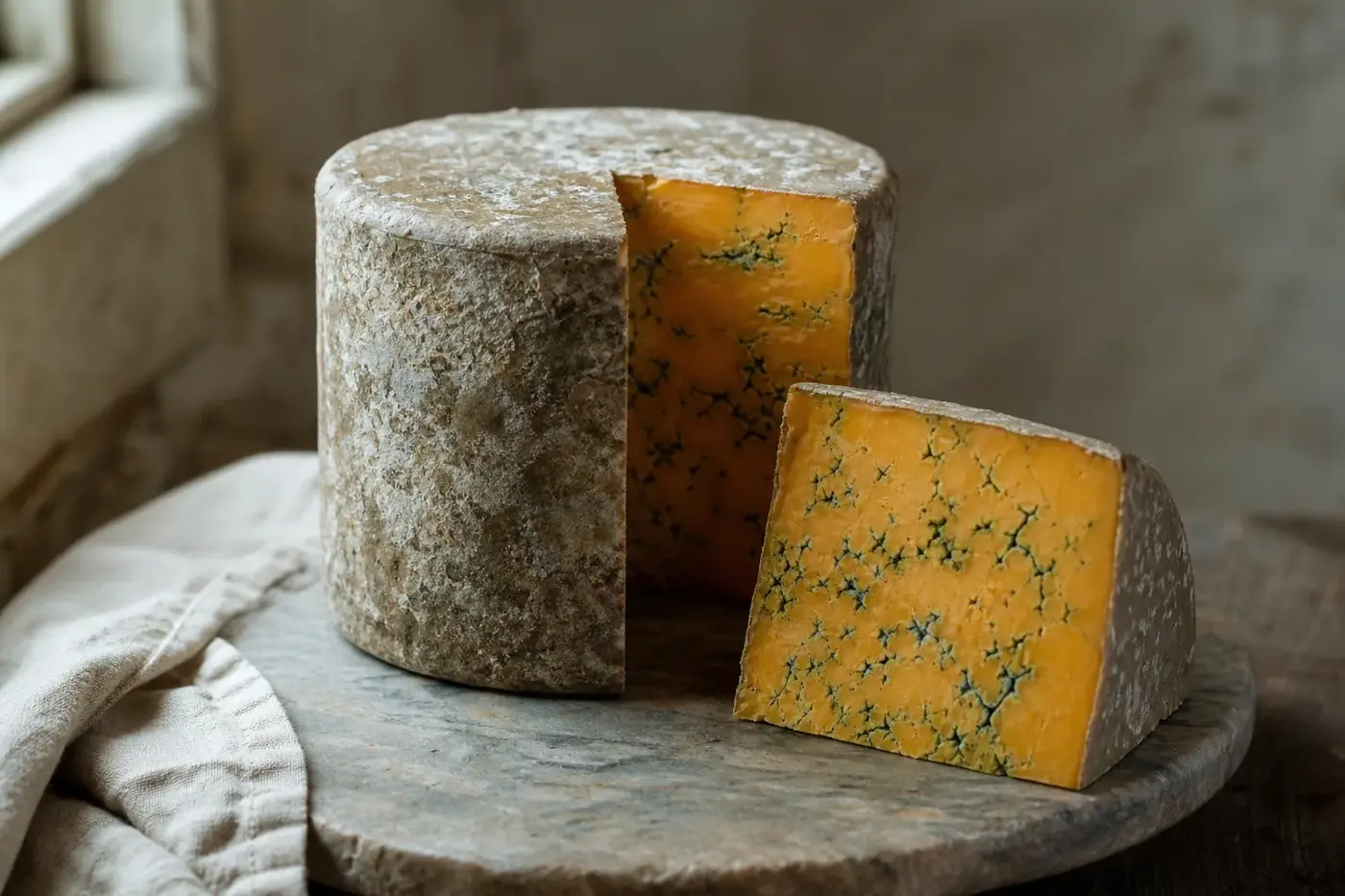
Shropshire Blue
Cut into Shropshire Blue and you get quite a colour scheme: orange crossed by blue-green veins.