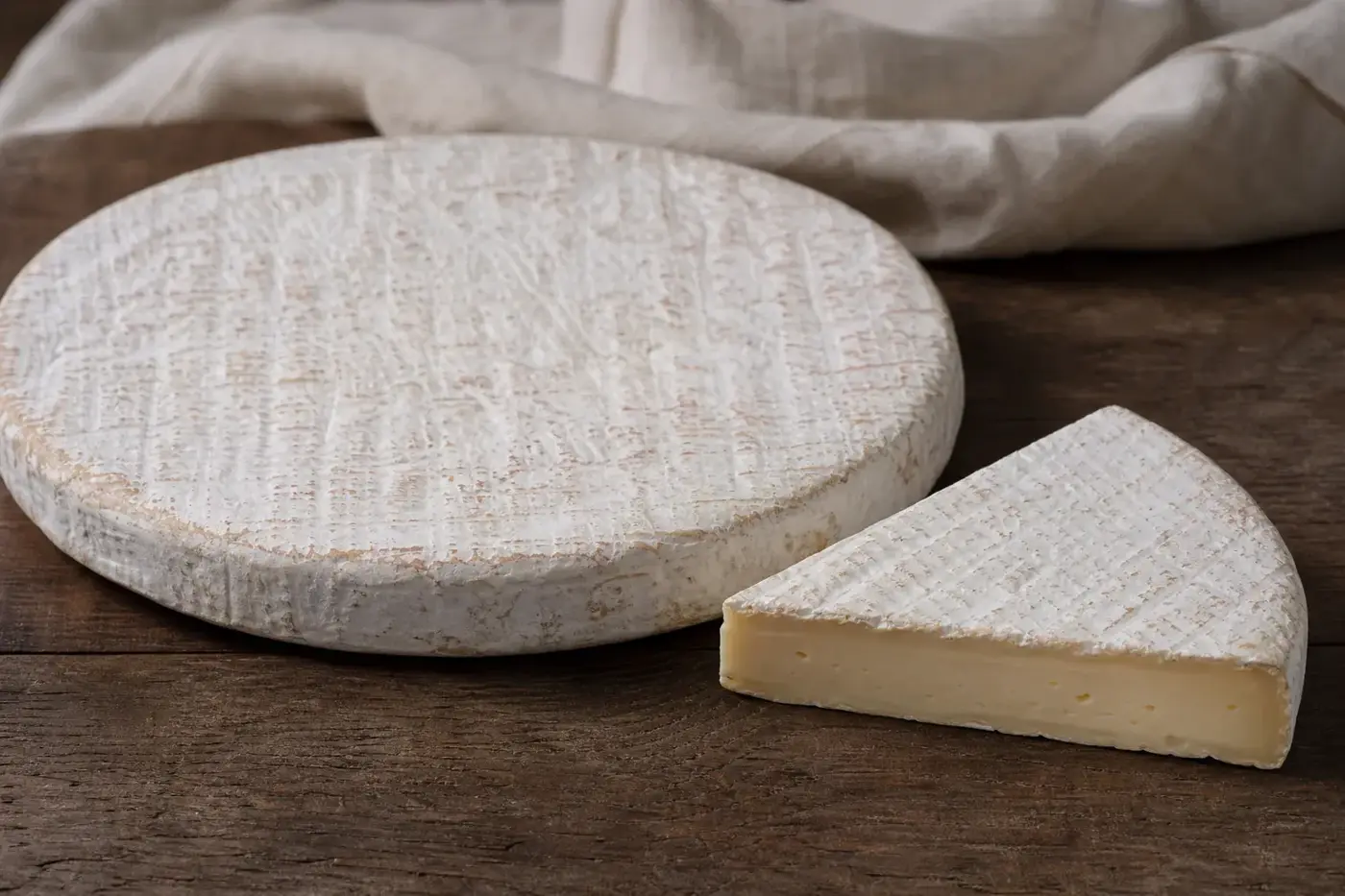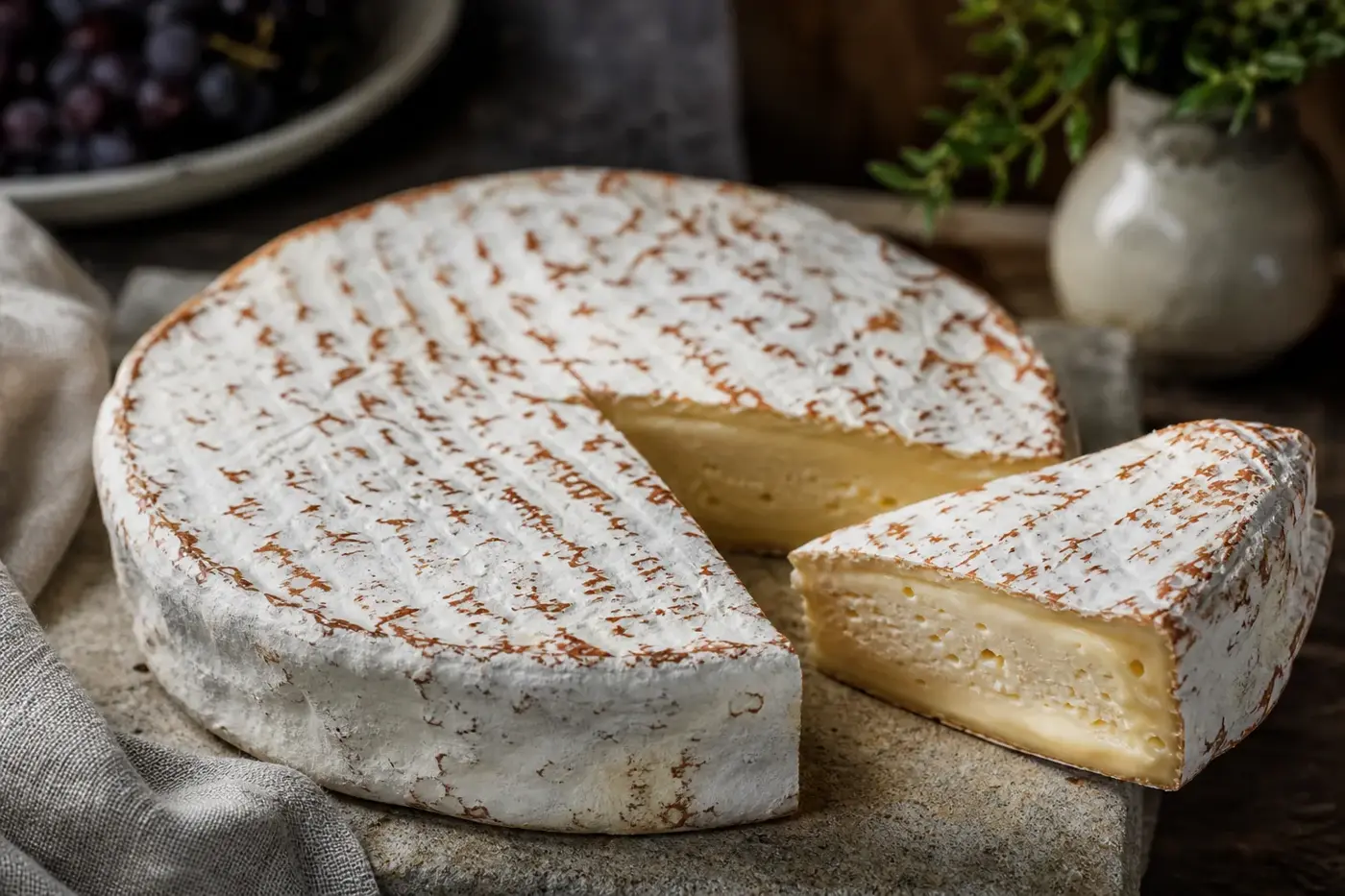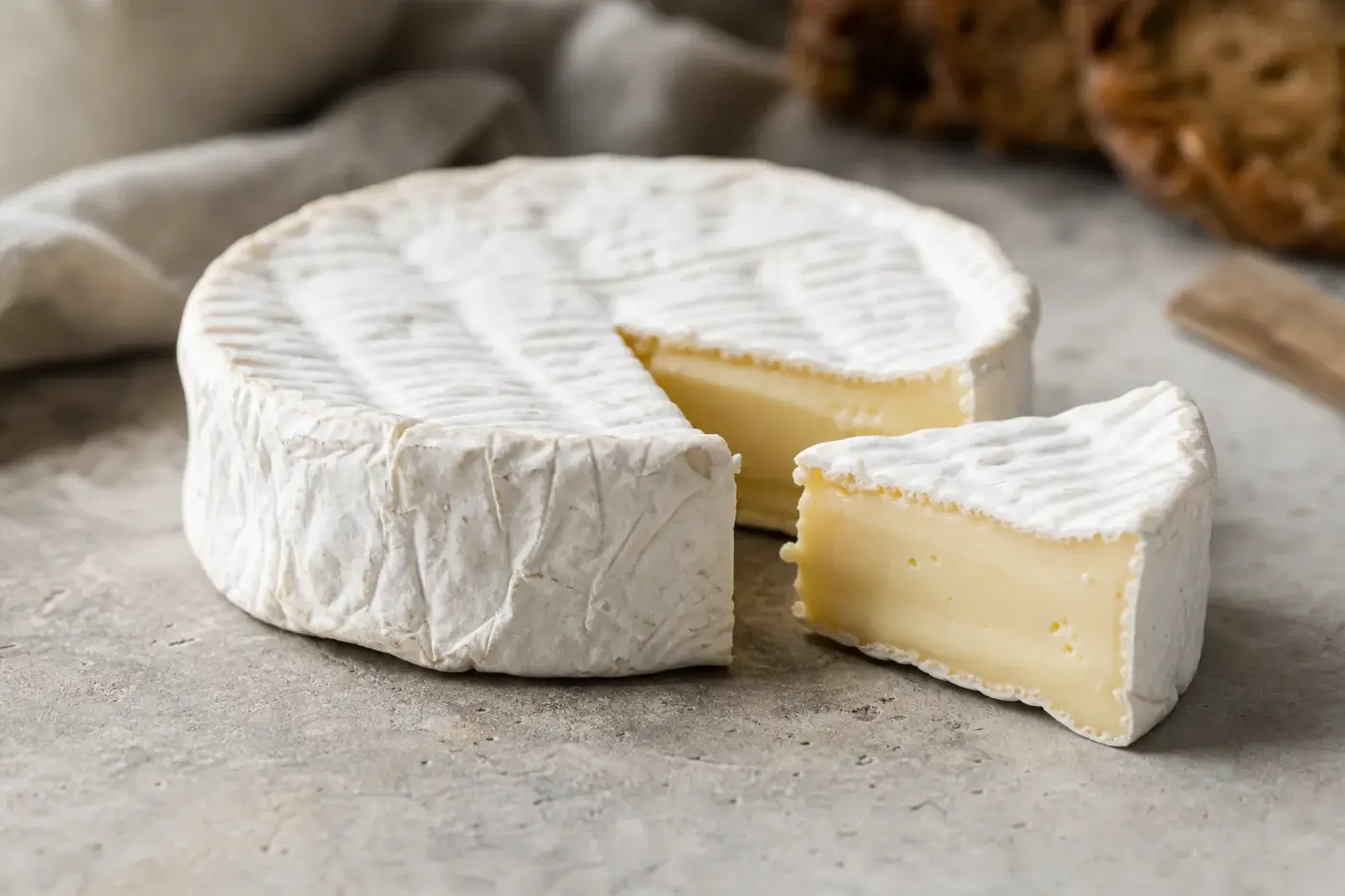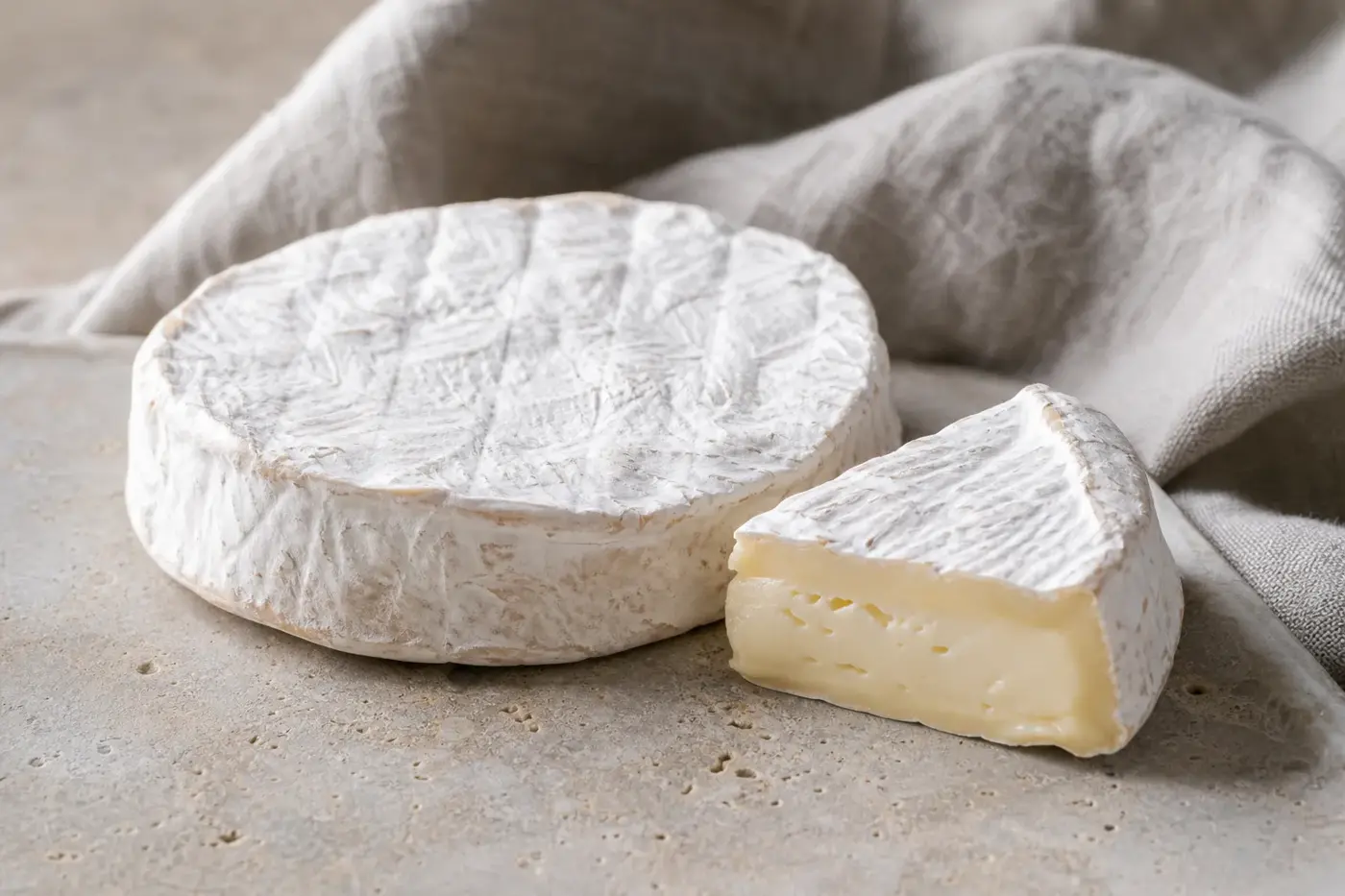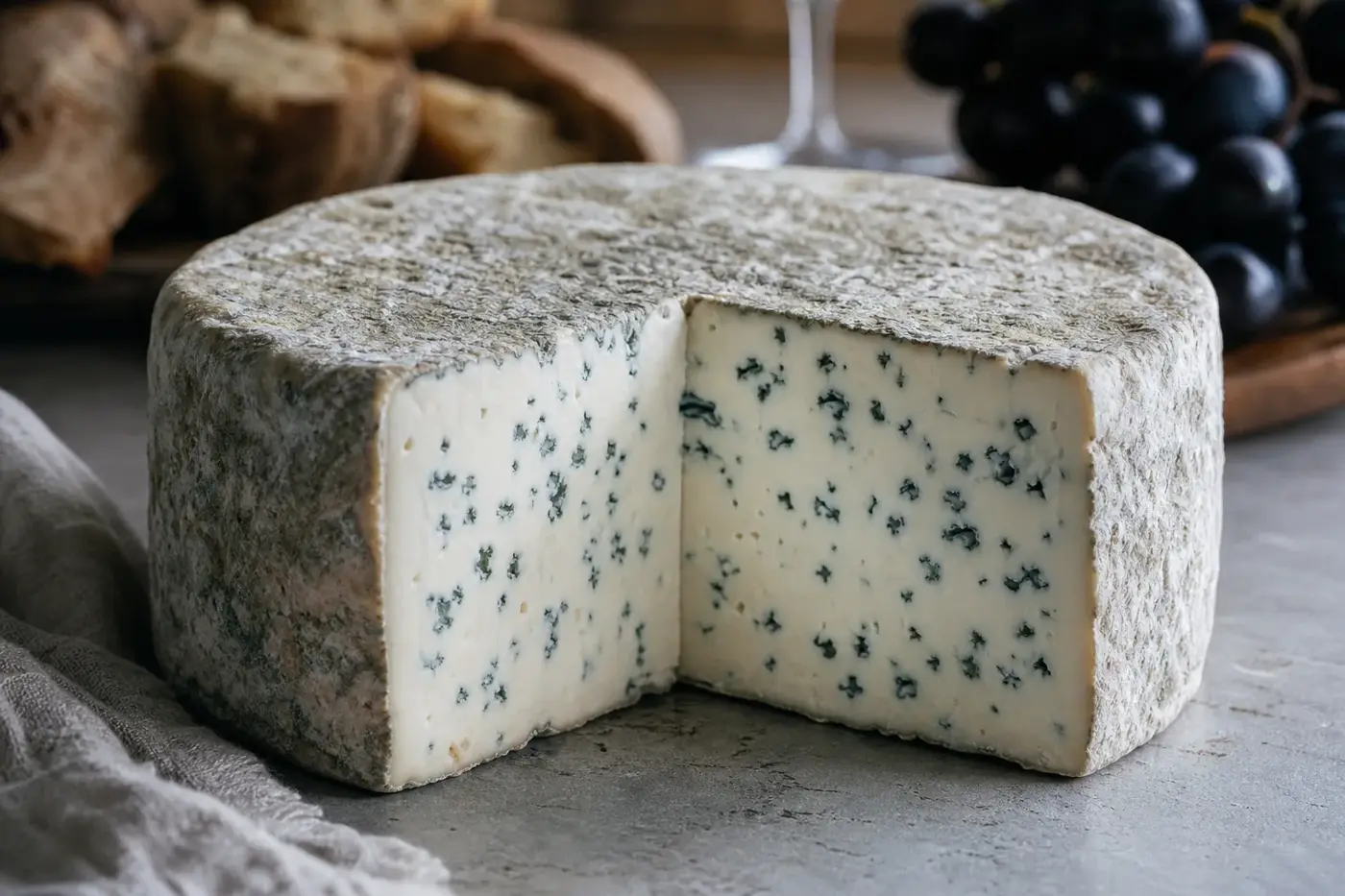
A large needle sinks into pale, yielding cheese. Air follows it inside, giving the mould what it needs to build Bleu d'Auvergne's blue-green heart. Your slice begins here, in the volcanic uplands of France's Massif Central, where this cow's milk cheese holds France's appellation d'origine protégée, or AOP, recognising its protected origin. [1, 2]
| What you want to know | The detail |
|---|---|
| The name to look for | Bleu d'Auvergne. [1, 3] |
| Protected designation | AOP listed by France's INAO; registered PDO in Great Britain, with November 2026 as the reference date. [2, 3] |
| EU registration authority and identifier | European Commission; identifier: Not verified. [1] |
| Where it comes from | Defined communes in parts of seven Massif Central departments. [1] |
| Great Britain registration | Registered under the UK scheme on 31 December 2020 at 23:00. [3] |
| The milk | Exclusively cow's milk. [1] |
| A whole cheese | Flat cylinder, 19 to 23 cm across, 8 to 11 cm high, weighing 2 to 3 kg. [1] |
| The blue mould | Penicillium roqueforti. [2] |
| Earliest sale | From the 28th day after renneting. [1] |
| Minimum fat | 50% fat in dry matter. [1] |
| Pregnancy guidance | UK NHS guidance on soft blue-veined cheeses, with November 2026 as the reference date. [8] |
Follow the blue through your slice
Cut into that broad, low cylinder and you find white to ivory paste, with blue to green mould filling its openings. The specification calls for regularly distributed blueing. Individual patches range roughly from a wheat grain to a maize grain in size, small details that give the slice its character. [1]
The natural rind has its own palette. Grey, green and blue surface moulds are all permitted, so two whole cheeses need not look alike. Underneath that variety is a firm requirement: a sound surface, without wet patches or exudation. [1]
Then you reach the flavour. INAO describes it as intense and balanced, with woodland and sometimes mushroom aromas in a smooth, yielding texture. The specification also allows a slight salty or bitter edge, while flavours from the mould become more pronounced as maturation progresses. [1, 2]
When choosing your piece, look for that partnership of savoury blue-cheese character and yielding paste. Rather than simply asking for the oldest or strongest, ask your cheesemonger about the cheese in front of you. Tell them where it is headed: onto bread, over vegetables or straight onto your plate.
Get to know its Massif Central home
Bleu d'Auvergne belongs to the centre-north of the Massif Central, a territory INAO describes as partly volcanic. Its protected origin ties it to this upland landscape and an established local way of making cheese. Here, the place and the craft come together. [2]
The boundaries are precise, rather than a loosely drawn circle on a map. The specification names communes across Cantal, Puy-de-Dôme, Aveyron, Corrèze, Haute-Loire, Lot and Lozère. Milk production, cheesemaking, maturation and conservation through the 28th day after renneting must all happen within that defined area. [1]
That distinction matters at the counter. A broad regional name is not the same as a designation's production area, and a blue cheese made somewhere in Auvergne does not automatically earn the registered name. Look for the full name and protected-origin information, then ask about the producer and milk treatment.
Give milk treatment its own question. Ask whether your piece was made with raw or pasteurised milk, and request confirmation from the label or product information. You can explore the differences in raw, thermised and pasteurised milk.
Antoine Roussel and the rye-bread clue
In 1854, Antoine Roussel helped advance the techniques that encouraged blueing, according to INAO. Its account also records French appellation recognition in 1975. Not every detail of the invention story told today appears in that account. [2]
The producers' organisation offers a fuller story. In its account, Roussel noticed blue mould growing on rye bread, introduced mould into cheesemaking and used needles to admit air. The breakthrough was control: more abundant, evenly distributed blueing, rather than leaving its development to chance. [4]
You can also read the organisation's imagined interview with Roussel. This is a modern retelling of the industry's history, not a transcript or nineteenth-century testimony. Enjoy the storytelling, but do not mistake its dialogue for Roussel's recorded words. [5]
At the heart of the story is a refinement of cheesemaking knowledge. Introducing the desired mould was only part of the task. Giving it access to air was the other essential step.
The needle holes behind the blue
The characteristic mould is Penicillium roqueforti. INAO describes adding it to the milk, then piercing the cheeses with large needles so air can enter. Without that air, the mould cannot develop inside the cheese. [2]
Those holes, then, do more than leave a mark. They help create the conditions for blueing within the cheese. Look at a cut piece and its marbling records the relationship between the openings, the mould and the air admitted during making. [2]
The earliest marketing date follows a different clock. It starts at renneting, when the milk-clotting agent is added, not at piercing or arrival in the shop. [1] For a closer look at coagulation, curd and whey, turn to how cheese is made.
Bleu d'Auvergne or Roquefort? Let your slice decide
Forget a fixed league table of blue-cheese strength. Begin with the actual pieces on the counter. For Bleu d'Auvergne, your points of comparison are clear: cow's milk, a yielding texture and those woodland or mushroom notes described by INAO. [2]
Ask the seller to explain the other cheese's milk, treatment, maturity and texture alongside it. If tasting is offered and appropriate for you, try a little of each without bread first. Think about the occasion, too: your favourite cheese to eat alone might not be your choice for a sauce.
Find the name, then ask the good questions
Look first for the complete name, Bleu d'Auvergne. In French information, AOP means appellation d'origine protégée; PDO is the English abbreviation for protected designation of origin. The Great Britain register lists the name as registered, with November 2026 as the reference date here. [2, 3]
Once you have found the name, a few direct questions will tell you more. Keep them focused on the piece you are actually taking home:
- Who made this cheese?
- What milk treatment does its product information declare?
- When was this piece cut?
- What storage and consumption instructions come with it?
- How would you describe this batch's texture and maturity?
Buy an amount that fits your plans. A modest piece, enjoyed according to its instructions, beats a grand wedge waiting for your social diary to improve. Keep its identifying label, especially if you transfer the cheese to another container.
Labels carry several kinds of information, each with a different job. For help separating a designation from producer details and other wording, see how to read a cheese label.
Give your first bite room to speak
Serve Bleu d'Auvergne cool, letting the refrigerator chill ease briefly rather than warming the wedge all the way through. Put out only what you expect to eat. Leave the rest refrigerated.
Count its total time out, including preparation and time on the table. US FDA guidance says to refrigerate perishables within two hours, or within one hour when the surrounding temperature exceeds 32 °C (90 °F). That time includes arranging the board. [6]
Start with small portions and offer more as needed, rather than setting out your entire purchase. On a mixed board, leave each cheese enough room for cutting. The neighbours need not all leave wearing blue.
The producers' organisation suggests walnut bread and gingerbread. [4] For a simpler comparison, begin with plain bread, then try another bite with ripe pear or apple. You can decide how much sweetness you enjoy beside the savoury cheese.
Try water first, followed by an alcohol-free apple drink. These are invitations to taste and compare, not rules to obey. Choose the combination you enjoy.
Give the blue a clear role in your cooking
Use Bleu d'Auvergne where you will still recognise its character in the finished dish. Give it one clear role to begin with. Several equally assertive cheeses can make that harder.
The producers' 2020 recipe collection offers a leek and chard pie, ravioli with pine nuts, a tomato tart and a potato preparation. [4] Follow the complete recipes when exploring those ideas. Their methods are not interchangeable.
In your own cooking, try a little stirred into a vegetable sauce, distinct pieces across a tart or a filling that keeps the blue flavour identifiable. Taste before adding more salt. Note how much cheese you use, so your next adjustment is deliberate rather than guesswork.
Cooking for someone following pregnancy or other higher-risk guidance needs a different focus. Use the relevant agency's cooking advice below. Simply softening or melting the cheese should not be taken as sufficient.
Keep it cold, and keep its label
For England, Wales and Northern Ireland, the Food Standards Agency advises keeping your home fridge between 0 and 5 °C. It also advises refrigerating dairy products and following the packaging's storage instructions. US FDA advice specifies 4 °C (40 °F) or below. [6, 7]
Keep the original wrapping and instructions where practical. If you move the cheese, use a clean food container and retain the label. Follow any after-opening instruction rather than assigning it a fresh shelf life.
The intended blue veins belong in Bleu d'Auvergne. [1] Follow the label's use by date and storage instructions. If you notice an unfamiliar change, consult the relevant food safety agency before eating it.
Follow any recall notice covering the identified product and batch. Keeping the label helps you identify these. For the broader distinction between intended ripening mould and unwanted growth, see mould on cheese.
This page summarises published guidance from the official sources it cites. It is not medical advice. Guidance differs between countries and changes over time, so check the current source for where you live, and ask your doctor, midwife, pharmacist or dietitian about your own circumstances.
Find the higher-risk guidance for you
United Kingdom, November 2026 guidance reference: the NHS says pasteurised and unpasteurised soft blue-veined cheeses must be thoroughly cooked during pregnancy. Its advice allows cheese cooked until steaming hot. Read the current NHS guidance before deciding how to serve yours. [8]
United States, November 2026 guidance reference: consult the CDC's current advice on Listeria and cheese. Use the guidance applicable to your circumstances. [9]
Follow the advice for your country and circumstances. For individual guidance, ask your doctor, midwife, pharmacist or dietitian.
Questions people ask
Where is Bleu d'Auvergne made?
It comes from a defined area in the Massif Central, across parts of seven departments. Milk production, cheesemaking, maturation and conservation through the 28th day after renneting must all take place within that area.
What milk is Bleu d'Auvergne made from?
Bleu d'Auvergne is made exclusively from cow's milk. Ask the seller whether the piece was made with raw or pasteurised milk, and check its label or product information.
How does Bleu d'Auvergne get its blue veins?
The characteristic mould is Penicillium roqueforti. Cheesemakers pierce the cheese with large needles to admit the air the mould needs to develop inside.
What does Bleu d'Auvergne taste like?
INAO describes its flavour as intense and balanced, with woodland and sometimes mushroom aromas. The texture is smooth and yielding, and the specification allows a slight salty or bitter edge.
Can I eat Bleu d'Auvergne during pregnancy?
The NHS says that pasteurised and unpasteurised soft blue veined cheeses must be thoroughly cooked during pregnancy. Its advice allows cheese cooked until steaming hot. Read the current NHS guidance before deciding how to serve it.
Sources
- French Ministry of Agriculture, Cahier des charges de l'appellation d'origine « Bleu d'Auvergne », approved by the order of 16 December 2016 and associated with Commission Implementing Regulation (EU) 2017/1931, published in Bulletin officiel no. 2017-43, 2017. Product description and geographical delimitation.
- Institut national de l'origine et de la qualité, Bleu d'Auvergne, undated product record, retrieved November 2026. Product, sensory description, territory, mould development and historical milestones.
- Department for Environment, Food & Rural Affairs, Bleu d'Auvergne, protected food-name register entry, published 4 January 2021, retrieved November 2026.
- Syndicat Interprofessionnel Régional du Bleu d'Auvergne, AOP Bleu d'Auvergne: dossier de presse, 2020. Industry account, bread suggestions and recipe collection; this organisation represents and promotes the designation.
- Bleu d'Auvergne producers' organisation, Qui a « inventé » le Bleu d'Auvergne ?, undated. Modern dramatised account, retrieved November 2026.
- US Food and Drug Administration, Safe Food Handling, current online edition retrieved November 2026, “Chill”.
- Food Standards Agency, How to chill, freeze and defrost food safely, published 18 December 2017, current online edition retrieved November 2026. Applies to England, Northern Ireland and Wales.
- NHS, Foods to avoid in pregnancy, current online edition retrieved November 2026, “Cheese, milk and other dairy”.
- US Centers for Disease Control and Prevention, Preventing Listeria Infection, 31 January 2025, current online edition retrieved November 2026.
This piece was researched from official product information, the published specification, the Great Britain register, attributed industry material and national food-safety guidance.
Last checked: November 2026
Last checked November 2026.
The editors suggest you read next